Key Takeaways
- A standard 500ml double-wall stainless thermal bottle usually lands at USD 2.85-4.90 FOB China at 1,000-5,000 pcs depending on steel grade, finish, and lid
- Existing-mold MOQ is commonly 1,000 pcs per SKU, while custom color split usually starts at 500 pcs per color and full new mold projects run 25-45 days longer
- Mass production lead time for repeat orders is often 25-35 days; first orders with sampling, artwork, and packaging approval usually take 45-70 days
- Decoration, packaging, and testing can add 12%-28% to total program cost even when the bottle body price looks competitive
You usually do not lose a thermal bottle order on the quoted unit price. You lose it on the items nobody spelled out at the start: mold amortization, print setup, lid leak risk, carton limits, and the extra 12 days that show up after a Pantone change post-sample approval. We have seen this go sideways on the line after one PO typo on a cap color code. If you are buying an in bulk thermal bottle program for Europe or North America, the right tool is a cost model and a production calendar, not polished sales talk.
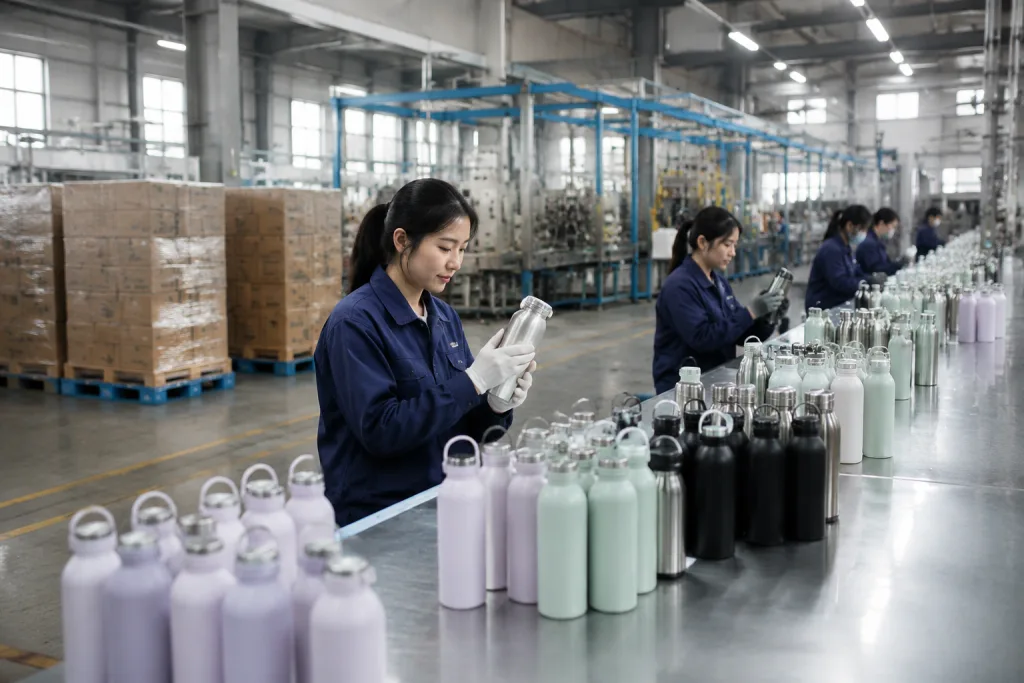
At BottleForge Industrial in Hangzhou, Zhejiang, we run export drinkware programs for distributors, retailers, and private-label brands. Our factory output is around 450,000 units per month in Zhejiang, China, with standard MOQ starting at 1,000 pieces per SKU for existing molds. QC pulled the sample last month because a lid hinge gap was out by 0.3 mm, and that is exactly why the numbers below matter. These are the figures you use to judge whether a quote is realistic, open for negotiation, or missing cost lines that will come back later.
What the bottle really costs
Ask for an in bulk thermal bottle quote, and the body price is just the first line. For a typical 500ml 18/8 stainless steel double-wall vacuum bottle with powder coating and a screw lid, a fair export range from Zhejiang, China is usually USD 2.85 to 3.60 FOB at 3,000 pieces using an existing mold. We quote this SKU off line data, not guesswork; on a standard neck-thread setup, the vacuum yield and coating pass rate decide whether you land near the low end or the high end. Move to a more complex lid with carry loop, silicone overmold, or tea filter, and you are often at USD 3.40 to 4.90. A larger 750ml version can add USD 0.35 to 0.80 depending on steel weight and carton efficiency. The wrong question is “what’s your cheapest bottle?” The better one is “what exactly is included?”
The biggest cost drivers are plain:
- Steel grade and weight: 18/8 inner and outer is the mainstream export choice. 18/0 on the outer shell can save USD 0.08 to 0.18 but changes corrosion performance and market perception. We’ve had buyers push for the saving, then flag rust marks after salt-spray comparison on sample sets.
- Wall thickness: common body gauges are around 0.4mm outer / 0.4mm inner. Go heavier for dent resistance and cost rises fast. On the floor, QC pulled the sample and checked the body lip with a micrometer; 0.05mm extra across both walls does not sound like much, but the steel math doesn’t lie.
- Lid construction: PP lid with silicone seal is basic. Stainless cap top, bamboo insert, handle, or flip mechanism increases assembly time and defect risk. A flip lid looks good in a render, but the line runs slower once you add spring parts, hinge fit, and leak testing.
- Surface finish: spray paint is usually cheaper than durable powder coating by USD 0.10 to 0.25 per unit. Powder usually gives better abuse resistance. We see this in cross-hatch adhesion checks and drop tests after curing.
- Decoration: one-color silk screen may be USD 0.05 to 0.12; laser engraving USD 0.08 to 0.18; full-wrap transfer or special effects can go above USD 0.30. One missed detail here causes noise later: we’ve seen a PO typo on logo size turn a 35mm print into a 53mm print, and the whole carton mark had to be reworked.
If you are comparing bulk canteen, wholesale canteen, or drinkware wholesale quotes, make every supplier break out body, lid, decoration, unit pack, carton, and testing. Put each item on its own line. If they only give one number, you cannot manage the program, and you will not know where the extra USD 0.22 showed up when the buyer flagged the final offer.
MOQ tiers that change your price
MOQ is not one number. It is at least four numbers: bottle body MOQ, color MOQ, print MOQ, and packaging MOQ. For existing models at our Zhejiang facility, the commercial starting point is usually 1,000 pcs per SKU. Buyers ask if 1,000 pcs can be split across six lid colors and three gift boxes at the same price; the short answer is no. We run cost by component, and the line still has to change silicone rings, ink, and cartons.
Here is how MOQ usually works in practice:
- 1,000 pcs: workable for standard in bulk thermal bottle orders with stock lids and one basic logo position. Price room is tight. QC pulled the sample on one recent 1,000-pc order, and the buyer had only one Pantone body color with one side logo, which is why the math held.
- 3,000 pcs: better tier for custom body colors, mixed decoration, and stronger carton optimization. Unit cost often drops by 6% to 12% versus 1,000 pcs. At this level, we can usually spread setup loss better across the run, especially if the screen-print fixture and carton marks stay stable.
- 5,000 pcs and up: this is where you can push harder on printing, spare parts, and sometimes free sample credits. We have also seen buyers get better terms on replacement lids because the seal supplier runs larger batches at this volume.
Packaging has its own threshold. A plain white box may work at 1,000 pcs, but a custom offset gift box often needs 2,000 to 3,000 pcs or the amortization gets ugly fast. This is the wrong question to ask: “Can you make the gift box MOQ disappear?” Better to ask how to hit the target with a 157g coated paper box, one insert, and one ship mark. If you need barcode labels, FNSKU for marketplace programs, or multilingual inserts for Europe, add cost and handling time. We have even had a PO typo on barcode sequence force a full relabel before loading.
The same logic applies if you are sourcing canteen bulk, drinkware bulk, or best wholesale drink bottle assortments. A distributor who combines a thermal bottle, sports bottle, and beer tumbler wholesale bulk line into one container usually gets better freight efficiency, but factory MOQ still applies per item. We ship mixed containers like this every month, and the buyer often flags freight first, then gets surprised by per-SKU MOQ on caps or boxes. The same is true for bulk growler, growler bulk, and beer growler wholesale programs. Stainless growlers typically need thicker bodies and larger cartons, so their MOQ may stay at 1,000 pcs even when smaller bottles can be more flexible. We have seen this go sideways when a buyer assumes one container means one blended MOQ.
You can negotiate MOQ, but you cannot negotiate process reality. If a component supplier wants 3,000 silicone seals in one color, that limit will surface somewhere in your quote.
Why one sample week becomes six
Lead-time trouble usually starts before the line runs. Buyers often assume the delay is on the factory floor. Most of the time it begins in artwork files, packaging details, and approval loops. For a first-time in bulk thermal bottle order in China, this is a realistic schedule, and yes, we’ve seen a “one-week sample plan” stretch to six because the buyer flagged a 3 mm logo shift on the second proof:
- Day 1-3: RFQ confirmation, drawing check, decoration positions, packaging brief
- Day 4-10: pre-production sample or existing sample preparation
- Day 11-17: buyer comments, Pantone confirmation, box artwork revision
- Day 18-22: final sample approval and deposit
- Day 23-50: mass production for 1,000-5,000 pcs
- Day 51-55: inspection, rework if needed, export carton finalization
- Day 56-63: booking and port handover
So a straightforward first order usually needs 45 to 70 days from approval to FOB readiness. Repeat orders move faster, often 25 to 35 days, because the lid, artwork, and cartons are already locked. QC pulled the sample once, the buyer signed the color card, and the outer box dieline is not getting revised for the third time. That saves days fast.
New molds are a different job. A custom cap or bottle silhouette can add 25 to 45 days for toolmaking, trial sampling, and leak validation. If you need a differentiated canteen wholesale or growler wholesale design, budget the development time honestly. This is the wrong place to squeeze. We’ve seen this go sideways when a buyer pushed tooling too hard to save 12 days, then failed leak test at 0.03 MPa or got poor paint adhesion on the first trial. The math doesn’t work.
China lead times also shift around national holidays and shipping peaks. If your target ship window lands near Chinese New Year, add at least 10 to 18 days buffer. Buyers in Europe miss this all the time, then point at production when the real problem was calendar planning. Last season, one PO even had the ship date typed as 2/6 instead of 6/2, and that single typo cost a full booking cycle.
Testing, compliance, and hidden add-ons
If you sell into the EU, UK, US, or Canada, compliance is not PO line noise. It changes how we quote, sample, and run the line. A thermal bottle that touches beverages should be checked against food-contact requirements such as REACH relevant substances where applicable, plus the food-contact standards for the target market. For children’s items or accessories, buyers also ask for ASTM or other category rules. We’ve seen this go sideways: a buyer sent a clean PO, then added a lid straw set for kids after sampling, and the test scope changed in one day. Factory system certifications like BSCI or ISO 9001 do not replace product testing. They still matter because audit teams ask for them, and missing files can hold shipment for 3 to 5 days.
Typical cost additions look like this:
- Leak test and vacuum retention checks: usually built into production, but define the standard in writing. On our floor, QC pulled the sample from the vacuum tester and logged less than 5% temperature loss variance across a tested batch after the agreed hour window.
- Third-party lab test: often USD 250 to 600 per test scope depending on market and material set. This is the wrong question to ask if you only ask for “full test” pricing; the real cost depends on bottle body, lid plastic, silicone ring, print, and straw.
- Drop or transit validation for gift boxes: add USD 120 to 300 if done externally. The weak point is often the EVA insert or a 3 mm corner crush on the mailer, not the bottle.
- Factory inspection: third-party AQL inspection commonly USD 280 to 450 per man-day in China. Most teams want sealing, logo position, carton count, and barcode scan checked before the container loading window.
For AQL, 8 out of 10 buyers we quote use AQL 2.5 major / 4.0 minor as a baseline for drinkware. That works for wholesale drinkware, drinkware wholesale, and alcohol flask wholesale bulk programs. Define critical defects separately. Leakage is critical. Missing vacuum is critical. Sharp edge, wrong barcode, mold contamination, or coating peel should be written clearly on the inspection sheet. If you are sourcing alcohol flask bulk, alcohol flask in bulk, or alcohol flask wholesale for gifting channels, ask about weld finish, cap tether strength, and alcohol odor retention. Those items fail for different reasons than thermal bottles. We had one buyer flag a flask order because the weld bead looked rough under matte paint, even though the bottle passed leak test.
The hidden add-ons usually sit in freight prep: palletization, outer carton mark changes, suffocation warning labels for polybags, and barcode application. None looks big on its own. The math changes at 5,000 or 10,000 units. Together they can add USD 0.06 to 0.22 per unit. We also see small PO mistakes here—a carton mark typo, a missing FNSKU file, a barcode placed 12 mm too close to the carton edge—and those are the fixes that burn time before ship date.
How to quote mixed drinkware programs
Most buyers do not buy one bottle SKU and stop there. We usually quote an in bulk thermal bottle with beer tumbler bulk, beer growler bulk, or wholesale growler items for the same launch window. That changes cost in two places: container loading and shared parts. On the line, we see this fast once packing specs come in and the carton cube sheet starts fighting the pallet plan.
A mixed bulk drinkware program cuts freight waste if the SKU mix is planned early. Smaller cartons fill dead space that large growler cartons leave behind. For example, a 40HQ may fit fewer large growlers than standard 500ml bottles because of carton cube and axle weight balance, not just piece count. We have seen mixed loads improve cube use by 8% to 15% when buyers lock carton sizes before sample approval; if they wait until mass production, the math doesn't work. One factory-floor detail that gets missed: QC pulled the sample once and found two outer carton heights differed by 12 mm, which broke the stacking plan for the whole container.
Ask your supplier to quote each item and the blended program:
- Thermal bottle: body, lid, print, box, carton, FOB unit price
- Beer tumbler in bulk: check whether lid is included; many quotes exclude it
- Beer growler in bulk: specify capacity, handle style, and closure system
- Alcohol flask wholesale: state whether funnel, sleeve, or gift box is included
For beer tumbler wholesale bulk and beer growler wholesale bulk, finish quality drives more cost than most buyers expect. Matte powder, stone texture, electroplating, and special wraps do not fail the same way, and reject rates can swing hard from lot to lot. A finish with a 92% first-pass yield will price differently than one consistently above 97%. We run this through actual yield sheets, not guesswork. Last quarter a buyer flagged a low quote, and the issue was simple: the supplier was pricing to a finish standard that would never pass retail review in North America.
The practical move is to standardize the parts you can control. Shared Pantone colors, common logo positions, and common carton marks across your wholesale drinkware line cut setup loss, plate changes, and carton mix-ups. We ship programs faster this way. On one PO, the buyer typed the wrong shipping mark on 3 SKUs, and reworking those cartons cost more time than another USD 0.03 on one item would have saved.
Questions that expose a weak supplier
You do not need a 40-point audit form. Ask 6 or 7 direct questions and you will see fast whether the supplier runs the line or just forwards WeChat messages. We use these early when checking in bulk thermal bottle quotes from China, and the weak suppliers usually get stuck on the second follow-up.
Ask about production control
- What is your monthly capacity for stainless vacuum bottles? A real factory will give a usable range and explain line loading by season, not just say “no problem.” Our plant in Zhejiang runs about 450,000 units per month across bottle and tumbler lines, with output tracked by line and cap style.
- What is your standard lead time for 1,000 / 3,000 / 10,000 pcs? Ask for the answer by quantity, decoration method, and box type. We have seen 12 days vs 18 days on the same bottle just because the buyer added a gift box with a 3mm E-flute insert.
- Which parts are made in-house and which are outsourced: tube forming, powder coating, laser marking, carton printing? This is the right question. If they avoid it, the buyer flagged the same risk we see all the time: nobody owns the schedule once outside vendors miss one step.
Ask about defect prevention
- How do you test vacuum retention and leakage? Ask what equipment they use and how often QC pulled the sample. If they cannot mention a vacuum test bench, pressure check, or hot-water hold test, we have seen this go sideways.
- What is your AQL plan and what counts as a critical defect? A serious team should answer without reading from a sales sheet, and they should define issues like sharp edge on the rim, failed seal, wrong logo position over 2mm, or coating peel at the base.
- Do you provide pre-production sample photos during mass run? We do, and we also send line shots when the first cartons are packed, because one PO typo on logo size can turn 3,000 pieces into dead stock.
Ask about cost discipline
- What packaging cost is included in the FOB price? Get the carton spec, inner pack count, and whether the quote includes barcode label, hangtag, or just a plain white box. This is where the math often does not work.
- What MOQ applies to each color, logo method, and gift box? Ask for each item separately. We run into buyer pushback here because “MOQ 1,000 pcs” often means 1,000 per body color, not a mixed 6-color order.
- How much is the sample charge refunded after order placement? Put the refund trigger in writing, including order value and timing, or the sample fee will sit there and nobody owns it.
If the answers stay general, expect surprises later. That matters whether you are buying canteen bulk, drinkware bulk, growler wholesale, or a broad wholesale canteen range. A reliable China supplier should talk plainly about steel specification, silicone hardness, carton drop risk, and booking cut-off dates. If they hide behind “good quality” claims, move on.
You are not buying a bottle. You are buying a process you can repeat next month with the same lid fit, the same print position, and the same packing result. The bottle is just the proof.
Get a workable bottle quote, not a guess
Send your target capacity, MOQ, logo method, packaging, and ship date. We will reply with a realistic FOB cost and lead-time breakdown from Zhejiang, China.
Frequently asked questions
What is a realistic MOQ for an in bulk thermal bottle order?
For an existing mold, 1,000 pcs per SKU is a realistic starting MOQ in China. At that level, you usually get one bottle size, one lid style, and limited color options. If you want custom Pantone body colors, multiple logo positions, or a printed gift box, 2,000 to 3,000 pcs is more practical. For better unit economics, 3,000 to 5,000 pcs is the range where steel purchasing, coating setup, and carton efficiency start to work in your favor. New mold projects are different. A custom body or cap can push MOQ to 3,000 to 5,000 pcs because the tooling must be recovered over volume. Always ask for MOQ by body, color, print method, and packaging, not just one headline number.
How long does a first order from China usually take?
For a first order, plan 45 to 70 days from final specification lock to FOB shipment. Sampling usually takes 7 to 10 days for standard models, then buyers often spend another 5 to 10 days approving color, logo placement, and box artwork. Production for 1,000 to 5,000 pcs is commonly 25 to 35 days, followed by inspection and booking. If you add a custom mold, insert, or lid mechanism, add 25 to 45 days. Repeat orders are much quicker, often 25 to 35 days total, because approved artwork, cartons, and process settings already exist. Around Chinese New Year or peak shipping months, add at least 10 to 18 buffer days if your launch date matters.
What makes one thermal bottle quote much cheaper than another?
Usually four things: lower steel weight, simpler lid construction, cheaper finish, or missing line items. A quote can look USD 0.40 lower simply because it uses 18/0 outer steel instead of 18/8, spray paint instead of powder coat, or excludes the logo and color box. Some suppliers also quote a basic leak test standard but do not include third-party inspection support, barcode application, or export-grade cartons. On large items like bulk growler or beer growler wholesale orders, body thickness and handle construction can change cost sharply. Ask for a breakdown covering material grade, wall thickness, decoration method, unit packaging, carton spec, and compliance testing. If the supplier will not itemize, you are not comparing like for like.
Do I need third-party inspection for wholesale drinkware orders?
If this is your first order with a factory, yes, it is usually money well spent. In China, a third-party AQL inspection often costs USD 280 to 450 per man-day, which is small compared with the cost of receiving leaking, scratched, or mispacked goods. For drinkware, many buyers work with AQL 2.5 for major defects and 4.0 for minor defects, but they also define critical defects separately: leakage, vacuum failure, sharp edges, missing parts, or incorrect barcode labeling. For marketplace or retail programs, inspection should also check carton marks, FNSKU labels, and inner pack count. Once the factory has a strong quality history over several repeat orders, you can adjust the frequency, but skipping inspection on a new program is usually false economy.
Can I combine thermal bottles, tumblers, growlers, and flasks in one order?
Yes, and many distributors do exactly that to improve container utilization and broaden a launch line. You can mix in bulk thermal bottle, beer tumbler wholesale, wholesale growler, and alcohol flask bulk products in one shipment, but each SKU still has its own MOQ, tooling status, and packaging requirement. The real challenge is coordination. A thermal bottle may be ready in 28 days, while a growler with custom handle and gift box may need 40 days. Mixed programs work best when you standardize colors, logo methods, and carton markings across SKUs. Ask the factory for both per-item pricing and a combined loading plan. If container cube improves by even 8% to 15%, your freight cost per unit usually gets noticeably better.