Key Takeaways
- For a standard 500 ml stainless in bulk tea bottle, MOQ is usually 1,000 pcs per color, with FOB China pricing around USD 2.85-4.60 depending on lid, infuser, and print method
- Sample approval should cover 8 checkpoints minimum: capacity, weight, leak test, thread fit, coating, logo adhesion, carton drop, and barcode placement
- A realistic production window in Zhejiang is 30-45 days after deposit and approved pre-production sample; rush orders under 25 days usually increase defect risk by 2-4%
- Use AQL 2.5 for major defects and AQL 4.0 for minor defects on export drinkware bulk orders, not a vague 'inspect before shipment' note
You need an in bulk tea bottle order to land on time, on spec, and without the usual quality fight after the deposit is wired. Sounds easy. Then the first quote shows up with no steel grade, a vague lid assembly, and a unit price that moves after artwork review because the buyer flagged a 1-color logo and the supplier priced 2 passes on the screen-print line. If you also buy bulk canteen, wholesale drinkware, or a seasonal beer tumbler bulk program, you've seen this before.
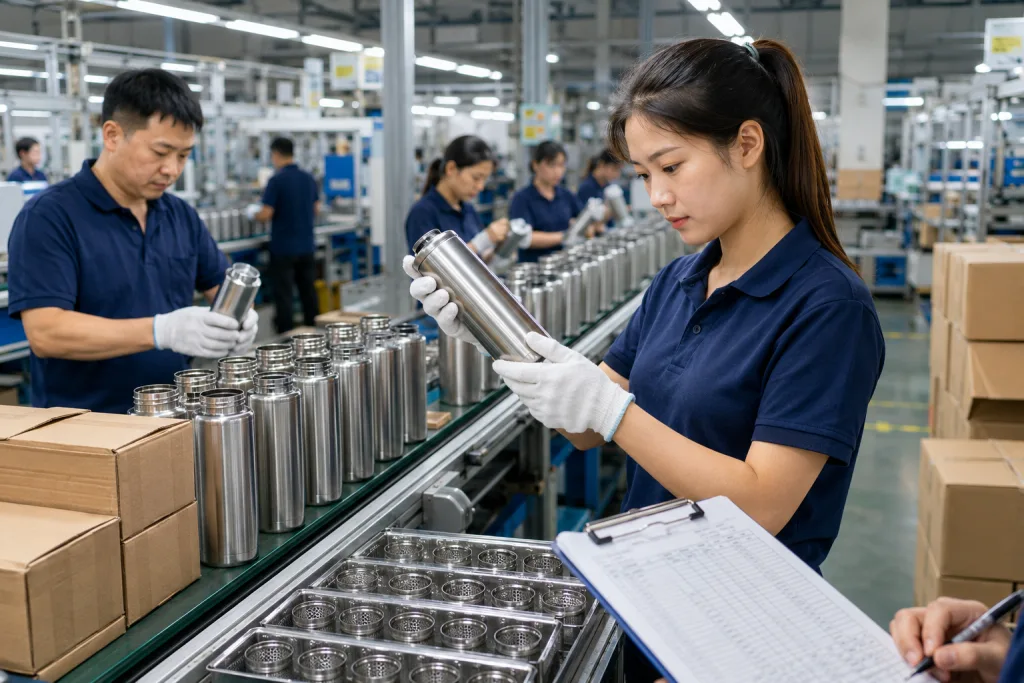
The practical way to buy from China is to treat one tea bottle order like an engineering job, not a catalog click. At our Hangzhou, Zhejiang factory, we see the same failures repeat on the line: capacity tolerance off by 20 ml, infuser silicone leaking at the thread start, logo abrasion after 300 rubs, and export cartons made with the wrong wall strength for pallet stacking. Lock the sequence early. This is the right question to ask, because we've seen this go sideways once the PO typo, sample sign-off, and carton spec are all left to different people.
The order starts with one SKU
A buyer in Germany sends an RFQ for an in bulk tea bottle program: 8,000 units, two colors, gift box packed, delivery in 55 days. The brand also sells canteen wholesale and wants to test a tea bottle beside its main line of wholesale drinkware. Fair opening. Still, the first RFQ is missing the details that drive cost and failure rate on the line. Last month QC pulled a sample where the PO said “tea botle,” and the bigger problem was not the typo—it was no wall thickness, no filter spec, no carton pack-out.
If you want quotes you can compare, lock one SKU first and ask for options after that. This is the right sequence. If you send a loose brief to 6 factories, you will get 6 different assumptions and a price spread that means nothing. We see this every week. For example:
- Body: 500 ml double-wall vacuum stainless steel, SUS304 inner and outer, 0.4 mm outer wall, 0.35-0.4 mm inner wall
- Lid: screw lid with PP inner, silicone gasket, carry loop
- Infuser: removable 304 tea filter, hole diameter 0.8-1.0 mm
- Finish: Pantone-coated matte body, laser logo 25 x 25 mm
- Packaging: individual kraft box, 20 pcs per master carton, drop-tested
Once this is defined, factories in Zhejiang or other parts of China quote on the same basis. Without it, one supplier prices 201 steel, another leaves out the infuser, and a third quotes single-wall while the headline says vacuum bottle. Then the buyer flagged one offer as “too cheap,” but the math doesn’t work because it was a different bottle. We run into this with lid drawings too: one factory builds a 62 mm neck, another uses 65 mm, and the samples do not even share tooling.
For tea bottles, the main cost drivers are the filter assembly, lid structure, surface finish, and packaging spec. A plain 500 ml bottle with basic screen print may land at USD 2.85 FOB China at 3,000 pcs. Add a polished steel infuser basket, rubber paint, custom color box, and stronger export carton, and the same bottle may move to USD 4.20-4.60 FOB. That range is normal. What matters is that the spec stays fixed from quotation to pre-production sample. We have seen this go sideways after a buyer asks for a softer matte feel, then the line shifts from standard powder coat to rubber paint and the carton weight jumps by 1.2 kg per case.
You do not control tea bottle sourcing by negotiating the last 3 cents first. You control it by removing the 30 hidden changes that appear after sampling.
Price only makes sense after specification
Procurement teams usually ask for a target price first. Fair enough. For an in bulk tea bottle order from China, these are workable 2025 reference bands if you buy from a mid-scale Zhejiang factory that already ships export orders and runs standard leak test fixtures on the line:
- 500 ml single-wall glass tea bottle with sleeve: USD 1.60-2.80 FOB at 2,000-5,000 pcs
- 500 ml single-wall stainless bottle with filter: USD 2.10-3.20 FOB at 2,000-5,000 pcs
- 500 ml vacuum stainless tea bottle with infuser: USD 2.85-4.60 FOB at 3,000-10,000 pcs
- Gift box add-on: USD 0.28-0.75 each depending on insert and print coverage
MOQ is usually 1,000 pcs per color for standard bodies. If you open a new mold or ask for an uncommon lid structure, that number often moves to 3,000 pcs because the math does not work at lower volume. At BottleForge Industrial, our practical MOQ for standard stainless programs is 1,000 pcs, and monthly output is around 600,000 units across bottle, tumbler, and canteen bulk lines. We run mixed loading every month. That capacity matters because buyers often pack a tea bottle with related SKUs such as a bulk growler, alcohol flask wholesale bulk pack, or beer tumbler wholesale program in one container, and carton size by mm starts deciding how much dead space you pay for.
Here is the blunt part. If one quote is 18% below the rest, do not assume you found the best wholesale drink bottle supplier. Ask what was cut. We have seen this go sideways. Common shortcuts are 201 stainless outer wall, lighter vacuum construction, thinner gaskets, domestic-grade cartons, and looser logo QC. QC pulled the sample on one order last year because the gasket hardness was off and the cap started weeping after the third inversion test. The savings were real on paper. The claims came later.
What to ask on the first quotation
- Steel grade certificate for contact parts
- Vacuum retention claim, for example 12 hours hot / 24 hours cold
- Net weight tolerance, usually plus or minus 3%
- Unit pack dimensions and master carton gross weight
- Tooling charge if logo position requires a fixture
- Sample time, mass production time, and validity of quote
Once you have this, price comparison means something. Before that, it is guesswork dressed up as procurement. This is the wrong question to ask at the start: “What is your best price?” A better one is, “What exactly is included?” We have had buyers flag a quote gap that came down to a 5-ply export carton versus a domestic carton and a PO typo on logo location.
Sampling is where bad orders are saved
The sample stage is not for admiring color. It saves bad orders before 8,000 pcs get locked on the line. For a tea bottle, we ask buyers to approve 3 checkpoints: a stock sample for structure, a pre-production sample with branding, and for higher-value orders, one sealed golden sample signed by both sides. QC usually marks the golden sample with date, PO number, and cap torque reading in N·m. Skip that step and we've seen this go sideways.
A proper sample approval sheet should include measurable points:
- Capacity tolerance: 500 ml nominal, acceptable actual fill 500 plus or minus 3%
- Weight: for example 312 g plus or minus 10 g
- Leak test: no leakage after inverted 30 minutes and side placement 2 hours
- Coating: no obvious orange peel, pinholes, or color delta beyond agreed standard
- Logo adhesion: pass 3M tape test for screen print or check engraving depth consistency
- Thread fit: cap opens and closes smoothly in 3 cycles with no cross-threading
- Infuser fit: no rattling, sharp burrs, or loose weld points
- Odor: no strong paint or silicone smell after 24 hours aired out
If your retail channel includes North America, confirm labeling layout at sample stage, not after print files go out. UPC, FNSKU for Amazon FBA, country of origin marking, and warning text often change the unit box and master carton size by 5-10 mm. We had one PO with the FNSKU digit transposed, and the buyer flagged it only after carton print. Fixing a sample costs little. Reprinting 2,000 cartons does not.
This is also where you choose branding method. Silkscreen is lower cost and suits simple logos, typically USD 0.05-0.12 per color. Laser engraving costs more, often USD 0.10-0.22, but it holds up better in use. On powder coat bottles, laser usually gives fewer after-sales claims than large screen prints, especially around the 90 mm wrap area where scratching shows first. If you only ask which option is cheaper, that is the wrong question to ask.
If your line extends into wholesale canteen, growler wholesale, or alcohol flask in bulk projects, keep sample standards separate by SKU. Buyers do this a lot: approve one bottle quality level, then assume it covers the full drinkware wholesale shipment. It does not. A tall tea bottle may fail at the thread; a growler may fail at handle welds; a flask may fail on shoulder denting at drop test. QC pulled samples from 3 shapes last season and each one had a different weak point.
Production control before cartons close
After sample approval, production control starts. The standard China term is still 30% deposit and 70% before shipment after inspection approval. For repeat buyers running stable volume, we sometimes move to better terms after 3 orders, but on a first PO this is the safest setup. We’ve seen this go sideways when the PO copy had the logo position typo and nobody caught it before the line ran.
Lead time for a standard in bulk tea bottle is usually 30-45 days after deposit and sample sign-off. Add 7-12 days if you need a new box structure or custom-matched powder color. On the floor, a new carton dieline often needs 2 rounds of drop-test adjustment before approval. From August to November, Zhejiang factories tighten capacity around holiday programs, so book 7-14 days earlier. If you wait, the math doesn’t work.
Do not wait for final inspection to find trouble. Ask for checkpoints during production:
- IQC: incoming steel, lids, gaskets, paint, cartons
- First article approval: first 20-50 pcs from the line checked against sample
- Mid-line report: photos and counts when 20-30% is completed
- Vacuum retention spot test: recorded internal QC result by lot
- Packaging audit: barcode scan, carton marks, pallet pattern
At our Hangzhou, Zhejiang operation, we usually put defect grading in writing before mass production. Critical defects mean leakage, sharp edges over 0.3 mm burr, mold contamination, or wrong barcode. Major defects mean wrong logo location, serious color mismatch, denting, or a loose filter. Minor defects are small coating dots under the agreed size and slight carton rub. Then assign AQL, commonly 0 for critical, 2.5 for major, and 4.0 for minor. QC pulled the sample once because the filter thread had 0.8 mm play, and the buyer flagged it right away.
This matters because bulk drinkware claims often start with vague wording like “quality should be good.” That is the wrong question to ask. AQL is a standard. So are pass/fail rules for leak testing and finish tolerance. If your order combines canteen bulk, beer growler bulk, or alcohol flask wholesale items in the same PO, set QC criteria by SKU and by pack-out. Growlers need different neck and pressure checks than tea bottles. Flasks bring more coating and cap-fit complaints. One QC memo for all SKUs is too loose, and we ship enough mixed orders to know where it breaks.
Compliance is not optional paperwork
For Europe and North America, the tea bottle is the easy part. The compliance file is where weak suppliers get exposed. If the bottle has direct food contact, ask for material declarations and market-specific test reports, not a one-line note saying “passes food grade.” We see this go sideways all the time: the buyer asks for one report, the factory sends a 2-year-old PDF for a different lid resin, and QC pulled the sample only after mass production was done.
For the EU, buyers usually ask for REACH-related declarations and food-contact test reports for the actual material set: stainless steel, PP, Tritan if used, silicone gasket, paint or coating where relevant. For the US and Canada, the file often includes FDA-related food-contact declarations, plus CPSIA or Proposition 65 screening if packaging components or decoration raise concern. Kids programs bring ASTM and tighter labeling checks. A standard tea bottle for adults is simpler, but this is the wrong question to ask if your gift box has ink, foam, or a carry strap with a small sewn label.
If your supplier claims BSCI, ISO 9001, or audited social compliance, ask for the current report or certificate scope. A real file shows issue dates, covered entity, and scope, not just a logo sitting in a PDF footer. Same for LFGB, dishwasher claims, and thermal claims. On our line, the buyer flagged a “dishwasher safe” print once, but the coating report covered only the body, not the logo panel. The math doesn't work if the claim on the carton is broader than the test report.
Documents worth collecting before balance payment
- Proforma invoice matching final PO
- Packing list with carton count, gross/net weight, CBM
- Inspection report with sample size and defects logged
- Material or test reports relevant to destination market
- Photo set of packed goods and carton marks
- Booking confirmation or shipping plan if FOB China
If you sell multiple categories such as wholesale growler, beer tumbler in bulk, or alcohol flask bulk, standardize your document checklist across suppliers. We run this as a gate before balance payment. One checklist, one file set, one approval flow. It saves time and cuts the usual last-minute email—“please send test report urgently”—12 hours before vessel cutoff. We even caught a PO typo once where the item code on the proforma invoice did not match the inspection report, and that small mismatch would have delayed customs filing.
Landing cost and claims after shipment
The last trap in an in bulk tea bottle project is assuming the job ends when the container sails from China. It does not. For procurement, the order ends when sellable stock is on your shelf and the claim file is closed. On our line, QC pulled the final sample after carton drop testing, but that still does not tell you your real cost after arrival or who pays if defects show up in your warehouse.
Example: 8,000 vacuum tea bottles at USD 3.48 FOB China equals USD 27,840 ex-factory shipping point value. Add export carton upgrade, local trucking in Zhejiang, sea freight, destination charges, duty, and domestic warehousing, and your landed unit may be closer to USD 4.25-4.90 depending on route and season. We have seen buyers focus on a 10-cent FOB gap, then lose the margin on repacking after an outer carton crush issue. A supplier who is 10 cents cheaper on FOB but creates 3% repacking loss is not cheaper. The math doesn't work.
Before shipment, agree the claim method in writing. This should sit on the PO or sales contract, not in a loose email chain with a typo on the item code.
- Shortage claims supported by carton count and receiving photos within 7 days
- Functional defects such as leaking reported within 30 days or before retail launch
- Cosmetic claims based on inspection standard, not subjective market feedback
- Compensation by credit note, remake, spare units, or refund formula
For larger accounts, ask for 0.5-1% spare units packed by color mix, especially on custom lid or infuser programs. We ship these as mixed-color backup stock in marked cartons, usually with the same master carton size so receiving is easy. That small buffer can save a launch if a few units are damaged or fail incoming inspection. We have seen this go sideways on lid programs where the buyer flagged 46 pieces with bad thread fit, and there was no spare stock to cover the set count. This is common for tea bottles and for drinkware wholesale assortments like wholesale canteen, growler bulk, and beer growler wholesale bulk orders where matching sets matter.
The best suppliers in China are not the ones promising zero defects. Any factory saying that is selling the wrong story. The right supplier defines defect risk clearly, controls it during production, and closes the remaining issues fast, without a fight over AQL 2.5 photos after arrival. Buy that way, and your second PO is usually easier and cheaper than the first.
Send your tea bottle spec for a workable quote
Share capacity, material, logo method, target price, and delivery window. We will review MOQ, compliance, and lead time before you commit.
Frequently asked questions
What is a realistic MOQ for an in bulk tea bottle order?
For a standard stainless steel tea bottle using an existing mold, 1,000 pcs per color is a realistic MOQ in China. If you need a custom lid, new infuser, or a special gift box, MOQ often moves to 2,000-3,000 pcs because packaging and component suppliers have their own minimums. Glass tea bottles can start around 2,000 pcs due to breakage allowance and packing efficiency. If you are mixing SKUs such as a canteen bulk line or beer tumbler bulk order in the same purchase plan, some Zhejiang factories will combine production value to help you hit MOQ, but usually not across completely different molds. Ask whether MOQ applies per color, per logo, or per item, because that changes the real buy-in cost.
How long does mass production take after sample approval?
For an in bulk tea bottle using a standard body and normal decoration, plan 30-45 days after deposit and signed pre-production sample. Add 3-5 days for plain kraft box updates, or 7-12 days for custom color box, molded insert, or complex Pantone matching. During peak export months, especially August through November, a practical schedule from Zhejiang, China should also include 5-10 days of buffer for line loading and booking. If a supplier promises 15-20 days for a fully custom vacuum bottle order, ask what will be skipped. Usually it means less curing time, weaker sampling control, or delayed packaging completion. Fast is possible, but fast with stable quality needs extra capacity, not just confident emails.
What quality tests matter most for tea bottles?
The first three are leak test, vacuum retention if insulated, and finish durability. For leak testing, ask for 100% on-line cap fit plus sample-based inversion and side-rest tests. For insulated bottles, request a defined thermal standard such as 12 hours hot and 24 hours cold, then confirm the factory’s test method. For coating or logo, use an agreed adhesion check like a 3M tape test and visual standard under consistent light. On stainless tea bottles, also inspect burrs on the infuser, weld cleanliness, and odor from silicone parts. If you use third-party inspection, AQL 2.5 major and AQL 4.0 minor is common for wholesale drinkware. Avoid vague words like 'good quality' and put pass/fail points in the PO or QC checklist.
Can I combine tea bottles with other drinkware in one shipment?
Yes, and many buyers do exactly that. A factory handling drinkware bulk often ships tea bottles together with wholesale canteen items, bulk growler orders, or alcohol flask wholesale programs to improve container utilization. The benefit is better freight efficiency and sometimes easier MOQ management. The risk is that buyers apply one packaging and QC rule to all SKUs. Tea bottles, beer growler in bulk items, and flasks do not fail in the same way. Keep separate SKU specifications, carton marks, barcode files, and AQL notes. Also check pallet height and carton crush strength if different categories are packed together. Combining products makes sense when one supplier genuinely controls multiple lines, but it only works well when documentation stays item-specific.
What should I ask a China factory before placing the first PO?
Ask for six things before paying a deposit: exact material specs, final FOB or EXW price breakdown, sample lead time, production lead time, QC standard, and compliance documents relevant to your market. Then ask practical questions many new buyers miss: how many units per month they ship, whether MOQ is per color or total, what their carton drop standard is, and how they handle post-arrival claims. A solid Zhejiang supplier should answer directly with numbers, not generic promises. If they produce 500,000-600,000 units per month, can show ISO or audit scope, and are comfortable defining AQL and leak-test criteria in writing, that is a better sign than a low quote alone. First PO discipline matters more than first PO speed.