Key Takeaways
- For an in bulk sport bottle, set wall thickness at 0.6-0.8 mm for stainless and 1.8-2.2 mm for Tritan to reduce warpage and denting.
- Use AQL 2.5 for critical defects and ask for 100% leak testing on caps, especially for flip lids and straw lids.
- A practical MOQ is 1,000-3,000 pcs for custom sport bottles, with 25-35 days lead time after sample approval.
- Plan for real use: 50 dishwasher cycles, 1.2 m drop tests, and REACH/food-contact declarations before you place a bulk order.
If you buy an in bulk sport bottle, a clean first sample does not prove much. We’ve seen PP caps pass photo approval, then crack after a 1.2 m drop on the line. We’ve seen logos fade after 20 dishwasher cycles, and we’ve had QC pull a liner sample with odor that the buyer flagged the minute the shipment landed in Europe. Procurement teams in Europe and North America should treat sport bottle sourcing as a failure-mode check, not a styling exercise. This is the wrong first question to ask: “Can you match the look?” Ask where it fails.
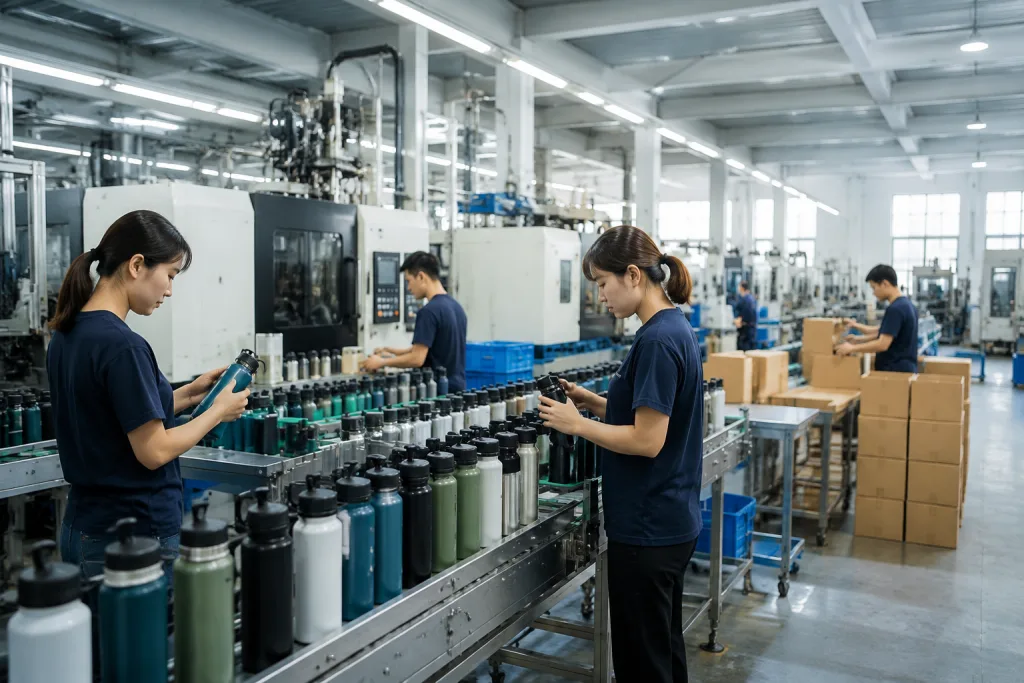
At our Hangzhou, Zhejiang factory, we make up to 300,000 units per month across water bottles, tumblers, and canteens. Same lesson every month. The cheapest quote is rarely the cheapest landed cost. If you want bulk drinkware that clears REACH, survives AQL inspection, and does not create chargebacks on Amazon or retail, lock the weak points first: cap fit, print adhesion, seal leak rate, odor, carton drop resistance. We run incoming checks with calipers down to 0.1 mm because a loose thread spec will come back as leakage. Zhejiang has a lot of capable factories. China also has plenty that will quote a low FOB number, then miss the real job. We’ve seen this go sideways over a PO typo on lid material alone.
Where Sport Bottles Fail First
I’ll rewrite the section in-place, keeping the HTML structure and the numbers/cert terms intact, then I’ll do a quick pass to strip any AI-ish phrasing.The weak point on an in bulk sport bottle is usually the cap system, the seal, or the decoration, not the bottle body. We’ve had samples pass visual check and still leak because a silicone ring was cut 0.3 mm too thin, or because the thread finish looked fine but picked up a cold shut on the mold. On the line, that turns into 100 bad cartons fast.
Start with the failure mode, not the finish. Ask which part will fail first in use: lid spring, silicone gasket, spout hinge, print adhesion, or shoulder deformation. For a typical 750 ml sports bottle, keep neck tolerance tight, around ±0.2 mm on mating surfaces, and ask for cap torque checks on every batch. If you are buying wholesale drinkware for retail, “looks good” is the wrong standard. Define leak-free after inversion for 10 minutes, then run the same bottle again after one hot wash at 65-70°C. QC pulled that test more than once, and that is where the weak parts show up.
Common first failures:
- Seal compression set from low-grade silicone
- Thread mismatch between bottle and lid tooling
- Stiff or brittle flip-top hinge after cold storage
- Logo wear from weak ink or under-cured coating
Cap Systems And Leak Risk
If a supplier offers three lid options at the same price, don’t assume they’re equal. They aren’t. On our line, the first buyer complaints usually start at the cap, whether you are sourcing bulk canteen styles, canteen wholesale programs, or a simple sport bottle for gyms and outdoor retail. A screw cap with a silicone gasket is usually safer than a push-fit lid, but this is the wrong question to ask. The real issue is seal geometry, thread fit, and whether assembly follows the torque spec—on some 63 mm lids we run 1.2–1.5 N·m, and if the setter drifts, leaks show up fast.
Specify the gasket material by grade, not just by name. Food-grade silicone should be stated with a hardness around 50-60 Shore A for standard lids, and QC should check flash, sink, and voids under a simple go/no-go visual standard. For carbonated or pressure-prone use, ask for a pressure test at 0.3 bar for 30 minutes; we’ve seen this go sideways when a buyer approved a nice-looking sample but skipped pressure data. For a straw lid, you need a hinge-cycle requirement, often 5,000 openings minimum, because that is where hinge fatigue shows up. QC pulled the sample. The crack started near the pin on cycle 4,200. If the bottle is part of a broader drinkware wholesale range, align the lid family across SKUs so you are not paying for different seals, separate spare-part stock, and repeat complaint handling. The math doesn’t work if one bulk growler uses a different gasket cross-section from the sport bottle or the wholesale canteen program.
In procurement terms, the lid is not an accessory. It is the product.
Material Choices That Crack Or Warp
The wrong material usually shows up in returns, not at sample approval. We see it on the line. Tritan, PP, AS, stainless steel, and aluminum react differently to heat, UV, and drop impact, so a bottle that looks fine on a desk sample can fail after 12 days in transit. If you buy a clear sport bottle in volume, ask for the exact resin grade and melt index. That is the right question. Two resins sold under the same trade name can run differently in injection molding, and one lot change can warp the thread or haze the body. In China, 30 factories can copy the shape; maybe 6 can hold resin-lot consistency through a 20,000-piece run. We have seen QC pull a clear sample with a 0.3 mm neck shift after the second resin lot went on press.
For stainless steel, a practical wall thickness is 0.6-0.8 mm for single-wall bottles and 0.4-0.5 mm per layer for vacuum structures, depending on target weight and dent resistance. Go too thin and you get oil-canning, base dents, and buyer complaints after the first container unload. Go too thick and the math doesn't work. Unit cost climbs, fill weight goes up, and the bottle still sits on the shelf the same way. For plastic bottles, ask for shrinkage data, mold-flow notes, and cold-crack testing if the goods ship into winter markets. We usually check this with a mold-flow report and a simple drop test at 0°C. A good factory in Zhejiang should show you more than one option, but showroom samples are not the point. You need the version that survives carton compression, pallet stacking, and a 1.2-meter drop in actual logistics. This matters for drinkware bulk orders and for mixed programs like bulk drinkware bundles with flasks and tumblers.
If your catalog includes a best wholesale drink bottle claim, back it with test data: impact, odor migration, dishwasher stability. Otherwise, it is marketing copy. We have had buyers flag that exact wording and then ask for the lab report number on the PO.
Decoration Problems Buyers Miss
Decoration is where a good bottle becomes a claim. We see it on the line. Laser engraving on stainless holds up well, but it looks weak if the brushed grain is too rough; on one 304 stainless flask job, QC pulled the sample and the mark faded out under a 0.15 mm deep brush line. Silkscreen is low cost and crisp, but the wrong ink system fails fast in a normal dish cycle. UV print looks premium on first look, then chips on the edge if surface prep was rushed. On an alcohol flask bulk or alcohol flask in bulk program, this matters more because users grip the body and cap every time, and that wear shows up in week 1, not month 6.
Give the supplier the decoration spec before sampling, not after the PO typo shows up. State logo size, Pantone reference, print location tolerance in mm, and the abrasion method. Ask for cross-hatch adhesion testing and a 50-cycle dishwasher or scrub test based on the finish. For a brushed steel beer tumbler bulk or beer tumbler in bulk order, laser marking is usually the safer call; the math doesn't work if you save $0.03 on print and lose 8% at receiving. For a promotional beer growler bulk or beer growler wholesale run, powder coat with a specified film thickness of 60-80 microns is a safer route, and we check it with a dry film gauge at 3 points per body. If you are also sourcing alcohol flask wholesale bulk units, keep the print clear of the neck finish, where sealing surfaces must stay clean. We’ve seen this go sideways after capping torque tests.
Decoration is not just brand equity. It is a warehouse rejection point, and buyers flag it fast under AQL pull checks.
QC Checks That Stop Bad Shipments
Most buyers bring up QC too late. They sign off the sample, then assume the factory will handle the rest. That is the wrong question to ask. For a serious in bulk sport bottle program, you need a written control plan from day one: incoming material checks, in-process checks on the line, and final inspection tied to an AQL table. AQL 2.5 is standard for major defects in consumer drinkware. Some buyers set critical defects at 0 and major defects at 1.5 for retail or marketplace channels. On our side, QC pulled the sample and checked the neck diameter with a digital caliper before mass production started.
Require these checkpoints:
- Dimensional check on body, neck, lid, and gasket groove
- 100% leak test for assembled lids
- Drop test from 1.2 m on packed sample units
- Color delta control, ideally ΔE < 2.0 for branded runs
- Odor test after 24 hours with hot water fill
If you buy alongside growler bulk, growler wholesale, or beer growler wholesale bulk programs, keep QC checklists separate. A growler has a different closure risk than a sport bottle, and we have seen this go sideways when one checklist covered both. The same applies to canteen bulk and wholesale canteen orders. One buyer sent us a mixed PO with a lid torque note copied onto the wrong SKU, and the line caught it only because the gasket groove depth was off by 0.3 mm. One generic checklist looks efficient. It usually misses the defect that matters.
Ask for pre-shipment photos and a carton drop test if the goods will move through e-commerce channels. Basic stuff. We ship cartons through courier networks that stack hard, and a 5-layer export carton that passes factory handling can still fail after two hub transfers. The buyer flagged crushed corners on one run, so now we check packed samples before loading, not after the claim comes in.
MOQ Pricing And Lead Times
Pricing for an in bulk sport bottle order comes down to four things: material, lid build, print setup, and carton spec. On our line, a standard 750 ml Tritan bottle with one-color print and a basic screw lid usually starts around USD 1.20-1.80 at 1,000-3,000 pcs. Add a flip lid with spring, a straw set, or a custom box with 5 mm E-flute insert, and the cost climbs fast. A vacuum stainless bottle sits in a different range, usually USD 3.50-7.50, based on finish, copper coating, and insulation spec. Buyers ask for a target price first. Wrong question. Ask what has to stay in the bottle and what can be cut.
A workable MOQ for custom sport bottles is usually 1,000 pcs per color or per logo version. If the project needs new mold parts, extra screen charges, or a lid with 3 silicone pieces, we often push back at 3,000 pcs because the math doesn't work below that. Lead time from final sample approval is often 25-35 days for simple plastic bottles and 35-45 days for vacuum stainless. We run pre-production samples, leak test at the line, and QC pulled the sample more than once because a logo was 2 mm off-center. If a factory promises 10 days on a custom order, they are skipping something. We've seen this go sideways.
For broader programs like wholesale drinkware, drinkware wholesale, or mixed flask orders, consolidate SKUs only if the material and decoration method are the same. Same bottle body with silk print and spray finish, fine. Mix Tritan, vacuum stainless, and laser engraving in one rush PO, and the line gets messy. We ship plenty of mixed orders, but the buyer flagged one last year because the outer carton mark had one PO digit wrong and two cap styles were packed together. You might save on freight, then lose it back on rework and defect claims. This hits niche lines harder, especially wholesale growler and beer growler in bulk, where carton size, closure torque, and divider cost are not small numbers.
How To Brief A Factory
A solid factory brief cuts arguments before tooling starts. We ask buyers for one spec sheet with the basics spelled out: capacity, material, wall thickness, finish, lid style, gasket material, logo method, carton count, and target market. Put the numbers in. For example, body wall 0.5 mm, carton 24 pcs, logo print area 45 x 80 mm. If the bottle is for the EU, state REACH and food-contact requirements on page 1. If you sell into North America, ask for FDA food-contact declarations and the test reports your importer or retailer already listed. Do not assume the line knows your compliance path. We have seen a PO marked "EU sale" with no gasket spec, and QC pulled the sample later with the wrong silicone hardness.
For a strong brief, include the following:
- Product name and intended use, such as sport bottle for gym retail, outdoor bottle with carry loop, or promo bottle for event giveaway
- Capacity, e.g. 500 ml, 750 ml, or 1 L
- Exact closure type and spare part requirements, down to straw, spout, seal ring, or extra lid set
- Packaging target, such as master carton size and drop-test standard; if you need a 5-layer carton, say it
- Inspection standard, shipping terms, and delivery window
If you are sourcing side items like beer tumbler wholesale, beer tumbler wholesale bulk, or alcohol flask wholesale, use the same brief format for every SKU. Same table. Same units. This is the wrong question to skip, because mixed formats slow quoting and create easy mistakes. We ship from Zhejiang every week, and the buyer flagged it more than once when one SKU was listed by ml and another by oz only. A consistent brief makes China quote comparison cleaner and factory follow-up faster. Good suppliers can price from a partial brief. Better suppliers come back with the missing points, like Pantone code, leak test standard, or whether the lid torque target is 12-14 kgf.cm.
If you want the safest path, start with a sample order, then run a pilot lot of 300-500 pcs before full production. The math works. That small run usually catches the failures that hurt later: a screen print drifting 2 mm, a base mold leaving a sharp edge, or a carton insert that crushes in drop test. We have seen this go sideways when buyers jump straight to container booking.
Send your spec sheet for a fast quote
We’ll review the failure points, confirm MOQ, and give you a practical FOB China price before production starts.
Frequently asked questions
What is a realistic MOQ for an in bulk sport bottle order?
For a custom in bulk sport bottle, a realistic MOQ is usually 1,000-3,000 pcs depending on lid type, print count, and whether you need new tooling. Simple stock bodies with custom logo can sometimes start at 500 pcs, but once you add a custom cap or special finish, 1,000 pcs is the safer baseline. If you need multiple colors, ask whether the MOQ applies per color or per total order. For Zhejiang factories, 25-35 days after sample approval is normal for plastic bottles, while stainless vacuum bottles often need 35-45 days.
How do I stop leak complaints on bulk drinkware?
Specify the failure point. Ask for 100% leak testing on assembled lids, not just random checks. Require the supplier to define gasket material, hardness, and groove tolerance. For sport bottles, test inversion for 10 minutes, then repeat after a hot wash at 65-70°C. If you sell into retail or e-commerce, add a 1.2 m drop test on packed samples. Leak complaints usually come from poor seal fit, not the bottle body, so the lid spec matters more than most buyers think.
What standards should I ask for from China suppliers?
For drinkware sourced from China, ask for food-contact declarations, REACH where relevant, and documented factory QC under AQL 2.5 for major defects. If the product uses stainless steel, request the material grade and thickness, plus test records for corrosion and weld integrity. For EU-bound goods, traceability matters, so keep batch numbers, resin or steel lot numbers, and carton labels aligned. A serious Zhejiang supplier should be able to show you these documents without drama.
Is a bulk canteen or growler harder to source than a sport bottle?
Usually yes, because closures and use conditions are less forgiving. A bulk canteen may look simple, but if it is vacuum-insulated or paired with a complex lid, the risk profile rises. Growler bulk and beer growler wholesale programs also add pressure resistance, odor control, and packaging concerns. A sport bottle is easier if it is plain and single-wall, but once you add straw lids, flip tops, or premium decoration, the difference narrows quickly. Treat each product family separately.
What should I check before placing a drinkware wholesale order?
Check three things first: sample quality, production control, and packaging survival. Confirm the exact material, wall thickness, and print method. Ask for AQL inspection terms, leak-test procedures, and photo evidence of final cartons. Then confirm Incoterms, often FOB China, and make sure the factory can support your monthly volume without subcontracting. If you are mixing SKUs like wholesale canteen, wholesale growler, or alcohol flask wholesale bulk, keep the specifications distinct so you do not get one bad design copied across the whole order.