Key Takeaways
- A practical MOQ for a custom shaker bottle is usually 3,000-5,000 units per colorway, with 25-35 day production lead time.
- FOB China pricing for a 600-700ml PP shaker bottle often lands around USD 1.10-2.20 depending on mold, print, and insert.
- Leak testing, thread fit, and print adhesion should be checked under AQL 2.5, not only by visual approval.
- For gym chains, one standard bottle body with 2 lid colors can cut inventory complexity by about 30%.
You are not buying a giveaway pen. A shaker bottle gets stuffed into a gym bag, dropped on rubber flooring, run through dishwashers, and judged hard by end users who notice every small leak. If you buy an in bulk shaker bottle like a basic promo item, the line usually pays for it later: leakage claims, print that starts lifting after 50 wash cycles, or a cap thread that feels off by 0.3 mm and gets flagged by the buyer in week two.
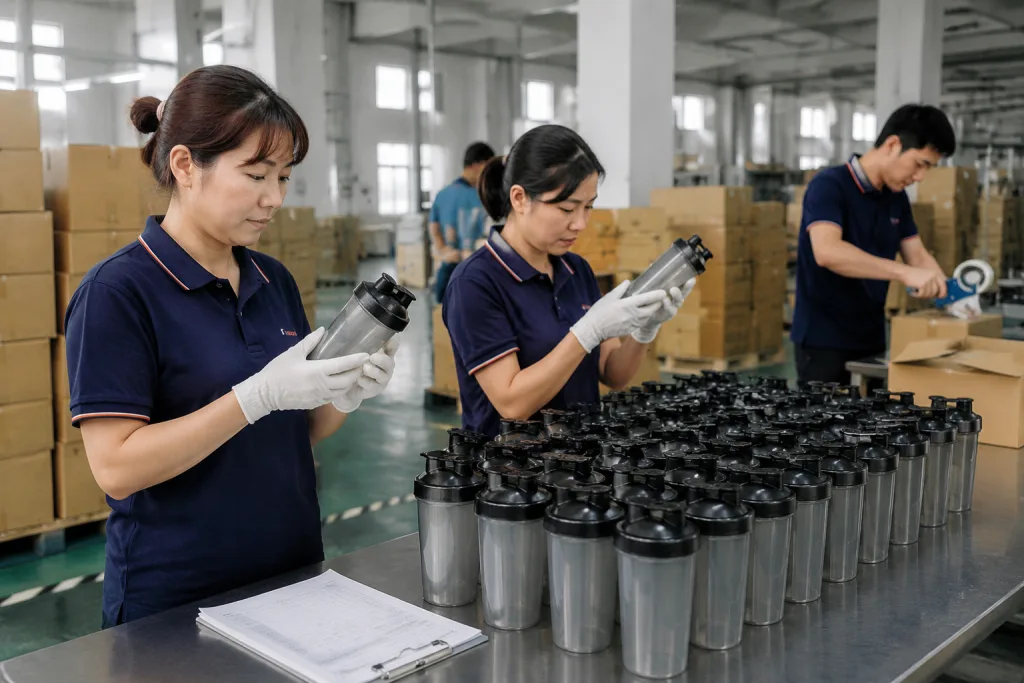
The better way is to start from the actual use case. For fitness brands and gym chains in Europe and North America, we usually balance landed cost against compliance and repeat-order consistency, because this is the wrong question to ask if the only target is the lowest unit price. At BottleForge Industrial in Zhejiang, China, we run the order like a real project: lock the spec, check samples, confirm decoration, run testing, do AQL inspection, and ship against the PO. That is how we cut surprises on a 5,000 to 30,000 unit run; QC pulled one sample last month over a lid torque issue before it turned into a full rework.
Start with the actual usage
Use a real buyer case. You run a fitness brand or a regional gym chain and need 8,000 units for a new protein launch plus front-desk retail. Your team wants a custom shaker bottle that looks premium and still lands at a safe entry price. The first mistake is jumping straight to artwork. Start with actual use. We’ve seen this go sideways when the buyer approved a nice render first, then QC pulled the sample and the lid leaked after 500 open-close cycles on the bench test.
For an in bulk shaker bottle program, lock these five points before you ask for firm pricing:
- Capacity: 500ml, 600ml, 700ml, or 800ml
- Material: PP, Tritan, or stainless outer with shaker insert
- Mixing system: wire whisk ball, plastic grid, or snap-in agitator
- Decoration: silk screen, heat transfer, IML, or laser on steel parts
- Sales channel: retail, subscription box, gym POS, or distributor carton sales
If the bottle is mainly a bulk gym water bottle for membership kits, PP is usually the best value. A typical PP body with 0.9-1.2mm wall thickness gives decent durability without pushing freight cost too high. We run this spec every month. If you want a more premium custom fitness water bottle feel, Tritan improves clarity and odor resistance, but unit price often rises 20-40%. Buyers like the look, then flag the quote once they see the resin delta.
In Zhejiang, China, buyers often over-spec at the start, then cut features after sampling. That burns 10 to 14 days. The math doesn’t work. A cleaner route is one simple spec sheet with body material, lid type, mixing insert, Pantone colors, logo size, and carton pack. If you sell through distributor shaker bottle channels, add barcode placement and master carton weight limit early, especially if your distributors in North America cap cartons at 15kg. We’ve had POs held up over one small carton mark and one wrong barcode position 12mm off panel center.
The bottle that photographs well is not always the bottle that survives daily gym use. Ask for a sample built to final spec, not a pretty pre-production mockup.
Build the quotation around real costs
Once the spec is locked, the quote gets easier to read. For a basic 600ml bulk shaker bottle in food-grade PP with a screw lid, mixing grid, one-color silk screen logo, and individual polybag, a normal FOB China price at 5,000 units is often around USD 1.10 to 1.45. Move to Tritan with a stronger lid design and two-color print, and you may be at USD 1.70 to 2.20. Stainless hybrid styles go higher. On our line, a thicker lid rib of 0.3 mm and a better hinge pin usually explain part of that jump.
If a supplier sends one round number with no breakdown, push back. Ask for the cost sheet. At minimum, you want these line items, because we have seen POs delayed over a missing logo plate charge or a sample fee nobody mentioned:
- Unit price by volume break: 3,000 / 5,000 / 10,000 units
- Tooling charge if there is a new lid, insert, or cap component
- Logo setup cost and print method
- Packaging cost for color box, sticker, sleeve, or PDQ tray
- Sampling cost and refund policy after order
For a custom logo shaker bottle, decoration can swing cost more than buyers expect. One-color silk screen may add only USD 0.04 to 0.08. A wraparound heat transfer can add USD 0.12 to 0.25. If you want metallic effect, soft-touch coating, or a transparent viewing strip with registration tolerance, add both cost and QC risk. QC pulled the sample more than once for logo misalignment over 1.5 mm, and the buyer flagged it right away.
This is where a lot of distributors fitness water bottle buyers save money the wrong way. They chase the lowest bottle body price, then pay it back through poor yield, scratch-prone surfaces, or repacking claims. Better value comes from asking how many units the factory can produce monthly and whether decoration is done in-house. A factory in Zhejiang with 300,000 to 500,000 units/month capacity and in-house printing usually controls shade consistency better than a trader splitting work across three workshops. This is the wrong question to ask: “Who is cheapest?” Ask who controls the print room and who ships the reorders on time.
If you are sourcing a bulk sports water bottle and shaker format together, ask whether the bottle body can share the same mold family. That cuts spare-part complexity and makes repeat orders easier for a gym chain with multiple SKUs. We have seen this go sideways when two caps look similar on the drawing but use different thread starts, so the warehouse packs the wrong replacement lid.
Approve samples like a buyer, not a designer
Sampling is where gym programs go sideways. We’ve seen buyers approve a clean prototype, then the mass run shows a looser lid fit, lower gloss, or a seal that fails after transit. For a custom made shaker bottle, approve function first, looks second. That is the right order. On our line, QC pulled one pilot sample last month where the cap looked fine but leaked after 8 shakes because the silicone ring sat 0.6 mm proud of the groove.
What to check on the sample
- Leak test after 30 minutes upside down and 10 hard shakes
- Thread engagement on the first twist, without cross-threading
- Insert fit: whisk or grid should not rattle excessively
- Odor after 24 hours with warm water sealed inside
- Logo adhesion after 50 dishwasher-style rub cycles or tape test
- Fill-line readability if measurement marks are molded or printed
If the order is for a custom gym water bottle used at multiple club locations, ask for a golden sample signed against Pantone references and approved texture. Put a date and PO number on it, even if the buyer typed the PO suffix wrong once—we see that more than you’d think. That sample becomes the production standard. Without it, every color call turns into opinion, and we’ve seen this go sideways fast.
For Europe and North America, confirm the compliance file before deposit. This is not paperwork for later. Depending on material and market, ask for REACH, LFGB where relevant, food-contact declaration, and test support against applicable ASTM or CPSIA points if the design might cross into family or youth channels. If you are sourcing a customized sports water bottle for a gym chain’s kids class or family membership line, check this before tooling sign-off, not after the cartons are packed. One buyer flagged a lid nib last year because the small-part risk changed the channel review.
At our side in China, we usually suggest one pre-production sample, then one sealed production sample made from actual line materials. That adds 5 days, not 12, and the math still works. A presentation sample is often hand-fitted at the bench; mass production runs on fixtures and torque control, usually around 1.2 N·m on the cap station. For a 5,000-unit order, spending 5 more days in sample control is cheaper than replacing 400 leaking bottles after launch.
Lock quality control before mass production
Quality control on a shaker bottle is simple on paper. On the line, it takes discipline. A bottle can look fine in a quick visual check and still fail after 200 shake cycles in a gym bag. The complaints we see most on a custom shaker bottle order are leaking lids, off-register print, burrs on the drinking rim, and cap hinges that turn white or crack after a few weeks.
Your purchase order should state the inspection standard clearly. AQL 2.5 for major defects and AQL 4.0 for minor defects is a common starting point for this category. Put the defect definitions in plain language so QC, the line leader, and your inspector read the same thing off the same sheet. We have seen one PO say “acceptable slight scratch” with no mm limit, and that argument cost two days.
- Critical: sharp edge on mouth contact area, non-food-safe contamination, severe leakage
- Major: logo unreadable, thread mismatch, insert missing, crack, lid not sealing
- Minor: small color shade variation, light scuff inside agreed limit, tiny gate mark
For a bulk fitness water bottle or shaker project, inspection should include practical tests, not defect counting alone. This is the wrong question to ask if the team only wants the final defect rate. We run functional checks early because QC pulled samples before with zero visual issues, then found seepage after the third inversion test. We recommend:
- 100% leak test during production if the lid design is new
- Drop test from 1.0m with empty bottle, 3 times on base and side
- Torque check on lid closure consistency
- Print adhesion cross-hatch or tape test by lot
- Carton drop test if you ship by parcel or Amazon FBA
If your order goes to distributors, add barcode scan verification and carton assortment check. If it goes to Amazon, include FNSKU labeling rules and outer carton dimension limits in the SOP. We have seen distributors gym water bottle buyers lose margin fast through relabeling at a third-party warehouse because pack-out was not locked before production. One missed carton mark or a wrong 24-pack assortment shows up later as chargebacks.
A factory with ISO-style document control and BSCI or similar social compliance is easier to manage on repeat programs. The certificate alone does not make the bottle better; the process does. The difference shows up six months later when you reorder the same customizable shaker bottle and expect the same cap fit, same hinge tension, and the same 0.2 mm liner compression instead of a fresh round of sampling.
Plan packaging and shipping early
Freight can wipe out the unit-price gain you fought for. Shaker bottles look cheap to ship, but they eat space fast, so carton efficiency is where the real math sits. A 700ml bottle with a wide lid and insert often takes 8-12 mm more headspace in the carton than a standard bulk sports water bottle, even when the resin cost gap is small.
For gym chain orders, buyers usually pick one of these pack-out options:
- Individual polybag in export carton for the lowest cost
- White box or kraft box for cleaner retail presentation
- Color box or sleeve for e-commerce and supplement bundles
If you need a customizable sports water bottle for front-desk retail, the box needs to take shelf handling without pushing landed cost out of range. We run drop tests on the line, and this is where weak tuck flaps show up fast. A simple kraft box with one black print panel often adds only USD 0.10 to 0.18, while a full color box may add USD 0.25 to 0.45 plus more carton cube.
Lead time is usually easier to control than most buyers expect, but only if packaging artwork is locked early. For a standard customized fitness water bottle order in Zhejiang, China, a realistic schedule is 5-7 days for sample revision, 25-35 days for mass production after deposit and artwork approval, and another few days if you require third-party inspection. QC pulled the sample last month on a job like this because the PO had one lid color typo, and that alone cost 3 days. If your logo uses special coating or the box supplier is separate, add buffer.
Decide your shipping term with open eyes. FOB Ningbo or Shanghai gives you control if you already have a freight forwarder. DDP looks simple on paper; we have seen the math go sideways once local delivery fees and duty adjustments land. For North America, a difference of USD 0.08 per unit in freight on 10,000 pieces is not trivial. If you are buying as a distributor sports water bottle importer, request carton dimensions, gross weight, and loading quantity per 20GP and 40HQ before confirming the order. Ask for the gross weight in kg and a loading plan photo if possible. That is the right question.
Set up repeat orders from day one
The best sourcing decision is the one that makes the second order easier, not just the first order cheaper. First runs are only the start. If sales move, you will need replenishment fast for a new club opening, a holiday promo, or a new supplement flavor, and that is where standardization saves time on the line.
For a customizable gym water bottle or shaker line, keep the body mold and thread finish stable, then change lid color, print, or sleeve artwork only. We have seen this cut repeat-order approval time by 20-30%, especially when the neck finish gauge stays unchanged from the first PO. Your retail SKU, your distributor fitness water bottle partners, and your private-label gym program can share the same hardware base, which keeps replacement parts and packing simpler.
You should ask your supplier to archive these items:
- Approved Pantone references and print position drawing
- Master carton specification and pallet pattern
- Golden sample and signed QC checklist
- Material batch records for body and lid resin
- Spare component policy for lids, inserts, and seals
If the factory can keep color masterbatch data and print screens on file for 6 to 12 months, repeat-order risk drops fast. QC pulled the sample on one reorder last year because the blue lid was half a shade off the approved Pantone chip, and that delay cost 3 days. At BottleForge Industrial in Zhejiang, China, we usually tell buyers to keep one common bottle platform and change the artwork for seasonal launches. That setup works well for a customized gym water bottle or customized shaker bottle program because branding changes faster than hardware. Asking for a new mold every season is the wrong question to ask.
One practical point: ask what happens if defect rate exceeds the agreed standard. Serious factories will write the corrective-action path into the order flow, and the buyer should see who signs off, who remakes stock, and how fast replacement units ship. We have seen this go sideways over something small, like a PO typo on lid color or a seal seating issue found at AQL pull. You do not need legal drama on a bottle order. You need a clear answer before you scale to 20,000 units or more.
Get your shaker bottle spec reviewed before ordering
Send your target capacity, logo file, quantity, and market. We will flag MOQ, compliance, decoration, and packaging risks before you place a bulk order.
Frequently asked questions
What MOQ should I expect for an in bulk shaker bottle order?
For a fully custom shaker bottle, a practical MOQ is usually 3,000 to 5,000 units per design, sometimes per colorway if the body or lid color changes. If you use an existing mold with one-color logo print, some factories in China can start around 1,000 to 2,000 units, but the unit price will be higher. For gym chains, 5,000 units is often the most balanced point because you get better FOB pricing, more stable color control, and enough volume to justify a proper pre-production sample and AQL inspection. If packaging is custom, the box MOQ may also set the real minimum.
Which material is best for a custom shaker bottle: PP or Tritan?
PP is the standard choice for many bulk shaker bottle projects because it is cost-efficient, light, and widely accepted for food-contact drinkware. A 600-700ml PP bottle often gives the best balance for gym promotions and supplement bundles. Tritan costs more, often 20% to 40% above PP, but it looks clearer, feels more premium, and usually performs better on odor resistance. If your target customer is a value-driven gym member, PP is often enough. If you sell a premium custom logo shaker bottle at retail above USD 12-15, Tritan may support the price point better.
How do I prevent leakage complaints on bulk shaker bottle orders?
Start with lid design and thread fit, then verify with process control. Ask for a sample built from production materials, not a hand-adjusted prototype. During QC, require leak testing after filling, 10 hard shakes, and 30 minutes upside down. For a new lid structure, request 100% leak test in production, at least for the first order. Also check the seal material, hinge stress point, and insert seating. Many leakage claims come from cap distortion during assembly or from inconsistent torque. If your order is 5,000 units or more, a third-party inspection under AQL 2.5 is a sensible cost.
What lead time is realistic for a customized shaker bottle order from China?
If you use an existing bottle mold and only customize color, logo, and packaging, a normal schedule is about 5 to 7 days for samples and 25 to 35 days for production after deposit and final artwork approval. Add 7 to 15 more days if you need a new mold insert, more complex decoration, or custom retail packaging from a separate supplier. During peak season, especially before major holiday shipping windows in China, you should add buffer. If your gym launch date is fixed, it is safer to approve artwork and carton details early than to rush manufacturing later.
What documents and tests should I ask for before shipping to Europe or North America?
Ask for a food-contact declaration plus material test support relevant to your market and bottle construction. For Europe, REACH-related documentation and, where appropriate, LFGB-oriented testing are common checkpoints. For North America, confirm the applicable food-contact and labeling requirements for your sales channel. If the bottle may be used in family or youth-oriented programs, review ASTM or CPSIA-related points where relevant. On the factory side, ask for inspection records, carton spec, barcode accuracy, and if needed BSCI or similar social compliance documents. These papers do not replace your own QC, but they reduce avoidable import and retailer issues.