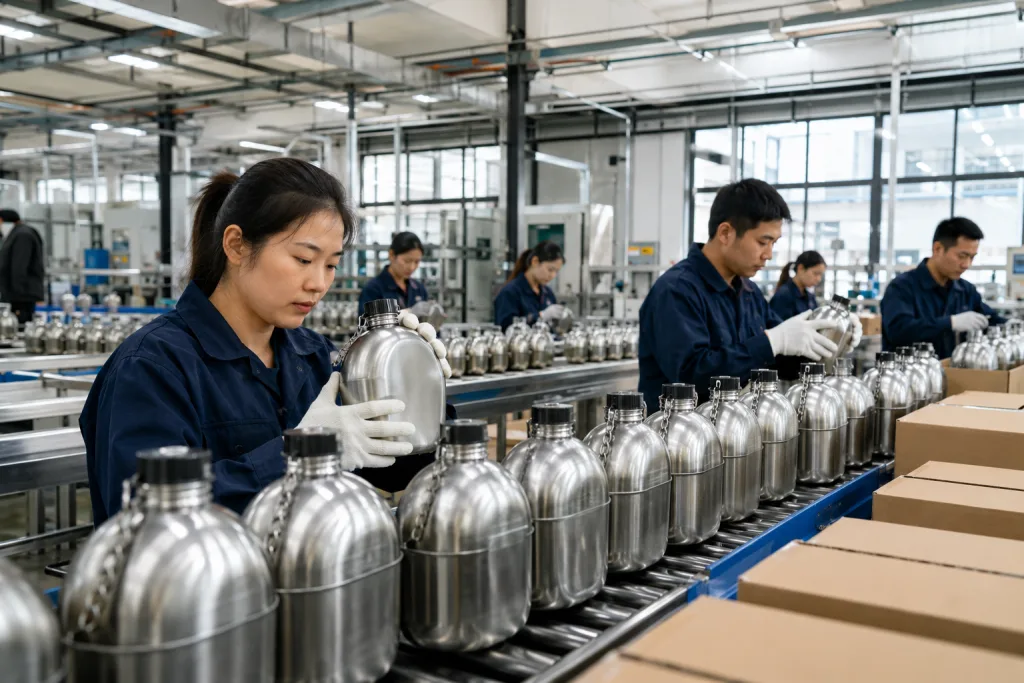
Key Takeaways
- Lock the 4 core decisions first: material, capacity, cap system, and decoration, or you will lose 15-30 days in sample revisions.
- Typical MOQ for an in bulk military canteen is 1,000-3,000 units per SKU, with mass production lead times of 25-40 days from sample approval.
- Use AQL 2.5 for major defects and request 100% leak testing; field returns often start with lid torque or gasket inconsistency.
- If your channel needs food-contact compliance, confirm REACH, LFGB, or FDA test scope before deposit, not after packing starts.
You can buy a bulk canteen from almost any trading catalog in China. That part is easy. Buying the right in bulk military canteen for your channel, your margin, and your compliance risk is where orders get messy. The hard part is not finding a bottle-shaped product. The hard part is locking the material, closure, coating, and packaging before tooling starts, samples bounce back, and the line loses 12 days on changes that should have been fixed at RFQ stage.
If you sell into tactical retail, government supply, outdoor chains, or private-label ecommerce, the wrong call usually shows up later as leaks, dent claims, coating failure, or label non-compliance. We see this every month in Zhejiang: the buyer flags unit price first, then asks about the use case after QC pulled the sample and found a cap fit issue at 1.5 mm tolerance. A factory that can run 300,000 units/month in China helps only when the specification is disciplined from day one. Otherwise, we've seen this go sideways.
Start with the mission profile
The first call is not color or logo. It is the mission. We need to know where the canteen will be used, how hard it gets knocked around, and whether the line is building for camping retail or an in bulk military canteen packed into tactical bundles, institutional bids, or 10-day field use. Skip that step and the quote sheet gets messy fast; last month one buyer asked for a retail finish on a body we had specced at 0.5 mm for rough transport.
Ask four straight questions. What liquid goes inside: water only, hot drinks, or alcohol? Does the user carry it on a belt, pack, or vehicle rack? Is lower weight more important than dent resistance? Does the channel want a heritage military look, or a modern insulated format? QC pulled a sample last week where the PO said “olive drab,” but the buyer actually wanted a clean matte black gift look. Small wording issue, big delay.
- Water-only field canteen: Usually single-wall stainless steel or BPA-free plastic, lighter to carry, lower FOB cost, and simpler to run on the line.
- Temperature retention: Double-wall vacuum body, usually 18/8 stainless steel, with better heat hold, more weight, and a higher unit cost because vacuum yield matters.
- Rugged tactical positioning: Scratch-resistant powder coat, tethered cap, matte earth-tone colors, and a direct conversation about acceptable denting after drop tests.
- Gift or premium retail: Better finish consistency, tighter logo positioning, upgraded packaging, and stricter carton presentation at final inspection.
Buyers often group this item with bulk drinkware, drinkware bulk, or nearby lines like bulk growler and beer tumbler bulk because the factories overlap. That part is true in Zhejiang, China; we run sports bottles, growler wholesale orders, and canteen wholesale programs on shared lines with the same laser marking station and leak-test bench. But this is the wrong question to ask. The sourcing logic changes once the canteen has to take impact, rough truck loading, and repeated opening outdoors without cap or thread issues.
If your channel also sells alcohol flask bulk or wholesale growler products, separate those families during quotation. The wall thickness, sealing standard, and volume tolerance are not the same, and we have seen this go sideways when one RFQ tries to combine all three into one MOQ. A serious buyer gets samples faster by stating the mission first, then the construction, then the packaging target price.
Choose the body and cap system
The second decision is construction. For an in bulk military canteen, the trade-off is straightforward: lower weight and lower price versus higher abuse resistance and a better hand feel. On the line in Zhejiang, most RFQs start with three body options, and we usually check wall thickness with a micrometer before we talk packing.
Common body constructions
- Single-wall 18/8 stainless steel: A solid choice for durable water canteens. Typical wall thickness is 0.5-0.6 mm. Lower freight cost than vacuum models, and fewer process points for QC to chase.
- Double-wall vacuum stainless steel: Better for temperature retention. Typical outer wall 0.5 mm, inner wall 0.4 mm. Higher FOB and more process steps, including vacuum sealing and leak check.
- Tritan or food-grade plastic: Lowest weight and often lower unit cost, but it is a harder sell if the buyer flagged “military-style toughness” on the PO.
Then comes the cap. This is where bulk canteen programs usually go sideways. The body alone seldom drives returns; lids, gaskets, and threads do. We ask buyers to lock cap material, sealing ring material, torque range, and whether the cap is tethered before sampling. For outdoor use, a wide-mouth screw cap with a silicone gasket is common. If the canteen will be clipped to packs, request a loop cap load test. A practical benchmark is a 5 kg hang test for 1 hour without deformation or crack propagation. This is the right question to ask, because QC pulled more failed cap samples than dented bodies in one recent 3,000-piece run.
If you are cross-sourcing wholesale drinkware with beer growler wholesale bulk or alcohol flask wholesale bulk items, do not assume the same closure vendor works across all products. We have seen this go sideways. Beer growler bulk orders often care more about carbonation resistance or larger neck finishes, while alcohol flask in bulk programs may run different gasket compounds. For canteens, repeated field opening matters more than shelf display, and thread wear after 500 open-close cycles tells you more than a nice first sample.
When a quote looks cheap, check whether the factory quietly downgraded steel grade, gasket quality, or cap weight. That is where the missing USD 0.25 usually went.
At BottleForge-style manufacturing scale in Zhejiang, a practical MOQ is often 1,000 pieces for stocked molds and 3,000 pieces for customized colors or packaging. We ship this range every month. It is normal, not a red flag.
Price the real landed cost
The third decision is commercial, not technical. Quote comparison only works if the basis matches. We still see buyers line up one FOB Ningbo quote, one EXW quote, one plain box offer, and one gift box offer, then expect the math to be clean. It is not. Last month a buyer flagged a PO where the carton spec was missing, and the “cheaper” offer flipped higher in 10 minutes.
For a standard single-wall stainless wholesale canteen in the 750-1,000 ml range, you may see FOB China pricing from roughly USD 2.20 to USD 4.80 depending on steel weight, finish, cap complexity, and packaging. Vacuum versions can move into USD 4.50 to USD 8.50. A custom strap, pouch, or nesting cup pushes cost further. If a supplier offers numbers far below market, ask for actual net weight in grams and carton pack details immediately. We ask for body weight, cap weight, and carton size in mm because we have seen “304 stainless” offers come in 38 g light on the sample.
Your landed cost framework should include:
- Unit FOB price: Body, cap, gasket, standard export carton.
- Decoration cost: Silk screen, laser engraving, heat transfer, or embossed logo.
- Packaging cost: White box, color box, barcode label, insert card, master carton spec.
- Testing cost: Food-contact, coating adhesion, salt spray if relevant, drop test protocol.
- Freight efficiency: Carton size, units per carton, container loading quantity.
This also matters if you are buying drinkware wholesale across categories such as wholesale growler, beer tumbler wholesale bulk, or best wholesale drink bottle programs for multiple channels. Unit price alone is the wrong question to ask. One supplier looks cheaper, then loses the edge after oversized cartons and weak pallet efficiency; we have seen a 5-layer carton pass drop test but waste 14% of container space. Another supplier comes in a little higher on FOB and fits 12-18% more units per container.
If you sell to Amazon or 3PL-heavy channels, do not leave labeling until the end. FNSKU placement, suffocation warning language, carton marking, and pallet height limits should be written into the PI. We run into this on the line more than we should: a label window off by 8 mm, a carton mark typo, a pallet cap missed on the booking. A canteen bulk order with incorrect carton dimensions can erase margin faster than a USD 0.10 material saving.
Treat compliance as a purchase spec
The fourth decision is compliance. Buyers often ask, “Can you provide FDA?” That is the wrong question to ask. For an in bulk military canteen, spell out the target market and the exact reports required for the final build, including coating and decoration where they apply. We have seen PO notes miss the print ink requirement, then QC pulled the sample and the lab had to retest the decorated part.
For Europe, ask for REACH screening and, if the customer standard requires it, LFGB-related food-contact testing from a recognized lab. For North America, buyers usually ask for FDA food-contact declarations and sometimes California Proposition 65, based on the sales region and product build. If children are involved, ASTM and CPSIA move onto the list, though that is less common for a military-style canteen. On our side, the buyer flagged this more than once after seeing a silicone strap added at the last minute.
Factory system documents matter too. BSCI, ISO 9001, and social audit records do not replace product testing; they tell you whether the line runs under control. If the supplier says they also produce canteen wholesale, wholesale drinkware, and beer growler in bulk lines, ask one direct question: is the report from the same factory and the same material stack-up? If not, the math does not work. We still see old reports pulled from another SKU in China, sometimes with a 304 stainless body but a different lid set, and that file does not protect your shipment.
Practical controls you should write into the order:
- AQL standard: AQL 2.5 major, 4.0 minor is common for finished drinkware.
- Leak test: 100% air-pressure or inverted water leak test before packing.
- Coating check: Cross-hatch adhesion and basic abrasion test by lot.
- Odor check: No abnormal odor after 24-hour sealed rest with warm water.
- Traceability: Production date code or lot code on carton and inner pack.
If your assortment includes alcohol flask wholesale, growler bulk, or beer tumbler in bulk items from the same factory, ask for separate compliance files by SKU family. We ship mixed programs like this all the time. It saves arguments later when one report does not legally or technically cover another product, especially after a carton label typo or a cap material change slips into the order.
Sampling, tooling, and production discipline
Once the first four decisions are locked, the job turns into process control. This is where disciplined buyers save 7-12 days. For most stock-mold projects in Zhejiang, sampling takes 5-10 days for existing bodies with a simple logo, and 10-15 days if custom color matching or new cap components are involved. New tooling can add 20-35 days depending on complexity. On our line, the delay usually shows up at color approval or thread-fit correction, not at the first CAD drawing.
Your sample flow should be staged. First approve a plain reference sample for shape, weight, and thread fit. We check this with a digital scale and a go/no-go gauge before decoration starts. Then approve a pre-production sample with real decoration, real packaging, and barcode placement. Skipping the plain sample looks faster on paper. It usually creates a costly mess.
Lead times for mass production are usually 25-40 days after sample approval and deposit, assuming normal seasonality and no long holiday interruption in China. If a factory quotes 15 days for a fully customized 3,000-piece order, ask what they left out. This is the wrong question to ask: “Can you do it faster?” The better question is whether coating cure time, packaging lead time, and final inspection are already built in. We have seen buyers push for 15 days, then QC pulled the sample and found the logo position was off by 3 mm.
Use a specification sheet that includes:
- Capacity tolerance: for example 1,000 ml plus or minus 3%.
- Net weight: for example 285 g single-wall body.
- Finish: Pantone reference, gloss or matte level, coating area exclusions.
- Logo position: artwork size and distance from seam or base.
- Packaging: box dimensions, insert material, drop test expectation.
This level of detail also helps if you are sourcing adjacent products like wholesale growler, beer growler in bulk, or alcohol flask bulk from the same supplier base. Zhejiang factories move fast, but they run best with a binary approval path. Approve or reject. Not “almost okay.” We have seen that phrase add 7-10 days, especially when the buyer flagged a carton mark after the PO already had one typo in the barcode line.
Audit the supplier before scale-up
The last decision is simple: does this supplier deserve repeat volume? One clean shipment proves one thing only. We have seen factories pass a first PO, then drift on lot two when weld polish changes by 0.3 mm or a new pack team joins the line. Before you scale your in bulk military canteen program, check if they can hold quality across multiple lots, not just show one pretty golden sample.
Ask direct operating questions and wait for straight answers. How many units per month do they run on this product family on one line, not in theory? What share is subcontracted? Which steps stay in-house: forming, welding, powder coating, laser marking, assembly, packing? In China, a factory that controls coating thickness and final assembly under one roof usually keeps cosmetic consistency tighter than a trader stitching together three workshops. We ship smoother that way.
For a stable program, look for predictable communication and control points you can measure. Good suppliers speak plainly about rejection criteria, spare parts ratios, and packaging drop test failures from 76 cm, instead of circling back to price on every call. MOQ talk matters too. For example, 1,000 units for a stock color is realistic, but 500 units with a fully custom lid and color box often means padded margin or excuses later. The wrong question is not "Can you do 500?" It is "What breaks at 500?"
If your portfolio spans wholesale drinkware, canteen wholesale, beer tumbler wholesale, and wholesale growler lines, consolidate only where the factory has real depth. Do not consolidate because one sales rep says yes to everything. We have seen this go sideways: the buyer flagged a growler lid leak at 15 kPa, and the same supplier was solid on insulated tumblers. The best wholesale drink bottle supplier for insulated tumblers is not automatically the right partner for rugged canteens.
A practical first order is often one or two SKUs, 1,000-3,000 pieces each, with clear QC gates and a mid-shipment photo review. Keep it tight. QC pulled the sample at carton drop check, and that tells you more than another polished factory presentation. If that run stays smooth, then discuss annual blanket forecasts, safety stock, and packaging optimization. That is when a supplier in Zhejiang, China starts acting like a supply partner, not just a quote source.
Need a tighter quote for military canteen sourcing?
Send your target capacity, material, MOQ, logo method, and delivery window. We will review the spec and flag cost or compliance risks before sampling.
Frequently asked questions
What is a normal MOQ for an in bulk military canteen order?
For stocked body molds, a normal MOQ is 1,000 pieces per SKU. If you want a custom Pantone color, branded color box, or a non-standard cap assembly, many factories in China will move the MOQ to 2,000-3,000 pieces. If new tooling is required, the MOQ can rise further or the factory may charge a separate mold fee of USD 300-2,000 depending on the part. You should also ask whether MOQ is per color, per logo, or per combined order quantity. Some suppliers say 1,000 pieces, but actually mean 1,000 pieces per colorway. Lock that point early or you will lose pricing accuracy.
How long does production usually take after sample approval?
For a standard canteen bulk order using existing molds, mass production commonly takes 25-40 days after deposit and final sample approval. Plain samples can be ready in 5-7 days, and decorated samples in 7-15 days depending on logo method and packaging detail. If you add a new cap, custom accessory, or complex gift box, add another 7-15 days. Around major China holidays, especially before Lunar New Year, you should build in at least 10 extra days. If your sales window is fixed, place the order backward from ship date, not from quotation date.
What tests should I require before shipment?
At minimum, require 100% leak testing, visual inspection to an agreed AQL standard, and verification of weight, capacity, and logo position against the approved spec. For food-contact products, request relevant material compliance documents for your market, such as REACH or LFGB-related testing for Europe and FDA-related documentation for North America. If the canteen has powder coating, ask for adhesion testing and a basic abrasion check by lot. For rugged retail channels, add carton drop testing and a small sample impact review. The exact test list should match the final construction, not a generic report from another bottle.
Is stainless steel always better than plastic for a wholesale canteen?
Not always. Single-wall 18/8 stainless steel is usually the safer choice if you want a durable, premium-feel military-style canteen with stronger retail positioning. Typical wall thickness is 0.5-0.6 mm, and it handles dents better than many buyers expect. But plastic can be lighter and cheaper, which matters for large-volume institutional buying or weight-sensitive field kits. The question is not which material is universally better. The question is which material matches your use case, target FOB price, and customer expectation. If your channel expects a rugged tactical look, stainless is usually easier to sell at a healthy margin.
How do I compare suppliers that also quote growlers, tumblers, and flasks?
Use the same scorecard for all of them: construction accuracy, closure quality, compliance paperwork, packaging control, and actual lead time reliability. Many factories in Zhejiang offer wholesale growler, beer tumbler wholesale bulk, and alcohol flask wholesale bulk lines together, but shared catalog breadth does not prove process depth. Ask for net weight, wall thickness, monthly capacity, defect criteria, and sample lead time by product family. Then compare on the same FOB basis with the same packaging assumptions. A supplier that is excellent on insulated tumblers may still be weak on canteen caps or rugged coating consistency, so evaluate by SKU type, not by brochure size.