Key Takeaways
- For a standard PP or Tritan bulk kids water bottle, expect MOQ around 3,000 units and FOB unit prices roughly USD 1.20 to 3.80 depending on size and print.
- Ask for ASTM and REACH compliance, plus AQL 2.5 inspection and 100% leak testing on spout or straw-lid models.
- A practical production window for custom kids water bottle orders is 25 to 35 days after sample approval, not 10 days.
- For school programs, choose 350 ml to 500 ml bottles with simple one-hand lids, fewer small parts, and replacement straw availability.
An in bulk kids bottle order is not a bottle order. It is paperwork, leak control, print wear, and on-time shipment packed into one PO. For school districts and kids-product importers, a low quote that skips ASTM, REACH, or migration testing gets expensive fast. We have seen this go sideways after a lid fails a 5,000-cycle hinge check or QC pulls a decorated sample with ink rub after 50 wipes. The real issue is simple: 10 suppliers will say yes, and 2 will tell you where the risk sits.
If you buy from Zhejiang or wider China, ask for a working checklist, not polished sales lines. This is the wrong question to ask: “What is your best price?” Ask for MOQ, sample days, wall thickness, leak-test method, and packaging options first. On our Hangzhou, Zhejiang line, standard MOQ starts at 3,000 units per design, lead time is usually 25 to 35 days, and output can reach 300,000 units per month depending on model and decoration. We also quote wall thickness in mm, run vacuum or upside-down leak checks by model, and flag PO typos early because one wrong print color code can hold a full carton run.
What should you lock first?
Lock the use case first. It decides cost, compliance, and how we build the bottle on the line. A bulk school water bottle for daily classroom use is a different item from a children water bottle promotional giveaway for a 3-day summer camp. If the bottle is for children aged 4 to 8, we usually cut weight, reduce detachable parts, and ask for a lid that survives repeated drops from 80 to 100 cm onto tile. QC pulled samples last spring where the hinge cracked at the third drop, so this is not a small detail. For ages 9 to 12, a slightly taller custom kids bottle with a carry loop and higher fill volume usually works.
Your first checklist should lock four points: capacity, material, lid style, and decoration area. Ask these first. For school and retail programs, 350 ml, 400 ml, and 500 ml are the practical sizes we ship every week. Smaller than 350 ml looks undersized on shelf. Above 500 ml, the filled bottle gets too heavy for younger children, and buyers flag that fast in sample review. For material, most children water bottle suppliers in China offer PP, Tritan, 304 stainless steel, or sometimes glass with a protective sleeve. For kids, PP and Tritan are the normal starting point because the weight-price math works and the drop performance is easier to control.
- PP bottle: lower cost, usually USD 1.20 to 2.10 FOB for volume orders.
- Tritan bottle: clearer appearance, better perceived value, usually USD 1.80 to 3.20 FOB.
- 304 stainless steel bottle: stronger premium position, usually USD 2.80 to 5.80 FOB depending on vacuum structure.
If a children water bottle vendor cannot give you a clear material recommendation by age group and project type, keep looking. This is the wrong question for them to dodge. A serious children water bottle factory in Zhejiang or elsewhere in China should narrow the spec within one call or one email thread, often after checking the bottle weight in grams, the lid structure, and the target MOQ.
Which materials are safest for kids?
Safety is not a slogan. It comes down to resin choice, additive control, test coverage, and disciplined product design. For most bulk children water bottle projects, we usually run three materials on the line: food-contact PP, Tritan, and 18/8 stainless steel. Each solves one problem and creates another.
PP is the standard pick for entry-level custom school water bottle programs because it is light, takes drops well, and keeps the math workable at 3,000 to 5,000 pcs MOQ. Tritan fits buyers who want a clear body and a cleaner shelf look without using glass; we often see this on 500 ml styles with silk-screen logos. Stainless steel makes sense for older children and insulated formats, but the added 120 g to 180 g shipping weight per bottle changes freight and carton count fast. For very young users, skip lids with complex bite valves or loose decorative parts. QC pulled too many samples with soft spouts tearing at the hinge after cycle testing.
What documents should you ask for?
- REACH test reports for the EU market
- LFGB if your customer specifically requires German food-contact standards
- ASTM or CPSIA-related testing where relevant for children-focused products sold in the US
- BPA-free declaration, but only as a supporting document, not the main proof
- Factory audit records such as BSCI or ISO 9001 if social and quality systems matter to your program
Do not accept a generic test report tied to another model number. Ask if the exact lid, straw, silicone seal, and print process were tested together. This is where buyers get burned. We have seen body material pass cleanly while the straw failed odor review after 48 hours in a sealed bag, or the lid hinge cracked before drop test retest. A children water bottle supplier that only shows body-material paperwork is showing half the risk.
For kids items, the lid is often the real risk point: hinge fatigue, straw odor, small-part retention, and color migration all show up there first.
If you are buying from children water bottle manufacturers in China, also confirm that the color masterbatch is food-contact compliant and that the print ink sits on an external dry surface only. This is a basic check, but buyers still miss it. Last year one buyer flagged a PO because the logo color on the lid did not match the approved Pantone chip after migration testing, and the issue came from a subcontract print shop, not the bottle body. That is why we ask who prints, what ink series they use, and whether the line keeps wet print areas away from mouth-contact zones.
How do you compare quotes properly?
Most buyers look at FOB unit price first. That is the wrong question to ask. We have seen a quote come in USD 0.06 lower, then turn into the higher-cost shipment because the spec sheet was loose and the packing was oversized. For a bulk kids bottle, ask every supplier to quote on the same structure: capacity, material, wall thickness, lid style, logo method, packaging, carton standard, test requirement, and Incoterm. If one factory prices a 0.45 mm straw and another prices 0.60 mm, you are not comparing quotes.
Wall thickness changes cost and drop performance fast. On a 400 ml Tritan body, we usually see 2.0 mm to 2.8 mm, and QC pulled the sample more than once because the lighter wall failed the drop check at the shoulder. Weight moves with that change. Break resistance does too. Decoration shifts the number just as much. A one-color silk screen print costs less than wrap printing, heat transfer, or laser marking on steel. Individual polybag packing is cheaper than a color box, but the buyer flagged it on one school program because the retail shelf needed front-facing graphics.
- Tooling: confirm whether the existing mold fits your size and lid requirement; we have seen a “close enough” mold miss thread match by 0.3 mm.
- Sampling: pre-production sample is often 5 to 10 days after artwork approval; if the logo position needs a jig, the line usually needs one more day.
- MOQ: standard models may start at 3,000 units, while custom made kids bottle tooling can push MOQ to 5,000 or 10,000 units; below that, the math does not work.
- Spare parts: ask for extra straws and seals at 1% to 2% of order quantity; on one PO, the buyer typed 0.1% by mistake and had a shortage after launch.
For a children water bottle wholesale program, ask for carton count, carton gross weight, and container loading estimate. This part is boring, but we ship by carton, not by spreadsheet. A quote that is USD 0.08 lower per unit can lose its advantage if carton efficiency is poor and you ship 15% fewer units per container. We have seen 24-pack cartons come in at 19 kg gross, then fail the warehouse limit and need repacking. Experienced children water bottle distributors look at landed cost, not just piece price.
If you sell into Amazon or large retail, add barcode labeling, carton marks, and if needed FNSKU application to the quote request from the start. Late changes slow the line. Last month a buyer added carton mark rules after sample approval, and it pushed shipment back 3 days because outer carton artwork had to be rechecked before printing.
What custom options actually work?
Not every custom option deserves a budget line. The programs that hold up best keep the bottle structure standard and change what the child and parent actually see: body color, lid color, logo, print artwork, strap color, or packaging. We usually run this on an existing bottle mold and adjust the visible parts after color matching with a Pantone chip at the line. That cuts lead time and risk compared with opening a new mold. On most orders, the gap is obvious: sample approval in 12 days vs 18 days, and no new tooling argument in the PO.
For a custom logo kids bottle project, the common decoration methods are silk screen, heat transfer, digital print, and laser engraving on steel parts. Silk screen is still the safe pick for simple logos because color stays consistent and the unit cost works at MOQ 3,000 pcs. Heat transfer fits multi-color artwork, but ask straight about scratch resistance and dishwasher limits. We have seen bright graphics look perfect in approval photos, then QC pulled the sample after a tape test because curing temperature drifted on the line. That buyer pushback is avoidable.
Custom checklist that saves time
- Use Pantone references for lid and body colors.
- Confirm artwork position with a 2D mockup before sampling.
- Approve one physical pre-production sample, not photos only.
- Specify whether logos must pass tape test or rub test.
- Define packaging by channel: bulk pack, PDQ, color box, or mailer-safe pack.
If you need a children water bottle customizable program for annual school rollouts, favor modularity. A standard 400 ml bottle with interchangeable lid colors can cover 6 district themes without changing tooling, and the cap fit stays within the same 0.3 mm tolerance window. This is the right move for repeat programs. Redesigning the whole bottle every season sounds fresh, but the math does not work.
A good children water bottle factory should tell you where customization stops making sense. If a factory says yes to every new shape, hinge, and accessory without flagging tooling cost or breakage risk, watch out. We have seen this go sideways: one buyer asked for a new flip hinge, the first trial came back with stress marks after 500 open-close cycles, and the shipment plan slipped two weeks. That is not flexibility. That is poor project control.
How do you control quality before shipment?
For kids products, quality control should be written into the order before deposit payment, not argued after the line finishes. Set a spec sheet and inspection standard that covers dimensions, weight tolerance, color tolerance, logo position, leak testing, odor check, and carton condition. We usually lock this on the PI with a 0.5 mm drawing note, and it saves trouble later when the buyer flags a logo shift. Many importers use AQL 2.5 for major defects and 4.0 for minor defects, but school tenders and branded retail often ask for tighter limits.
Leak testing should be 100% for straw-lid and spout-lid models. Random sampling is the wrong call here. One silicone seal seated off by 1 mm can turn a clean shipment into a claim case. We run full leak checks on these lids, then QC pulled the sample for a filled-bottle drop test from desk height and repeated lid opening cycles when the hinge is part of the selling point.
- Critical defects: sharp edges, failed leakage, wrong material claim, missing compliance marks.
- Major defects: broken hinge, unreadable logo, heavy odor, distorted threading.
- Minor defects: light print offset, small cosmetic specks, outer carton scuffing.
If you work with children water bottle distributors or a children water bottle distributor network, align the quality standard before production so nobody reads defects differently at shipment stage. We have seen this go sideways over one PO typo on logo position and one inspector calling a scuff minor while the buyer called it major. In Zhejiang, experienced export factories often work with third-party inspectors such as SGS, Intertek, or Bureau Veritas. Use them when the order value supports the cost.
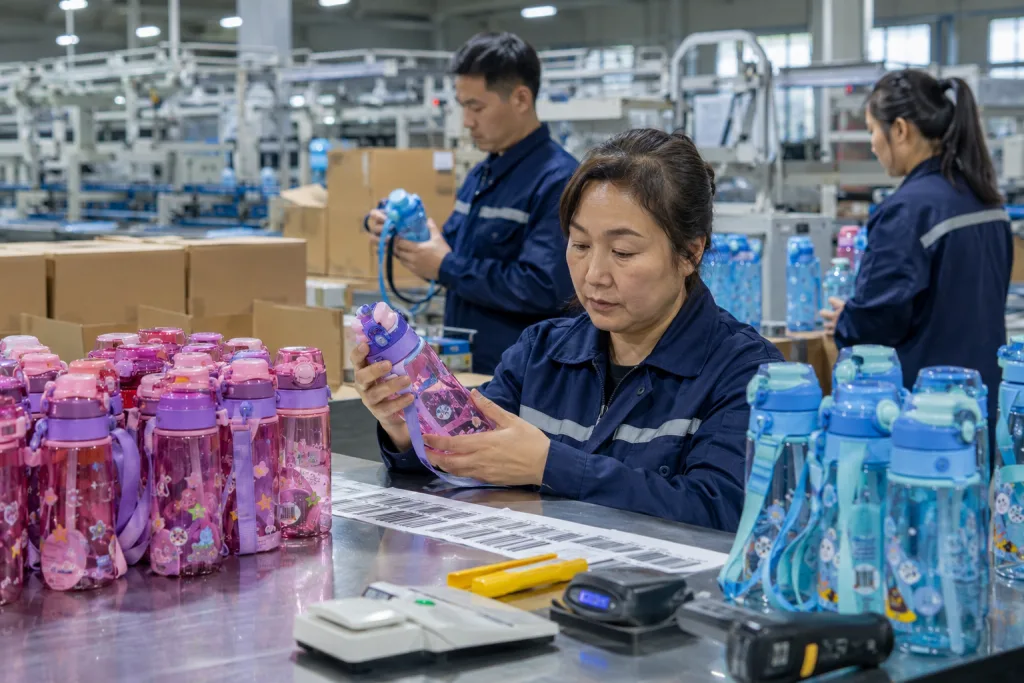
The strongest suppliers in China also check incoming straws, seals, and color concentrates before production starts. Ask that question directly. We normally check silicone hardness with a Shore A gauge and confirm masterbatch against the approved chip before the line runs. A factory that only inspects finished bottles is already too late.
What lead times are realistic?
Skip the fastest promise. Ask for the schedule the factory will actually sign off on. For a standard bulk kids water bottle on an existing mold, we usually see 2 to 3 days for quote revision, 5 to 7 days for artwork mockup and sample setup, 7 to 10 days for pre-production sample, and 25 to 35 days for mass production after approval and deposit. On the line, a simple logo shift by 2 mm on a printed bottle body can push artwork back one full day. Before back-to-school and year-end promotions, add another 7 to 10 days of buffer.
If your order needs a new mold for a custom children water bottle, tooling usually adds 20 to 35 days, depending on part structure and cavity count. If you also need third-party lab testing on production samples, plan another 5 to 12 days. We have seen buyers mark both steps as "to confirm later" on the PO, then the buyer flagged the launch date one week before vessel cut-off. That is where projects go sideways. These steps look optional only until the retailer asks for the report or the mold trial misses spec.
For a children water bottle manufacturer with steady scheduling, you should get a dated production calendar, not "soon" or "ASAP." This is the wrong question to ask if you only ask for total lead time. Ask these questions:
- How many lines handle kids bottle assembly?
- What is monthly output for this model family?
- When do printed parts need final artwork lock?
- What is the cut-off for packaging changes?
- Can the factory split shipment if one SKU is delayed?
At our Hangzhou, Zhejiang base, monthly capacity can reach 300,000 units across selected kids bottle models, but the real lead time still moves with lid complexity, decoration method, and packaging. A flip-straw lid with a spring and silicone bite valve does not run like a plain screw cap, and QC pulled the sample more than once for carton drop test issues on inner trays. That is the honest answer you should expect from any children water bottle manufacturer or children water bottle suppliers in China.
When is a supplier fit for schools?
School district buying is not the same as general retail import. Paperwork is heavier. The user group is less forgiving, and replacement needs show up fast once bottles hit 30 classrooms. A supplier that fits school business knows the PO may call for plain-language carton labels, class-set packing, color coding by grade, and spare lids after delivery. We see this on the line all the time: outer cartons marked by homeroom, 24 pcs per carton, with a simple sticker gun label that teachers can read in 3 seconds. That is a different job from a one-time children water bottle promotional order for an event.
Ask direct questions. Can the factory run mixed colors under one PO? Can they hold replacement lids or straws for 6 to 12 months? Can they match the same blue again on a repeat order instead of sending “close enough”? Schools often reorder in phases, and this is where weak suppliers get exposed. We have seen buyers flag a 2 mm lid-fit change and a shade shift between semesters; once that happens, the math does not work for the distributor handling complaints.
Check how the supplier answers, not just what they answer. Good children water bottle vendors reply with procurement facts: MOQ, FOB, HS code, test scope, carton dimensions, and production risk. No dancing around it. If QC pulled the sample and found a straw bite valve fitting too tight at 1.5 kg pull force, the supplier should say so and give the fix. Weak children water bottle vendors push everything back to marketing claims, and that is the wrong question to ask when a school buyer needs shipment details for approval.
If you import from China for school channels, the safest path is usually a standard certified structure, moderate customization, and a written QC plan attached to the PO. We ship more clean repeat orders this way. One page helps: color reference, drop test scope, AQL checkpoint, carton marks, and spare-part count. We have seen this go sideways over one typo on a PO label or an unstated carton size, so fewer moving parts usually means fewer surprises and a better shot at hitting the delivery window without quality claims waiting after arrival.
Get a workable kids bottle quote, not guesswork
Send your target size, lid type, quantity, market, and logo file. We will reply with MOQ, FOB pricing, lead time, and compliance options.
Frequently asked questions
What is a normal MOQ for an in bulk kids bottle order?
For a standard model using an existing mold, MOQ is usually 3,000 units per color or per design from a children water bottle factory in China. Some simpler PP models may start at 2,000 units, while stainless or heavily customized styles often need 5,000 units. If you want individual color-box packaging, mixed lid colors, or custom accessories, the effective MOQ can rise because packaging and assembly become less efficient. Always ask whether MOQ applies to total order quantity, each SKU, or each print design. That detail changes your real cost more than buyers expect.
Which bottle material is best for school-age children?
For most school programs, PP and Tritan are the practical choices. PP is lighter on budget and usually works well for ages 4 to 8 when you need impact resistance and a FOB target near USD 1.20 to 2.10. Tritan suits ages 6 to 12 if you want a clearer premium look and can accept about USD 1.80 to 3.20 FOB. Stainless steel makes sense for older kids and premium retail, but weight and price increase quickly. If the bottle will be carried daily in school bags, simple structure and low weight usually matter more than premium appearance.
What tests should I require before shipping kids bottles?
At minimum, require food-contact compliance matched to your market, such as REACH for the EU and relevant ASTM or CPSIA-related checks for the US if applicable to the item. Ask for testing on the complete assembly, not only the bottle body. That means lid, straw, silicone seal, paint, and print process. For production control, request 100% leak testing on straw or spout lids, plus an AQL inspection such as 2.5 major and 4.0 minor. If the project is for schools, add drop testing from about 80 to 100 cm and odor checks on random finished samples.
How long does a custom kids water bottle order usually take?
For an existing model with custom colors and logo, expect about 5 to 10 days for sampling and 25 to 35 days for production after sample approval and deposit. If you need new tooling, add around 20 to 35 days. If the order also needs third-party lab testing before shipment, add another 5 to 12 days depending on sample transit and lab queue. Buyers often underestimate packaging lead time too. A custom color box can add 5 to 7 days if artwork is approved late. For back-to-school delivery, place orders at least 60 days ahead.
Should I develop a new mold or use an existing kids bottle design?
Use an existing design unless your volume justifies the risk and cost of new tooling. A proven existing mold gives you faster sampling, lower MOQ, and fewer surprises in leakage or assembly. For many importers, customizing color, print, strap, and packaging delivers enough differentiation without creating engineering risk. New molds make sense when you have a protected retail concept, expected annual volume above 50,000 to 100,000 units, or a school contract that demands a specific shape. Even then, ask for tooling ownership terms, mold maintenance responsibility, and sample sign-off stages before you proceed.