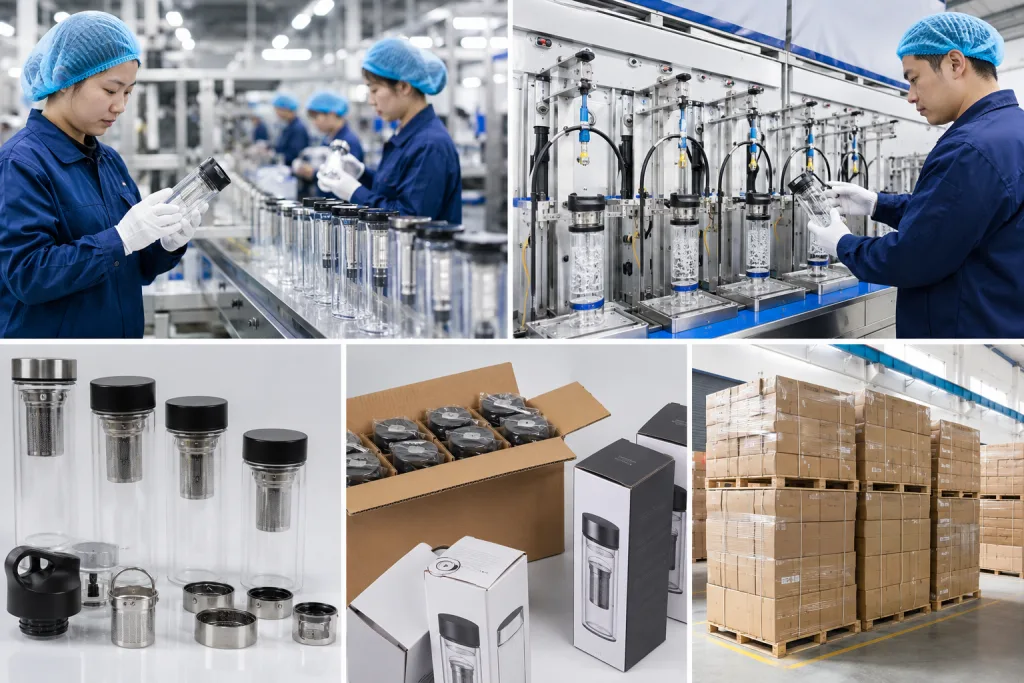
Key Takeaways
- A workable MOQ for a custom infuser bottle is usually 1,000 to 3,000 units per color, while stock-color programs can start around 500 units
- For most stainless and Tritan infuser bottle projects, production lead time from Zhejiang factories is typically 25 to 40 days after sample approval
- Leak performance depends on lid structure, gasket hardness, and thread tolerance more than bottle shape; ask for 100% vacuum or inversion leak checks
- EU and North American buyers should confirm REACH, LFGB or FDA food-contact compliance, plus AQL 2.5 final inspection before shipment
You can buy an infuser bottle from almost any trading company in China. Easy part. The hard part is buying an in bulk infuser bottle that reaches your warehouse with the right filter fit, an acceptable leak rate, clean decoration, and compliance paperwork that clears your market. We have seen first samples pass, then mass production drift after 3,000 units because the lid torque on the line was off by 0.2 N·m and QC pulled the sample too late. Wellness brands and hydration startups usually learn this after the first shipment, not at quotation stage.
If you are comparing a bulk infuser bottle, bulk fruit infuser bottle, or bulk tea infuser bottle program, the spec sheet tells the real story. The catalog photo does not. In Zhejiang, serious factories build around repeatability: wall thickness tolerance in mm, lid torque range, mesh grade, and AQL inspection limits. We run into buyer pushback here all the time—someone wants to talk color first, but this is the wrong question to ask. If you know which lines on the sheet affect claims, returns, and margin, you buy better and spend less time arguing after the goods ship.
Start with the bottle body
The first line on the spec sheet should show body material, capacity, unit weight, and wall construction. If it is missing, stop there and ask before you ask for price. On our line, factory-direct infuser bottles usually fall into three body types: Tritan, soda-lime glass with a sleeve, or 18/8 stainless steel. That one choice drives cost, breakage claims, and where your brand sits on the shelf.
Tritan is the usual pick for a bulk fruit infuser bottle sold to gyms, wellness subscription programs, and retail programs under USD 8 to 12 landed, depending on order size and decoration. A 650 ml Tritan bottle usually weighs 180 to 260 g, which saves freight on e-commerce parcels. We ship a lot of this format. Stainless steel fits better if you need heat retention and a higher selling price. A double-wall 500 ml custom tea infuser bottle may weigh 320 to 450 g, and the extra mass helps the hand-feel. Glass looks clean and moves well for tea and fruit infusion, but the math changes fast once QC adds thicker EPE and a stronger mailer after a drop-test failure.
Ask for actual thickness numbers, not just material names. A Tritan body at 2.0 mm and one at 2.6 mm can look close in a rendering but perform differently in drop tests and dishwasher cycles. We have seen buyers approve artwork, then flag cracking after the first pilot run because no one pinned down the wall thickness. For stainless, ask whether the inner and outer walls are 0.4 mm or 0.5 mm. For glass, ask for borosilicate versus soda-lime and confirm whether the base is reinforced.
In China, especially in Zhejiang, decent factories will quote body weight tolerance, usually within plus or minus 3% to 5%. Ask for that line in writing. Underweight units dent faster, crack faster, and feel cheap the second a customer picks one up. QC pulled the sample more than once at 12 g light against the approved standard, and the buyer was right to push back. If you are building a custom made infuser bottle line, this is one of the fastest checks for separating a real manufacturer from a trader forwarding catalog PDFs.
The infuser insert decides usability
Buyers often obsess over the shell and skim past the infuser basket. That is the wrong question to ask. The insert decides whether your customized fruit infuser bottle works on day 30 or comes back as a returns issue. We see it on the line: if the mesh opening is off by 0.2 mm, or the lock tab has too much play, the basket rattles loose fast. A good insert needs the right opening size, enough volume for ingredients to move, and a lock structure that stays tight after a week of daily use.
For fruit infusion, larger perforations and a longer basket usually work better because water has to pass through sliced citrus, berries, or cucumber without blocking up. For a bulk tea infuser bottle, the mesh needs to be finer. Tea leaf particle size decides everything. A hole pattern that runs fine for lemon slices will dump tea dust straight into the drink. Ask what filter structure the supplier runs: laser-cut holes, woven stainless mesh, or molded plastic strainer geometry. QC pulled samples before where woven mesh cleaned well but trapped pulp at the crimp edge, while plastic strainers passed rinse tests faster.
What to confirm on the insert spec
- Basket material: food-grade PP, Tritan, or 304 stainless steel
- Mesh or hole size: typically 0.3 to 1.5 mm depending on tea versus fruit use
- Basket length: short baskets suit tea; full-length baskets suit fruit infusion
- Lock method: thread-in, bayonet, press-fit, or integrated lid insert
- Removability: easy cleaning reduces odor complaints and repeat claims
If you are selling to distributors infuser bottle channels, pick the insert for the end use, not for the render. A distributor fruit infuser bottle line for sports retail needs easy washout and impact tolerance; we have had buyers flag baskets that held strawberry seeds after one rinse. A distributor tea infuser bottle for office gifting usually wants stainless appearance and cleaner leaf separation. For most custom infuser bottle projects, we ask clients to test two basket styles with real ingredients before tooling sign-off. The sample cost is small next to relabeling a weak design across 3,000 units, and we have seen that mistake go sideways over one PO typo and one rushed approval.
The infuser is not an accessory. It is the product. Treat it like a functional component, not a decorative add-on.
Lid geometry is where leaks begin
When a buyer says a customizable infuser bottle failed quality control, we usually trace it back to the lid, not the body. That is where leaks start. The lid packs in the thread path, sealing gasket, drinking spout, carry loop, and sometimes the infuser joint, so a 0.2 mm miss on one feature can turn into return claims after the first shipment. We have seen QC pull a sample that looked fine on the bench, then drip after a carton drop test.
Start with the thread type. Fine threads feel smooth in hand, but they react badly to molding swing and cross-threading on the line. Coarser threads are safer for high-volume runs, especially once output gets past 10,000 pcs. Then check gasket material and hardness. Silicone gaskets in the 50 to 60 Shore A range are common because they compress well without taking a set too fast. If the gasket channel is shallow or loose, your custom logo infuser bottle might pass an inversion sample at the factory and still fail after freight vibration. We have seen this go sideways after one buyer approved a golden sample and skipped packed-carton testing.
A reliable factory infuser bottle supplier should explain the leak test method in plain terms. The bare minimum is an inversion test for a fixed time, often 30 minutes. Better is a 100% inline vacuum or air-pressure assisted check on capped units, plus spot testing after assembly. If a supplier only says “no leak” and gives no method, push back. That is the wrong question to dodge, and good factories usually have a fixture, pressure setting, and reject record ready.
Useful lid questions for buyers
- Is the carry loop load-tested, and to what weight, such as 5 kg for 1 minute?
- Does the lid use virgin PP, ABS, stainless, or mixed materials?
- Can replacement gaskets be supplied for after-sales support?
- Is the spout easy to clean, or does it trap fruit residue and tea stain?
If you are sourcing a customizable tea infuser bottle for North America, also check how the lid behaves in top-rack dishwasher testing if you plan to make that claim. We ship replacements every year for warped lids; cracked bottles are not the main issue. One buyer flagged whitening around the hinge after 12 wash cycles, and the body was still fine. Buyers who check lid geometry early usually avoid the costliest defect—the one found by consumers, not inspectors.
Decoration specs affect yield and margin
Your artwork file is not the decoration spec. For a customized infuser bottle or customized fruit infuser bottle, decoration needs its own rules for tolerance, adhesion, and placement. We see buyers miss this point on the first PO, then flag logo drift after the cartons land. If you sell through wellness retail, subscription boxes, or influencer-led launches, visual consistency is not a small detail.
On Tritan and PP parts, we usually run silkscreen, heat transfer, or pad printing. On stainless, laser engraving, silkscreen, and powder-coat logo printing are standard on the line. A custom tea infuser bottle with a matte powder coat looks premium only when the coating thickness stays under control and the print passes tape and abrasion checks; QC pulled samples last month where the logo edge chipped after 20 rubs. Ask for the decoration zone drawing in millimeters, not just “front logo area.”
Factories in Zhejiang that handle export volume often run monthly output above 300,000 units across multiple drinkware lines. Scale helps repeatability only after the approved standard sample is locked in the sample room. Confirm color by Pantone reference, logo position tolerance such as plus or minus 2 mm, and whether the supplier uses pre-production approval before mass print. For a custom logo infuser bottle, this is the wrong question to skip.
If you need a customizable fruit infuser bottle for promotions, stock colors with one-color print may keep MOQ near 1,000 units and tooling cost at zero. If you want a custom made infuser bottle body color, gradient finish, or a special mold feature, MOQ usually moves to 3,000 to 5,000 units and lead time stretches by 7 to 15 days. We have seen buyers push for 1,000 units on a new body color, and the math does not work.
One practical rule: never approve decoration based only on a digital mockup. Request a printed or engraved sample on the real substrate. Stainless curves distort artwork by 1 to 2 mm across the wrap, and transparent bodies show glue marks or insert shadow lines fast under warehouse lighting. What looks clean on screen can look cheap in hand. Then you ship discounted stock.
Compliance paperwork should match your market
For Europe and North America, compliance is not a single box to tick. It is a document set matched to the actual bottle build. If a supplier sends a generic food-contact report from another SKU, treat it as a red flag. We have seen buyers catch this on page 2, where the report showed a 500 ml sports bottle while the PO was for a 420 ml infuser bottle with a flip lid. A distributor infuser bottle program needs paperwork tied to the same materials, same lid system, and same decoration process used on the line.
For EU programs, ask about REACH and, where relevant, LFGB food-contact testing. For the US and Canada, FDA food-contact alignment is common, and some buyers also request California Proposition 65 review depending on decoration chemistry. If the bottle targets children, the discussion changes fast, and ASTM or CPSIA-related considerations may apply. This is the wrong question to ask late in the order. A customized tea infuser bottle with stainless body, PP lid, silicone seal, and printed logo may need 4 separate material declarations, not one blanket statement.
Quality control terms also need to be explicit. AQL 2.5 for major defects and 4.0 for minor defects is a normal starting point for finished drinkware, but you should define your critical defects separately. Leakage, wrong logo, sharp metal burrs on the infuser, and odor issues usually sit in the critical or major category. QC pulled the sample last month because the infuser rim had a 0.3 mm burr. Ask whether the factory can share BSCI, ISO 9001, or social audit records if your retail channel requires them.
China suppliers vary widely here. The better Zhejiang factories keep a document pack ready and update it by item family. The weaker ones scramble after you ask, and we have seen this go sideways when the buyer flagged a missing lid-material declaration 3 days before booking. If you are buying a factory tea infuser bottle for a launch date, late compliance paperwork can delay customs clearance just as effectively as late production. Put document deadlines into the purchase order, not just the email thread, and list the exact item code even if the PO typo looks minor.
MOQ lead time and packing reality
Most first-time buyers look at unit price first, then get caught by MOQ splits, carton counts, and packing limits. On an in bulk infuser bottle order, the terms have to match how you sell. If you are a startup testing one SKU, 5,000 units in four colors looks fine on a spreadsheet and then sits in stock for 90 days. We have seen this go sideways. A better opening run is often 1,000 to 1,500 units in one or two colors with standard components, especially when the line is already set for that lid and filter combo.
Typical MOQ for a bulk infuser bottle from a China factory is around 1,000 units for existing molds and standard colors, rising to 3,000 units or more for custom body colors, custom lids, or unique insert structures. That jump is not arbitrary. The buyer usually wants one Pantone lid, one body spray color, and a custom insert, but the math does not work unless the factory can spread setup loss across volume. In Zhejiang, some factories running about 500,000 units per month will bend on a trial order if you stay with stock components and simple print. Lead time is usually 7 to 10 days for sampling and 25 to 40 days for mass production after approval and deposit. On our floor, that schedule still depends on plain things like screen-print queue, lid injection slot, and whether QC pulled the sample on the first pass.
Packing deserves the same attention as the bottle. Ask for inner box dimensions, master carton count, gross weight, and drop-test standard. A glass fruit infuser bottle bulk order needs stronger dividers and often lower carton counts to stay under practical handling weight, usually below 15 kg. We ship plenty of cartons where the buyer first asked for 24 pcs per master, then dropped to 12 after seeing the gross weight and corner crush risk. If you sell online, ask whether the factory can support mailer-safe packaging or FNSKU labeling for marketplace prep. If you sell through distributors fruit infuser bottle channels, pallet efficiency usually matters more than gift-box appearance, down to simple details like 1.2 m pallet stacking height and carton overhang.
The right question is not “What is your best price?” Price alone is the wrong question to ask. Ask, “What specification set gets me the return rate and landed cost I need?” That is how experienced buyers source a custom infuser bottle from China without paying for mistakes later, whether the issue is a 3 mm divider gap, a logo position shift, or a PO typo on the shipping mark.
Get an infuser bottle spec review before ordering
Send your target volume, market, and bottle concept. We will check MOQ, compliance, decoration, and packing options before you commit to tooling or mass production.
Frequently asked questions
What MOQ should I expect for a custom infuser bottle order?
For an existing mold, most factories quote 1,000 to 3,000 units per design, often with one MOQ per color. If you accept stock body colors and only add a one-color logo, some suppliers in Zhejiang will start around 500 to 1,000 units. If you want a custom body color, unique lid, or a new infuser basket, MOQ often moves to 3,000 to 5,000 units because material setup, color matching, and production loss increase. Always ask whether MOQ is based on total units, per color, or per decoration version. That detail changes your real inventory risk more than the headline MOQ number.
Which material is best for a bulk fruit infuser bottle?
It depends on your sales channel and price point. Tritan is usually the safest all-round choice for a bulk fruit infuser bottle because it is lightweight, shatter-resistant, and easier for e-commerce shipping. A 650 ml Tritan bottle often lands in a practical mid-market cost band. Glass gives a cleaner premium feel and works well for tea and wellness positioning, but breakage risk is higher, so packaging cost rises. Stainless steel suits premium insulation programs and gift channels, especially in 450 to 550 ml sizes, but the unit cost is higher. For most hydration startups, Tritan is the lowest-risk first order.
How long does production take for a customized infuser bottle?
If you use an existing mold and standard components, sample time is usually 5 to 10 days after artwork and color details are confirmed. Mass production for a customized infuser bottle normally takes 25 to 40 days after sample approval and deposit. During peak season, especially before summer promotions or year-end gifting, add 7 to 10 days. A new mold or custom structural changes can add 20 to 35 days depending on complexity. Ask the supplier to break lead time into sampling, material purchase, production, and final inspection. That gives you a more realistic schedule than one headline number.
What quality checks matter most for a bulk tea infuser bottle?
For a bulk tea infuser bottle, focus on leak testing, filter performance, odor control, and decoration adhesion. Leak testing should include inversion testing and preferably 100% inline checks on finished units. The filter should be tested with real loose-leaf tea to confirm that leaf particles do not escape through the mesh. Odor matters because lids with poor resin quality can create immediate consumer complaints. Decoration should pass tape and rub tests, especially on painted stainless bodies. At final inspection, many buyers use AQL 2.5 for major defects and 4.0 for minor defects, but define leakage and sharp burrs as critical or major in writing.
What documents should a factory direct infuser bottle supplier provide?
At minimum, ask for a proforma invoice with full item specs, food-contact compliance documents that match the actual materials, and a final inspection report. For Europe, that often includes REACH and sometimes LFGB-related testing depending on your requirements. For North America, FDA food-contact alignment is standard, and some buyers also check Proposition 65 exposure risk based on decoration materials. If your retail customers ask for factory audit records, request BSCI or ISO 9001 documentation early. The key point is that the paperwork must match the same lid, seal, body, and logo process used in mass production, not just a similar bottle.