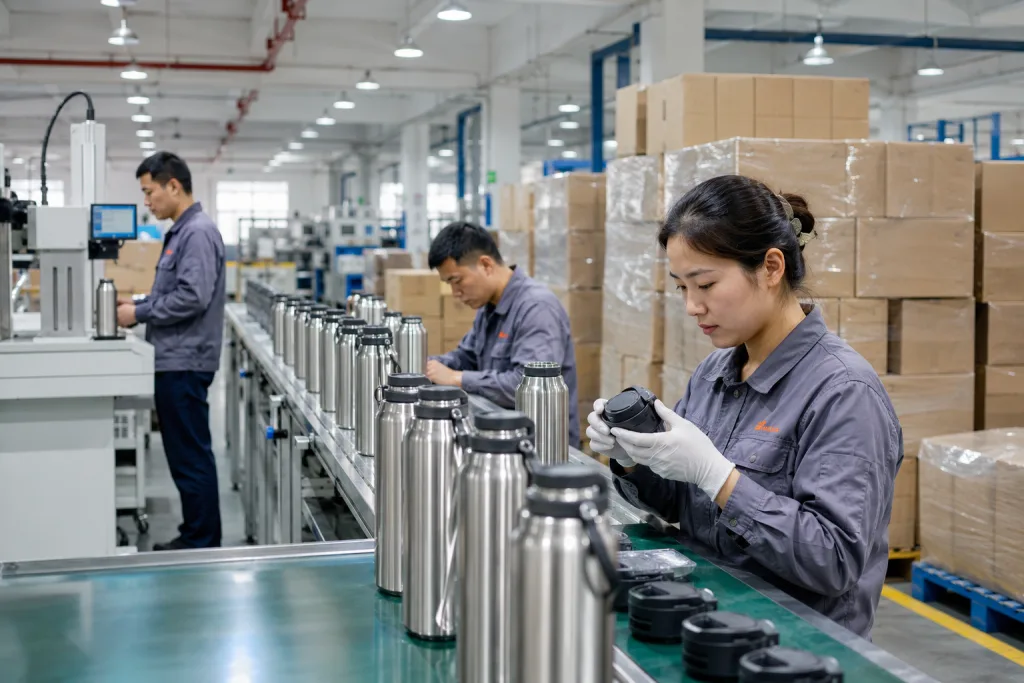
Key Takeaways
- For a standard 32 oz stainless steel in bulk hydration flask, realistic MOQ is 1,000-3,000 pcs per color, with 35-45 day production after sample approval
- A usable target FOB China price is often USD 3.80-6.90 depending on steel grade, lid type, coating, and logo process
- Leak testing should be 100% inline, while final inspection should follow AQL 2.5 major / 4.0 minor before balance payment
- For Europe and North America, confirm REACH, LFGB or FDA contact compliance, carton drop testing, and barcode accuracy before shipment
You are not buying a sample for Instagram. You are buying a production run that has to ship on time, pass compliance, and still leave margin after freight, duty, and rework. That is where first-time buyers get stuck on an in bulk hydration flask program. The drawing looks simple. Then the line finds the real problems: a 0.3 mm thread mismatch, powder coating that fails the tape test, a master carton that bursts in the drop test, the wrong logo process on the PO, or a lid that starts leaking after two weeks. We have seen this go sideways.
A practical sourcing process in China starts with one live order case and runs it through every checkpoint. If you buy from Zhejiang or another China base without a clear spec sheet, an approved golden sample, and an AQL plan, you are not placing an order. You are taking a bet on lead time, landed cost, and your brand. QC pulled samples on programs like this where the buyer flagged color drift before mass production, and that saved a 3,000 pcs reorder. This is the wrong question to ask: "Who has the lowest unit price?" Ask who can hold the spec at shipment.
Start with the buyer brief
Let’s use a real PO scenario. You are a North American outdoor brand launching a private-label in bulk hydration flask for retail and corporate gifting. Your opening forecast is 5,000 units across two colors, with one laser logo and one retail box. You also want pricing on the next wave: bulk canteen, bulk growler, and insulated tumblers. That part is normal. We ship plenty of buyers who start with one flask and add 2 or 3 matching SKUs after the first sample round.
A usable brief should read like an engineering sheet, not a mood board. At minimum, define:
- Capacity: 18 oz, 24 oz, 32 oz, or 40 oz
- Body material: 18/8 stainless steel, usually SUS304 for inner and outer
- Insulation: double wall vacuum, copper lining optional
- Mouth style: narrow, standard, or wide mouth
- Lid type: PP screw lid, straw lid, flip lid, or stainless cap with silicone seal
- Finish: powder coating 60-80 micron, spray paint, or brushed steel
- Logo: silk screen, laser engraving, UV print, or water transfer
- Packaging: polybag, white box, color box, or PDQ display
If you ask for the best wholesale drink bottle without locking those points, each factory quotes a different bottle. Then the comparison breaks fast. One supplier prices 0.4 mm outer wall, another uses 0.5 mm, and a third includes a wider logo area without saying so. This is the wrong question to ask. In Zhejiang, the better factories usually push for confirmed dimensions, wall thickness, and decoration area before they quote. On our line, that is a good sign, not sales resistance.
For example, a practical 32 oz spec might be 0.5 mm outer wall, 0.4 mm inner wall, 304 stainless steel, BPA-free PP lid, food-grade silicone ring, powder coat finish, and 1-color logo. Now you have a clean base cost. QC pulled samples like this last month with a 42 mm mouth and a logo area the buyer flagged as 3 mm too low on the first layout. That kind of detail matters. It gives you a solid way to compare drinkware bulk offers or extend into wholesale canteen and wholesale drinkware programs later.
What the factory should quote
Break the quote into cost drivers. A proper quote for in bulk hydration flask should not stop at one FOB number. It needs to show what is included, what moves the price, and where the tooling or setup charges sit. On our line, QC usually checks the first packed sample against the BOM before we even discuss unit cost changes.
For our 5,000-unit order, a typical Zhejiang factory with capacity around 300,000-500,000 units per month may quote like this:
- 32 oz vacuum flask, SUS304 inner/outer, powder coat: USD 4.65 FOB Ningbo
- Straw lid upgrade: +USD 0.38
- Laser logo: +USD 0.08 each
- 1-color gift box: +USD 0.42
- New box artwork setup: USD 80-150
- Sample lead time: 7-10 days
- Mass production: 35-40 days after deposit and approval
- MOQ: 1,000 pcs per color, 3,000 pcs per model
That is enough to make the call. If a supplier replies with vague wording like "best price later," or cannot break out lid cost, coating cost, and packaging cost, expect trouble once revisions start. We have seen this go sideways after a buyer changed a 3 mm straw spout and the factory suddenly added charges that were never listed on the first PI.
Where quotes usually go wrong
Buyers compare a flask quote with a canteen bulk or drinkware wholesale offer and assume one factory is 20% cheaper. Then the details come out. One quote uses 201 steel outside, one uses thinner gauge, another leaves out the retail box. We see the same mess on growler bulk, growler wholesale, and beer tumbler bulk jobs. This is the wrong question to ask if the specs are not lined up first.
The cheapest unit price is often the most expensive landed decision if the coating fails, the lid leaks, or the carton cube increases freight by 12%.
Ask for FOB port, carton size, gross weight, units per carton, and loading quantity per 40HQ. Those five points tell you a lot. For bulky insulated bottles, freight efficiency matters almost as much as ex-factory price. The buyer flagged this on one 40HQ booking after carton width increased by 25 mm, and the loading quantity dropped enough that the math did not work.
Sampling is where specs become real
Once you shortlist a supplier, sampling is not a formality. This is where the spec sheet meets the line. For an in bulk hydration flask, ask for two rounds if needed: a construction sample first, then a pre-production sample with final coating, logo, and packaging. We usually check the first piece with a thread gauge and seal sample on the bench before we move on.
A typical sample workflow in China looks like this:
- Blank existing mold sample: 3-5 days, often USD 30-80 plus courier
- Custom logo sample: 5-7 more days
- Final packed approval sample: 7-10 days
What should you check? Start with function before cosmetics. Fill with hot water, invert for 30 minutes, and inspect leakage around thread and silicone seal. Check cap engagement; it should tighten smoothly without cross-threading. Verify net weight because a 20-30 g gap often means thinner steel than quoted. Review logo position tolerance, usually within plus or minus 2 mm. QC pulled one sample last month where the print sat 3 mm off center, and the buyer flagged it right away.
For coating, run a simple tape adhesion check and rub test. We use a 3M tape pull on coated samples because weak powder shows fast. For retail programs in Europe, also confirm warning text, barcode placement, and country of origin marking. If you sell through Amazon or a big-box channel, outer carton label accuracy matters as much as bottle finish. FNSKU, carton ID, and scan readability should be fixed early. This is the wrong question to delay, because one PO typo on carton marks can hold shipment at the warehouse.
This step is also where adjacent SKUs often get added. You may start with a hydration flask, then ask for a wholesale growler, beer growler bulk, or beer tumbler wholesale quote from the same supplier. That only works if the factory has solid sample control. We have seen this go sideways: one buyer added 3 SKUs after the first flask sample, then had mixed lid fit on the second round because the drawings were not locked.
A good factory in Zhejiang will save your approved sample, signed artwork, and packing standard as a golden reference for production and inspection. We usually tag it with the PO number and keep it in the sample cabinet beside the line. If they do not formalize that, small changes creep in batch to batch.
Production control before problems appear
After sample approval, a lot of buyers disappear for 30 days, and that is where orders start drifting. For private-label bulk drinkware, production control needs a written checkpoint list, not chat messages. Your purchase order should attach the approved spec, packaging file, defect standard, carton marks, and inspection plan. We still see basic misses here: one PO had the wrong carton mark suffix, and 5,000 cartons were printed before anyone caught it.
For stainless steel hydration flasks, the main risk points are predictable:
- Vacuum performance inconsistency caused by weak weld seams or unstable vacuum pump settings
- Color variation between powder coat batches, sometimes a 1-2 shade delta the buyer flagged under daylight check
- Lid leakage caused by wrong silicone hardness, usually checked in Shore A, or poor thread fit
- Dents and scratches from weak in-process protection, especially after polishing and transfer between stations
- Mixed parts when 2 lid colors run on the line at the same time
Ask the factory for a simple production timeline: raw material arrival, body forming, welding, vacuuming, polishing, painting, logo, assembly, packing, and final inspection. If lead time is 40 days, you should know the rough date for each stage, not just the ship date. For example, on a 40-day order, polishing may sit around day 12 and painting around day 18. That is how you book inspections at the right time. This is the wrong question to ask: “Can you update me next week?” Ask which process is running now.
For a 5,000-piece order, a sensible control plan is:
- Pre-production meeting after artwork approval, with the golden sample, color swatch, and carton layout on the table
- Inline inspection when 10-20% is completed, while the line is still easy to correct
- Final random inspection when 80% packed, so QC pulled the sample from finished stock instead of handpicked pieces
- 100% leak test before packing, usually with an air-pressure or inverted-water check
If your line also includes alcohol flask bulk, alcohol flask in bulk, or alcohol flask wholesale bulk, the inspection points change slightly because cap fit, weld finishing, and polish appearance matter more than thermal performance. We ship these with closer attention on neck threading and shoulder weld cleanup; a 0.3 mm burr can turn into a complaint fast. For beer growler wholesale bulk or beer tumbler wholesale bulk, lid seal and condensation control matter more. Do not reuse one generic QC checklist across all drinkware wholesale categories. We have seen this go sideways.
China factories respect buyers who are specific. Buyers who only say "make it good quality" usually get uneven results because nobody on the floor can inspect a sentence like that. Quality is not a mood. It is a measurable agreement.
Compliance and testing for your market
For Europe and North America, compliance is not end-stage paperwork. It needs to match the material set and structure you signed off on at sampling. For an in bulk hydration flask, ask which tests apply to the body, lid, seal, decoration, and packaging, then match each item to the BOM line by line. We usually check this against the sealing ring hardness and lid resin spec before the line starts.
Common requirements include:
- FDA food-contact compliance for the US market
- LFGB testing for Germany and broader EU retail acceptance
- REACH SVHC screening for applicable components
- CPSIA review if the design is aimed at children
- CA Prop 65 attention for coatings or decoration where relevant
- Transit testing such as carton drop test for e-commerce packs
If the factory says "we passed before" but cannot show a recent report tied to similar materials, push back. We’ve seen this go sideways. A report linked to one lid resin, one paint batch, or one silicone supplier does not fully cover the next build. QC pulled the sample once on a PO where the coating code was off by one letter, and that small typo changed the declaration set. You need traceability.
For larger accounts, tie this to supplier system checks too. Ask for BSCI, ISO 9001, or social audit reports and check the issue date before you file them. These documents do not guarantee clean production, but they cut down the odds of messy records and missing signatures. In Zhejiang, export factories usually send the pack within 24-48 hours if their document control is in order. If it takes 5 days, the buyer should ask why.
This matters even more if your sourcing plan extends beyond hydration bottles into canteen wholesale, wholesale growler, beer growler in bulk, or beer tumbler in bulk. Shared material platforms help on cost, but this is the wrong question to ask if you assume one report covers all SKUs. The lid on a hydration flask and the closure on a growler can use different silicone grades, different torque targets, and different contact surfaces. On our line, one closure runs at 12-14 kgf·cm and another does not. Treat them separately during compliance review.
Final inspection, shipment, and the second order
Near the end of production, final inspection tells you if the nice sample turned into a shipment you can actually receive. Put the AQL standard in writing. A common approach is AQL 2.5 for major defects and 4.0 for minor defects, with critical defects at zero tolerance. For drinkware, critical means unsafe goods: an exposed sharp edge, heavy leakage, mold contamination, or labeling that creates regulatory risk. On our line, QC pulled the sample after sealing and checked lid fit with a go/no-go gauge before the cartons were taped.
Your final inspection checklist for a 5,000-piece flask order should cover:
- Quantity and assortment by color
- Visual finish, dents, scratches, coating consistency
- Logo artwork, position, and permanence
- Leak test sample size per AQL plan, with 100% factory inline leak testing already completed
- Net weight and dimension checks against approved sample
- Inner and outer carton markings, barcode scan, and packing count
- Carton drop or transit spot checks if retail packaging is involved
For first orders from China, payment terms are commonly 30% deposit and 70% balance before shipment. Later, if you keep buying from a proven supplier in Zhejiang and volume moves from 5,000 pieces to 20,000 pieces, you can push for better terms. Do not give up inspection rights just to get credit. We have seen this go sideways after one late PO revision and one carton mark typo.
After the shipment passes, review the order from the commercial side, not only the factory side. Did actual packed CBM match the quote? Did defect rate stay below 1%? Did production hit the promised 35-40 days? Check the packing list against the booking sheet; we once saw a 6 mm height difference on a lid change push one order into a higher freight bracket. Those numbers show whether this supplier can support broader wholesale drinkware growth, including wholesale canteen programs, alcohol flask wholesale runs, beer growler wholesale orders, or beer tumbler wholesale bulk business.
The second order should move faster. The spec exists. The approved sample exists. The defect history exists. If the second order still feels messy, the wrong question is not “can they quote 3% lower,” it is “why is the same factory repeating old mistakes?” We have seen buyers flag the same logo position issue twice on the same 304 stainless body, and that usually means the process control is not ready for scale.
Need a factory-ready hydration flask specification?
Send your target size, MOQ, market, and packaging plan. We will review the spec, quote realistic FOB pricing, and flag compliance or QC gaps early.
Frequently asked questions
What is a normal MOQ for an in bulk hydration flask order?
For a standard stainless steel hydration flask, normal MOQ is usually 1,000 pieces per color and 3,000 pieces per model for FOB China orders. Some factories in Zhejiang will accept 500-800 pieces if you use existing stock colors and simple packaging, but unit cost usually goes up by USD 0.25-0.60. If you need custom mold changes, unique lids, or retail gift boxes, expect the MOQ to move back toward 2,000-3,000 pieces. For mixed programs covering canteen wholesale, growler wholesale, or drinkware bulk assortments, ask whether the supplier can combine SKUs into one container while keeping each color above the minimum production threshold.
What FOB price should I expect for a bulk hydration flask?
A realistic FOB China price for a double-wall stainless steel hydration flask is often USD 3.80-6.90 depending on size, steel grade, coating, lid type, and packaging. A 24 oz basic bottle with a standard screw lid and plain white box may land around USD 3.80-4.60 FOB Ningbo. A 32 oz version with powder coating, straw lid, laser logo, and color box can move to USD 4.80-6.20. Premium finishes, copper lining, or complex decoration push it higher. If a quote is far below market, check whether the supplier downgraded to thinner wall thickness, changed steel to 201 on the outer wall, or excluded packaging and testing.
How long does production usually take after sample approval?
For most export orders, sample approval to finished goods takes about 35-45 days. Sampling itself is normally 7-10 days for a logo sample and 10-14 days for a final packed approval sample. In peak season, especially before August and October shipping rushes, lead times can extend to 50-60 days. If you add custom packaging, third-party lab testing, or multiple SKUs such as beer growler bulk and beer tumbler bulk in one order, build in another 7-10 days. Ask the factory for a stage-by-stage schedule, not just one final ship date, so you can time inline inspection and freight booking properly.
Which quality checks matter most for stainless steel drinkware?
The essentials are leak performance, vacuum retention, coating adhesion, logo durability, dimensional consistency, and packing accuracy. For a hydration flask, insist on 100% inline leak testing and a final AQL inspection at 80% packed or later. A practical standard is AQL 2.5 for major defects and 4.0 for minor defects. Check thread fit, silicone seal seating, powder coat finish, and carton drop resistance if the item is sold in a retail box. If you also source alcohol flask wholesale or beer growler wholesale bulk products, revise the checklist because polish quality, closure torque, and mouth finish can matter more than thermal retention.
What compliance documents should I request before shipping to Europe or North America?
At minimum, request food-contact documentation relevant to your market and product construction. For the US, buyers commonly ask for FDA-related food-contact confirmation and, where relevant, Prop 65 attention on coatings or decoration. For Europe, LFGB and REACH screening are common requests. If the item targets children, review CPSIA or ASTM-related points as needed. Also ask for packaging test records, barcode confirmation, and any factory system documents such as ISO 9001 or BSCI if your customer requires them. The report should match similar materials and components, not just any old bottle the supplier made in China 2 years ago.