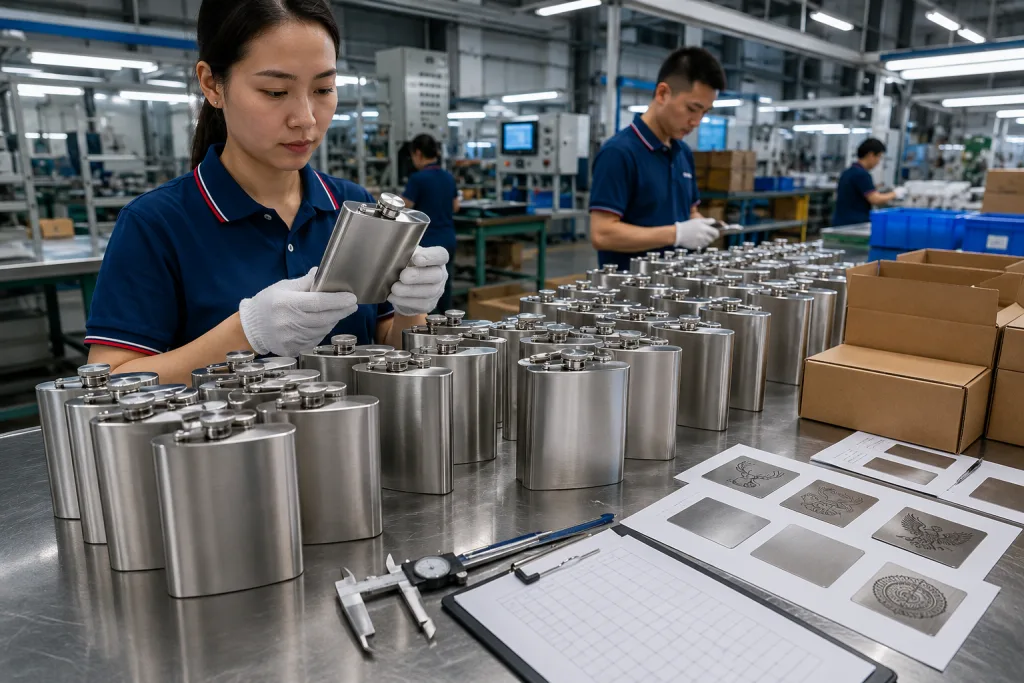
Key Takeaways
- A 6 to 8 oz in bulk hip flask should be specified at 0.5 mm to 0.6 mm stainless thickness to reduce dent claims by roughly 20% versus thinner shells.
- For custom logo orders, practical MOQ is usually 1,000 to 3,000 pcs per SKU, with 30 to 45 day lead time after sample approval.
- Leak testing should be 100% in-line, while AQL final inspection can run at Major 2.5 / Minor 4.0 before shipment from China.
- Ask for REACH, LFGB or FDA-contact declarations, plus coating and salt spray data if you also source canteen wholesale or growler wholesale products.
You rarely lose money on a hip flask at quote stage. You lose it 35 days later, when the cap leaks at 0.02 MPa air test, the weld line ghosts through the coating, or customs asks for LFGB files your supplier never lined up. The item is small. The production risk is not.
If you buy bulk drinkware, bulk canteen, or bulk growler lines from China, the same rule applies: most claims start with vague specs, not bad intent. In Zhejiang, we see buyers lock onto unit price and logo size, then the buyer flagged a 6 mm dent, metallic taste after first fill, or lead time slipping from 18 days to 26. You need to write the failure points into the PO before approval; this is the wrong question to ask if the discussion stays on price only, especially for a wholesale drinkware or alcohol flask wholesale program shipping into Europe or North America.
Where flask projects usually fail
Hip flasks fail in plain, expensive ways. We see the same issues on the line: leaks at the cap seat, polishing waves showing through matte coating, odor transfer after weak inner cleaning, hinge misalignment, and micro dents from thin shell stock or poor packing. QC pulled samples last month with a 0.3 mm shoulder dent that looked minor in the carton and ugly on shelf. If you buy an alcohol flask in bulk for retail, gifting, or beverage merchandise, these are the defects that drive returns.
New buyers often treat an in bulk hip flask like a simple stamped steel item. That is the wrong question to ask. The part is formed, welded, polished, assembled, coated, and packed, and each process adds its own tolerance stack. In our Zhejiang production network, a flask can look fine before coating, then fail fast after powder coating or PU paint makes every buffing ring and weld line show up under inspection lights.
- Leak risk: usually starts with uneven mouth threading, a loose gasket fit, or cap chain tension pulling the cap off-center. We check this with a vacuum leak tester, because hand feel misses too much.
- Appearance risk: most often comes from mixed buffing grit, over-polishing at the shoulder radius, or weld sink marks printing through the finish. The buyer flagged this on a black matte run after 600-grit prep was mixed with 800-grit parts.
- Compliance risk: shows up as missing material declarations, no migration testing plan, or decorative finishes that do not belong near food-contact areas. We have seen POs marked “304 stainless” with no backing paperwork.
- Transit risk: thin walls and loose inner trays create dent rates above 2% on ocean shipments. The math does not work if the tray gap is 5 mm and the master carton has no corner protection.
If you also source drinkware bulk categories like wholesale canteen, wholesale growler, or beer tumbler bulk lines, this will sound familiar. Small metal containers fail when factories quote first and engineer later. We have seen this go sideways. You need the reverse order.
Thin steel saves cents, costs claims
The quickest way to make a quote look sharp is to shave steel thickness. On a standard 6 oz flask, dropping from 0.5 mm body stock to 0.4 mm may save only a few cents, often around USD 0.04 to 0.07 per unit depending on material market. On the line, that “saving” shows up fast. QC pulled the sample after polishing and the sidewall was already softer, then dents increased again during coating and carton drop tests.
For a workable wholesale program, ask the supplier to print exact wall thickness on the PI and sample card, not just say “same as approved sample.” For 6 oz to 8 oz formats, 0.5 mm is a solid baseline. For premium gift-box retail packs, 0.6 mm gives better hand feel and fewer shape distortions after welding. We check this with a micrometer at the body curve. If the supplier cannot hold it lot to lot, you will see different body curvature between shipments, and the buyer will flag it.
What to lock in before sampling
- Material: SUS304 for body and cap contact area.
- Body thickness: 0.5 mm minimum; 0.6 mm for premium SKUs.
- Cap style: screw cap with food-grade silicone or PE seal.
- Surface: mirror, satin, spray, or powder coat with target gloss.
If your broader portfolio includes canteen bulk, growler bulk, or the best wholesale drink bottle programs, keep the material spec consistent across the PO set. This is the wrong question to ask: “Is it stainless?” Ask for the grade and thickness. We have seen one flask PO marked “stainless steel” only, then the same loose wording rolled into a bulk growler and canteen wholesale order later.
When a factory in China quotes low on an alcohol flask wholesale bulk order, ask which cents were removed: steel thickness, polishing time, gasket quality, or carton strength.
At BottleForge Industrial, typical MOQ for custom hip flasks is 1,000 pcs per model and color, while combined monthly output across drinkware lines in Zhejiang can exceed 300,000 units. Capacity matters less than discipline on the spec sheet. A factory can ship volume all month and still miss a 0.5 mm callout or pack soft 3-layer cartons — that is where claims start.
Leaks start at the cap system
A flask can pass on the showroom table and still leak after 21 days in a distribution center. We see this on the line. The problem is usually the cap system, not the body shell. Buyers often stare at the hinge and chain because they are easy to spot, but leaks usually come from thread tolerance, mouth lip flatness, and gasket compression. Last month QC pulled a sample with a clean weld and a bad cap seat; the mouth edge was off by 0.3 mm, and it failed after carton vibration.
For an in bulk hip flask order, require 100% water leak testing during production, not only random final inspection. A basic upside-down test for 30 minutes catches obvious failures. Better is filled, capped, inverted, then checked after vibration simulation or at least after 12 hours standing. No lab show. Just repeatable checks. We usually run the test right after cap assembly and again before packing, because one loose thread pass can turn into a return claim.
- Cap gasket: specify silicone or food-grade PE, and lock the hardness and diameter on the approved sample. We have had buyers flag a gasket that was 1 mm thinner than the sealed sample.
- Thread engagement: cap should fully seat without cross-thread resistance. If the cap grabs on the second turn, the math does not work for bulk packing.
- Mouth edge flatness: poor trimming causes uneven compression and intermittent leaks. A rough trim from the punching die will pass by eye and fail in storage.
- Chain assembly: if too short, it pulls the cap sideways during closing. We have seen a 2 mm chain shortage torque the cap off-center.
For Europe, ask for REACH declarations and, if the product is marketed with direct beverage contact claims, consider LFGB-related testing through SGS, TUV, or Intertek. For North America, FDA-contact declarations are commonly requested. The same discipline applies if you source beer growler wholesale, beer growler bulk, or beer tumbler wholesale bulk items. A leak in a flask creates returns. A leak in a growler is worse: wet cartons, stained labels, and distributor complaints. We ship enough drinkware to say this plainly—the wrong question is whether the body looks good; the right one is whether the cap still seals after transit.
If your supplier resists 100% leak checks because “AQL is enough,” take that as a warning sign. AQL works for cosmetic defects. Leakage is a functional defect. Treat it as critical. We have seen this go sideways when a factory hides behind AQL 2.5 while 6 pieces out of 500 fail after standing overnight.
Surface finish hides or exposes defects
Most buyers sign off a pre-production sample under office lighting, then the first finished lot lands and the complaint comes fast. Hip flasks show everything. The curved body throws back every buffing line from the cotton wheel, and a flaw that looks minor at 30 cm gets loud under store lighting. Satin can hide some variation. Matte black powder coat often exposes weld shadow and sanding lines instead, and we’ve seen QC pull a sample for a line that looked clean before coating.
Define the finish by process, not by color name. “Black” is not a spec. A workable finish callout should state coating type, target thickness, adhesion requirement, and salt spray expectation if the item is for outdoor use or a premium barware line. This is the wrong question to ask: “Can you match this black?” Ask for the microns, the test method, and the approved panel.
Better finish language on your PO
- Mirror polish: no visible wave marks at 40 cm under 1000 lux.
- Satin polish: uniform grain direction, no patch repair zones.
- Powder coat: 60 to 80 microns, cross-hatch adhesion minimum 4B.
- Logo laser area: no burn halo outside 0.3 mm tolerance.
This issue is not limited to flasks. Buyers building wholesale drinkware sets often want the hip flask to sit clean next to a wholesale canteen and a beer tumbler in bulk, with the same visual tone on shelf. That sounds simple. It is not. If one factory buffs to a finer belt and another runs a heavier powder pass, the set looks mixed even when the Pantone is close. Zhejiang factories ship fast, but speed without one finish standard gives you shelves the buyer flagged on arrival.
For custom branding, ask for a coated golden sample signed against a master, then use that sample for final inspection instead of a cellphone photo. We usually tape the approved sample in a PE bag with the PO copy because one typo on a logo position note can turn into 2,000 off-center pieces. Common final inspection can run at AQL Major 2.5, Minor 4.0, but for logo position and coating damage on gift-channel goods, buyers often tighten appearance acceptance further. The math doesn’t work if you save one day here and eat a full rework later.
Bad packing creates good-looking rejects
A lot of hip flask defects show up after production, not on the line. We see flasks polished clean, leak tested at 0.2 MPa, then dropped into a weak insert that collapses after a few hours of container vibration. The result is familiar: thin edge dents, cap scuffs, and logo rub. QC pulled the sample and the metal was fine; the packing caused the reject.
For alcohol flask bulk shipments, ask for a transit-tested packing layout, not just a neat photo. The setup we ship most often is one polybag per unit, one white box, then a master carton with dividers. For painted or powder-coated surfaces, add tissue or a foam sleeve, and keep master carton weight below 12 kg. Buyers push back on board cost all the time. Then the line loads 14 kg cartons, corners crush, and the math doesn't work.
- White box board: target 300 to 350 gsm for retail singles.
- Master carton: 5-ply export standard, stronger if shipping by parcel network.
- Drop expectation: pass basic corner and face drop after packed condition.
- Container loading: avoid loose top layers that shift in transit.
If you are combining SKUs such as drinkware wholesale assortments, canteen wholesale items, and growler wholesale products in one shipment from China, carton marking has to stay tight. Mixed cartons create warehouse mistakes fast, especially for Amazon FBA or 3PL routing where FNSKU and outer label accuracy drive chargebacks. We have seen one PO where item 6028 and 6208 were typed wrong on two outer labels, and the buyer flagged it before the truck even reached the forwarder.
A practical step is to approve both unit pack and master carton before mass production. Get the dimensions, gross weight, net weight, and loading quantity per 20GP and 40HQ in writing. On small flask projects, freight can move your landed cost more than a USD 0.03 factory saving. This is the wrong question to ask if the carton is failing a simple face drop.
Compliance gaps delay customs and retail
Procurement teams catch compliance gaps late because the flask gets treated like giftware, not a drink-contact item. We’ve seen this go sideways. If the hip flask is meant to hold spirits, treat material certs and migration paperwork as a gate at day one, not after the first sealed sample comes off the line with a 0.6 mm body.
For Europe, the document pack often needs REACH declarations, LFGB-related testing, and packaging compliance statements, depending on the market and sales channel. For North America, FDA-contact declarations and state chemical rules come up fast; California is the usual buyer pushback. Major retail accounts also ask for social compliance records such as BSCI or Sedex. ISO 9001 is not a shield. It does tell us the factory probably controls revisions better, which matters when QC pulled the sample and found the PO still showed last month’s artwork code.
The same document discipline carries across drinkware bulk categories. Buyers sourcing beer growler in bulk, beer tumbler wholesale, or wholesale growler lines need traceability by SKU, current test reports, signed artwork, and carton specs locked before printing. This is the wrong question to ask: “Can you send some certificates?” Ask whether the supplier can match the cert set to the exact flask, finish, gasket, and factory address. If they cannot do that for a simple hip flask with a 500 pcs MOQ, they usually struggle once vacuum items and multi-part lids hit the line.
- Ask for stainless grade declaration and gasket material confirmation.
- Confirm whether exterior coating is food-contact adjacent only, not interior-contact.
- Require lab report schedule before production, not after vessel departure.
- Keep test reports tied to the actual SKU, finish, and factory address.
Lead time for a custom program is commonly 30 to 45 days after deposit and sample approval. If testing gets added after mass production starts, the program often slips another 7 to 12 days; we’ve seen 33 days turn into 45 because the buyer flagged a missing coating report after packing started. That delay is avoidable.
How to spec the PO so factories behave
If you want a calm shipment, write the purchase order like a mini engineering sheet, not a sales email. Most production disputes start with one line the buyer skipped and the factory treated as optional. We see this on private-label in bulk hip flask orders every month. The product looks simple, so people stop writing down basics like a 0.5 mm wall, brushed finish direction, or which side gets the logo.
Your PO should lock five things: product spec, test plan, packing spec, inspection rule, and who gives final approval. Do not leave finish, leak standard, or logo method open. QC pulled one sample last month where the PO said only "matte black logo," and the line used screen print instead of laser mark. The same structure works across alcohol flask wholesale, canteen bulk, growler wholesale, and best wholesale drink bottle sourcing.
Minimum PO checklist
- SKU drawing with capacity, dimensions, body thickness, mouth design, and cap structure.
- Material callout: SUS304 body, seal material, coating type, and logo process.
- Quality plan: 100% leak test, appearance criteria, AQL Major 2.5 / Minor 4.0.
- Packing spec: unit pack, carton construction, drop expectation, shipping marks.
- Document pack: invoice, packing list, test reports, and origin details.
If you are also planning line extensions into wholesale canteen, bulk growler, or beer tumbler wholesale bulk items, align the specs now. Use the same inspection rules and the same document request list across categories. This saves days. We have seen buyers run three formats with three different carton mark layouts, then lose 12 days fixing paperwork before booking vessel space from Ningbo.
For buyers new to Zhejiang, start with one controlled SKU, not eight variants. Approve a golden sample. Order 1,000 to 2,000 pcs. Inspect before balance payment. Then expand after the supplier proves repeatability on the line. Some buyers push for 8 SKUs in the first PO because the unit price looks better, but this is the wrong question to ask. We have seen this go sideways over one typo on a PO and one unapproved cap change.
Get your hip flask spec reviewed before ordering
Send your target size, finish, logo, and quantity. We will flag likely failure points, MOQ, lead time, and packing risks before you place the PO.
Frequently asked questions
What is a realistic MOQ for a custom in bulk hip flask order?
For a standard 6 oz or 8 oz custom flask, a realistic MOQ is usually 1,000 pcs per model per finish. If you want a gift box, custom emboss, or unusual coating color, MOQ often moves to 2,000 to 3,000 pcs because packaging and setup cost spread matters. Plain-stock programs can sometimes start around 500 pcs with simple logo printing, but unit cost rises. In Zhejiang and other China sourcing hubs, very low MOQ quotes often mean the supplier is mixing materials, outsourcing assembly, or accepting weak process control. If you are building an alcohol flask wholesale range, it is usually smarter to start with 1,000 to 2,000 pcs on one SKU and verify repeatability before adding more variants.
How do I prevent leakage complaints on alcohol flask bulk orders?
Put leak prevention into the specification and inspection plan. Require SUS304 body contact surfaces, defined gasket material, cap thread fit approval on the golden sample, and 100% in-line leak testing. A practical factory test is full water fill, cap torque to standard hand-tight position, invert for 30 minutes, then sample after vibration or overnight standing. At final inspection, leakage should be treated as a critical defect, not part of normal AQL tolerance. Also check chain length and hinge alignment, because a short chain can pull the cap off-center during closure. If your supplier only offers random leak checks, the risk is too high for retail or distributor programs in Europe and North America.
What compliance documents should I ask for when importing from China?
For Europe, ask first for REACH-related declarations, packaging compliance statements, and if beverage-contact claims are important, LFGB-oriented test reports from a recognized lab such as SGS, Intertek, or TUV. For North America, FDA-contact declarations are common, and some channels may ask for additional chemical disclosures. If you sell into larger retail chains, also ask for BSCI or Sedex social audit status and ISO 9001 quality management information. The key point is to tie documents to the actual SKU, finish, and factory address. A generic test report from another product or another factory in China is not enough. Ask for the document list before deposit so you know what will exist before shipping.
What ex-factory price should I expect for a hip flask?
For a standard single-wall 6 oz stainless flask, ex-factory pricing in China often lands around USD 1.20 to 2.20 depending on thickness, finish, logo method, and packing. A plain polished flask with simple box packing sits toward the lower end. A 0.6 mm premium body with powder coat, laser logo, and gift box can move well above that. Custom packaging can add USD 0.20 to 0.80 or more. Be careful with quotes that are dramatically below the market. Savings usually come from 0.4 mm steel, lower polish labor, weak cartons, or poor seal quality. For distributor math, freight and defect rate often matter more than a USD 0.05 factory saving.
Can one supplier handle hip flasks plus canteens, growlers, and tumblers?
Sometimes yes, but you should verify process capability rather than assume it. A supplier that makes single-wall hip flasks well may not be equally strong on insulated drinkware, bulk canteen models, beer growler wholesale programs, or beer tumbler bulk items. Ask what percentage of output comes from each category, what the monthly capacity is, and whether welding, coating, and final assembly are done in-house. A supplier handling 300,000 units per month across wholesale drinkware lines in Zhejiang may still outsource some specialized SKUs. That is not automatically bad, but you need transparency. For new buyers, it is safer to approve one category first, then expand into growler bulk or canteen wholesale after quality and document control are proven.