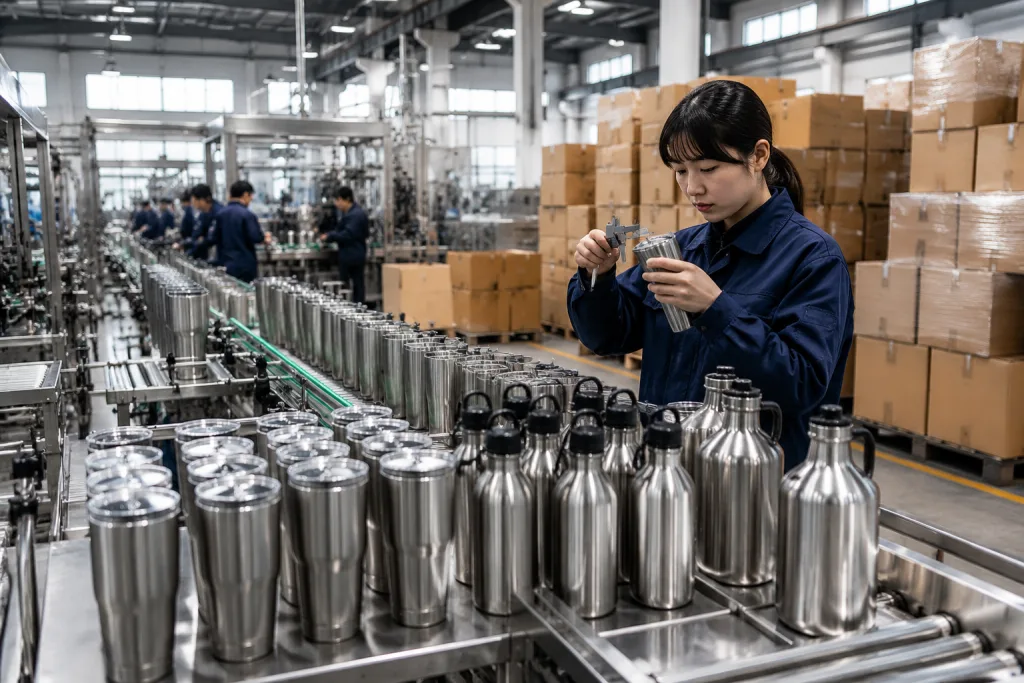
Key Takeaways
- A usable RFQ for in bulk drinkware should lock 12 core specs, including capacity tolerance, 18/8 or 18/10 steel grade, wall thickness, logo method, and packaging
- For custom wholesale drinkware, sampling usually takes 7-12 days and mass production 25-40 days after deposit and final artwork approval
- AQL 2.5 for major defects and 4.0 for minor defects is a practical starting point for most drinkware bulk inspection plans
- MOQ is usually 500-1,000 pcs per color for standard bottles, while complex bulk growler or alcohol flask wholesale bulk projects may start at 2,000 pcs
You can buy in bulk drinkware at a low unit price and still lose margin. We see this every month. The usual loss does not come from the quote sheet; it comes from vague RFQs, PO lines left blank, decoration mismatch, and carton assumptions that surface 25 days later after the line is already running. Last week a buyer typed “mat black” on the PO instead of “matte black,” and QC pulled the sample because the powder coat gloss was off by 8 GU. If you source from China or switch factories in Zhejiang, the gap between a smooth order and a claim usually starts with the first spreadsheet you send.
If you are a procurement manager or brand owner, you need a sourcing process that turns a product idea into factory specs the team can run. This is the right question to ask. At RFQ stage, ask for measurable points: 304 stainless, 0.5 mm inner wall, logo size in mm, drop test standard, master carton count, and MOQ by color. Before bulk drinkware goes live, approve the pre-production sample and write the PO line by line, including barcode position and spare lid rate. We have seen this go sideways when the buyer flagged “retail box included” but did not state E-flute or B-flute. Do that work early, and you ship with fewer delays, cleaner QC, and margin that holds up.
Start with an RFQ buyers can use
If you ask five factories to quote “best wholesale drink bottle, 750 ml, custom logo,” you usually get five prices built on five different specs. QC cannot compare that. Neither can purchasing. A workable RFQ for in bulk drinkware needs enough detail that a supplier in Zhejiang prices the same bottle the same way every time, down to wall thickness and carton count.
Your job here is simple: cut out guesswork. On our line, a quote shifts fast if the outer wall moves from 0.4 mm to 0.5 mm, or if the logo changes from 1-color silkscreen to powder coat plus laser engraving. We have seen buyers miss one lid detail on the PO, then ask why the sample cost changed. This is the wrong question to ask. First lock the spec, then ask the price.
- Product type: sports bottle, travel tumbler, bulk canteen, bulk growler, beer tumbler bulk, or alcohol flask bulk
- Capacity: 350 ml, 500 ml, 750 ml, 1,000 ml, with allowed fill tolerance
- Material: 18/8 stainless steel, 18/10 stainless steel, borosilicate glass, Tritan, PP lid, silicone seal
- Construction: single wall or double wall vacuum, copper coating yes/no, mouth diameter, base diameter, height
- Thickness: inner 0.4 mm, outer 0.45 mm, or your target spec
- Decoration: pantone color, powder coat, spray paint, silkscreen, heat transfer, laser engraving
- Accessories: straw lid, carry loop, tea infuser, bamboo lid, leakproof stopper
- Packaging: white box, color box, PDQ, master carton count, drop-test requirement
- Compliance: REACH, LFGB, FDA, California Proposition 65 where needed
- Trade term: FOB Ningbo, FOB Shanghai, or EXW China
For standard models from China, you can often get indicative pricing within 48 hours. For new molds or unusual shapes, expect 3-5 working days because the factory has to check tooling, lid fit, and decoration yield. We run that review with the mold drawing, the neck gauge, and the print area size in mm. At BottleForge Industrial in Zhejiang, standard bottle MOQ is often 500 pcs per SKU, while a new wholesale growler or canteen wholesale design with custom components may start closer to 2,000-3,000 pcs.
The main point is plain enough: do not ask for “best price.” Ask for price against a fixed spec. That is how you compare drinkware wholesale suppliers fairly, and it saves the back-and-forth after QC pulled the sample and the buyer flagged a mismatch.
Sort quotes by landed cost, not unit price
After quotes land, new buyers usually stare at unit price and miss the lines that add real cost later. That is how a "cheap" offer turns expensive. Read an in bulk drinkware quote as a landed-cost stack, not one headline number. A bottle quoted at USD 3.18 FOB can beat one at USD 2.92 if the lower quote uses thinner steel, shows a 3% leak issue in vacuum testing, or packs in 5-layer cartons that fail the drop test. We have seen cartons crush at 62 cm stack height because the board spec was cut.
Ask every supplier to quote in the same buckets, on the same sheet. Then the gaps show up fast, and you can negotiate the right line instead of arguing over 8 cents. QC pulled the sample on one project and found the supplier had quoted screen print but shipped laser marking in the sample cost. This is the wrong question to ask: "Who is cheapest?" Ask what is included.
Quote lines you should request
- Unit price by MOQ tier: 500 pcs, 1,000 pcs, 3,000 pcs, 5,000 pcs
- Tooling charge: new mold, logo plate, print screen, embossing mold
- Sample cost: existing sample, pre-production sample, logo sample, courier cost
- Packaging cost: standard white box vs full custom retail box
- Testing cost: third-party lab if required
- Shipping basis: FOB, CIF, DDP if offered separately
Typical export pricing from Zhejiang for common shapes can vary a lot by finish. A plain 500 ml single-wall bottle may sit around USD 1.20-1.80 FOB at 3,000 pcs. A 500 ml double-wall vacuum bottle with powder coating may be USD 2.80-4.20 FOB. A bulk growler with swing top, larger body, and thicker steel can move higher because material weight and welding time go up fast. On the line, an extra 0.1 mm in body thickness changes steel weight enough to move the quote, and buyers often miss that.
A cheap quote is often just an incomplete quote. If carton spec, logo method, and leak testing are not written down, you are not looking at a finished cost.
This is where you verify the commercial basics too: payment term, sample lead time, production lead time, and monthly capacity. Numbers matter. A factory saying it can ship 80,000-120,000 units per month only means something if your SKU mix matches what it already runs. We ship vacuum bottles faster than swing-top growlers because weld time, polish steps, and leak-check time are different. One buyer flagged a 25-day lead time as "too long," but the PO included three lid colors, two logo methods, and a custom insert tray. The math doesn't work if capacity is quoted on simple SKUs and your order is not simple. Vacuum bottles, wholesale canteen items, beer growler wholesale bulk orders, and alcohol flask in bulk projects do not move through production at the same speed.
Approve samples with production conditions
Sample approval is where bulk orders go wrong. Fast. The sample on your desk might not match production at all. We’ve seen a nice-looking piece hand-polished with 800-grit, logo aligned by one technician, then the bulk run came off the line with normal tolerance and the buyer flagged it. Separate concept samples from production samples, or you are approving the wrong thing.
The sequence should be plain. First, confirm an existing sample for shape, fit, and basic function. Second, ask for a pre-production sample with your exact color, logo, and packaging, made on the line if possible. Third, for retail programs, lock a sealed golden sample signed by both sides before mass production. Put the PO number on the carton and the sample bag. We once saw one digit typed wrong on a PO, and the factory matched the wrong logo file.
For custom wholesale drinkware, sample timing usually looks like this:
- Existing stock sample: 2-4 days
- Logo sample on existing mold: 7-10 days
- New color box sample: 5-7 days after artwork confirmed
- New mold prototype: 15-30 days depending on tooling complexity
What should you check? Not just appearance. For drinkware bulk projects, inspect actual net weight, finish consistency, weld marks, thread smoothness, vacuum retention, leakproof performance, odor, and barcode readability. Use numbers. If the approved sample is 286 g and bulk comes in at 271 g, ask why. QC pulled the sample on one order because the thread felt rough after only 1.5 turns, and that small issue became a leak complaint later. For canteen bulk and wholesale canteen orders, check cap torque and strap durability. For growler bulk or wholesale growler products, verify closure pressure, handle strength, and whether the body balance feels safe when filled. This is not a minor detail. We’ve seen this go sideways at 64 oz fill weight.
If you buy alcohol flask wholesale or alcohol flask wholesale bulk items, include a smell test after 24 hours with liquid inside. Do it every time. Flasks pass visual review and still fail on odor because of low-grade seals or weak post-process cleaning. The same issue shows up on beer tumbler wholesale items with lids and sliders. One sample looked clean, but after a 24-hour hold the silicone ring carried a sharp rubber smell that no retail buyer would accept.
Ask the factory to state whether the approved sample was made from production tooling and standard line process. If not, get that difference in writing. Put it on email, not just WeChat. In China, a factory that tells you the sample was bench-made, adjusted by hand, or packed outside normal flow is usually easier to work with than one promising perfect consistency with no process explanation. Frankly, “can you make it identical?” is the wrong question to ask. Ask what changes between sample room and mass production, then judge the risk.
Write the PO line by line
The purchase order is not just a payment paper. It is the sheet we run against on the line. If a detail matters and it is missing from the PO or attached spec sheet, it usually disappears in a dispute. We have seen this go sideways on drinkware wholesale orders from China after 6 email revisions, 3 sample updates, and one old attachment still sitting in the thread.
A clean PO for in bulk drinkware should read like a short contract. One line for product. One line for packaging. One line for decoration. One line for inspection standard. If you have 3 colors and 2 logo positions, write 6 separate combinations or attach a matrix table. Do not squeeze it into one sentence. The buyer flagged this exact shortcut on a 40HQ tumbler order after QC pulled the sample and found the back logo missing on the navy color only.
PO fields worth locking down
- SKU code and revision number
- Product name and exact capacity
- Material grade: for example SUS304 inner and outer, or SUS304 inner/SUS201 outer if you intentionally accept that structure
- Dimensions and weight tolerance: for example 320 g plus or minus 5%
- Color code: Pantone reference or approved sample reference
- Logo method and size: silkscreen 1 color, 35 x 40 mm, front center
- Packaging: 1 pc/polybag/white box, 24 pcs per master carton, carton size and gross weight limit
- Barcode requirements: UPC, EAN, FNSKU placement if Amazon FBA
- Testing and inspection: 100% leak test, vacuum test by sampling plan, AQL standard
- Trade term and port: FOB Ningbo or FOB Shanghai
- Lead time: for example 30 days after deposit and artwork approval
- Payment term: 30% deposit, 70% balance against inspection or B/L copy
For beer growler bulk, beer growler in bulk, or beer growler wholesale orders, add one more line for internal pressure or cap sealing target if the closure system is part of the sales pitch. Be specific. A swing-top and a screw cap do not behave the same in transit. For alcohol flask bulk projects, specify the food-contact seal material and ask for a no-rust statement after salt spray if the exterior finish is painted or plated. We had one PO where the cap liner was listed only as “safe material,” and that is the wrong question to ask.
If your brand sells to Europe or North America, add compliance attachments to the PO file set: REACH declaration, LFGB or FDA contact compliance depending on market, and packaging labeling rules. Do it at PO stage, not after production. We ship faster when this file set is complete, and the difference is often 12 days vs 18 days once lab booking and carton mark approval get pulled into the schedule. Last-minute “please send test report” emails are common, and the math does not work if cargo is already booked.
Control bulk production before cartons close
Once the PO is placed, the risk shifts to the line. We usually see five failure points: color drift between batches, logo position off by 2-3 mm, lid mismatch, wrong packing layout, and mixed cartons. The clean way to control this is to lock checkpoints before production starts and again before final inspection is booked. Skip that, and we’ve seen this go sideways on simple 10,000-piece runs.
A practical production control flow looks like this: raw material confirmation, pre-production meeting, first-off approval, in-line inspection, and final random inspection. On our side, QC pulls the sample at first-off and checks Pantone match, logo location, and thread fit before the line runs full speed. If the order value is meaningful, ask for time-stamped photos or 20-second line videos. That is not micromanagement. It is standard remote production control.
- Before production: confirm artwork, carton mark, barcode, and approved sample reference
- During production: check coating adhesion, print position, vacuum rate, lid fit, and assembly consistency
- Before packing finishes: verify carton count, assortment, inserts, manuals, and retail box version
For inspection criteria, many buyers use ANSI/ASQ Z1.4 with AQL 2.5 for major defects and 4.0 for minor defects. Critical defects should be zero. This is the right question to ask. In drinkware, a leak usually lands as major or critical depending on the use case. We also flag sharp edges, missing logos, wrong barcode, color contamination inside the bottle, and vacuum failure as common major defects. Last month, QC found an inner wall stain in 7 pieces out of a 500-piece pull, and the lot had to be re-sorted before packing.
If you are ordering canteen wholesale, wholesale growler, or beer tumbler wholesale bulk items with several accessories, watch carton assortment control closely. Mixed accessory errors show up often because lids, straws, and seals are packed separately before final assembly. A disciplined Zhejiang factory will usually run color-coded bins, station SOPs, and final count sheets at the packing table. Ask to see that system if your order is recurring. One buyer flagged a straw count issue on a PO last season because the seal bag spec was typed wrong by 1 piece.
Lead time for standard bulk drinkware is often 25-35 days after deposit. From August to November, 35-45 days is the safer estimate in China, especially for custom retail packaging or orders with two print processes on the same SKU. The math does not work if a supplier promises 18 days on a custom vacuum bottle and gift box set without stock components ready.
Plan shipping, claims, and repeat orders
The last step in sourcing in bulk drinkware is not the vessel departure. It is what happens after unloading: the goods hit your warehouse, intake checks start, and the next PO should not need a full reset. We usually tell buyers to close three files before shipment: handover records, a claims rule, and the exact shipment record from the line.
Before balance payment, request the final pack list, carton dimensions, gross and net weight, production photos, inspection report, and shipping marks. Ask for the outer carton size in mm and confirm pallet height if the goods go to Amazon FBA or a retail DC. We have seen one FNSKU typo and one missing suffocation warning hold up a full container, and the buyer flagged the relabel bill before unloading. Make FNSKU, suffocation warning, country-of-origin mark, and carton pallet standard part of the shipment checklist.
Claims should be defined before shipment. This is the right place to be strict. A practical approach is to agree that visible manufacturing defects above the accepted AQL level are compensated by credit note, remake, or discount in the next PO. QC pulled the sample, counted the defect types, and matched them against the report; that keeps the discussion on facts. If you wait until a problem happens, the math does not work and every call gets emotional. If the rule is written in advance, it stays commercial.
For repeat orders, keep one controlled document set:
- Approved spec sheet
- Signed sample photos
- Artwork files with revision date
- Carton and packaging standards
- Latest passed inspection report
- Confirmed production lead time and MOQ
This matters more on mixed programs with 12 SKUs or 30 SKUs, such as wholesale canteen, growler wholesale, beer tumbler in bulk, and alcohol flask wholesale bulk programs. A 2 mm logo shift, a cap color swap, or an old AI artwork file can slip through fast if no one controls revisions. We have seen this go sideways.
If a supplier in Zhejiang or elsewhere in China can keep your revisions controlled, repeat your colors accurately, and hold lead time within plus or minus 5 days, that supplier is usually worth more than one who saves you USD 0.08 per unit on the first order. We ship repeat orders smoother when the same carton spec, seal test result, and approved sample photos stay on file. Sourcing is not just buying a batch. It is a process you can run again under pressure.
Send your RFQ and get a manufacturable quote
Share your bottle, canteen, tumbler, growler, or flask specs. We will review MOQ, pricing, lead time, and packaging before you place the PO.
Frequently asked questions
What MOQ should I expect for in bulk drinkware orders?
For standard existing models, MOQ is commonly 500-1,000 pcs per SKU or per color. A plain stainless sports bottle may start at 500 pcs, while a powder-coated vacuum bottle with custom box is often 1,000 pcs. For bulk canteen, bulk growler, or alcohol flask wholesale projects with custom lids, embossing, or new tooling, MOQ can move to 2,000-3,000 pcs. If you need multiple colors, ask whether the MOQ applies per color or can be mixed within one master style. In Zhejiang and other China sourcing hubs, some factories allow trial orders below MOQ with a surcharge of around USD 0.10-0.35 per unit, but only on existing molds and standard finishes.
How long does custom sample and mass production usually take?
A stock sample normally takes 2-4 days. A logo sample on an existing bottle, tumbler, wholesale growler, or wholesale canteen mold usually takes 7-10 days after artwork approval. A custom packaging sample often adds another 5-7 days. For mass production, plan 25-35 days for standard drinkware bulk orders after deposit and final sample sign-off. If the order includes custom color boxes, several logo methods, or multiple accessories, 35-40 days is safer. Peak season in China, especially from late summer into Q4, can stretch production to 45 days. New molds may add 15-30 days before sampling starts.
What quality checks matter most for bottles, canteens, tumblers, and growlers?
Start with function, not cosmetics. For wholesale drinkware, ask for 100% leak testing, plus vacuum retention checks on insulated items. Verify net weight, dimensions, coating adhesion, logo position, odor, and thread fit. For canteen bulk and wholesale canteen programs, cap torque and strap strength matter. For growler bulk, beer growler in bulk, and beer growler wholesale bulk orders, closure seal and handle strength are high-risk points because the filled weight is higher. For alcohol flask bulk, inspect smell after 24 hours with liquid inside and check for metal taste or seal odor. Most buyers use ANSI/ASQ Z1.4 with AQL 2.5 major and 4.0 minor as a starting inspection standard.
Which compliance documents should I ask for when sourcing from China?
That depends on your market and material, but for Europe and North America you should commonly ask for food-contact compliance declarations and supporting test reports. These may include REACH, LFGB, FDA, and California Proposition 65 where relevant. If children’s products are involved, ASTM or CPSIA-related requirements may also apply. Ask the supplier whether the report is for the same material set you are buying, not just a similar model. For example, changing a lid seal, coating, or straw can affect compliance scope. Also request factory documents such as BSCI audit status if social compliance matters to your customer base, and ISO-style quality process records if you need stronger vendor qualification.
How do I reduce claims and rework on my first bulk order?
The fastest way is to control documents before production starts. Use a detailed RFQ, approve a true pre-production sample, and write the PO with exact materials, pantone colors, logo size, packaging method, carton count, barcode rules, and inspection standard. Ask for one approved master sample and one final packaging photo set before the factory closes cartons. On first orders over about USD 8,000-10,000, a pre-shipment inspection is usually money well spent. Also agree in writing how claims are handled if defects exceed the AQL limit. Most first-order problems are not factory fraud. They come from missing specifications, unclear revisions, or assumptions made by both sides.