Key Takeaways
- Most claims on an in bulk coffee mug order come from 4 areas: lid leakage, coating adhesion, denting, and logo defects; each can be reduced with pre-production tests and AQL 2.5 inspections
- For 18/8 stainless travel tumblers, a practical starting spec is 0.4-0.5 mm inner wall, 0.45-0.6 mm outer wall, with vacuum retention tested for 6-12 hours depending on capacity
- Typical MOQ for custom tumblers from Zhejiang, China is 1,000-3,000 pcs per color, with 25-35 day lead time after sample approval and deposit
- Factory-direct pricing often lands around USD 2.80-5.90 FOB China for common 20 oz-30 oz models before freight, depending on lid style, finish, print method, and packaging
You can buy an in bulk coffee mug in two ways: chase the lowest unit price, or lock the 4 or 5 specs that trigger most post-shipment claims. For coffee brands and corporate-gift buyers, the second option costs less. We’ve seen this go sideways. A tumbler that leaks at the lid thread, peels after a 3M tape test, dents at 0.4 mm wall thickness, or fails flavor testing stops being “cheap” once returns, reprints, and delayed launches hit the PO.
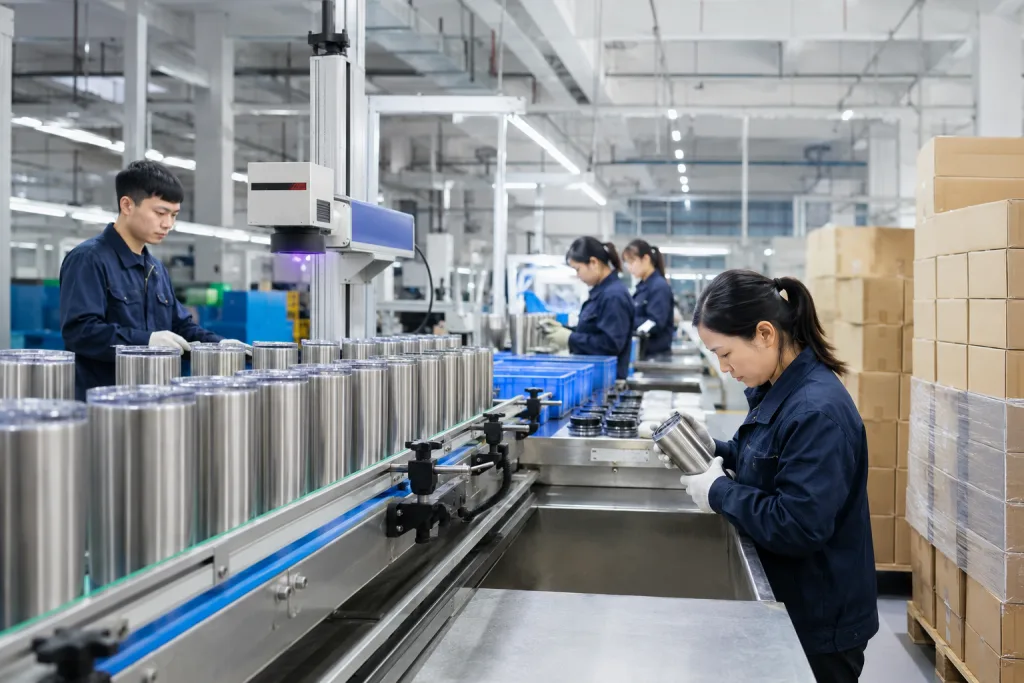
At China factory level, most travel tumbler failures are visible before mass production starts. On the line in Zhejiang, QC pulled the sample and found the same issues again: vague lid standards, spray finishes approved before adhesion testing, and gift-box packaging signed off with no drop test from 76 cm. If you are buying a bulk coffee travel mug or bulk travel tumbler from China, this is the wrong question to ask: not “do I need to know everything?” You do not. Your job is to freeze the right tolerances early, before tooling, before color matching, before the buyer flags leakage after shipment.
Where bulk tumbler orders actually fail
First-time buyers usually focus on color, logo position, and carton size. Fair enough. Those are not the points that usually kill a project. Bulk tumbler orders fail later on the line: a lid leaks in a car cup holder test, powder coat gets scratched after a 1.2 m carton drop, logos drift 2-3 mm between batches, or the cup looks premium in a photo and lands with thin walls that dent after one hit on the packing table.
If you are buying from a coffee mug manufacturer or coffee mug supplier in China, the RFQ should work like a control sheet, not a price-comparison form. This is the wrong question to ask: “What is your best price?” A usable RFQ for a bulk coffee tumbler needs measurable specs that production, purchasing, and QC can all follow with a caliper and checklist:
- Body material: 18/8 stainless steel, or SS304 inner and outer if that is your minimum.
- Wall thickness: inner 0.4 mm minimum, outer 0.45 mm minimum for mainstream travel tumbler bodies.
- Lid material: AS, Tritan, PP, or SAN, with gasket material specified.
- Insulation target: for example, hot above 55°C after 6 hours from 95°C fill in a 20°C room.
- Decoration: powder coat, spray paint, silk screen, heat transfer, laser engraving, or UV print.
- Packaging: white box, color box, PDQ, mailer-safe pack, or Amazon FBA labeling.
Too many coffee mug distributors and corporate-gift buyers approve a hand sample and assume bulk will match it. We've seen this go sideways. A hand sample can hide mass-production risk: unstable lid fit, inconsistent weld polish, weak coating adhesion. You need the supplier to confirm process capability in plain terms—monthly capacity, lid sourcing stability, welding method, inspection standard. If a Zhejiang factory claims 300,000 units/month, ask what they run for incoming inspection, how QC pulled the sample for vacuum testing, and what carton drop test they follow. We ship against AQL sheets for this reason. If they cannot explain the failure points, they do not control them.
You are not buying a photo sample. You are buying repeatability over 1,000 to 20,000 pieces.
Leakage starts with vague lid specs
The number one complaint on a bulk coffee travel mug is still the same: it leaks. Sometimes not on day one. Sometimes QC pulled the sample, tilted it to 45 degrees, and saw a slow seep at the slider corner after 30 seconds. Sometimes the leak starts after the lid has been opened 20 times and the gasket has already taken a set. “Spill resistant” is the wrong spec to approve. The buyer reads one thing, the end user expects another, and the factory line hears something else.
Write the lid requirement as a test method, not a slogan. For example: no visible leakage after inversion for 60 seconds; no continuous dripping after horizontal placement for 10 minutes; slider lid must survive 500 open-close cycles without fracture. We usually add water fill volume too, like 90% capacity, because headspace changes the result fast. Then your coffee mug OEM manufacturer has a target the line can build to and QC can check with a timer, a fixture, and a simple pass/fail sheet.
Common lid failure points
- Loose silicone gasket: gasket hardness is off, or the groove tolerance drifts by 0.2 mm and the seal stops sitting flat.
- Thin slider track: the track warps after molding or snaps during use; we have seen this on PP lids with thin ribs under 1.2 mm.
- Poor thread fit: lid engagement feels fine on samples, then goes rough in production after cavity wear starts showing on mold No. 3.
- Steam vent placement: the buyer flagged splashback on one program because the vent sat too close to the drink opening when filled to the max line.
For a coffee mug custom made project, ask for both component drawings and assembled leak-test criteria. Ask who makes the lid. That matters. A serious coffee mug factory direct supplier should tell you whether the lids are fully in-house or sourced from a partner plant in China, and they should track them by mold number or batch code. Sourced lids are normal. No issue there. What causes claims is weak traceability, especially when 4% of lids from one lot leak and the stainless body is fine.
For inspection, we usually recommend:
- 100% basic fit check for lid-to-body threading
- Vacuum spot check per batch
- Leak test on finished goods at AQL 2.5 or tighter for premium retail programs
- Cycle testing on pre-production samples and first mass-production lot
If the use case is commuter coffee, be straight with your end customer. A bulk travel mug can be leak-resistant and still fail inside a backpack. We ship both types, and the lid structure is not the same. If you need true leakproof performance for bags, specify a screw-seal or lock lid, not a standard slide lid designed for desk use. We have seen this go sideways when a buyer approved a slide lid on a 5,000-piece PO, then tried to hold it to a bag-drop standard later.
Thin steel becomes dent claims fast
Buyers sourcing coffee mug in bulk often compare capacity and decoration first. That misses the structural problem: wall thickness. A 20 oz tumbler with a 0.3 mm inner wall can look fine in photos, but on the line it picks up dents during forming, packing, ocean freight, and daily use. QC pulled samples like this before—the first clue was an oval rim by 1.2 mm or a base wobble on the flat plate, not a crushed body.
For most mid-range bulk travel tumbler programs, 18/8 stainless with inner wall 0.4-0.5 mm and outer wall 0.45-0.6 mm is the safer commercial zone. If you are buying a coffee mug promotional item for one-off events, lighter steel can work. If you are selling through retail or subscription coffee channels, the math usually does not work. We have seen buyers save a few cents, then ship replacements 12 days later because the buyer flagged dented rims on arrival.
Ask your coffee mug supplier list or coffee mug supplier directory candidates direct questions:
- What is the actual body thickness tolerance, plus or minus 0.03 mm or plus or minus 0.05 mm?
- How is roundness checked after forming?
- Are rims rolled or straight-cut before finishing?
- What percentage receives vacuum testing after sealing?
Shipping damage is part product design and part packaging. A coffee mug manufacturer may blame freight, but if the individual box has no rim protection and the master carton has 35 mm of empty space on one side, the packaging spec is the real problem. This is the wrong question to skip. For export from Zhejiang, China, ask for a standard drop test such as 1 corner, 3 edges, 6 faces from 76 cm for normal master cartons. If you plan e-commerce distribution, the unit pack must be stronger, often with molded pulp or EPE inserts, and we usually add a mailer test after the first carton sample.
Factory-direct pricing is sensitive to steel weight. Increasing body thickness can add USD 0.12-0.35 per piece depending on size and shape. That sounds painful at quotation stage. It is still cheaper than replacing a launch order because a soft-wall coffee mug customized for gifting arrived dented. We have seen this go sideways over a PO typo too: buyer approved 0.4 mm, factory ran 0.35 mm, and the claim came back after unloading.
Decoration looks good until adhesion fails
A coffee mug custom project is usually won on decoration, then lost on adhesion. Powder coat, matte spray, metallic paint, wrap print, silk screen, laser mark, and UV print can all look sharp on the sample table under 5000K lights. Then the sample hits carton friction, hand oil, lid drag, or a buyer’s “dishwasher test,” and the complaints start. We’ve seen factories promise showroom finish and ship parts with scratch marks at the rim after one transit drop test.
Powder coating is still the safest commercial option for a bulk coffee tumbler, but the pretreatment and cure window decide the result. If the line skips cleaning, or the oven dwell is cut by 6 minutes to push output, edge chipping shows up fast on the bottom radius. The math doesn’t work if a factory saves one hour and you lose a full reprint batch. Silk screen fails the same way when the ink system does not match the coating surface; QC pulled the sample on one order because the logo rubbed off after 20 wet strokes.
For a coffee mug private label or coffee mug private labeling program, set decoration tests before approving artwork:
- Cross-hatch adhesion: commonly ASTM-style tape adhesion check on coated surface
- Rubbing test: dry and wet rub count agreed in advance
- Color tolerance: define Pantone target and acceptable visual deviation
- Logo position tolerance: usually plus or minus 1.5 mm to 2.0 mm for common round bodies
Laser engraving is the most stable option for logo durability. It removes one failure point. It also changes the look, and on coated bodies it may expose raw stainless under the finish, which some buyers like and others reject at first sample review. UV print gives bright graphics for coffee mug promotional products, but abrasion is where it goes sideways unless you add a protective layer. Heat transfer works for full-wrap art, though on tapered bodies we always check seam alignment with a positioning jig because 2 mm drift is easy to spot by eye.
If you are buying for a campaign and need a coffee mug customizable across multiple logos, cut the decoration variables early. This is the right question to ask. One body color with 5 laser logos is easier to hold than 5 body colors with 5 silk-screen logos when the lead time is 25-35 production days and the line is also trying to close carton packing before vessel cutoff. We ship cleaner this way, and buyers push back less on shade variation lot to lot.
Food-contact compliance is not a checkbox
A surprising number of buyers still ask one question: “Can you pass REACH?” That is the wrong question to ask. For drinkware sold into Europe and North America, compliance has to match the sales market, the actual material set, and who will use it. A travel tumbler for a coffee chain is usually not a kids item, so it does not follow the same path as a children’s bottle. The paperwork still has to be tight. We’ve seen this go sideways over a 2 mm silicone straw tip that was added late and never entered the file.
For stainless steel coffee mug bulk orders, ask for a document pack that matches the bill of materials line by line: stainless grade declaration, plastic lid material declaration, silicone gasket declaration, plus migration or food-contact test reports from a recognized lab. If the BOM shows 304 stainless outside and PP on the slider, the report set should show the same parts, not a similar cup from last season. Depending on destination, that can include REACH SVHC screening, LFGB-oriented testing for the EU market, and California Proposition 65 consideration for the US market. If you sell the item in North America as a corporate gift, add CPSIA-adjacent packaging caution if children could reasonably access it, even if the mug was not designed for them. QC pulled a sample last month where the PO said “AS lid,” but the approved file was for PP.
A capable coffee mug distributor or coffee mug distributors network asks suppliers for current reports, not a five-year-old PDF tied to a different lid structure. Match report dates, material names, and model numbers to the live SKU you will ship. This sounds basic. It gets missed all the time. In China, factories do change lid vendors without updating the compliance file, especially on lower-MOQ runs of 3,000 pieces. That is where trouble starts, and the buyer usually flags it only after the artwork is approved.
Also ask about management systems and audit basics:
- BSCI: useful for social compliance screening if your brand requires it
- ISO 9001: indicates a formalized quality system, though not a guarantee
- AQL standard: define inspection level before production, often AQL 2.5/4.0
Good compliance control is boring and document-heavy. That is why it works. On our line, the clean version is simple: every resin, metal, ink, and gasket maps back to a current declaration or test report, and the SKU on the carton matches the SKU in the file. If your coffee mug supplier cannot do that, you do not have a controlled private-label product yet. The math doesn’t work if the paperwork trails the production by 6 months.
Sampling mistakes that distort final cost
Buyers lose 2-3 weeks on samples that answer the wrong question. This is the wrong question to ask. A pre-production sample is not for photos or a manager signature alone. It needs to show whether the spec will run on the line without trouble. We check this with actual production points, like body weight tolerance in grams, lid thread match, and whether the gasket seats flat after assembly. If you approve looks only, both factory and brand are still guessing.
For a coffee mug custom made order, split the sample process into stages:
- Reference sample: confirms shape, capacity, and lid style
- Logo sample: confirms artwork process and placement
- Pre-production sample: confirms final mass-production materials, packaging, and tests
Each stage should clear one risk. If you jump straight to a painted logo sample, you might miss body weight, gasket fit, or even a 0.5 mm lid gap that shows up after torque testing. We have seen buyers approve a nice-looking sample, then QC pulled the sample standard later and found the production body was lighter than the approved piece. That is how a coffee mug factory direct quote that looked competitive turns expensive after rework.
Be careful with low setup promises. A supplier offering coffee mug custom work at 300 pcs is often giving up control somewhere: stock lids from a different batch, hand-set logo position, or coating from 2 small mixed drums. We run these programs in Zhejiang every week, and repeat orders are smoother at 1,000 pcs per color per model. At 3,000 pcs, the math starts to work on tooling setup, spray loss, and carton print runs. Sample charges of USD 50-150 are normal for simple logo work; custom mold development is another discussion entirely. One buyer pushed back on MOQ last month, then sent a PO with the lid code typed wrong, and the whole sample cycle lost 4 days.
Lead time should also be broken down. Typical export timing in China looks like this:
- 7-10 days for decorated samples
- 2-5 days for artwork and carton confirmation
- 25-35 days for mass production after deposit and final approval
- 3-7 days for final inspection and booking handoff
If a supplier packs all of that into 15 days for a coffee mug private label order with custom packaging, assume something got cut. Usually it is coating cure time, inspection depth, or carton prep. We have seen this go sideways. The line finishes fast, then cartons are still waiting for barcode stickers, or the coating has not sat long enough before the drop test.
How to write a PO that survives production
The safest buyers are not the ones sending hard emails. They are the ones whose POs leave almost no room for guesswork. Whether you buy from a coffee mug supplier, a coffee mug distributor, or a coffee mug OEM manufacturer in Zhejiang, your PO should read like a short production spec. We’ve seen this go sideways from one missing line on a PO: the buyer wrote “matte black,” the line ran fine sand powder coat, and the sample they wanted was smooth spray paint.
At minimum, include:
- SKU photo and internal item code
- Capacity and tolerance, for example 20 oz plus or minus 3%
- Material callout for body, lid, and gasket
- Body thickness minimums
- Finish and logo method with Pantone reference
- Logo location drawing with tolerance
- Leak-test standard
- Packaging method and carton marks
- Inspection standard, such as AQL 2.5 major / 4.0 minor
- Trade term, usually FOB Ningbo or FOB Shanghai
If you are buying coffee mug promotional products for an event, write the date the goods must be handed to your forwarder, not only the factory finish date. Those are not the same date. We usually see a 2 to 4 day gap for final packing, booking, and loading. For Amazon or 3PL channels, put FNSKU, carton size limit, and labeling rules on the PO itself. QC pulled a sample once where the carton was 8 mm over the warehouse limit because the rule sat in an old email thread.
Payment terms should match risk. For a new supplier in China, 30% deposit and 70% balance after inspection but before shipment is still common. If you want tighter control, book a third-party final inspection and define pass/fail points before mass production starts. This is the wrong question to ask: “Can you inspect at the end?” The better question is which defects fail the lot—leakage, logo offset over 2 mm, or color mismatch against the signed Pantone chip.
The practical gain shows up on the reorder. A solid coffee mug customizable program should get simpler with each PO, not messier. We run repeat orders off one approved sheet, one item code, and one carton mark file, sometimes at 1,000 pcs MOQ with no call to clarify basics. If every reorder still depends on chat screenshots, memory, or a PO typo like “304 steal,” your sourcing system is too fragile to scale.
Send your tumbler spec and get a practical quote
Share capacity, lid type, logo method, target price, and packaging need. We will review the failure risks, MOQ, lead time, and FOB China options.
Frequently asked questions
What is a realistic MOQ for an in bulk coffee mug with custom logo?
For a standard 20 oz or 30 oz travel tumbler, a realistic MOQ is usually 1,000 pcs per color per model from a China factory, with some programs starting at 500 pcs if you use stock lids and simple 1-color printing. If you want a coffee mug customized with powder coat, gift box, and multiple logo positions, 2,000-3,000 pcs is more common for stable pricing and cleaner production scheduling. Zhejiang factories with monthly output around 200,000-300,000 units often prefer these volumes because they can run coating and decoration more consistently. If a supplier offers 200 pcs for a fully custom bulk travel mug, ask what is actually custom and what is coming from stock components.
How much should I budget for a bulk coffee travel mug order?
For factory-direct FOB China pricing, many mainstream stainless travel tumbler orders land around USD 2.80-5.90 per piece for 20 oz to 30 oz sizes. A basic single-wall item can be lower, while a double-wall vacuum coffee mug private label program with powder coat, slider lid, and color box moves upward quickly. Laser engraving may add USD 0.08-0.20, silk screen roughly USD 0.05-0.15 per color, and stronger e-commerce packaging can add USD 0.30-0.80. Heavier steel also affects cost. Budget sample fees separately, usually USD 50-150 for decorated samples. Ocean freight, duties, and local warehousing are outside FOB and often change the landed cost more than buyers expect.
What tests should I require before approving mass production?
At minimum, require leak testing, vacuum insulation verification, logo adhesion testing, and packaging drop checks. For a bulk coffee tumbler, I would ask for a 60-second inversion leak test, hot-retention verification from a 95°C fill, and coating adhesion by cross-hatch tape method or your agreed equivalent. If the lid has a slider or lock feature, ask for 300-500 cycle testing on the pre-production sample. On packaging, use at least a standard export carton drop test, and if you sell online, validate the unit pack for parcel handling. Final inspection should be set at an agreed AQL, commonly 2.5 for major defects and 4.0 for minor defects, before you release the balance payment.
How do I check if a coffee mug manufacturer in China is really reliable?
Start with process questions, not marketing claims. Ask for monthly capacity, usual MOQ, current lead time, and whether lids are made in-house or sourced. A reliable coffee mug factory should answer clearly, for example 250,000 units per month, MOQ 1,000 pcs, and 30 days production after sample approval. Then verify documents: business license, ISO 9001 if they have it, BSCI or audit reports if your brand needs them, and recent food-contact reports tied to the actual lid and gasket materials. Finally, inspect how they control quality. Ask about incoming checks, vacuum-test rate, in-line logo inspection, and AQL final inspection. In Zhejiang and wider China, good factories sound operational, not theatrical.
What is the biggest mistake corporate-gift buyers make with coffee mug promotional products?
They approve the visual sample and ignore the use case. A tumbler for office gifting has different needs than a retail travel mug for daily commuters. Corporate-gift buyers often choose a standard slider lid because it looks sleek, then assume it is bag-safe. It usually is not. They also under-spec packaging, which leads to dented units and scratched coating before the event even starts. If you need 2,000 pieces for a campaign, write the product brief around actual usage: desk use or commuting, hand wash or rough handling, basic carton or premium gift box. That one step prevents most mismatch between the sample you approved and the complaints you receive after distribution.