Key Takeaways
- A 500 ml double-wall stainless in bulk canteen usually lands at USD 2.85-4.60 FOB China at 1,000-3,000 units depending on steel grade, lid, and finish.
- Wall thickness matters: 0.4 mm outer with 0.3 mm inner can cut cost, but 0.5/0.4 mm usually improves dent resistance and perceived quality.
- Typical MOQ is 500 pcs per color for stock molds, while custom body or lid tooling often starts around 3,000-5,000 pcs.
- Standard lead time from Zhejiang is 25-35 days after sample approval, with 7-10 extra days if you add custom gift box or complex printing.
You can buy an in bulk canteen from 200 suppliers in one afternoon. That part is easy. The hard part is buying one that survives retail returns, keeps landed cost in line, and does not trigger a compliance mess 6 weeks before shipment. On paper, two bottles can look the same: 500 ml capacity, the same powder coat, the same laser logo. On the line, they fail for different reasons. One uses thinner 304 stainless, one loses vacuum after 12 hours instead of 24, one fails a cross-cut adhesion test, and one dents after a 76 cm carton drop. That is where margin disappears. We have seen buyers focus on logo position and miss a 0.2 mm wall-thickness gap; this is the wrong question to ask.
If you source bulk canteen, bulk growler, or wider drinkware wholesale programs from China, read the spec sheet like a production file, not a sales flyer. In Zhejiang, serious factories make decisions from wall thickness, thread tolerance, AQL level, and lead time, then price from that. A cap thread that feels smooth on a hand sample can still leak in mass production if torque drifts past 1.8 N·m and QC pulled the sample from the top of the carton. If you are buying wholesale canteen for Europe or North America, each line on the spec sheet changes cost, risk, and reorder speed. We ship plenty of repeat orders, and the pattern is clear: a clean spec gets you 18 days sampling instead of 28, fewer claims, and less back-and-forth after the buyer flagged the first pre-production sample.
Start with body material
The first line buyers skim is the metal spec. Don’t skim it. For an in bulk canteen, the gap between SUS304 and SUS201 is not cosmetic; it shows up later in salt-spray results, rust complaints, and claim risk. For food-contact inner walls, you normally want 18/8 stainless, which most China factories mark as 304 on the coil tag. It handles acidic drinks better and is easier to support for REACH and LFGB-related testing programs. If a factory sends a low canteen wholesale quote, ask straight: is the inner wall 304, and is the outer wall 201 or 304? We’ve seen POs typed as “SS inside” with no grade listed, and that is where trouble starts.
A common commercial build for wholesale drinkware is inner 304 / outer 201. That works for value lines sold into promotion, gym, or event merchandise. For better retail programs, especially in Europe, buyers usually shift to 304 inside and outside. On a 500 ml bottle, the added cost is often only USD 0.18-0.35 per unit. The math usually favors the upgrade. The line sees fewer rust claims, and your sales team gets a cleaner product claim. Last season one buyer flagged orange spots near the base seam after a warehouse moisture issue; that project was outer 201.
The same rule applies if you are sourcing a bulk growler or alcohol flask bulk order. Growler wholesale projects holding beer or cold brew for 24 to 72 hours do better with full 304 construction and a tighter lid seal; on our bench, QC pulled the sample and checked thread fit with a go/no-go gauge before leak testing. If you are building a premium best wholesale drink bottle range, ask for the exact composition on the quotation and PI, not just “stainless steel.” This is the wrong question to ask: “Is it food grade?” Ask for the grade by part.
- Entry spec: inner 304, outer 201
- Mainstream spec: inner 304, outer 304
- Typical buyer check: request material declaration plus third-party food-contact test on final decorated sample
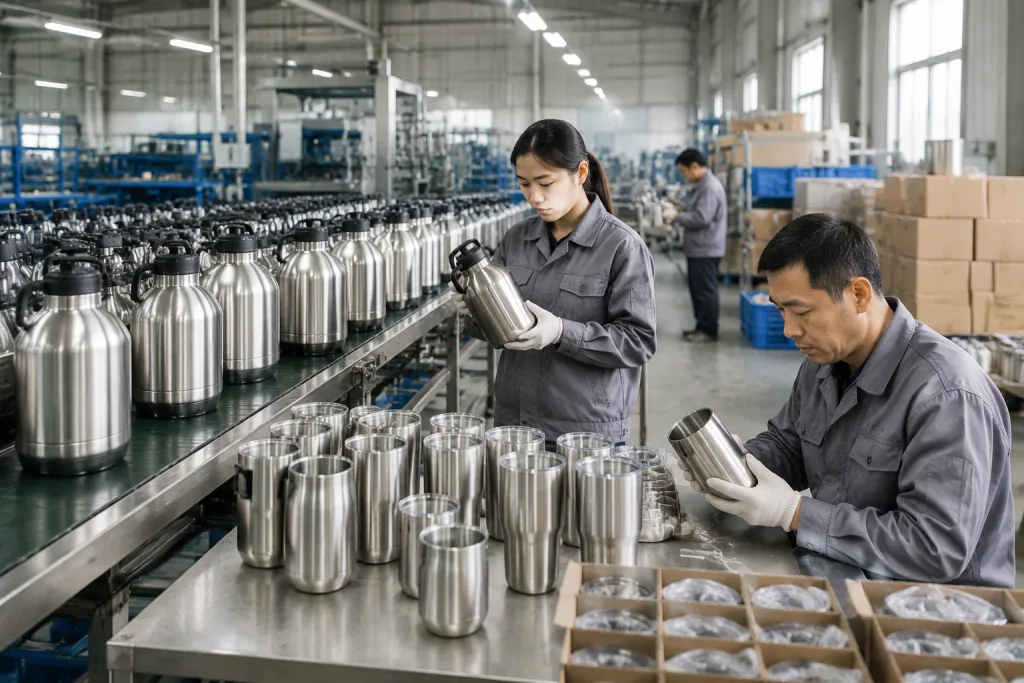
BottleForge Industrial in Zhejiang runs stainless drinkware bulk programs up to 600,000 units per month, and the first pricing question is always the same: what steel is actually in the body? We ship plenty of mixed-spec projects, but the body callout should be clear before sampling, not after mass production starts.
Wall thickness changes the whole quote
Compare bulk canteen quotes by body thickness in mm. Ask for it on page 1 of the quote. This single spec changes dent resistance, unit weight, freight, and the hand feel. We’ve seen suppliers cut cost with thinner stock while keeping the same product photo and same 500 ml drawing.
For a vacuum bottle, the common build is 0.3 mm inner / 0.4 mm outer on cost-driven orders and 0.4 mm inner / 0.5 mm outer on stronger retail programs. On a 500-750 ml format, the heavier build can add roughly USD 0.12-0.28 per unit. It also holds shape better after vacuuming and survives carton pressure better in transit. On our line, QC pulled the sample after neck rolling because thin outer walls usually show the problem first.
This gets more serious if you also buy related SKUs like beer tumbler bulk, beer growler bulk, or alcohol flask wholesale bulk. A thin wall might pass on a promo flask. It is not enough for a retail tumbler or growler bulk line, where the mouth, base, and thread area take more abuse. This is the wrong question to skip. If the factory does not list thickness, ask for finished unit weight and tolerance in writing. Weight is the fastest check for under-spec production, and the buyer flagged this more than once after receiving first bulk samples 18 g light.
Useful control points
- 500 ml single-wall canteen: about 180-260 g depending on shape and thickness
- 500 ml vacuum canteen: about 260-380 g
- Weight tolerance: keep within plus/minus 3% on approved sample
- Base design: wider base lowers tip risk but raises carton cube slightly
Buyers often stare at FOB price. End users notice weight, balance, and dent resistance first.
If your target is drinkware wholesale for chain retail, ask the supplier for cross-section photos or cut samples. A small band saw cut or polished section tells you more than a polished sales sheet. Factories in Zhejiang doing real OEM work should show this without excuses. If they push back, we’ve seen this go sideways.
Vacuum, temperature, and leak specs
Insulation claims get inflated fast. The real question is how the factory tests them on the line. For an in bulk canteen, the vacuum spec should show fill temperature, ambient temperature, hold time, and the test method used. If that sheet only says “12 hours hot,” it tells you almost nothing. We have seen buyers approve that line, then argue after receipt because the lab logged 26°C ambient instead of 20°C.
A workable benchmark for a 500 ml double-wall bottle is 95°C water filled, tested at 20°C ambient. After 6 hours, mainstream bottles should still hold above 55-60°C. After 12 hours, better builds may remain above 45°C. For cold retention, tests often start with ice water below 4°C, with results of below 10°C after 12 hours for standard retail spec. Ask for the actual internal QC standard, not the sales line. In our factory, QC pulled the sample from the vacuum tester rack and logged all three points by lot number.
Leak testing matters more. For wholesale canteen, bulk drinkware, or growler wholesale programs, write in 100% leak test before packing. A simple inverted air-pressure test or vacuum leak check catches more trouble than sample-only inspection. The lid structure drives the result: a screw cap with silicone ring is standard, while carry-loop lids and multi-part lids add failure points. Last season one buyer flagged seepage on 3 out of 500 pcs, and all 3 traced back to a mis-seated ring after manual assembly.
If you sell beer growler wholesale or beer growler in bulk, carbonation retention is a separate spec. This is the wrong question to blur with insulation. Standard drink bottles are not the same as pressure-rated vessels. Most stainless growler bulk products are built to reduce temperature loss and limit spills, not to hold high pressure like keg hardware. You should state “for still beverages” unless your supplier can support a specific pressure requirement. If they cannot show a pressure test record in bar or kPa, do not assume anything.
- Recommended spec: 100% leak test, visual vacuum dot check, and random retention test per lot
- Buyer QC: AQL 2.5 major / 4.0 minor is common for final inspection
- Transit concern: lid loosening after vibration, especially with straw lids or heavy accessory lids
For buyers importing from China to North America, clear written thermal and leak standards cut claim disputes after receipt. We ship against the written spec, not against memory, and that saves a lot of back-and-forth when a PO typo or carton mix-up shows up at destination.
Surface finish is not just color
Most return claims we see are finish failures, not bottle-body defects. The shell is fine; the coating is where trouble starts. Powder coat, spray paint, electroplating, rubber paint, and bare stainless run differently on the line, with different reject points and touch feel. For canteen bulk orders, standard powder coat is still the safest mainstream choice. It gives better grip, steadier color, and better scratch performance at a cost most buyers can accept. On our line, QC pulled 3 samples last month where spray paint passed color but failed edge adhesion around the shoulder radius.
For a 500 ml vacuum bottle, moving from plain spray finish to powder coat usually adds about USD 0.10-0.22. That range is normal for a 0.6-0.8 mm coating build, depending on color and order volume. Special textures, metallics, gradients, or dishwasher-oriented coatings push the cost up again, and the math does not work for every low-price promotion. If your program includes custom-logo work, check decoration compatibility early. Screen printing sits differently on powder coat than on UV print or laser engraving, and we have seen buyers flag logo edge spread after approving only a body-color chip.
Ask for finish tests on the approved sample, not only on the catalog photo. This is the right question to ask. A practical spec list includes cross-hatch adhesion, tape peel, color tolerance, and a basic salt spray expectation for coated metal parts where relevant. For logo durability, state whether the item is for hand wash only or dishwasher use. We have seen this go sideways when the PO says “dishwasher safe logo” in one line and “standard silk print” in another. Many wholesale drinkware complaints start there, after the customer assumes dishwasher-safe performance that was never tested.
This affects adjacent categories like beer tumbler wholesale bulk and alcohol flask wholesale too. A mirror-plated alcohol flask in bulk looks premium on day one, then shows hairline scratches after carton movement and retail handling. A matte powder coat tumbler hides those marks better, which matters in e-commerce where one scratch triggers a claim photo. If you are building wholesale drinkware collections, keep finishes consistent across canteen, growler wholesale, and tumbler items so the assortment looks intentional. We ship sets like this often, and mixed gloss levels on the same shelf usually look off.
- Lowest risk finish: standard powder coat
- Lowest cost finish: plain spray or uncoated stainless
- Best premium feel: fine matte powder, ceramic-look coating, or dual-finish body
In Zhejiang factories, finish lines are often the production bottleneck. A difficult Pantone match can add 3-5 days to lead time. We run into this most with light beige, muted sage, and low-gloss navy, where the buyer approved a digital mockup but the spectrophotometer reading still missed target on the first batch.
Lids, seals, and accessory parts
The lid causes more claims than the bottle body. If your in bulk canteen quote comes in low, check the cap build first: virgin PP, Tritan, stainless trim, silicone gasket, or a mixed-material setup. Each extra part adds mold cost, hand-assembly time on the line, and one more defect point. Last month QC pulled the sample and found a 0.3 mm flash line on a two-piece cap that the buyer flagged at once.
For simple wholesale canteen programs, a single-color PP screw lid with one silicone ring is still the safest pick. Lower cost. Easier leak test. Easier to swap during production if one cavity starts running off. Flip lids, straw lids, bamboo caps, and metal-handle lids do help shelf presentation, but they also add failure points. Bamboo tops look good, yet moisture swing changes color and grain from lot to lot; we have seen cartons with the same PO show two shades. Straw systems bring leakage complaints once users toss bottles into bags sideways, and this is the wrong question to skip just because the lid looks better.
For procurement managers, the working spec should state material, thread fit, gasket hardness, and spare-part policy. Put numbers on it. Ask if the factory will ship 1-2% replacement lids free with the order or charge at cost, and ask the silicone Shore hardness if you want seal performance to stay consistent. We run into this all the time: the PO says "black lid," but the buyer later wants the spare lids packed separately in a plain PE bag, 50 pcs per carton.
The same logic applies to growler wholesale and beer tumbler in bulk. A handle lid on a beer growler bulk SKU may help shelf appeal, but carton size goes up and handles crack in drop tests more often than buyers expect; we have seen the top corner take the hit at 76 cm. A slider lid on beer tumbler wholesale bulk works for splash resistance, not for a true leakproof claim. Write that clearly in artwork and carton labeling, or the math does not work once returns start.
- Best low-risk cap: PP screw lid with silicone seal
- High-risk features: straw lids, wood inserts, electroplated trim, multi-piece handles
- MOQ note: custom lid colors may start at 3,000 pcs even when body MOQ is 500 pcs
If you are sourcing from China for Amazon FBA or mass retail, fewer moving parts usually means fewer returns. We ship plenty of simple lids for that reason alone.
Packaging, testing, and shipment math
Packaging is where procurement teams lose margin fast. The bottle spec looks fine, then the carton spec blows up the landed cost. For in bulk canteen orders, ask for unit box size, master carton size, pcs per carton, gross weight, and whether the insert is paper pulp, PE bag, or EPE foam. We still see POs missing this, and then the buyer argues freight after booking. Without these numbers, you are not comparing freight on the same basis.
A typical 500 ml vacuum bottle packs 24 pcs per master carton, with gross weight around 9-11 kg. QC pulled the sample last month and the carton wall was 5 mm thinner than the approved one; the cube stayed close, but stacking strength dropped. Add a rigid gift box and carton cube climbs fast, so ocean freight cost per unit can increase by 8-15%. In plenty of cases, that hurts more than the bottle cost increase itself. For canteen wholesale and drinkware wholesale, retail packaging needs to earn its space. If not, the math doesn't work.
Testing and inspection need the same discipline. Your PO should state the compliance target by market: REACH for EU chemical requirements, LFGB where requested, and for North America, relevant food-contact expectations plus any retailer-specific protocols. For kids formats, CPSIA or ASTM may become relevant. We run into this all the time: the buyer says “food safe” on the PO, but the lab needs the exact target before testing starts. Factory quality systems like ISO 9001 and social audits like BSCI are not product guarantees, but they do show whether the line runs with process control or just paperwork.
For shipment control, most buyers we ship for use:
- Pre-production sample: 5-7 days
- Mass production: 25-35 days
- Third-party final inspection: when 80-100% packed
- AQL: 2.5 major, 4.0 minor
- MOQ: 500 pcs per model/color for stock molds; 1,000 pcs is more comfortable for cost
If you also buy wholesale growler, alcohol flask wholesale bulk, or best wholesale drink bottle assortments from Zhejiang, consolidate finishes and packaging where possible. We ship mixed programs like this every month, and shared carton formats plus common lids usually cut dead space first. One buyer flagged a 2 mm lid height difference across three SKUs, and that small mismatch forced a second insert set. We have seen this go sideways. Standardize early and the China sourcing program holds margin better.
Send your canteen spec sheet for a factory review
We will check material, wall thickness, lid structure, MOQ, and packaging details against real production limits in Zhejiang before you place the PO.
Frequently asked questions
What is a realistic MOQ for an in bulk canteen order from China?
For a stock mold stainless bottle, a realistic MOQ is usually 500 pcs per color and around 1,000 pcs per order if you want better pricing leverage. If you need a custom Pantone body, laser logo, and standard lid, many Zhejiang factories can still work at 500 pcs. If you want a new cap mold, embossed body, or custom retail box with low volume, expect 3,000-5,000 pcs. For bulk drinkware assortments, you can sometimes mix 2-3 capacities under one program, but each SKU still needs a workable color and packaging minimum. Always ask whether MOQ is based on model, color, logo method, or packaging type, because suppliers in China often mean different things by “MOQ.”
How much should I budget for a 500 ml wholesale canteen?
For a 500 ml double-wall stainless wholesale canteen, a common FOB China range is USD 2.85-4.60 at 1,000-3,000 pcs. Entry builds with 304 inner, 201 outer, plain powder coat, and PP lid sit near the lower end. Full 304 construction, heavier wall thickness, premium powder coat, and custom gift box push pricing higher. Single-wall options can start near USD 1.35-2.20 FOB, depending on finish and decoration. If you compare quotes, make sure they include the same steel grade, thickness, leak test standard, and carton spec. A quote that is USD 0.30 cheaper can become more expensive after returns, freight cube, or failed inspection.
Can I source canteen bulk, bulk growler, and beer tumbler bulk together?
Yes, and it is usually a smart way to build a drinkware wholesale program. Many factories in Zhejiang make canteens, tumblers, and growler wholesale items on related production lines, so you can align finish, logo method, and packaging standards. The advantage is purchasing efficiency: one supplier, one inspection schedule, and shared carton planning. The limitation is that not every factory is equally strong in every category. A plant that makes 600,000 bottles per month may still have weaker lid options for beer tumbler wholesale bulk or fewer pressure-safe solutions for beer growler wholesale. Ask for category-specific test reports, not just a general catalog, and request pre-production samples for each SKU family before placing the combined PO.
What quality checks matter most before shipment?
The most useful checks are simple and measurable: 100% leak test, vacuum retention sampling, decoration adhesion, carton drop resistance, and final AQL inspection. For a standard order, many buyers set AQL 2.5 for major defects and 4.0 for minor defects. Your inspector should confirm unit weight, logo position, color consistency, and carton markings against the approved sample and PO. If you sell online, also check barcode placement, FNSKU label accuracy, and master carton dimensions. For alcohol flask wholesale, pay extra attention to cap threading and gasket fit. For wholesale drinkware going to the EU or North America, make sure the tested sample matches final mass production decoration, because coatings and logos can affect compliance results.
How long does production take for custom drinkware wholesale orders?
For stock models with standard decoration, production usually takes 25-35 days after deposit and sample approval. A pre-production sample often needs 5-7 days. If you add a new mold, custom lid color, or gift box, add about 7-15 days depending on complexity. During peak season from August to November, some China factories extend to 40 days or more, especially when powder coating lines are full. If you are ordering canteen wholesale, growler bulk, and alcohol flask in bulk together, build extra time for sample confirmation across all SKUs. The safest schedule is to lock artwork early, approve packaging before mass production, and book inspection when 80-100% of goods are packed, not while units are still waiting for cartons.