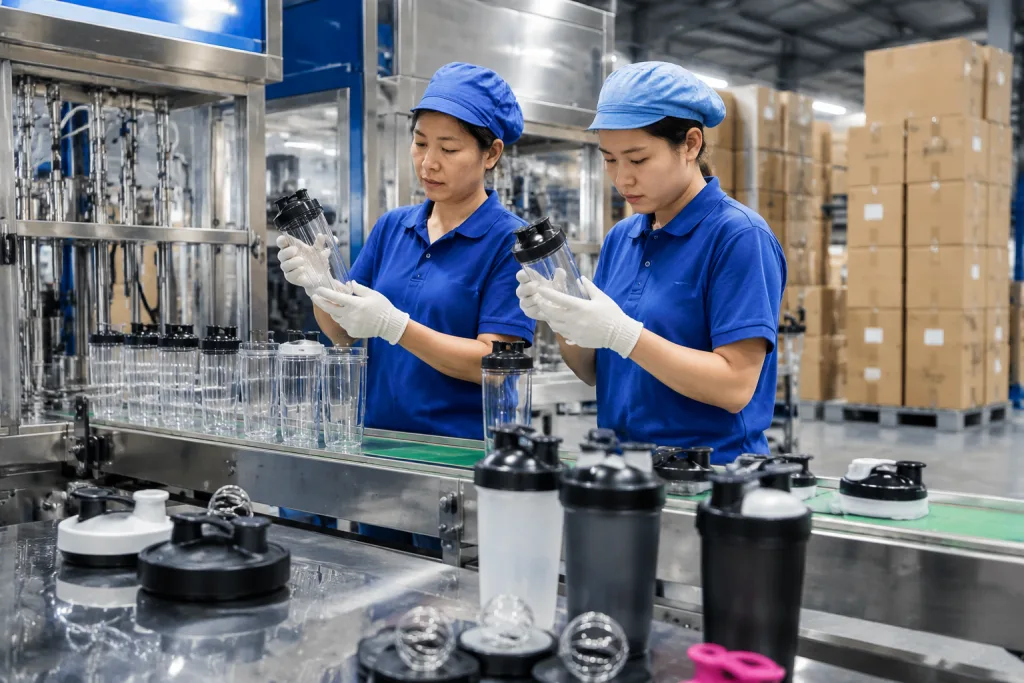
Key Takeaways
- For a custom in bulk blender bottle order, MOQ usually starts at 1,000 to 3,000 units per color, with 25-35 day lead time after sample approval
- Typical FOB China pricing runs about USD 1.80-4.80 per unit depending on Tritan, PP, stainless steel, lid tooling, and decoration method
- AQL 2.5 for major defects and 4.0 for minor defects is a practical inspection standard for wholesale drinkware production
- You should lock carton pack, barcode placement, and leak-test standard before deposit, not after mass production starts
You are not buying a shaker cup. You are buying a repeatable result: the same leak rate at 20 kPa, clean logo edges after line printing, the right carton count, and a landed cost that still works after duties, testing, and warehouse receiving. This is where first-time buyers get stuck on an in bulk blender bottle order. The sample looks fine. The production file is thin, and QC pulled the sample with no agreed torque spec for the lid.
If you are sourcing from Zhejiang, China, you need a tighter process than “send me your best price.” That is the wrong question to ask. A blender bottle order touches mold options, resin or stainless selection, agitator design, logo method, drop tests, and AQL inspection. We run these as controlled projects from quotation to final loading, especially when the same supplier also quotes bulk drinkware, bulk canteen, bulk growler, or alcohol flask wholesale bulk programs. We have seen this go sideways over a 2 mm logo shift on the line and a PO typo on carton count.
Start with the order brief
Start with the buyer case on the table. You need 5,000 units of an in bulk blender bottle for a spring promotion in Europe, split into two colors, with a one-color logo and retail-ready master cartons. Our sales team in Zhejiang will ask for target volume, material, shaker type, print area in mm, compliance market, and Incoterm on the first round. If those points are still vague, the quote will be vague too. We see this every week. Last month a buyer wrote “medium” on the PO, and the line stopped because 700 ml and 800 ml use different carton layouts.
A working brief should include at least these details:
- Capacity: 500 ml, 700 ml, or 800 ml are common; do not say “medium size.”
- Body material: PP for entry price, Tritan for clearer premium retail, or 18/8 stainless if insulation matters.
- Mixer style: wire whisk ball, plastic agitator, or fixed mixing grid under the lid.
- Leak expectation: upside-down for 30 minutes with no visible seepage, not just “good seal.”
- Logo method: silk screen, heat transfer, laser, or powder-coat print window.
- Packaging: polybag, egg-crate divider, white box, or color box with FNSKU and carton marks.
This is also the stage where experienced buyers stack the blender bottle program against adjacent categories such as canteen bulk, growler bulk, and beer tumbler wholesale bulk. A factory that already runs wholesale drinkware in several formats usually understands decoration limits, carton drop resistance, and compliance paperwork with less back-and-forth. QC pulled the sample on one mixed program here and flagged a 3 mm logo shift before mass print. That kind of catch matters. Quality is still about process control, not product range alone, but the learning curve is shorter.
If your target is retail, give the supplier your price ceiling early. If your landed target is USD 3.90 and ocean freight plus duties will absorb USD 0.70, the FOB China number probably needs to stay below USD 3.20. This is the right question to ask first, not last. Without that number, factories often quote the safest premium version, maybe Tritan with a color box and extra insert, and the math doesn't work.
What changes the unit price
Buyers ask this every week: why is one in bulk blender bottle quote USD 1.95 and another USD 4.60 if the photo looks the same? In most cases, the gap is not margin. It is the build. On our line, a 0.3 mm wall-thickness change or a different lid mold cavity shows up in cost fast.
The main cost drivers are resin grade, lid structure, decoration method, and how tightly we pack the carton. A basic 600 ml PP bottle with injection lid and stock whisk ball can land in the USD 1.80-2.30 FOB range at 3,000 units. Move to Tritan with a colored overmold lid, printed scale marks, and individual color boxes, and you are more likely at USD 2.80-3.60. A double-wall stainless version with a shaker insert can push above USD 4.50. We have seen buyers miss the carton side of the math: 24 pcs per master carton vs 36 pcs changes freight per unit enough to kill the “cheap” quote.
Price points buyers should expect
- PP blender bottle: USD 1.80-2.50 FOB China at 3,000-5,000 units
- Tritan blender bottle: USD 2.40-3.80 FOB at the same volume
- Stainless shaker bottle: USD 4.20-6.50 FOB depending on copper lining and powder coat
- Custom color box: usually adds USD 0.18-0.45 per unit
- New screen print setup: around USD 30-80 per color per design
This is the wrong comparison to make. Some buyers sourcing drinkware bulk expect a blender bottle to price like a wholesale canteen or wholesale growler because both are “just bottles.” They are not. Agitator parts, lid threading tolerance, and flip-cap sealing add assembly time and extra checks. QC pulled one sample last month because the thread start was off by less than 1 mm, and the cap cross-threaded under torque.
Ask the same supplier for three quote tiers: stock model, custom color model, and retail-pack model. That gives you a clean cost read without mixing specs. We ship this way often, especially for buyers building a broader line with bulk canteen, bulk growler, beer growler wholesale bulk, or alcohol flask wholesale items. One buyer flagged a PO typo that switched plain polybag packing to color box packing, and the unit cost jumped USD 0.22 before production even started. Standardize packaging specs first, then compare margins across the collection. Guessing from one headline unit price goes sideways.
The cheapest unit price is expensive if 4% of lids seep and your customer service team spends six weeks cleaning up returns.
Samples before you release deposit
For first orders, we usually run three sample stages: stock sample, pre-production sample, and sealing confirmation sample. Skip one and you might save 4 to 7 days. We’ve seen that go sideways. One missed check can burn a full production run and leave 3,000 to 5,000 pcs sitting on the floor.
A stock sample tells you if the factory’s current mold family is usable or if you should stop there. Check wall thickness with a caliper, thread feel by hand, mold line finish, graduation marks, and whether the whisk or agitator actually breaks up powder after 20 to 30 shakes. If you are also sourcing bulk drinkware such as beer tumbler bulk, wholesale growler, or alcohol flask in bulk, compare finish quality across categories. We ship mixed programs like this often, and buyers notice fast if one item has a clean polish and the next shows a 0.3 mm mold seam. Consistency matters if all of it sits under one brand.
The pre-production sample is the commercial reference. This is the sample sales, QC, and the line all follow. It needs your exact Pantone, logo size, packaging text, and barcode location. No guesswork. For retail orders in North America, confirm whether carton labels need FNSKU, PO number, or suffocation warning language. We had one PO last year with the PO number typed wrong by one digit, and the buyer flagged it before deposit release. For Europe, make sure any food-contact declarations or REACH-related documentation matches the material actually used, not what was copied from an old file.
Your sample checklist should include:
- Net weight and finished height within agreed tolerance
- 24-hour smell check after washing
- Leak test with room-temperature water and shaken contents
- Dishwasher claim only if the factory can support it
- Logo adhesion cross-hatch or tape test if printed
A practical supplier in Zhejiang may turn stock samples in 2 to 4 days and pre-production samples in 7 to 12 days. Custom mold changes are much slower. If a factory promises everything in 48 hours, ask what they are skipping. This is the right question. A serious manufacturer with 400,000 to 600,000 units monthly capacity still needs time to align the production drawing, color chips, and packaging files properly. QC pulled one sample here last month because the cap color was half a shade off the signed Pantone chip under the light box, and that delayed approval by 2 days.
Production control and inspection points
Once you pay the deposit, sales talk is over. Now we run the order by process control. For an in bulk blender bottle order, ask for a one-page production control plan. Nothing fancy. It should show what the line checks before molding, during assembly, and before packing, with actual sign-off points.
On the factory side, watch resin verification, color consistency, lid fit, agitator count, print position, and carton packing ratio. We usually check color against the approved chip under a light box, and print shift should be called out in mm, not by eye. On your side, approval discipline and inspection timing matter most. If artwork changes after molding starts, we've seen this go sideways fast. Last month a buyer flagged a PO typo after cups were already on the line.
Useful QC checkpoints
- Incoming material: verify food-contact grade PP, Tritan, or stainless certificates
- In-line checks: thread fit, cap hinge action, logo position, visible scratches
- Functional test: 100% leak test or defined sampling plan on filled bottles
- Final inspection: AQL 2.5 major, 4.0 minor, based on ANSI/ASQ Z1.4
- Carton review: drop resistance, shipping marks, barcode scan readability
For defects, be precise. This is the right question to push hard on. A major defect may be leakage, cracked lid, missing agitator, or wrong barcode. A minor defect may be slight print shift under 1.5 mm, small black speck under a defined diameter, or carton scuff. QC pulled the sample, but if the defect standard was never written down, the factory and the inspection team will judge it differently.
This matters more when your vendor also supplies canteen wholesale, growler wholesale, beer growler in bulk, or alcohol flask wholesale bulk items. Multi-category factories move fast, and that is good for cost. The risk is shared assembly lines and shared packing crews. We ship these mixed programs every week, and leak-risk standards are not always the same across categories. Clear work instructions keep your blender bottle from being packed like ordinary drinkware wholesale, where the lid check is often looser.
Compliance, claims, and market risk
A blender bottle looks simple until the carton says “BPA free,” “dishwasher safe,” “EU food grade,” or “shatterproof.” Then the risk shifts to paperwork. Match each claim to a real test report or signed material declaration. We’ve seen this go sideways after QC pulled the sample and found the logo card said “dishwaser safe” on a 5,000-piece PO, while the supplier had no dishwasher test at all.
For Europe, buyers usually ask for food-contact declarations and checks on REACH-related substances. For the US and Canada, the file depends on the bottle structure and sales channel, but buyers often want test support aligned with FDA food-contact expectations and, if relevant, California Proposition 65 screening. If the target user is children, ASTM-related issues move up fast. This is the wrong question to ask: “Do you have one report?” Ask which part was tested—the 304 stainless bottle body, the PP lid, the silicone seal at 3.0 mm, or the whisk ball. A report from a steel tumbler or wholesale canteen does not cover a PP shaker lid.
Ask about social and system audits too if your customer requires them. BSCI, Sedex, and ISO 9001 do not prove product quality, but they do block or clear vendor setup for bigger accounts. In Zhejiang, 7 out of 10 factories we see can provide part of this file set; only 3 have documents lined up cleanly with the quote, invoice, and factory legal entity. The buyer flagged this more than once: audit under one company name, PI under another, shipment from a third. The math doesn’t work.
One practical rule: do not overclaim durability. A factory can support a transit drop standard such as 1.0 m for packed cartons or a leak test after 500 open-close cycles if it has data from the line and a written method. “Unbreakable” is a bad claim. We ship plenty of shaker bottles, and even a 0.8 kg filled unit can crack if the lid corner takes the hit at the wrong angle. That wording creates claims risk, especially if you are pairing the blender bottle with related lines like best wholesale drink bottle assortments, beer tumbler in bulk, or bulk growler gift sets for retail distribution.
Shipping decisions that protect margin
Buyers fight for USD 0.08 off the unit price, then give back USD 0.20 per unit on bad packing and wasted freight. We see this all the time. On a 5,000-piece in bulk blender bottle order, carton efficiency is not a side issue. It changes landed cost from Ningbo or Shanghai to your warehouse. Last month, QC pulled the sample and found 22 mm headspace in the master carton after drop-test packing. That empty air was pure cost.
Ask the factory for unit dimensions, carton size, pieces per carton, gross weight, and estimated loading quantity for both 20GP and 40HQ. Ask for the numbers in mm and kg, not a rough claim that the packing is "optimized." A better nesting design or a different whisk packing method can improve carton density by 8% to 15%. On the line, we sometimes switch from loose whisk placement to cup-insert packing and gain 12 days vs 18 days on warehouse turnover because one container covers more stock. If you run repeat orders, this is the right question to ask, not just unit price.
Lead time needs a hard breakdown. A common schedule in China is 7 to 12 days for sample confirmation, 25 to 35 days for mass production, and 3 to 7 days for final inspection and loading prep. If you are ordering mixed categories such as wholesale drinkware, wholesale growler, beer growler bulk, alcohol flask bulk, and blender bottles in one container, the slowest SKU will hold the shipment unless you split bookings. We've seen this go sideways when one flask cap mold needed rework and the whole 40HQ missed ETD by 6 days.
Before balance payment, confirm:
- Final packed photos and carton marks
- Inspection pass report and defect summary
- Pallet requirement if your warehouse needs it
- Booking cut-off date and vessel ETD
- Commercial invoice and packing list consistency
If you sell through Amazon FBA or a 3PL, put carton weight limits and label rules into the PO from day one. We ship against the written PO, not against memory. One buyer flagged this after arrival because the PO had "18kg max" typed as "18g max" on one carton note, and 400 cartons had to be relabeled. It is cheaper to print the right carton mark in Zhejiang than fix it after landing. Good suppliers know the process. They only run what you approve.
How repeat orders get easier
The first order shows where the risk sits. The second order is where you earn margin back. Once a blender bottle program is stable, we usually build a repeat-order file with approved Pantone codes, logo position in mm, master carton spec, AQL limits, and the defects QC pulled on the first run. That file does more work than polished sales talk.
Good buyers cut variation early. If you change body color, logo size, lid finish, and packaging in one PO, the line gets messy fast. Keep two points locked and change one, so root-cause checks are possible when the buyer flags leakage or print shift. It is the same discipline we run on canteen bulk, wholesale canteen, drinkware bulk, or alcohol flask wholesale programs. This is the wrong question to ask: not “how many changes can we squeeze in,” but “which single change are we testing on this release?”
Ask the factory to lock key raw material references and keep a retained golden sample from each shipment. If your volume reaches 10,000 units per release, talk about forecast windows and component stock before the PO typo shows up and slows everything down. Some China factories will hold caps, seals, or whisk balls for 30 to 45 days with a rolling plan in place. We have shipped repeat orders in 20 to 25 days versus 35 days because those parts were already on the rack.
The broader point is simple: an in bulk blender bottle order is not difficult, but vague buying gets punished fast. Clear specs, realistic lead times, and disciplined inspection beat arguing over the last few cents, especially after QC finds a 2 mm logo drift or carton drop-test failure.
Get a workable quote before you place the PO
Send your target quantity, material, logo file, and packing requirement. We will quote practical MOQ, FOB pricing, and lead time from Zhejiang, China.
Frequently asked questions
What is a normal MOQ for an in bulk blender bottle order?
For stock molds, a realistic MOQ is usually 1,000 to 3,000 units per size or color, depending on material and decoration. A plain PP model may start at 1,000 units, while a Tritan body with custom Pantone lid and printed box often needs 2,000 to 3,000 units. If you add a new mold insert, special shaker grid, or several color splits, the practical MOQ can move higher. In Zhejiang, China, many factories will quote a lower trial quantity, but the unit price rises fast because setup, print screens, and packing labor are spread over fewer pieces. For a real retail launch, 3,000 to 5,000 units usually gives better FOB pricing and more stable production.
How long does production usually take after sample approval?
For a standard custom order, plan on 25 to 35 days after the pre-production sample and deposit are approved. Stock sample dispatch may take 2 to 4 days, and a logo sample often needs another 7 to 12 days. If the order includes custom packaging, third-party testing, or mixed loading with products like wholesale growler or beer tumbler wholesale bulk, add a few extra days for coordination. During peak season before summer promotions or year-end gifting, some China suppliers extend to 40 days. Ask for a timeline split into molding, printing, assembly, inspection, and booking. That is more useful than hearing one vague lead-time promise.
What quality checks matter most for blender bottles?
Leak performance is the first priority, then lid fit, print durability, and packing accuracy. A sensible QC plan includes incoming material verification, in-line thread and hinge checks, and a final inspection using AQL 2.5 for major defects and 4.0 for minor defects. Major defects usually include leaking lids, cracks, missing agitators, wrong barcodes, or incorrect colors. Minor defects may include small print shift, slight specks, or light carton scuffs. If you are buying 5,000 units, ask for a final inspection after at least 80% is packed so carton count and assortment can be checked properly. Also confirm whether the factory performs 100% leak testing or a defined sampling plan.
Which material is better: PP, Tritan, or stainless steel?
It depends on your price point and sales channel. PP is the most economical and often works for promotions or gym chains where FOB cost matters most; expect roughly USD 1.80 to 2.50 at volume. Tritan gives a clearer premium look, better stain resistance, and stronger retail appeal, typically around USD 2.40 to 3.80 FOB. Stainless steel fits higher-ticket programs and insulated variants, but pricing often starts above USD 4.20. If you need visible measurement marks and strong shelf presentation, Tritan is usually the balanced choice. If you are building a broader wholesale drinkware line in China, keep materials consistent where possible so compliance files, packaging language, and testing requirements stay manageable.
Should I buy blender bottles from a factory that also makes other drinkware?
Usually yes, if the factory controls quality well and can separate product standards clearly. A supplier that already produces bulk canteen, bulk growler, alcohol flask wholesale, or drinkware wholesale items often has stronger sourcing depth for lids, seals, coatings, and packaging. That can help with price stability and mixed-container planning. The risk is that not every drinkware line has the same leak tolerance or assembly discipline. A simple beer tumbler bulk order does not face the same sealing risk as a shaker bottle. So the right question is not whether the factory makes multiple categories, but whether it can show clear QC points, retained samples, inspection records, and consistent lead time for the blender bottle program itself.