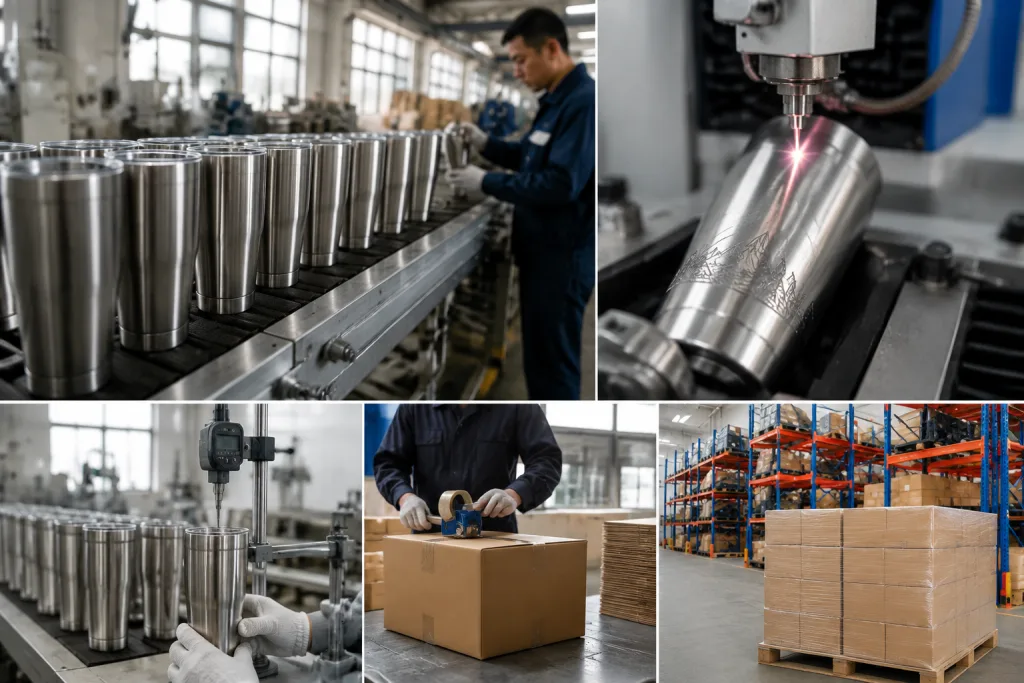
Key Takeaways
- A usable RFQ for beer tumbler bulk orders should define at least 12 line items, including capacity tolerance, 18/8 grade, finish, logo method, packaging, and AQL level
- Pre-production samples usually take 7-12 days, while mass production for 3,000-10,000 pcs commonly takes 25-35 days in Zhejiang, China
- MOQ for custom stainless steel tumblers is often 500-1,000 pcs per color, but printed retail boxes can push practical MOQ to 2,000 pcs
- AQL 2.5 for major defects and 4.0 for minor defects is a common inspection baseline before balance payment
You can buy an in bulk beer tumbler from almost any supplier directory. Easy part. The expensive part shows up later: the lid leaks at 45 degrees on the tilt test, the logo scratches after 200 dishwasher cycles, or the outer carton fails the Amazon drop sequence at 76 cm. In drinkware, most procurement trouble does not start with the cup shape. It starts with loose RFQs, weak sample sign-off, and POs missing basic callouts like Pantone, wall thickness, or even a lid color typo that the buyer flagged after mass production.
If you are buying from Zhejiang or elsewhere in China for Europe or North America, you need a sourcing process that turns a simple tumbler into a controlled production item. We run this the same way whether the program is beer tumblers, bulk canteen, bulk growler, wholesale drinkware, or alcohol flask wholesale bulk. Lock the spec step by step before the line runs 10,000 units the wrong way. This is the wrong question to ask: “Who has the lowest price?” Ask who can hold the details—304 stainless callout, logo position within 2 mm, AQL level, pack-out method, and master carton weight under 18 kg—because we have seen cheap orders go sideways fast.
Start with a usable RFQ
If your request for quote says only “need beer tumbler 20 oz with logo,” the pricing spread will be useless. One factory quotes a thin-wall single-grade body, another builds a copper-lined vacuum version, and a third slips in plain white box packing with no insert. The numbers can sit within $0.20, then QC pulled the sample and the difference was obvious in 10 seconds. For an in bulk beer tumbler program, your RFQ needs enough detail so two China factories quote the same cup, not two guesses.
At BottleForge Industrial in Zhejiang, we usually see first-time buyers miss these points: wall structure, packing spec, and logo process. This is the wrong question to leave open. A 20 oz vacuum beer tumbler can be made with 18/8 inner and 18/0 outer, or full 18/8 if your compliance team asks for it; we have had buyers reject a pre-production sample over one PO typo on outer material. Powder coating, spray painting, and brushed steel land at different costs on the line. So do laser engraving, silk screen, heat transfer, and UV print, and some add 5 to 7 days to lead time.
PO and RFQ line items to lock first
- Item name: beer tumbler in bulk, double-wall vacuum insulated
- Capacity: 20 oz / 590 ml, tolerance plus or minus 3%
- Material: stainless steel SUS304 inner, SUS201 or SUS304 outer, PP lid, silicone seal
- Wall thickness: inner 0.4 mm, outer 0.45 mm
- Finish: Pantone black powder coat, 60-80 micron coating
- Logo: 1-color silk screen, 1 side, max 45 x 45 mm
- Packing: individual polybag plus white box, 25 pcs/master carton
- Carton spec: drop-test requirement if for FBA
- Compliance: REACH, LFGB or FDA as required
- Inspection: AQL 2.5/4.0
- Trade term: FOB Ningbo or Shanghai
- Target qty: 3,000 / 5,000 / 10,000 pcs price break
This level of detail matters whether you are buying beer tumbler wholesale bulk, wholesale canteen, or growler wholesale. We ship cleaner quotes this way. It lets you compare drinkware wholesale pricing across 2 or 3 factories on equal terms, instead of arguing over assumptions nobody wrote down.
Read the quote beyond unit price
Once the quotes come back, don’t chase the lowest unit price first. A quote at USD 3.15 can be worse than USD 3.42 if the first one leaves out lid tooling, logo setup, export carton upgrade, or test fees. We’ve seen this go sideways: the buyer reads a base FOB line, then finds out the 5-layer export carton was never included. On beer tumbler wholesale jobs, this is where quote disputes start.
A proper quotation sheet should show the full cost structure, line by line. For standard 20 oz vacuum tumblers, you will often see FOB China pricing in the range of USD 2.80-4.80 depending on steel grade, coating, lid style, and order volume. MOQ may start at 500 pcs for stock colors, but custom body color, custom retail box, or handle tooling can push the real MOQ to 1,000-3,000 pcs. A factory with 300,000 units monthly output may accept a small pilot order, but only if your specification uses existing molds. On the line, that usually means no new lid injection mold and no base redraw die. This is the wrong question to ask: “What is your best price?” Ask what is included.
Low price is useful only when the specification, packaging, and defect standard are already fixed.
When reviewing quotes, ask for these cost items separately. QC pulled the sample on one order because the PO said “1 logo position,” but the artwork showed front and back print.
- Unit price by volume: 1,000 / 3,000 / 5,000 / 10,000 pcs
- Printing charge: per color, per position
- Laser engraving charge: per unit or flat setup
- Mold or tooling fee: if new lid, base, or handle
- Packaging adder: plain box vs retail color box
- Test fee: if third-party REACH, LFGB, California Proposition 65 screening, or ASTM packaging tests are needed
- Sample charge and refund rule: some factories refund after bulk order; we usually tie that refund to the first PO
The same rule applies if you later move into beer growler bulk, growler bulk, canteen bulk, or alcohol flask in bulk sourcing. We ship plenty of repeat programs where the first quote looked cheaper, then freight cube, carton drop-test upgrades, and sampling charges added 8% to 12%. For best wholesale drink bottle decisions, total landed cost matters more than the first headline number.
Approve samples like production tools
Samples are not a formality. They are your first production control document. For an in bulk beer tumbler order, treat sample approval as the point where guessing stops. A stock sample usually ships in 2-4 days. A logo sample or full pre-production sample takes 7-12 days because the line has to match your print file, lid, and pack-out. If you need a new mold, add 15-25 days before sample approval. We’ve seen buyers push for approval off a photo; this is the wrong question to ask.
Ask for the correct sample type. A random stock sample only shows the factory has a similar shape on hand. It does not confirm your Pantone, your lid seal, or whether the barcode sits 12 mm too low on the gift box. A pre-production sample with your exact coating, lid, logo, barcode, and packaging tells you if the order should run. QC pulled one sample last month where the PO typo changed matte black to mat black, and the supplier printed the wrong finish note on the carton label.
What to check on the sample
- Weight: does it match quoted build? Large gaps can mean thinner steel. We check on a digital scale in grams, not by hand feel.
- Vacuum performance: hot water and ice retention over 6-12 hours. Ask for the actual test record, not “passed.”
- Lid fit: thread alignment, press fit, and leak test when inverted. If the lid grabs on the second turn, the buyer will flag it.
- Coating adhesion: cross-hatch tape test, scratch resistance. A 3M tape pull tells you more than a sales photo.
- Logo quality: registration, opacity, rub resistance. On silk screen, even a 1 mm shift looks bad on a straight wall tumbler.
- Base stability: no wobble on flat table. We run this on a granite table because wood hides problems.
- Odor: no strong paint or silicone smell after wash. If the silicone ring still smells after one wash, we’ve seen this go sideways.
- Packaging: barcode placement, insert fit, carton markings, FNSKU if Amazon applies. Check scanability before mass print.
Your PO should reference the approved sample by date and version number. For example: “Bulk production to match signed PPS dated 2025-03-10.” Without that line, disputes turn into opinion. The factory says it matched the artwork. The buyer says the sample looked different. The math doesn’t work. This matters just as much for wholesale growler, beer growler wholesale bulk, wholesale drinkware, or alcohol flask wholesale orders. One approved sample can save a full container of rework.
Write the purchase order properly
Buyers will spend 6 days pushing unit price down by $0.08, then send a one-page PO with half the job missing. We’ve seen this go sideways. Your purchase order should read like a short production contract, with the quote number, approved pre-production sample, packaging artwork code, and inspection rule tied into one controlled file. On our side, the merchandiser usually cross-checks it against the BOM and carton spec before the line starts.
On custom drinkware bulk orders, the dispute is usually not “did you ship it.” The fight is whether shipped goods match the approved target. If the PO skips the finish code, barcode format, carton size, tolerance, or acceptance standard, the factory will fall back to its own internal standard. That is the wrong question to ask after production starts. Domestic default specs might pass for a local order and fail for Amazon FBA or a chain-store shelf test; we’ve had a buyer flag a 6 mm logo shift that was never defined on the PO.
Core PO line items
- SKU code: buyer internal item code and factory item code; if your PO has two names for one tumbler, QC pulls the wrong sample
- Description: beer tumbler bulk, 20 oz, double-wall vacuum
- Quantity: exact order qty by color, not “assorted”; for example, 3,000 black and 2,000 navy
- Unit price: FOB port and currency in USD
- Material construction: SUS304 inner 0.4 mm, outer 0.45 mm
- Color code: Pantone or approved spray/powder sample; on the line we usually keep the signed chip at the coating station
- Logo file reference: AI artwork revision number, size, position; one PO typo on Rev B vs Rev D is enough to remake 5,000 pieces
- Packaging details: retail box artwork code, insert material, master carton qty
- Markings: country of origin, suffocation warning, FNSKU, carton shipping marks
- Testing and compliance: REACH, LFGB, FDA, CPSIA where relevant to product category
- QC standard: AQL 2.5 major / 4.0 minor
- Delivery date: ex-factory or FOB date; write the actual date, not “ASAP”
- Payment term: typically 30% deposit, 70% before shipment or against inspection release
- Penalty or remedy: for late shipment or non-conforming goods if agreed; if there is a chargeback formula, put the percentage in writing
If you also buy canteen wholesale, drinkware wholesale, or alcohol flask bulk, keep the same PO structure across all 3 categories. It cuts internal mistakes on your side and makes supplier control easier over 12 months of repeat orders. We run into less back-and-forth when every PO uses the same carton template, approval log, and MOQ note.
Watch production before goods are finished
After the deposit lands, a lot of buyers go silent and wait for finished photos. That is too late. We’ve seen this go sideways. For a standard stainless beer tumbler in bulk, mass production usually takes 25-35 days after sample approval and deposit. In peak season, August to November, Zhejiang factories often stretch to 35-45 days, especially on orders with 3 Pantone colors and gift boxes that need a separate packing line.
You do not need to watch every step on the line. You do need clear checkpoints at the right stage.
- Raw material confirmation: steel grade, lid resin, seal material. QC should pull the mill cert and check wall thickness with a caliper before bodies move forward.
- Color sample approval: before full coating run. If the buyer flagged Pantone mismatch before, ask for a sprayed panel first, not a phone photo under warehouse lights.
- First article photos: logo placement and print quality. We usually check offset in mm, because a 2 mm logo drift will get rejected by retail programs.
- Packing line check: retail box assembly, barcode scan, carton count. This sounds basic, but one wrong UPC label on the outer carton can hold a whole shipment.
- Production status: body forming, vacuuming, polishing, coating, print, assembly, packing. Ask for actual quantities by stage, not “production is normal.”
A solid factory should report real progress, not just “everything is fine.” For example: 10,000 pcs ordered, 10,500 bodies formed, 9,800 vacuum completed, 6,000 powder coated, 2,000 packed. That is the update you need if your customer booked shelf space or your forwarder needs a loading date. We run these numbers daily from the workshop board, and the math does not lie.
If you are sourcing beer growler in bulk or growler wholesale with larger capacities such as 32 oz, 64 oz, or 128 oz, the risk shifts to handle welding, cap sealing, and pressure resistance. A weld that looks clean can still fail a pull test. For alcohol flask wholesale or wholesale canteen items, hinge fit and cap seal matter more; QC pulled one sample last month where the cap sat 0.8 mm high and leaked on inversion test. Same production flow, different weak points. This is the right question to ask. Not just lead time, but where the line is most likely to fail.
Inspect for defects that matter
Final inspection is where buyers lose money. Some teams build a 40-page manual for a standard beer tumbler bulk order; others skip the basics and approve by photos. Both miss the point. You need a defect list tied to claim risk, rework cost, and whether the goods can still ship. On our line, QC pulled the sample and found a 0.8 mm lip burr that looked small on paper but turned into a real cut risk. A third-party inspection under AQL is normal for export drinkware from China, and it costs less than one arrival claim.
For most orders, AQL 2.5 for major defects and 4.0 for minor defects works well. Critical defects should be zero tolerance. For a 3,200 pcs lot, the inspector may pull around 200 units under single sampling. Confirm the sampling plan before inspection day, not after the cartons are sealed and the truck is booked. We have seen buyers argue over 32 extra sample pulls on site; this is the wrong question to ask.
Typical defect checklist
- Critical: sharp edges, wrong material claim, mold contamination, severe leak, missing required warning, failed compliance point
- Major: obvious dent, wrong logo, coating peel, poor vacuum retention, unstable base, wrong barcode, mixed color in one carton
- Minor: small dust point, slight print offset within tolerance, light carton scuff
Ask the inspector to run practical tests, not just visual checks. A clean-looking tumbler can still fail on the bench. We ship plenty of orders where the buyer flagged no appearance issue, then the barcode would not scan because the print contrast was weak, or the lid leaked after a simple squeeze test.
- Leak test on sampled lids
- Vacuum retention spot check
- Barcode scan test
- Carton drop test where required
- Carton weight and count check
- Assembly verification against approved sample
This is also where repeat programs start to run smoother. Once your team builds a defect library for beer tumbler bulk, you can carry the same logic into drinkware bulk and beer growler wholesale, then adjust the few category points like cap fit, base stability, or warning label position. We have even copied notes from a growler wholesale PO with a barcode typo into an alcohol flask wholesale bulk file. The math works if your standards stay tight.
Plan freight, repeats, and expansion
The last step is not shipping one PO. It is setting up the repeat business so the second order does not drift. We see too many procurement teams open a new file every time, then the logo size changes by 2 mm or the carton mark picks up an old PO typo. Once your first in bulk beer tumbler run is approved, build a repeat-order file with the final quotation, signed sample photos, artwork version, carton dimensions, net and gross weights, inspection report, and shipping records. QC pulled this file on one 304 stainless repeat last month and caught an outdated lid spec before the line started.
For shipping, confirm whether FOB Ningbo, FOB Shanghai, or EXW fits your setup. Ningbo usually makes more sense for Zhejiang factories because the trucking run is shorter and vessel bookings are easier to lock; from Hangzhou, we often truck to Ningbo in the same day, while Shanghai can add cost with no gain. If your products go to Amazon FBA in North America, lock FNSKU labeling, carton dimension limits, and pallet rules before packing starts, or the math doesn't work once 1,200 cartons are taped and stacked. If they go to retail distribution in Europe, verify EAN barcode rules, country-of-origin marking, and packaging waste obligations. We have seen buyers flag outer cartons after packing because the origin mark was missing.
Repeat orders move faster than first orders if the specs stay unchanged. A first run might ship in 30-40 days; a clean repeat can ship in 20-30 days because tooling, artwork, and pack-out standards are already frozen. At BottleForge Industrial, custom MOQ for repeat stainless tumbler programs often stays at 500 pcs per color, and we run mixed-container programs across bulk growler, wholesale canteen, and wholesale drinkware to improve freight use. One 40HQ plan works fine if the carton sizes and loading sequence are set early.
The benefit is straightforward: once one SKU is under control, expansion gets safer. You can add beer growler bulk, growler bulk, alcohol flask bulk, or canteen wholesale items with the same sourcing file, inspection checkpoints, and shipping rules. This is the wrong place to improvise. Buyers who lock the first program well usually turn one beer tumbler wholesale order into a stable drinkware wholesale supply line from Zhejiang, China instead of repeating one-off price talks every quarter.
Send your beer tumbler RFQ with full specs
We will review your drawings, packaging, MOQ, and target price, then reply with practical China factory options, sample timing, and a cleaner PO checklist.
Frequently asked questions
What is a normal MOQ for an in bulk beer tumbler order?
For a standard stainless steel beer tumbler in bulk using an existing mold, MOQ is usually 500 to 1,000 pcs per color. If you choose a stock body color and a simple laser logo, some factories in China can be flexible at 300 pcs for a trial run. If you need a custom Pantone powder coat, printed retail box, or multiple logo positions, practical MOQ often rises to 2,000 pcs because coating setup, print waste, and carton purchasing need scale. For beer tumbler wholesale bulk programs with 3 to 5 colors, you should also check whether the MOQ applies per color or per total order. That detail changes your landed cost more than buyers expect.
How long does custom beer tumbler bulk production usually take?
A realistic timeline is 2 to 4 days for a stock sample, 7 to 12 days for a custom pre-production sample, and 25 to 35 days for bulk production after sample approval and deposit. In peak season, especially from late summer into Q4, factories in Zhejiang or other parts of China may quote 35 to 45 days. Add another 5 to 10 days if your order needs a third-party lab test before shipment. New tooling for a lid or unique body shape can add 15 to 25 days before the sample stage even starts. If you have a retail launch, build backward from your in-store date and leave at least one extra week for inspection and booking delays.
What should I put on the PO for beer tumbler wholesale orders?
At minimum, your PO should include SKU code, product description, capacity, material grade, wall thickness, finish color, logo method, logo size and location, packaging type, carton quantity, shipping marks, barcode requirement, compliance requirement, inspection standard, delivery term, unit price, quantity by color, and payment terms. You should also reference the approved pre-production sample by date or version number. For example, say bulk goods must match PPS approved on a specific date. If you omit packaging details or inspection criteria, the supplier may follow its default export standard instead of your channel requirement. That is a common cause of claims in beer tumbler wholesale bulk and wholesale drinkware orders.
How do I compare suppliers for beer growler wholesale, canteen wholesale, and tumblers together?
Use one comparison sheet and normalize the specification. Ask every supplier to quote the same trade term, usually FOB Ningbo or FOB Shanghai, and the same packaging basis. Then compare MOQ, lead time, monthly capacity, sample policy, compliance ability, and defect handling. For example, one supplier may be cheaper on a beer tumbler bulk item but higher on growler wholesale because their welding line is weaker on large-capacity bodies. Another may quote low until you add custom gift boxes. If you are planning a full bulk drinkware program, check whether they can consolidate tumblers, bulk canteen items, and beer growler in bulk products in one shipment. That can save meaningful freight and coordination cost.
Which compliance and quality checks matter most for stainless steel drinkware?
For Europe, buyers commonly ask about REACH and LFGB depending on the product and market channel. For North America, FDA-contact expectations, California Proposition 65 screening where relevant, and retailer-specific packaging rules often matter. On the quality side, the practical checks are leak testing, vacuum retention, coating adhesion, print durability, barcode accuracy, and carton integrity. AQL 2.5 for major defects and 4.0 for minor defects is a common export standard for drinkware bulk orders. If the item is for Amazon FBA, add carton drop performance and label placement checks. If you are buying alcohol flask wholesale or wholesale growler products, sealing performance becomes even more important because leaks create immediate consumer complaints.