Key Takeaways
- Typical MOQ for an in bulk alcohol flask order is 1,000-3,000 pcs per size, with laser logo options starting near 500 pcs on selected stock molds.
- FOB China pricing for 6 oz to 8 oz stainless flasks is often USD 1.45-3.20 depending on steel grade, finish, lid structure, and gift box packing.
- Normal production lead time runs 25-40 days after sample approval and deposit; custom color coating can add 5-7 days.
- Use AQL 2.5 for major defects, request 24-hour leak testing, and confirm REACH or LFGB-relevant declarations before mass production.
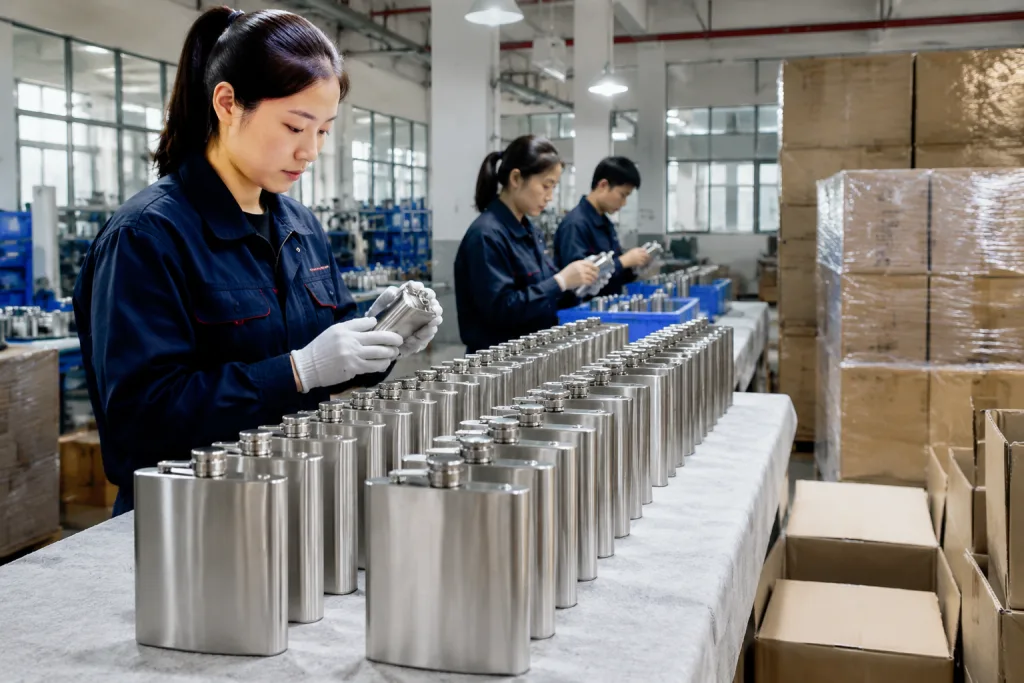
You are not buying a souvenir flask. You are buying a product that has to pass customs, clear logo approval, avoid leakage claims, and still survive a finance margin review. For an in bulk alcohol flask order, the flask itself is only half the job. The bigger issues are 304 stainless grade, decoration limits on the curved body, carton efficiency, and whether the supplier can run the same weld quality on shipment two and shipment three. On our line, QC pulled a sample last month because the cap thread sat off by 0.3 mm; that is the kind of detail that decides whether a reorder goes smoothly.
Buyers in Europe and North America often begin with one SKU, then add a bulk canteen or bulk growler, sometimes a beer tumbler bulk line after the first launch sells through. Stainless drinkware looks simple. It is not. Once tolerance, coating adhesion, and compliance files enter the PO, the buyer flagged questions usually shift fast from shape to risk. In Zhejiang, China, a capable factory should explain MOQ, AQL, lead time, REACH contact materials, and carton drop performance with plain numbers, not sales talk. If a supplier cannot tell you 12 days sampling versus 18 days resampling, or why a 5-layer export carton matters after a 76 cm drop test, this is the wrong factory to shortlist. We have seen this go sideways over one typo on a PO and one missing test report.
What are you really buying?
If you ask for an in bulk alcohol flask quote, don’t start with price. Start with spec control. Two flasks can look the same in photos and still come in 25% apart on cost because one body is 0.4 mm and the other is 0.5 mm, the hinge is stamped differently, the coating is spray instead of powder, or the cap is fully welded instead of pinned. We see this every month on the line.
For most B2B programs, the baseline spec is 18/8 stainless steel body, food-contact safe interior, and a capacity of 6 oz, 7 oz, or 8 oz. Common body thickness is 0.4-0.5 mm. Below 0.4 mm, dent complaints climb fast during retail handling; QC pulled a sample last spring that took a thumb dent before drop test. Above 0.5 mm, cost goes up and the sales value usually doesn’t follow unless you are building a premium gifting item. That is the wrong question to dodge.
A buyer who also handles drinkware bulk programs should split the inquiry into three product groups early. If you mix them on one RFQ, the quote gets muddy fast, and we’ve seen this go sideways over one typo on a PO.
- Classic alcohol flask: curved, pocket-sized, screw cap, usually 6-8 oz, with tighter cosmetic checks around the shoulder and cap thread.
- Bulk canteen or wholesale canteen: larger field-style body, often 16-64 oz, usually with strap or loop cap, and different forming tools.
- Bulk growler or wholesale growler: beer transport vessel, commonly 32-64 oz, with different sealing and insulation needs.
These are not interchangeable supply chains just because one factory says it makes all three. A flask line needs clean welding, accurate cap fit, and stable polishing; we usually check cap torque with a simple torque gauge before packing. A beer growler wholesale line needs stronger leak control, tighter thermal claim checking, and in most cases wider-mouth tooling. Different machines. Different headache.
You save money by narrowing the specification before you negotiate, not after the PI is issued.
At BottleForge Industrial in Zhejiang, China, output planning starts from four confirmed points: steel grade, exact capacity, logo method, and packaging format. If one is missing, the quote is still a guess. We ship cleaner and faster once those four are locked, whether the MOQ is 1,000 pcs or 5,000.
MOQ, pricing, and where costs move
Procurement managers ask for a clean benchmark. Here it is. For an alcohol flask bulk order on an existing mold, typical MOQ is 1,000 pcs per size per color. If you want a plain brushed flask with a 1-color silkscreen logo, some China factories will run 500 pcs, but only when matching stock caps, necks, and carton die-lines are already on the shelf. We’ve done this on line with a 0.18 mm logo screen and existing master carton marks. For gift-boxed retail packs, MOQ usually moves to 1,000-2,000 sets.
Real FOB Zhejiang pricing usually falls into these bands:
- 6 oz brushed stainless flask: USD 1.45-1.90 at 3,000 pcs
- 8 oz powder-coated flask: USD 1.95-2.55 at 3,000 pcs
- Flask with funnel and gift box: USD 2.40-3.20 at 2,000 sets
- Custom mold or major lid change: tool cost from USD 2,500-8,000
If a supplier comes in far below that band, ask what got stripped out. This is the wrong question to ask: “Why is your price higher by USD 0.12?” Better ask whether the quote still includes the 24-hour leak test, 304 stainless thickness, and abrasion-resistant coating. QC pulled one low-price sample last year with a hinge pin already loose after 15 cap flips. We’ve seen this go sideways. The cheap offer often means thinner steel, basic polybag packing, no leak test, or a weaker coating that scuffs during carton drop.
Cost drivers buyers usually underestimate
- Decoration: laser engraving is stable and clean; multi-color print raises reject risk. On the line, registration drift over 0.5 mm is enough for the buyer to flag it.
- Packaging: EVA insert boxes and mailer-safe cartons can add USD 0.35-0.90 per unit. A 20 mm EVA insert protects better, but carton count drops fast.
- Surface finish: mirror polish and rubberized coating slow output and increase handling marks. Mirror units need more glove handling, and the math doesn’t work if you expect brushed-speed output.
- Lid assembly: captive cap hinges and wrapped leatherette sleeves add labor. Even a small PO typo on left-hand vs right-hand hinge can hold sampling for 2 days.
The same logic applies if you are expanding into wholesale drinkware, growler bulk, or beer tumbler wholesale bulk. Unit price is only half the story. We ship by carton density first, not by unit fantasy. A flask packed badly turns into complaint cost, replacement freight, and dead stock on arrival. One buyer pushed for a lower-cost outer carton last season, and compression failed at 7 kg top load in warehouse stacking. A cheap unit that ships badly is expensive inventory.
Which materials and tests matter most?
The compliance question is basic: what touches the liquid, and what paper backs it up? For an alcohol flask wholesale program going to Europe or North America, the body and neck contact parts should normally be SUS304. If a supplier quotes SUS201 to shave $0.18 off the unit cost, ask exactly where they use it. Outside trim is one thing. Inside wall is another. For flask interiors, most serious buyers stay with 304, and we’ve seen this go sideways when QC pulled the sample and found a magnet sticking where it should not.
You should ask for:
- REACH declaration for EU market chemical compliance relevance
- LFGB-related testing when the program targets stricter EU food-contact expectations
- FDA-contact style declaration for US market reference where applicable
- BPA-free statement for plastic cap inserts or seals
- Coating adhesion and abrasion data for painted models
For quality control, use a written inspection standard, not a sales promise on WeChat. Typical checkpoints include the leak fixture, torque meter setting, and final carton drop notes. On our line, QC logs cap torque in N·m and flags any flask that seeps after standing 24 hours on absorbent paper. Typical checkpoints include:
- 24-hour leak test on filled sample units
- Salt spray reference if exterior coating durability is claimed
- Torque check on screw cap fit
- Odor check after 72 hours of sealed storage
- AQL 2.5 major, 4.0 minor on final inspection
If the same supplier also offers canteen wholesale, wholesale growler, or the best wholesale drink bottle for sports retail, ask whether the test report is for this flask or copied from another SKU. This is the wrong question to skip. A flask seal design is not the same as a beer growler in bulk closure or a beer tumbler in bulk sliding lid. We had one buyer flag a report last year because the PO said 8oz flask, but the lab sample photo showed a straw lid bottle.
A factory with export discipline should be able to talk straight about BSCI status, ISO-style process control, and third-party inspection booking windows. In Zhejiang, the better factories answer in 24 hours, sometimes faster, because they handle these requests every week. Ask for the next available inspection slot, not just “Do you support inspection?” The math doesn't work if goods finish on the 28th and the factory only gives SGS a 2-day window after loading starts.
How should samples and approvals run?
A slow sample cycle usually leads to a slow mass-production cycle. For a standard alcohol flask in bulk project, this is the sequence we expect on the line:
- Day 1-3: quote alignment and artwork review
- Day 4-7: blank stock sample or similar-shape reference sent
- Day 7-12: pre-production logo sample prepared
- Day 25-40: bulk production after approval and deposit
If you are ordering from China and the supplier needs 12 days just to send a plain sample from an existing model, planning is weak. That is the wrong question to dodge. On a standard flask body already in stock, we usually pull one from shelf inventory, check the neck thread with a go/no-go gauge, and ship in 4-7 days. A mid-sized plant handling 300,000-500,000 units per month across bulk drinkware categories should be able to slot a flask sample fast if the artwork file is clean.
Approval checklist before deposit
- Confirm capacity in oz and ml
- Confirm net weight tolerance, usually within plus/minus 3%
- Approve Pantone reference for coating or print
- Approve logo size and position by mm
- Confirm packaging layout, barcode, and carton marks
- Confirm whether spare caps are included, often 0.5%-1%
This step matters more if your sourcing plan later adds canteen bulk, drinkware wholesale, or growler wholesale. We have seen this go sideways. One approved flask file with logo position in mm, carton mark layout, and a signed sample photo becomes the master sheet for the next SKU, whether that is a beer tumbler bulk launch or a beer growler wholesale bulk line for seasonal promotions.
Good suppliers in Zhejiang keep signed sample photos, carton specs, and print positioning records against the PO. We also keep the common mistakes on file, including a buyer typo on a carton mark or a barcode digit that QC pulled from the sample room before bulk packing. If your vendor does not keep those records, the repeat order turns into the same argument again instead of a routine production run.
What can go wrong after shipment?
Most post-shipment failures are predictable. They get expensive fast if you find them only after the container lands. We’ve seen this go sideways on the line, and the fix usually starts before shipment, not after claim photos show up.
For an alcohol flask wholesale bulk order, watch these risks:
- Micro-leaks: usually trace back to bad neck threading or cap gaskets that sit unevenly; QC pulled the sample and found thread bite off by 0.3 mm on one lot
- Dents in transit: common when carton compression is weak or there is no divider plan; a 5-layer carton and inner partition cost less than one rework claim
- Logo rub-off: linked to weak silkscreen curing; we’ve had a buyer flag this after a simple 3M tape test failed
- Odor complaints: often come from low-grade seal materials or coating packed before full curing; this is the wrong place to save $0.02
- Mixed finish lots: brushed and polished flasks packed together will cause complaints; one master carton typo on the PO can start that mess
If you ship to Amazon or major retail DCs, packaging rules get tighter. FNSKU placement, carton size limits, master carton weight below 15-18 kg depending on channel, and scannable outer labels should be locked before production starts. We run into buyer pushback here all the time: “the product is fine, why did the warehouse reject it?” Because the label sat over a carton seam, or the box came in at 18.6 kg. Plenty of factories can make a flask. Fewer ship clean against retailer routing rules.
This is where cross-category experience matters. A supplier used to wholesale drinkware, growler bulk, and beer tumbler wholesale orders usually understands drop-test standards, barcode position, and pallet stack limits better than a gift-item trader. Ask for packed carton dimensions, units per carton, gross weight, and palletization proposal before you issue the final PO. If they cannot give you a 1200 x 1000 mm pallet plan or even a carton count estimate, the math doesn’t work.
If your supplier cannot tell you the carton gross weight before mass production, they do not fully control the order.
For sea freight planning from China, add buffer days. A 30-day production promise with no allowance for coating rework or third-party inspection is not a safe number. We usually tell buyers to plan 7-10 extra days, and on tougher logo jobs even 12 days vs 18 days can be the difference between normal booking and emergency air freight.
Buyer checklist for the first PO
If this is your first in bulk alcohol flask order, keep the PO boring. We have seen first orders go sideways when the buyer loads in six colors, two gift boxes, and three logo methods on day one. Start with one stable SKU, one dieline, and one spec sheet a QC inspector can run with a caliper and leak tester, no guessing.
Use this procurement checklist:
- Supplier identity: confirm factory or trading company, check the business license, export history, and audit status such as BSCI; we usually ask for the last 3 shipment records
- Product spec: lock capacity, dimensions, steel grade, body thickness, finish, lid material, and seal material; if the body wall is off by 0.1 mm, the hand feel changes fast
- Commercial terms: write down MOQ, FOB price, sample cost, tooling cost, payment terms, and any lead time penalty; if the MOQ says 3,000 pcs on the quote and 5,000 pcs on the PI, stop there
- Quality standard: set the AQL level, leak test method, cosmetic standard, and approved golden sample; QC pulled the sample once because the cap sat 1.5 mm high and the buyer flagged it
- Compliance file: collect REACH, LFGB-related, or market-specific declarations, plus packaging material statements if required; ask for the actual file list, not a sales promise
- Packing details: confirm inner pack, master carton, barcode type, country-of-origin marking, and drop protection; a 5-layer carton is cheap insurance
- Shipment control: fix inspection timing, booking window, ex-factory date, vessel target, and document list; we ship smoother when the booking window is set 7 days ahead, not 2
Once the first program runs clean, you can scale into adjacent categories such as wholesale canteen, bulk growler, or drinkware bulk collections. We see this with brand owners all the time because retailer buyers like a matched family on the shelf. A flask gets you in. Margin usually comes from the next line, like beer growler bulk or a matching beer tumbler wholesale bulk assortment.
The point is not to add SKUs from China right away. This is the wrong question to ask. Build one clean supply chain in Zhejiang first, then extend it if the MOQ, freight, and margin math still works.
Get your alcohol flask quote with real factory numbers
Send your target capacity, finish, logo file, and packaging need. We will reply with MOQ, FOB pricing, lead time, and workable QC points from Zhejiang, China.
Frequently asked questions
What is a normal MOQ for alcohol flask in bulk orders?
For standard existing molds, a practical MOQ is 1,000-3,000 pieces per size and color. Some factories in China will quote 500 pieces for a plain brushed flask with laser logo, but that usually depends on available stock parts and simple packing. If you want custom color coating, gift boxes, or special cap tooling, expect the MOQ to move back toward 1,000 or 2,000 pieces. For a first order, 1,000 pieces is often the best balance between landed cost and inventory risk. If your program may expand into canteen bulk or growler wholesale later, align decoration and carton standards from the start so future SKUs can share the same sourcing logic.
How much should I budget for an in bulk alcohol flask program?
A realistic FOB China budget for a standard 6 oz to 8 oz stainless flask is usually USD 1.45-3.20 per unit, depending on steel grade, coating, logo process, and packaging. Basic brushed units at 3,000 pieces land near the low end. Gift-boxed sets with funnel or premium surface treatment move toward the high end. Add tooling only if you are changing the shape or lid structure; that can range from USD 2,500 to 8,000. Also budget for sampling, third-party inspection, and possibly 5%-10% logistics fluctuation. Buyers comparing alcohol flask wholesale with bulk drinkware, beer tumbler bulk, or wholesale growler projects should also compare carton efficiency, not just unit price.
What compliance documents should I request from a China supplier?
Ask for material declarations tied to the actual flask structure, not generic statements. At minimum, request stainless steel grade confirmation for liquid-contact parts, REACH-related declarations for EU relevance, and BPA-free statements for any plastic seal or cap insert. If your market expects stricter food-contact review, ask for LFGB-related or other applicable third-party test support. For US programs, buyers often request FDA-contact style declarations as a supporting reference. You should also ask about packaging material compliance if you sell into major retail. If the supplier also produces wholesale canteen, beer growler wholesale, or wholesale drinkware items, confirm the paperwork is model-specific. Reused paperwork from another product family is a red flag.
How long does production usually take after sample approval?
For an existing flask mold, normal lead time is 25-40 days after final sample approval and deposit receipt. A plain stainless finish with simple laser marking can be closer to 25-30 days. Powder coating, gift packaging, or peak-season congestion can push it toward 35-40 days. Custom tooling adds development time before that, often 15-30 extra days depending on mold complexity. You should also reserve 3-7 days for final inspection and booking coordination. In Zhejiang, China, factories with stable monthly output and clear production planning can give firmer dates, but you should still build a 7-10 day buffer if the launch date matters or if the same shipment includes drinkware bulk items like canteen wholesale or growler bulk products.
Should I source flasks, growlers, and tumblers from one supplier?
Only if the supplier is genuinely strong in all three categories. Many factories can offer a broad catalog, but their real process control may be much better on one category than another. A flask needs tight cap fit, cosmetic finishing, and consistent leak prevention. A beer growler in bulk program needs stronger sealing and often insulation validation. A beer tumbler wholesale order brings different lid and coating issues. If one factory in China can show stable output, category-specific QC standards, and real export records across all lines, consolidating can reduce admin work and improve packaging consistency. If not, it is better to keep the alcohol flask bulk order with the stronger specialist and source adjacent lines separately.