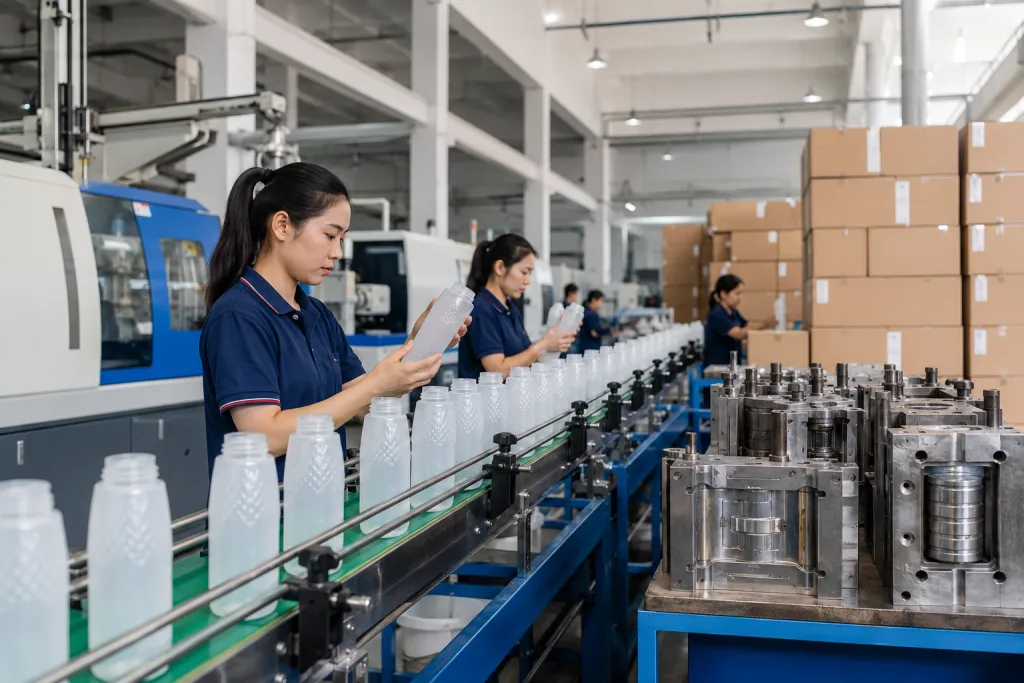
Key Takeaways
- A 0.3 mm wall thickness swing can change squeeze feel, top-load strength, and cap torque performance across a 10,000-unit order
- Typical MOQ for custom PP bottles is 3,000-5,000 pcs per color, with 25-35 day lead time after sample approval in Zhejiang, China
- Leak claims often start with cap-liner mismatch and torque drift; set a torque window such as 0.8-1.2 N·m and test 24-hour inversion at AQL 2.5
- A $0.03-$0.08 saving on resin or decoration can trigger retail rejects, REACH questions, or shipment delays that cost far more
You do not lose money on polypropylene bottles because PP resin is expensive. You lose it on the line when small spec gaps turn into freight claims and rework: lids that seep after 28 days at sea, Pantone color drift between lots, bodies warped after hot-fill above the stated limit, or retail cartons crushed because nobody wrote a drop test like 76 cm, 1 corner, 3 edges. The lowest unit price is the wrong question to ask. If you plan to import polypropylene bottle wholesale for Europe or North America, the job is to block predictable failures before tooling, sampling, and mass production freeze them in.
At BottleForge Industrial in Zhejiang, China, we see this every season on wholesale drinkware, canteen wholesale, and adjacent programs like beer tumbler wholesale bulk and alcohol flask wholesale bulk. A buyer asks for a quote first. Then QC pulled the sample and found the cap torque range was never defined, or the PO had a neck finish typo, or compliance asked whether the color masterbatch matched the food-contact file. That is where claim cost starts, not at the first quoted price. We have seen this go sideways over a 0.3 mm thread mismatch.
The quote is not the spec
Most sourcing mistakes happen before the first sample. A buyer sends one reference photo and asks for pricing on import polypropylene bottle wholesale. The factory sends back a clean FOB China number, maybe USD 0.62 to 1.45 depending on size, lid, decoration, and packout. That number is not a buyable spec. It is a budget estimate. We have seen POs approved off one photo, then the buyer flagged the bottle at sample stage because the grip panel felt soft and the body came in 6 g under what their retail sample suggested.
For PP bottles, the problem starts here: too many details look interchangeable on screen. A 650 ml body can be made with 1.8 mm wall, 2.1 mm wall, or 2.4 mm wall. All three may look close in photos taken on a white table. They do not run the same on the line. Molding stability changes. Squeeze feel changes. Drop resistance changes. Label panel flatness changes. The same goes for neck finish tolerance, cap thread profile, gasket material, and color masterbatch loading. QC pulled samples last month where a 0.15 mm neck variance caused cap fit complaints on a 28/410 thread. Small number, big headache.
If you buy wholesale drinkware or canteen bulk programs, define the critical points before approving price. This is the wrong question to ask: “What is your best price?” Ask what exactly is included in that price.
- Resin grade: virgin PP, food-contact grade, no recycled content unless declared and accepted.
- Body weight: for example 78 g plus or minus 3 g for a 700 ml bottle.
- Wall thickness: target and tolerance by section, not only average weight.
- Cap system: screw cap, flip lid, straw lid, tamper band, liner material.
- Use condition: cold fill only, dishwasher top rack, max service temperature.
- Compliance pack: REACH, LFGB or FDA food-contact declarations, migration testing if required.
- Carton spec: burst strength, dimensions, pallet pattern, and if needed FNSKU labeling for Amazon.
At our Zhejiang facility, custom MOQ is usually 3,000 pcs for standard molds and 5,000 pcs when color matching, special print setup, or custom components are involved. We run about 1.2 million units per month across bottles, tumblers, and related drinkware bulk programs. If a factory cannot turn a sales brief into a measurable production spec, you are still buying hope. We have seen this go sideways over simple things, like a PO typo showing “silicone ring clear” while the approved sample used gray TPE, and the shipment had to be reworked before loading.
When bottles crack, warp, or feel cheap
Buyers blame polypropylene first. On the line, the root cause is usually an underbuilt part or a weak mold setup. PP works well for bulk canteen and wholesale drinkware programs because it weighs less than stainless steel, takes impact better, and keeps unit cost under control. Still, it has limits. We’ve seen 1.6 mm bodies crack at the shoulder after carton compression, while the same shape at 2.2 mm ran clean. If the wall is too thin, ribs are in the wrong place, or mold cooling is uneven, the bottle fails in normal handling.
The usual production failures are:
- Sink marks around handle bases, logo bosses, and thick transitions.
- Oval necks causing poor cap fit and leak risk.
- Base rocking from uneven cooling or poor mold maintenance.
- Panel distortion that ruins silkscreen registration or wrap labels.
- Brittleness from filler-heavy resin blends used to save cost.
You can write a better spec around this. Ask for a section drawing with nominal wall thickness and tolerance, not just a rendering. For a mid-size 600-750 ml PP bottle, a workable wall range is often 2.0-2.5 mm depending on the shape and grip detail. We usually check this with an ultrasonic thickness gauge at 6 points. If the design uses a handle or deep finger grooves, avoid abrupt thick-to-thin jumps. This is where sinks start, and QC pulled samples with whitening at those stress points more than once.
QC checks worth paying for
Do not rely on visual inspection alone. That is the wrong question to ask. A bottle can look clean at packing and still fail after a 12-day sea transit. Set measurable tests at pre-production and during inline QC, and put the frequency on the PO. We’ve even seen a buyer typo “neck check every 2 hrs” as “2 pcs,” and the line followed the paper.
- Top-load test, for example 15-20 kg without permanent deformation if packed in master cartons.
- Drop test from 1.0-1.2 m, empty and filled, on base and side.
- Neck gauge check every 2 hours during molding.
- Weight check by cavity to catch drift from hot-runner imbalance.
When you source canteen wholesale from China, the cheapest bottle often passes a showroom look test and fails after 4 weeks of real logistics.
The same discipline applies even if your wider line includes wholesale growler, beer growler bulk, or best wholesale drink bottle assortments. Different category, same factory math. If the physical spec is loose, production will push cycle time and resin saving first. We’ve seen this go sideways with wrap-label panels off by 1.5 mm, and then the buyer flagged the print, not the bottle. Tight spec, lower claim rate.
Most leak claims start at the cap
Leak claims are the ones buyers remember. Consumers do not forgive a wet backpack or a leaking carton. On import polypropylene bottle wholesale orders, we see more field complaints from the cap set than from the bottle body. Usually it is not one bad part. It is 4 or 5 small misses stacked together: thread tolerance drift of 0.15 mm, liner hardness off spec, cap warpage after cooling on the line, flip-top hinge fatigue, or torque applied outside a controlled 0.8-1.2 N·m window.
PP bottles sold as canteen bulk or drinkware wholesale often have mixed materials in the closure: PP cap, TPE seal, silicone O-ring, PE straw, sometimes ABS button parts. If you do not lock these interfaces in the spec, the factory may swap in an equivalent-looking resin from another supplier lot. We have seen this go sideways after a 12-day sea transit and one dishwasher cycle. QC pulled the sample, and the seal recovery was different even though the parts looked the same in the tray.
Write the closure spec like you expect a claim. Include:
- Thread standard and neck finish dimensions with tolerance.
- Seal material, hardness range, and color.
- Application torque window, such as 0.8-1.2 N·m.
- Leak test method: 24-hour inversion, side lay test, and vacuum or pressure test if relevant.
- Cycle life for flip lids or push buttons, for example 3,000 open-close cycles.
For production QC, AQL 2.5 for major defects is common. For leakage, a lot of buyers ask for tightened inspection or 100% air-pressure screening on higher-risk lids. We run that on push-button lids and straw lids more often than on simple screw caps. It adds cost. The math still works: a $0.02 inspection step is cheaper than chargebacks from a retailer in Germany or the US, and cheaper than reworking 20,000 pcs because the buyer flagged 6 leaking samples at final inspection.
If your assortment also includes alcohol flask bulk, alcohol flask in bulk, or growler wholesale lines, check seal compatibility with more care. Acids, flavor oils, and alcohol change the job. A cap that passes on a plain water bottle may fail on a promotional flask or a beer growler wholesale bulk program after 48 hours of contact. This is the wrong question to ask: “Does it seal?” Ask what it seals, for how long, and at what fill condition. We do not recommend overengineering. We recommend the right interface, then test it under the actual use case.
Color, odor, and decoration failures
Brand owners watch shelf consistency like a hawk. Procurement watches the rework bill. PP is forgiving on impact and weight, but lot-to-lot color and surface finish drift show up faster than first-time buyers expect. We see it on the line: bottle body from one 320T molding press, cap from another cell, carry loop from a second supplier in Zhejiang. Matching one Pantone across all three parts is not automatic. This is the wrong question to ask: “Can you match the color?” The better question is, “What tolerance did you hold last 3 lots?”
The failures are usually simple and expensive: color drift, gloss mismatch, print adhesion loss, and residual odor from cheap additive packs or bad warehouse storage. QC pulled the sample on one 20,000-piece promo order because the loop came out 1 shade warmer than the body, and the buyer flagged it before loading. We ship these issues most often in drinkware bulk, wholesale canteen, and promotional bulk growler programs where 4 or 5 SKUs get packed against one launch date and nobody leaves enough time for retests.
Control them with a few plain rules:
- Color standard: approved master chip plus Delta E tolerance, not just a digital Pantone reference.
- Resin declaration: virgin food-grade PP, no unauthorized regrind.
- Odor check: sealed bag evaluation after 24 hours at room temperature.
- Decoration test: cross-hatch adhesion, tape pull, dishwasher simulation if claimed, and rub test with alcohol where relevant.
Silkscreen on PP runs well if pretreatment and curing are under control. No shortcuts. We run flame treatment before printing, or corona treatment on some parts, then check ink cure with a cross-hatch cutter and 3M tape. Laser marking is cleaner on selected caps, but on light tones the mark can look weak at 600 mm shelf distance. For a mass-market canteen wholesale run, single-color silkscreen may add USD 0.04-0.08 per unit. Full wrap transfer can cost several times that and usually throws more scrap if registration shifts by even 1 mm. If the retail target is tight, the math doesn't work on overdecorating.
The same discipline matters if your portfolio reaches beyond PP into beer tumbler in bulk, beer tumbler wholesale, wholesale growler, or alcohol flask wholesale categories. Buyers mix stainless, PP, and sometimes Tritan into one launch, then expect one approved blue chip to behave the same on every substrate. We've seen this go sideways. It does not. Ask your Zhejiang supplier for component-by-component color history across at least 3 production lots, not one hero sample the sales team hand-picked from the good carton.
Compliance gaps that stop shipments
A bottle can pass drop test and still be dead on arrival for retail. Compliance failures usually cost more than molding defects because they show up after production, when the importer asks for the file pack and QC has already sealed 68 cartons. For Europe and North America, food-contact paperwork needs to match the exact material set and production route you approved, down to the gasket callout on the BOM.
For import polypropylene bottle wholesale, the gaps are usually basic and avoidable: expired declarations, test reports tied to the wrong resin grade, missing migration data for seals or masterbatch, and social compliance claims that sit outside the audit scope. We see this on the line. A buyer in Germany flagged a DoC last month because the report covered PP copolymer grade H350, while the PO had switched to H550 for squeeze performance. If you source from Zhejiang or another China base, check that the documents point to the actual SKU construction, not a similar bottle from last year with a 1.8 mm wall and a different lid set.
What you should ask for depends on the market. The wrong question is “Do you have certificates?” Ask for the document set tied to the SKU and revision.
- Food-contact declaration for PP body and all wetted components.
- REACH where applicable for EU distribution.
- LFGB or FDA support documents depending on your channel requirements.
- BSCI or equivalent social audit if your customer requires it.
- ISO 9001 quality system evidence if you want process consistency.
Do not assume categories share one evidence file. A wholesale drinkware file does not automatically cover beer growler in bulk, growler bulk, or alcohol flask wholesale bulk if those items use different gaskets, interior coatings, or decoration inks from another supplier. Private-label changes cause the same problem. Change to a matte coating, add a soft-touch varnish, or move from silicone to TPE on the straw seal, and the old paperwork may fail review. We’ve seen this go sideways over one Pantone change because the new colorant had no migration support.
The practical move is simple: make compliance part of the sourcing gate, not the shipping gate. No bulk production release until documents, sample approval, and artwork approval match the approved revision. We run this as a hold point before mass production. It feels slower for 2 days. It is faster than remaking 8,000 units because a retailer spotted that the declaration listed PP and silicone, while the approved sample had been changed later to PP and TPE without notice.
Packing failures ruin good production
Factories like to talk about molds and resin. Retail buyers care just as much about whether the carton lands intact at the DC. A decent bottle turns into a bad delivery fast if inner packs float, cartons are oversized by 20-30 mm, or pallet loading ignores forklift handling. We’ve seen first-time drinkware wholesale buyers lose margin on this exact point, and it was preventable.
The failure pattern is familiar on the line: scuffed prints from bottle-to-bottle rubbing, crushed cap spouts, barcode label mismatch, and master cartons popping after humid ocean transit. QC pulled one sample last month with a rubbed-off logo because the polybag opening faced the print. Small miss, big claim. If you ship mixed wholesale drinkware, beer tumbler wholesale bulk, or beer growler wholesale assortments, bad pack engineering eats margin fast. The math doesn’t work.
Set packaging as a technical requirement:
- Individual protection: polybag, tissue, or divider based on decoration sensitivity; for silk print, we often add a 0.5 mm PE sleeve.
- Master carton strength: specify wall type and burst or ECT target; don’t leave this at “export carton.”
- Carton weight: keep practical handling under 12-15 kg for many channels; warehouse teams push back once cartons get awkward.
- Barcode control: outer carton marks, inner labels, FNSKU if Amazon FBA; the buyer flagged one PO because “BK” printed as “BX” on the carton mark.
- Pallet pattern: carton count per layer, wrap method, corner board if needed; we run a quick pallet sketch before mass packing.
For export from China, ask for a packed drop test and stacking simulation, not just a product drop test. This is the right question. A bottle that survives 1.2 m on the lab floor still shows up damaged if cartons bow during container loading or the top layer sinks under stack pressure. We regularly suggest cutting carton cube even if carton count goes up a little, because tighter pallet stability often cuts total damage rate by 1-3%. We’ve seen this go sideways when buyers chase carton quantity instead of pack strength.
Lead time matters here. If your factory quotes 20 days but needs 7 more days for custom inserts, barcode application, and final AQL inspection, your real lead time is 27 days. On our side in Zhejiang, standard custom PP bottle programs usually ship 25-35 days after deposit and sample signoff, and that includes pack-out, not just molding output. If a supplier promises everything in 15 days, check what they counted. We ship plenty of rush orders, but if the insert die-cut is still not ready, 15 days is sales talk, not production reality.
How to buy PP bottles with fewer surprises
The safest buying process is simple. It is disciplined. If you are handling canteen bulk, wholesale canteen, or broader drinkware bulk sourcing, cut ambiguity at each handoff: sales to engineering, engineering to production, production to QC, QC to logistics. On our line, one missed cap torque note of 0.8-1.0 N·m is enough to turn a clean PO into a leak claim.
Use a short, hard spec pack. Include the drawing, material list, color standard, decoration file, closure details, test protocol, AQL level, and packaging standard. Then make the factory quote against that pack only. If they offer substitutes, ask for every change in writing with the unit cost impact line by line. This is the right way to compare suppliers in China. We have seen buyers approve a matte finish by chat message, then QC pulled the sample and found the PO still showed gloss.
A practical approval sequence
- Engineering sample for dimensions, threads, and assembly fit.
- Color and decoration sample on production-like material.
- Pre-production sample with final packaging.
- Inline inspection at 20-30% output completed.
- Final random inspection before balance payment.
For standard import polypropylene bottle wholesale projects, FOB pricing often lands below insulated stainless items, which is why PP remains attractive for price-sensitive promotions and volume retail. Low cost only works if the defect rate stays controlled. This is the wrong question to ask: “Can you do the cheapest bottle?” Ask instead what defect level the factory is holding at 10,000 pcs MOQ. If your wider portfolio includes growler wholesale, beer growler bulk, beer tumbler bulk, alcohol flask bulk, or the best wholesale drink bottle assortment for a seasonal launch, do not let category sprawl weaken your controls. Each item family needs its own failure-mode checklist. A PP bottle issue is often thread mismatch or logo rub; a stainless growler complaint is usually weld appearance or vacuum loss.
The best factory relationships in Zhejiang are not built on miracles. They are built on clear tolerance, realistic lead time, and fast decisions when samples show a problem. We ship smoother projects when buyers lock the color chip and carton mark before mass production, not after 3,000 pcs are packed. If a supplier is direct about what PP can and cannot do, that is a good sign. We have seen this go sideways when a buyer wanted boiling-water performance from single-wall PP. You do not need perfection. You need a process that catches defects before your customer does.
Send your PP bottle spec for a real factory review
We will check wall thickness, cap risk, compliance gaps, MOQ, and FOB feasibility before you place a costly wholesale drinkware order.
Frequently asked questions
What MOQ should I expect when I import polypropylene bottle wholesale from China?
For standard existing molds, a realistic MOQ is usually 3,000 pcs per color or 5,000 pcs per mixed custom program. If you need a custom lid color, printed logo, and retail box, the practical MOQ often moves upward because of setup waste and packaging minimums. In Zhejiang, China, many factories will quote lower trial quantities, but unit pricing rises fast and color consistency usually gets worse. For a 600-750 ml PP bottle, buyers commonly see FOB pricing around USD 0.62-1.45 depending on weight, lid complexity, decoration, and packout. If you ask for canteen wholesale, drinkware bulk, or mixed wholesale drinkware assortment in one container, ask for MOQ by component, not only by finished SKU.
How do I prevent leaking on PP sports bottles and canteen wholesale orders?
Start with the closure, not the body. Specify the neck finish dimensions, cap material, gasket material, and torque window in the purchase spec. A common torque range is 0.8-1.2 N·m, but it depends on thread design and seal hardness. Then require a 24-hour inversion test and side-lay test on production samples, not just engineering samples. For flip lids, add cycle testing of at least 3,000 openings. During final QC, use AQL 2.5 for major defects at minimum, and consider tightened inspection for leakage if the order is for retail or e-commerce. Leakage claims on wholesale drinkware usually come from substitution of liner material or drift in neck dimensions during molding, so check both on every production lot.
Is polypropylene a good choice compared with other drinkware materials?
For price-sensitive volume orders, yes. PP is light, impact-resistant, and generally cheaper than insulated stainless steel or more complex multi-material constructions. It works well for promotional bottles, kids bottles, and entry-level canteen bulk programs. But you need to respect its limits. PP can warp under high heat, and it will not deliver the premium feel or thermal performance of double-wall stainless. For many North American and European retail programs, PP is a smart choice when target FOB is below about USD 1.50 and weight matters. If your line includes wholesale growler, beer tumbler wholesale bulk, or alcohol flask wholesale, use PP only where the liquid type, temperature, and branding position make sense.
What documents should I ask for before shipping a PP bottle order?
At minimum, ask for a food-contact declaration tied to the actual PP resin and all wetted components such as seals, straws, and colorants. For EU sales, REACH support is commonly requested, and some buyers also want LFGB-related evidence depending on the channel. For US programs, FDA food-contact support is typical. If your customer has ethical sourcing requirements, request BSCI or equivalent social audit records, and if process control matters, ask for ISO 9001 evidence. The key is matching the paperwork to the exact construction. If the factory changes a silicone seal to TPE after sample approval, the old report may no longer apply. That is how shipments get stopped even when the bottles look fine.
How long should lead time be for custom bulk drinkware orders?
For a custom PP bottle using an existing mold, 25-35 days after deposit and sample approval is a realistic export lead time in China. That usually includes molding, printing, assembly, packing, and final inspection. If you need custom packaging, Amazon labels, or multiple colors, add 5-10 days. New tooling can add 20-35 days depending on complexity and sampling rounds. Be careful with quotes that promise 15-20 days for fully customized wholesale drinkware unless they clearly state what is excluded. Many delays happen because buyers approve the bottle sample but not the carton, barcode layout, or final artwork. The true lead time is the one that includes every step to FOB shipment.