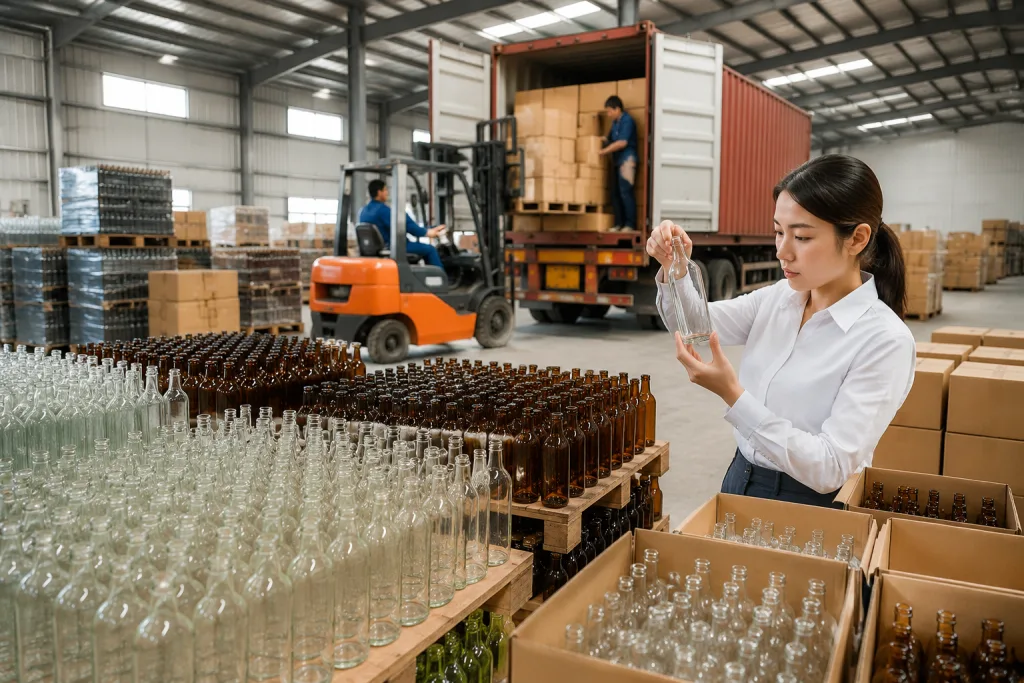
Key Takeaways
- Stock-shape glass bottles often start at 3,000-5,000 pcs, while custom molds usually need 20,000-50,000 pcs plus USD 1,500-8,000 tooling
- Typical ex-works unit prices run about USD 0.38-0.95 for simple borosilicate or soda-lime bottles before decoration, lids, and packaging upgrades
- A realistic production timeline is 35-55 days for stock items and 60-90 days for fully custom programs from China
- Sea freight and breakage controls can add 12%-28% to landed cost, so bottle price alone is a poor buying metric
You usually see the trouble after the quote hits your inbox: freight comes in 18% over budget, a screen-print color pushes MOQ from 3,000 to 5,000 pcs, and the sample schedule slips from a 45-day plan to 75 days because the decal proof sat for 6 days. That happens all the time on the line. If you are buying import glass bottle wholesale for Europe or North America, the bottle price is only one line on the sheet. Tooling, decoration scrap, 5-layer outer cartons, drop-test targets, and vessel cutoff dates drive the real number.
At our Hangzhou, Zhejiang operation, we run mostly stainless and mixed-material drinkware, and we also support glass bottle programs for brand owners who want one sourcing window across bulk drinkware categories. The practical question is not whether China can make the bottle. Zhejiang and wider China can. The right question is which neck finish, decoration method, carton spec, and MOQ give you the landed cost you can sell, plus a lead time your launch calendar can actually hold. We have seen buyers ask for low MOQ and custom spray color on the same PO; the math doesn't work. Last month QC pulled a glass sample because the mouth diameter was off by 1.2 mm, and that single issue would have delayed cap fit approval by a week if nobody caught it.
Start with the bottle specification
Most first quotes miss the mark because the RFQ is vague. “Glass bottle, 500 ml, custom logo” does not give a China factory enough to price cleanly. If you want a dependable import glass bottle wholesale quote, lock five basics before you compare suppliers: glass type, capacity tolerance, mouth finish, decoration method, and packaging standard. We see this every week. A buyer sends a 500 ml request, then later adds a 38 mm screw neck and individual color box, and the quote moves 12%.
Glass type changes price and risk fast. Soda-lime is standard for value programs. High-borosilicate costs more and handles thermal shock better, which matters if the bottle sits in a premium tea range or mixed-material wholesale drinkware line. Wall thickness also needs to be fixed early. A 500 ml bottle at 2.8 mm and the same bottle at 3.5 mm will not run, pack, or pass drop tests the same way. On our line, QC pulled the sample and found a 68 g weight gap between two “same size” bottles from different molds. Heavier glass can cut transit breakage. It also pushes up freight and pallet weight, so the math does not always work.
- Mouth finish: screw necks are simpler and lower cost than specialty caps; a common neck like 28 mm or 38 mm is easier to source than a custom tooling cap.
- Capacity: common commercial sizes are 350 ml, 500 ml, 650 ml, and 750 ml; you also need to state tolerance, because 500 ml ±5 ml prices differently from ±10 ml.
- Decoration: one-color silkscreen is cheaper than full-wrap decal or sprayed finish; screen printing also runs faster if the artwork stays within one print area.
- Packaging: egg-crate dividers, individual boxes, and mailer-grade cartons all change cost fast; the buyer flagged this on one PO after switching from 5-ply export carton to mailer-grade without updating the quote.
If your assortment includes canteen wholesale, bulk canteen, or wholesale growler programs alongside glass, keep the spec logic consistent across materials. Buyers often benchmark a glass bottle against canteen bulk or growler bulk pricing and skip freight density and breakage allowance. This is the wrong question to ask. Glass needs more protective packaging, stricter carton compression standards, and more care at loading. We have seen this go sideways when a buyer used the same outer carton standard for stainless and glass, then failed stack test at 160 kg.
A practical RFQ from an experienced buyer usually includes target market, compliance needs such as REACH or LFGB, acceptable AQL level, barcode format, and target ship date. Add one more thing: the exact pack-out, like 24 pcs per carton or 1 pc per gift box. We ship cleaner quotes when that part is clear. Last month, one PO even had the barcode suffix typed wrong, and the buyer had to reprint 18,000 labels. Once the core spec is fixed, the quote gets more honest.
What really drives the unit cost
For import glass bottle wholesale, the first unit price is almost never the shipped unit price. On most projects we run, the bottle body is only 45% to 65% of finished ex-works cost. The rest sits in the lid set, decoration, packaging, and yield loss on the line. We’ve seen buyers focus on the glass and miss a 1.5 mm silicone gasket spec that changed the actual offer.
For a plain 500 ml stock bottle from China, you might see ex-works pricing around USD 0.38-0.55 with a basic PP lid, depending on order volume and weight. Change it to a bamboo sleeve, stainless cap insert, or silicone boot, and the cost jumps to USD 0.68-1.20 fast. Add custom gift box packaging and you may add another USD 0.25-0.60 per set. That part is routine. The surprise usually comes from packing drop-test upgrades after QC pulled the sample and found corner crush on the first carton mockup.
Common cost drivers
- Glass weight: every extra 50 g affects both material cost and freight. On a 10,000-piece run, that extra weight shows up again in pallet load and container count.
- Decoration yield: sprayed coatings and metallic finishes usually carry higher rejection rates. Decals look simple on paper, but if the print registration drifts by 2 mm, the buyer flags it.
- Cap assembly: multi-part caps with seals or tea filters add labor and more QC points. A cap with 4 components is not priced like a one-piece PP lid.
- Packaging grade: plain export carton is cheap; retail box with inserts is not. The math doesn't work if the product is a USD 0.55 bottle packed in a box built like consumer electronics.
- Testing: migration, dishwasher, or drop-test validation adds cost but often saves claims later. We ship plenty of repeat orders where one pre-shipment drop test avoided a full batch complaint.
If a supplier gives you a bottle price that looks too low, check what they left out: lid gasket grade, master carton upgrade, or spare breakage allowance. We’ve seen this go sideways, especially when the PO had “12 pcs/ctn” typed instead of “24 pcs/ctn.”
This is where adjacent categories confuse cost targets. A buyer looking at drinkware bulk options may compare a glass bottle to beer tumbler bulk, alcohol flask bulk, or wholesale canteen items and assume the margin structure is close. It isn’t. The risk profile is different. A simple stainless item often ships with less breakage exposure than a glass SKU. A wholesale growler or beer growler wholesale project may look efficient on unit price, but the larger cavity, heavier glass, and lower pallet density usually push freight up.
If you are trying to identify the best wholesale drink bottle for margin, ask for a costed BOM instead of a single bottle price. This is the right question. A solid factory will break out bottle, lid, decoration, inner pack, master carton, and sample charges. We usually add MOQ notes too, such as 3,000 pcs for stock glass and 5,000 pcs for a custom color lid, because that is where the true cost driver shows up.
MOQ tiers and where pricing shifts
MOQ is not a penalty. It is the break point where the line runs cleanly and scrap stops eating the order. For stock-shape glass bottles, a workable MOQ is often 3,000-5,000 pieces per size per color. On our side, that is usually the point where carton MOQ, silk-screen plate setup, and pallet planning stop fighting each other. For a custom logo on a standard clear bottle, some factories will take 2,000 pieces if the artwork is one-color, the print area stays within the screen spec, and you accept shared packaging. Buyers push back on this all the time. The wrong question is “what is your lowest MOQ?” Ask what changes if you move from 2,000 to 3,000 pcs.
Custom molds are a separate cost block. If you want a proprietary silhouette, embossed logo, or non-standard neck finish, expect 20,000-50,000 pieces to make the economics work. Tooling commonly ranges from USD 1,500 to USD 8,000, depending on complexity and cavity count. Tool lead time is usually 20-35 days before formal sample approval. We have seen projects stall over a 1.5 mm logo relief that looked fine on the drawing but ran soft in the sample. Then QC pulled the sample, the buyer flagged it, and the clock reset.
Pricing moves in steps, not smooth curves. For a 500 ml stock bottle with standard cap and one-color print, the usual breakpoints look like this:
- 3,000 pcs: USD 0.72-0.95
- 5,000 pcs: USD 0.60-0.82
- 10,000 pcs: USD 0.52-0.74
- 30,000 pcs: USD 0.45-0.66
These numbers are not universal, but the step pattern is real. After 5,000 pcs, the screen-print setup cost gets spread better and carton buying starts to make sense. After 10,000 pcs, line speed and packing efficiency usually improve again. We see the same thing in canteen wholesale, drinkware wholesale, and alcohol flask wholesale bulk. MOQ is often set by the most stubborn component, not the glass body. A custom color silicone sleeve is a common problem. One sleeve supplier may quote 5,000 pcs while the bottle body can run at 3,000, and that is where the math doesn't work.
If you need mixed SKUs, ask whether the factory can combine bottle sizes under one print setup style or one shared cap platform. We run mixed programs this way to keep the order buildable. At BottleForge Industrial in Zhejiang, our broader drinkware programs often run mixed orders with MOQ starting around 3,000 pcs per model and monthly capacity over 300,000 units across categories. For glass, the practical move is the same: standardize components where you can, then use decoration to create variety. New molds look exciting on a PO. We have seen this go sideways over one cap-thread typo that forced a full recheck before shipping.
Timeline from inquiry to vessel booking
Lead time for import glass bottle wholesale is predictable if you stop treating sampling and production as one block. Split it by stage. That gives your team a schedule you can run with and a better shot at hitting launch. On our side, the first thing sales does is open the spec sheet and check neck finish, bottle weight, and carton size before the line even sees the job.
For a stock-shape bottle with standard cap and artwork only, the usual path from China is:
- Quotation and technical confirmation: 2-5 days
- Pre-production sample: 7-12 days
- Mass production: 20-35 days
- Final inspection and booking: 3-7 days
- Total before sailing: roughly 35-55 days
That timing works if the files are clean. A buyer once sent us the right logo with the wrong cap color code on the PO, and we lost 3 days just fixing artwork approval.
For custom mold projects, add mold making, mold trial, and sample revisions:
- Mold development: 20-35 days
- Initial mold samples: 7-10 days
- Revisions and approval: 7-15 days
- Mass production: 25-40 days
- Total before sailing: roughly 60-90 days
Custom mold timing goes sideways fast if the drawing is not locked. We usually ask for bottle height, base diameter, brimful capacity, and finish tolerance in mm upfront; if those keep changing after the mold trial, the math doesn't work.
The biggest delays are usually not on the factory floor. They come from slow artwork approval, unclear packaging rules, or a booking crunch at the port. We run fast in Zhejiang, but if your PO is signed off on Friday night and Ningbo space is tight on Monday, you still miss the retail window. In peak periods, add 7-14 days of buffer for container booking. QC pulled one booking-season sample last year with a correct bottle and the wrong 24-pack divider, and that single packaging issue held the release.
Mixed-category orders make timing harder. If your range includes beer growler bulk, beer tumbler wholesale bulk, alcohol flask wholesale, or wholesale drinkware assortments, the slowest SKU usually controls shipment. One item might need 48 hours of coating cure time, another goes to third-party testing, and another needs a custom insert with a 5000-set MOQ. We have seen buyers wait on all of it and lose 12 days vs 18 days they could have saved by splitting the urgent stock SKUs from the slower custom ones. Waiting for every carton to look perfect at once is often the wrong question to ask.
If you need Amazon FBA prep, barcode application, or bilingual packaging for Europe and North America, lock that before sampling. Late carton changes cost days no factory can give back. On the line, even a small carton revision means rechecking label position, outer carton drop mark, and pallet height before we ship.
Freight, duties, and breakage math
Glass punishes buyers who stare at FOB and stop there. Landed cost moves with carton cube, gross weight, and how much protection we put in before the shipment leaves China. We’ve seen a bottle priced USD 0.06 lower ex-works turn into the expensive option after the line switched to 5 mm thicker dividers, a larger master carton, and a higher breakage claim rate. That is the wrong question to ask.
For sea freight, smaller programs usually hit weight limits before cube. Larger programs get squeezed by both. As a planning range, freight, local charges, insurance, and inland delivery can add 12% to 28% on top of FOB, depending on destination, season, and order size. We run this check by CBM and kg at the quotation stage, not after the PO. Air freight is mostly for samples or emergency replenishment; the math does not work on glass.
Breakage allowance needs plain math. On well-packed standard bottles, buyers often plan for 0.5% to 1.5% transit loss. On heavy shapes, gift-box retail packs, or weak cartons, the number goes up fast. QC pulled the sample last month and found bottle-to-bottle contact inside a divider set that looked fine in photos. If your market includes e-commerce, not just pallet delivery to distribution centers, you need parcel-grade packaging, not a basic wholesale pack. We’ve seen this go sideways.
What to verify before booking
- Carton burst strength or edge crush requirement
- Divider type and bottle-to-bottle contact risk
- Palletization pattern and stretch-wrap standard
- Drop-test method for retail or parcel channel
- Inspection plan, usually AQL 2.5/4.0 unless tightened
Growler formats need extra caution. A bulk growler or beer growler in bulk order looks simple because the shape is familiar, but larger glass containers raise transit risk on every layer of the pallet. The same problem shows up in beer tumbler in bulk and alcohol flask in bulk programs with spray, decal, or electroplated finishes, where QC often flags rub marks after a 1A drop test. Buyers ask to save USD 0.08 with thinner packaging; then claims wipe out the savings.
If you are buying from Zhejiang or elsewhere in China, ask for packing photos, loaded carton dimensions, and a container load estimate before PO approval. Ask for the actual outer carton size in mm and the loading qty by 20GP and 40HQ. We ship those numbers every day. That is how you stop freight surprises from eating your margin.
How buyers keep projects on schedule
The fastest way to cut cost and lead time is to kill decision loops early. Teams that keep imports on track usually do this in 72 hours, not 2 weeks: freeze specs, approve artwork against line limits, and split legal compliance from optional custom touches. On our side, the buyer who keeps changing the bottle height by 2 mm after mold review is the buyer who loses 10 days.
For glass bottle programs, run stage gates. Approve the bottle body first, then cap fit, then decoration, then packaging. Don’t ask the factory to change all four in one round; we’ve seen this go sideways, and the line ends up debating whether the leak came from the neck finish, the gasket, or a bad carton drop test. If you are building a family of products that includes canteen bulk, growler wholesale, and drinkware wholesale SKUs, keep cap finishes, gasket materials, and outer carton logic shared where possible. Shared parts cut MOQ pressure. They also make repeat orders easier—say 3,000 pcs on one lid instead of 1,000 pcs each across three lid types.
Ask for these documents as standard, not as favors:
- Specification sheet with dimensions and tolerances
- Packing list with units per carton and carton gross weight
- Inspection standard with critical and major defects defined
- Compliance file for materials touching beverage
- Production timeline with milestone dates
For Europe, REACH and LFGB questions come up often. For North America, buyers may ask for ASTM-related packaging testing, California Proposition 65 screening where applicable, or food-contact declarations for lid parts. This is routine work, not a special case. QC pulled the sample last month because a PO said “silicon ring” instead of “silicone ring,” and that one typo stalled the declaration file for 2 days. Plan these checks before mass production.
Don’t chase the lowest quote if the supplier cannot explain yield loss, carton design, or inspection method. This is the wrong question to ask. Late claims usually start there. The best wholesale drink bottle for your brand is often not the cheapest unit price; it is the bottle that ships on day 35 instead of day 48, passes inspection at AQL 2.5, and does not eat margin with hidden repacking or breakage costs. If a supplier in China can answer those points clearly, you can work with them.
Get a workable glass bottle sourcing quote
Send your target size, decoration, MOQ, and ship date. We will map likely cost drivers, lead time, and packing risks before you place the PO.
Frequently asked questions
What is the normal MOQ for import glass bottle wholesale?
For stock-shape bottles, 3,000 to 5,000 pieces per size is the common starting point in China. If the bottle is clear, the cap is standard, and the decoration is one-color silkscreen, some suppliers may accept 2,000 pieces, but the unit price will be higher. Fully custom molds usually need 20,000 to 50,000 pieces to make sense, especially if you need embossed branding or a special neck finish. Also check component MOQs. A silicone sleeve, bamboo lid, or gift box can set a higher minimum than the bottle body itself. If you need multiple SKUs, ask whether shared caps or shared cartons can reduce total MOQ pressure without increasing your landed cost.
How long does a glass bottle order from China usually take?
A stock bottle program usually needs 35 to 55 days before sailing. That includes 2 to 5 days for technical confirmation, 7 to 12 days for pre-production samples, 20 to 35 days for mass production, and a few days for inspection and vessel booking. Fully custom projects normally take 60 to 90 days because mold development alone can take 20 to 35 days, followed by mold samples and revisions. If you buy during peak shipping periods, add 7 to 14 days of booking buffer. The fastest way to lose time is delayed artwork approval or late packaging changes. Freeze the spec early and lead time becomes much easier to manage.
What unit price should I budget for wholesale glass bottles?
For a basic 500 ml stock bottle, ex-works pricing often falls around USD 0.38 to 0.55 with a simple lid, but most finished programs land closer to USD 0.60 to 0.95 once you add decoration, upgraded closures, and stronger packaging. Premium features such as high-borosilicate glass, bamboo caps, silicone sleeves, or retail gift boxes can push cost above USD 1.00. Tooling for custom molds typically adds USD 1,500 to USD 8,000 one time. Do not compare bottle-only prices across suppliers. Ask for a cost breakdown covering body, lid, print, inner pack, master carton, and estimated breakage control. That gives you a quote you can actually use for margin planning.
How do I reduce breakage when importing glass bottles in bulk?
Start with packaging design, not insurance. Use dividers that prevent bottle-to-bottle contact, confirm master carton strength, and ask for palletized loading photos before shipment. For standard wholesale shipments, many buyers target 0.5% to 1.5% transit breakage as a planning range, but e-commerce programs may need much stronger individual packaging. Heavier glass is not always the answer because it raises freight cost. Focus on the full system: bottle shape, wall thickness, divider design, carton compression, pallet pattern, and stretch-wrap quality. If you sell through parcel channels, require drop-test validation on the retail pack. A cheap carton upgrade often saves more money than a cheaper bottle ever will.
Can I combine glass bottles with other drinkware like growlers or canteens in one order?
Yes, but combined orders need planning because the slowest SKU often controls the ship date. If your assortment includes wholesale growler, bulk canteen, beer tumbler wholesale, or alcohol flask wholesale bulk items, align component approvals and packaging milestones early. Shared outer carton standards, barcode rules, and inspection criteria help a lot. The best approach is usually to separate urgent stock SKUs from slower custom SKUs rather than waiting for everything to finish together. Also remember that different materials have different compliance and packing logic. Stainless, glass, and coated items do not move through production at the same speed. A mixed shipment can work well, but only if your PO schedule is built around real lead times, not wishful averages.