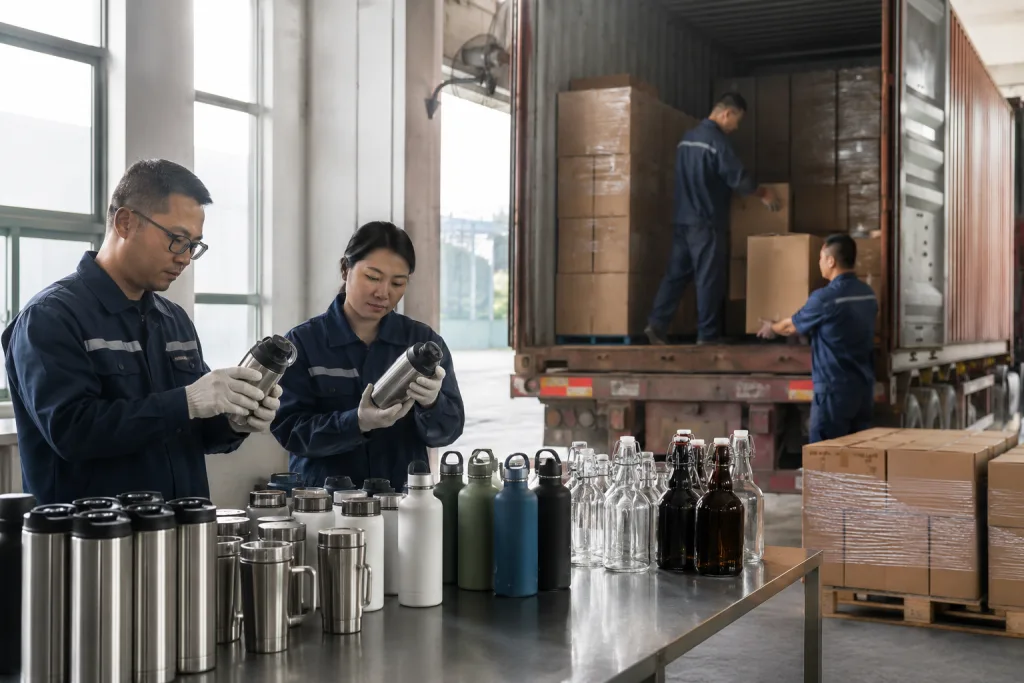
Key Takeaways
- Mixed-SKU import drinkware wholesale orders usually start at 1,000 pcs per color per model, with 30-45 day production lead time
- A 0.2 mm wall thickness change can shift unit cost by USD 0.12-0.28 and affect dent resistance during ocean freight
- Use AQL 2.5 for major defects and AQL 4.0 for minor defects on final inspection, with at least 32-drop carton checks per lot
- For Europe and North America, ask for REACH, LFGB or FDA-contact reports, plus barcode and carton mark approval before mass production
You do not lose money on wholesale drinkware because one bottle leaks on your desk. You lose it 6 weeks later, when customs asks for a missing LFGB report, Amazon kicks back the outer-carton label, or 3% of lids fail torque after arrival at 18–20 lbf·in on the torque meter. That is the real job in import drinkware wholesale: not finding a factory in China, but building a repeatable order that lands on time and sells without surprises. We’ve seen this go sideways.
Take one buyer case we see from Zhejiang: a mid-size brand owner booking a mixed container of wholesale canteen, beer tumbler wholesale bulk, and a small alcohol flask wholesale bulk run for Q4. The point is control, not theory. You need to lock the spec, price the risk, inspect against AQL, and ship with the right paperwork before the 30% deposit leaves the bank. On the line, QC pulled the sample and found a PO typo on lid color code once; that small miss would have turned into 12,000 wrong units. This is the wrong question to ask if you only want the cheapest quote.
Start with a real PO brief
Let’s start with a PO that looks like a real buyer file, not a mood board. Say you are a North American brand placing your first mixed order at 8,000 units total. The mix is standard for our line: a 32 oz wholesale canteen in 3 colors, a 20 oz beer tumbler in bulk in 2 colors, and a 6 oz alcohol flask bulk line for seasonal gift sets. You need your logo applied, retail boxes on part of the run, master cartons that fit Amazon replenishment rules, and compliance documents your Germany distributor can file without asking twice. This is where orders drift. We’ve seen one PO miss the box spec, then the buyer flagged it after 1,200 color boxes were already printed.
A usable PO brief should include at least the following:
- SKU breakdown: 4,000 canteen bulk units, 3,000 beer tumbler wholesale units, 1,000 alcohol flask in bulk units.
- Material: 18/8 stainless steel inner and outer for vacuum items; 18/0 is cheaper but usually the wrong choice for branded drinkware.
- Construction: double-wall vacuum for canteens and tumblers, single-wall or wrapped construction for flasks.
- Wall thickness: 0.4 mm inner / 0.5 mm outer for the canteen; 0.35 mm / 0.4 mm for tumbler if target price is tight.
- Surface finish: powder coat 60-80 microns, or spray paint if you accept lower scratch resistance.
- Decoration: one-color silkscreen, laser engraving, or wrap printing. Logo size in mm, Pantone code, placement tolerance.
- Packaging: polybag, egg-crate divider, white box, color box, insert card, carton size limit, drop standard.
At BottleForge Industrial in Hangzhou, Zhejiang, we usually get a reference photo, a target price, and not much else. That is not enough. This is the wrong question to ask: “Can you match this cup?” A factory with 600,000 units per month capacity can still make the wrong product fast if the brief leaves room for guessing. We run sampling off the spec sheet, not off screenshots. QC pulled the sample on one project last month because the logo placement was off by 3 mm, and the PO had no tolerance listed. Your brief should kill guesswork before sampling starts.
Price the order like an importer
Now price the order like an importer, not a first-time buyer. Ex-factory cost is only one line on the sheet. For a workable China example, we use these FOB Ningbo numbers at current mainstream spec levels, based on what we run on the line with standard carton pack and normal logo setup:
- 32 oz stainless canteen wholesale: USD 3.85-4.60 each at 4,000 pcs.
- 20 oz beer tumbler wholesale bulk: USD 2.55-3.20 each at 3,000 pcs.
- 6 oz alcohol flask wholesale bulk: USD 1.45-2.10 each at 1,000 pcs.
- One-color logo print: add USD 0.05-0.09 each.
- Laser engraving: add USD 0.10-0.18 each.
- Color gift box: add USD 0.22-0.48 each depending on board grade and insert.
If a supplier comes in 15% below this range, stop and check the spec line by line. We have seen this go sideways. The cheaper number usually came from somewhere: 0.4 mm outer wall instead of 0.5 mm, less copper plating coverage in the vacuum chamber, lower powder coat adhesion, untested lid gasket, or a weaker export carton. QC pulled the sample once on a canteen project where the quote was only USD 0.22 lower, and the dent rate after drop test was the problem, not the print. On paper it looked fine. In container handling, it did not.
Set the shipping basis early. FOB is cleaner for buyers who already know freight, carton count, HS code, and destination charges. DDP sounds easy, but this is the wrong question to ask if you do not know what is packed into that rate. We have had buyers focus on the all-in price and miss that one PO showed 24 pcs per carton while the actual packing was 20 pcs, which changed the freight math. For Europe and North America, a common first-order split is simple: FOB for the main palletized shipment, plus one express carton for pre-production and golden samples. We ship that small carton first so approvals move fast without loading the whole order with airfreight cost.
In Zhejiang and nearby Ningbo ports, normal MOQ is 1,000 pcs per model per color for standard shapes. Mixed colors in one Pantone family are sometimes workable once the total reaches 3,000-5,000 pcs, because the line can hold setup loss down. Specialty growler wholesale items are different. A 64 oz vacuum style or swing-top cap often needs 2,000 pcs since tooling cost, cap sourcing, and leak-test labor are heavier. On swing-top items, each piece still has to pass a water leak check, and that labor adds up fast.
Lock the spec before paying deposit
If the quote works, lock the tech sheet before deposit. Do it on paper. For private-label bulk drinkware, an approved sample is not enough; the line needs a signed spec sheet tied to the PI or purchase contract. We’ve seen this go sideways over a 0.8 mm logo shift that the buyer flagged after mass production.
What the sheet should cover
- Dimensions and tolerance: body diameter, mouth diameter, total height, and weight tolerance such as +/- 3%. Put the numbers in mm and g, not “same as sample.”
- Thermal performance: for vacuum items, set a retention target such as hot 65°C+ after 6 hours from 95°C fill, or cold below 10°C after 8 hours. QC should test from the actual fill line, not from a guess.
- Leak standard: 100% lid leak test inverted for 30 minutes, plus random torque verification. We run this with a torque meter, and loose-thread lids show up fast.
- Coating adhesion: cross-hatch tape test standard and acceptable level. If you only write “good painting,” the math doesn’t work.
- Odor standard: no abnormal odor after 24-hour hot water hold. This catches gasket issues early, especially on new silicone lots.
- Marking: logo location, barcode type, FNSKU placement if needed, carton mark layout, country-of-origin wording. One typo on a PO can turn into 5,000 wrong cartons.
For a bulk growler or beer growler in bulk project, cap design matters more than most buyers expect. Screw caps with silicone gaskets are easier to scale on the line and easier to inspect than decorative swing-top closures. If you sell into craft beer retail, ask for carbonation-related usage limits in the product insert unless the closure has been tested under your real fill condition. This is the wrong question to skip. We’ve had buyers ask for “beer safe” wording, then pull back after pressure tests showed the closure was fine for transport and short holding, not for pressure-vessel use. A lot of so-called wholesale growler products fit that bucket.
If a supplier says “same as sample” but cannot issue a spec sheet with numbers, you are not buying a controlled product. You are buying a promise.
Standard lead time from sample approval and deposit is usually 30-35 days for plain stock colors, 35-45 days for custom coating and boxes, and 45-60 days if your wholesale growler or best wholesale drink bottle program includes new tooling. New tooling often means one more mold trial and a first-article check before we ship. A common payment term is 30% deposit, 70% against inspection approval and before shipment.
Build quality checks into production
The order is live. This is the stage where first-time buyers disappear for 21 days, then ask for production photos 2 days before shipment. Too late. For drinkware wholesale, set 3 checkpoints in advance: pre-production, inline, and final random inspection. We run this off a signed checklist, not chat history. If the factory has internal QC, fine, but your own standard still needs to be confirmed in writing.
A practical control plan looks like this:
- Pre-production meeting: confirm golden sample, logo film, Pantone match, packaging artwork, barcode scannability, and carton mark.
- Inline inspection at 20-30% completion: verify body finish, print position, weld polish, lid fit, and box structure before the full run is complete.
- Final random inspection at 80-100% packed: use AQL 2.5 major, 4.0 minor unless your channel demands stricter tolerance.
Major defects on wholesale drinkware are not hard to define. Leaking lids, sharp burrs on the mouth, vacuum failure, missing logo, obvious color mismatch, failed carton drop, or wrong barcode all belong there. QC pulled the sample once because the mouth edge had a 0.3 mm burr after polishing; that is a reject, not a discussion. Minor defects are usually slight print offset, tiny coating dust points, small dents under an agreed limit, or carton scuffs that do not affect use.
For the 8,000-unit scenario, a third-party final inspection in China will normally sample according to ANSI/ASQ Z1.4. Ask for the functional tests by name. This is the wrong question to ask late. For screw-lid items, require a 100% leak test record. Add a vacuum retention spot check, dishwasher warning consistency if not dishwasher safe, and at least one packed carton drop sequence from 76 cm for standard transit validation. If your order includes beer tumbler bulk and alcohol flask wholesale lines in the same shipment, inspect each SKU separately. We have seen this go sideways when one flask SKU failed vacuum, but the overall report still looked acceptable because the tumbler count carried the pass rate.
Factories in Zhejiang with steady export experience usually understand BSCI audit requests, REACH SVHC concern, and retail packaging controls. Still, do not assume they know your channel rules. One buyer flagged pallet labels after production because their 3PL needed GS1-128 format and the PO only said “outer label.” We ship plenty of orders like this, and small details are where claims start. If your distributor needs lot coding, or your 3PL needs pallet labels in GS1-128 format, lock that before mass production starts.
Documents that clear customs and retail
After QC, paperwork decides if the shipment moves or gets held. The base pack for Europe and North America is short: commercial invoice, packing list, bill of lading draft, and test reports before cargo sails. Every line has to match. We’ve seen a PO typo on one 40HQ hold document approval for 3 days because the consignee name missed one word. If a SKU shows retail claims like BPA-free, dishwasher safe, or 12-hour hot retention, back them up with the right test reference or delete the claim from the artwork. This is the wrong place to guess.
For stainless steel canteen wholesale and drinkware bulk programs, buyers usually ask for:
- EU: REACH SVHC declaration, LFGB or food-contact migration testing where applicable, packaging directive attention, and buyer-specific declaration forms.
- US/Canada: FDA food-contact basis for relevant materials, California Proposition 65 review where needed, and ASTM/CPSIA checks if the item is marketed to children.
- Factory systems: ISO 9001 is helpful; BSCI or Sedex may be mandatory for larger retailers.
If you are shipping to Amazon FBA, add another check. Cartons need outer labels exactly where the prep partner wants them, and each sellable unit must carry a scannable barcode or FNSKU in the approved size. QC pulled the sample on one run and the scanner failed at 15 cm because the label sat over a textured powder coat seam. The buyer flagged it fast. A common mistake in import drinkware wholesale is sticking labels on curved or rough surfaces where scanners miss reads. Test this at pre-production, not after packing 5,000 units on the line.
For China origin shipments, verify the shipping mark against the booking file: consignee name, PO number, carton count, gross and net weight, and country of origin. If the order is split between a Germany distributor and a US warehouse, make separate carton mark files and separate photo approvals. We ship both ways, and mixing marks on even 12 cartons creates a port-side relabel job. The math doesn't work on low-ticket SKUs like alcohol flask in bulk lines.
Shipping choices and landed-cost traps
After inspection passes, three cost leaks still hit importers: pack-out volume, port timing, and destination charges. We’ve seen this go sideways. A vacuum bottle in a gift box is mostly freighted air, and on one 500ml item the outer carton grew by 38 mm just from the presentation sleeve. If you source the best wholesale drink bottle for shelf appeal but skip carton-efficiency math, freight per unit can jump 20-35% against a simple divider pack.
For the sample order, let’s say the total shipment is about 420 master cartons and 23-25 CBM depending on box style. That is the point where LCL vs FCL needs a real cost sheet, not a guess. On several lanes we ship, a 20GP starts beating LCL once destination CFS fees, terminal handling, and damage claims are added; QC pulled the sample on one LCL move and found 6 crushed gift boxes from stack pressure alone. Ask your forwarder for both landed scenarios, door to warehouse.
For FOB Ningbo or Shanghai cargo from Zhejiang, book space at least 10-14 days before ETD in peak season. “There are many sailings” is the wrong question to ask. In Q3 and before holiday cutoffs, space tightens fast, and we run into rollovers even on common routes. Miss one vessel and you may add 7-14 days plus warehouse storage; one buyer flagged this after a Friday cut-off miss turned into 12 days vs 18 days to final delivery.
The practical importer habit is to calculate landed cost per sellable unit before the PO is approved:
- FOB unit price
- Packaging add-ons
- Inspection cost spread per unit
- Ocean freight and destination charges
- Duty estimate by HS code
- Domestic delivery to your warehouse or 3PL
- Expected defect allowance, such as 0.5-1.0%
This hits beer growler wholesale bulk and growler bulk orders harder because the packs are heavier, taller, and less forgiving in transit. The math doesn’t work if the unit price looks good but the carton drop test fails at 76 cm or the freight adds USD 0.40 per unit through wasted cube and breakage. We’ve had POs with a cheap bottle line that lost the saving the moment destination charges were spread over the sellable quantity.
What a clean repeat order looks like
If the first order shipped clean, don't rebuild the file from scratch on the next PO. Set up a repeat-order file and keep it tight: approved spec sheet, golden sample photos, test reports, carton drawings, inspection history, and the signed color swatch with the Delta E note if you use one. We run this off one master folder on the line side. That is how a procurement team turns one good shipment into a stable wholesale drinkware program.
On repeat orders, make the factory confirm there is no change in steel source, gasket material, coating supplier, or carton board grade. Put it in writing. We've seen this go sideways when a purchasing team swapped a silicone ring during a 12-day shortage and the buyer flagged a light odor after sealing the lid for 24 hours. Not malicious. Still a problem. Your PO should state that no material or process change is allowed without written approval.
A healthy repeat-order KPI set is simple: on-time shipment above 95%, final inspection pass rate above 98%, claim rate below 0.5%, and print/color deviation below your approved standard. QC pulled the sample, checked logo position with a 0.5 mm tolerance ruler, and matched the powder coat against the approved chip before final pack-out. If a supplier holds those numbers across two or three cycles, then talk about cost-down through pack optimization or line balancing. Chasing a new factory for a 3% lower quote is the wrong question to ask.
For buyers building a broader assortment, use the first order to test adjacent categories. wholesale growler, canteen wholesale, and beer tumbler wholesale bulk often share finish standards, logo process limits, and outer carton rules, so development can run 12 days vs 18 days if the artwork files and drop-test standard stay the same. We ship these on mixed POs all the time. The same logic applies to alcohol flask wholesale and wholesale canteen projects if the brand look stays consistent.
The basic lesson is plain. Import drinkware wholesale is not about finding the lowest number on Alibaba or at a trade fair. It is about controlling variables from spec to shipment, down to the carton board grade and the typo the buyer missed on page 2 of the PO. Do that, and China and Zhejiang stop feeling risky and start feeling predictable. That is what a procurement manager needs.
Send your spec sheet and get a workable quote
We will review your wholesale drinkware brief, flag risk points, and quote MOQ, lead time, packaging, and FOB pricing from Zhejiang within 48 hours.
Frequently asked questions
What MOQ should I expect for import drinkware wholesale?
For standard stainless shapes from China, the normal MOQ is 1,000 pcs per model per color. A mixed order can sometimes combine colors if the total reaches 3,000-5,000 pcs. For a bulk canteen or drinkware wholesale order using stock lids and standard powder coat, 1,000 pcs is realistic. For bulk growler items with custom caps, or retail gift-box programs, MOQ often moves to 2,000 pcs because setup loss and packaging complexity are higher. If you need very low MOQ, expect fewer color options, stock packaging, and a higher unit price, usually 8-15% above normal production pricing.
How long does a wholesale drinkware order take from approval to shipment?
A practical schedule is 7-12 days for pre-production samples, then 30-45 days for mass production after sample approval and deposit. Simple wholesale canteen or beer tumbler bulk orders with stock components can ship in about 30-35 days. Custom color boxes, laser engraving, or multiple logo locations usually push it to 40-45 days. New tooling for a wholesale growler or custom lid may add 15-20 days. Book ocean freight space 10-14 days before ETD, especially in peak season. If you are shipping from Zhejiang through Ningbo, vessel rollover risk is real in Q3 and pre-holiday windows.
Which tests and certifications should I ask for?
For Europe, ask for REACH-related declarations and food-contact testing such as LFGB when your market requires it. For North America, ask for FDA food-contact basis for relevant materials, and review Proposition 65 if your channel asks for it. If the item is aimed at children, ASTM or CPSIA requirements may apply. On the factory side, ISO 9001 helps, and BSCI or Sedex is often requested by larger retailers. For the product itself, request leak test records, vacuum retention checks for insulated items, and coating adhesion verification. Do not print claims like dishwasher safe or 12-hour hot unless you have support for them.
What defects matter most when inspecting drinkware bulk orders?
The critical failures are leaks, vacuum loss, sharp edges, wrong barcode, missing or incorrect logo, and cartons that fail transit drop tests. Those are major defects and should be controlled under AQL 2.5 or stricter if your retailer requires it. Minor defects are usually small coating dots, slight logo offset, or tiny dents within an approved limit. For a typical 8,000-piece wholesale drinkware run, include functional checks: 100% lid leak testing for screw-cap items, random vacuum performance tests, torque checks, and carton drop tests from around 76 cm. Inspect each SKU separately; do not let pass results on tumblers hide issues on flasks.
Is FOB or DDP better for first-time drinkware importers?
If you already work with a forwarder, FOB is usually the cleaner choice because you control booking, routing, and destination charges. It also makes landed-cost comparison easier across suppliers. DDP can work for small trial orders, but many buyers accept it without seeing how much is tied up in freight, duty assumptions, and destination fees. For a mixed drinkware wholesale order from China, a good first-step is FOB for the main shipment and courier for samples. That gives you visibility. If your total volume is under 10 CBM and you lack logistics support, DDP may be convenient, but ask for a detailed cost breakdown before approving it.