Key Takeaways
- Typical MOQs run from 500 units for stock-color tumblers to 3,000 units for custom-molded bottles, with sample time of 7-12 days
- A 500 ml single-wall stainless bottle may land at USD 0.90-1.60 FOB China, while double-wall vacuum versions often run USD 2.20-4.80 FOB depending on finish and lid
- Production lead time is usually 25-45 days after sample approval and deposit, plus 7-35 days transit depending on air, rail, or sea
- Decoration, packaging, and testing can add 8%-30% to unit cost, often more than raw steel price movement
You are not buying a sample for a showroom. You are tying up cash in a container, a launch date, and a quality target your customers judge in 3 seconds. When you import drinkware in bulk, the bottle is usually the easy part. The hard part is the gap between USD 1.18 and USD 2.46, why one factory quotes 500 units and another holds at 5,000, and why a “30-day lead time” ends up at 47 days after lid sourcing slips 6 days and QC pulled the sample for color mismatch.
At BottleForge Industrial in Hangzhou, Zhejiang, China, we run into the same pattern with buyers sourcing bulk canteen, wholesale drinkware, beer tumbler bulk orders, and growler wholesale programs: the first quote looks clean, but the landed cost does not. This is the wrong question to ask. The better question is what sits inside the price: steel grade, coating line yield, carton spec, and whether the factory built the quote around a 500 pcs MOQ or a 5,000 pcs break. We’ve seen this go sideways over a 2 mm logo shift on a PO proof. The practical way to buy is to split the project into cost blocks, MOQ tiers, and timeline gates before you approve tooling or pay a deposit.
Where the unit price really moves
If you buy wholesale drinkware long enough, you stop asking for the “best price” and ask what is inside the price. That is the right question. On bulk import programs, unit cost usually moves on six points: material, structure, decoration, packaging, testing, and shipment density. On our side, QC pulled this up last month on a 40HQ loading plan because carton size was off by 12 mm and the freight math changed.
Material comes first. For stainless items, buyers usually ask about 18/8 or 304 for inner and outer walls, and sometimes 201 on non-contact parts for budget programs. A 500 ml single-wall bottle in 0.4 mm body thickness lands far below a 500 ml double-wall vacuum bottle with a 0.5 mm outer wall and 0.4 mm inner wall. Add copper coating and the cost climbs again; we run that step after vacuuming, and rejects show up fast if the coating is uneven. For glass, borosilicate sits above soda-lime. For plastic, Tritan is usually priced above basic PP or AS, but Europe and North America buyers still ask for it because the compliance file is cleaner and the clarity sells better on shelf.
Structure is next, and this is where quotes drift apart fast. A basic screw-cap canteen bulk order is cheaper than a bottle with a carry loop, straw lid, silicone boot, tea infuser, or leakproof flip top, because each extra part adds assembly time, mold cost, and leak-risk checks on the line. A wholesale growler with a swing-top closure or pressure-style cap runs through a different process than a standard sports bottle. A beer growler bulk order also ships worse per carton because of shape and wall protection. We have seen this go sideways when a buyer wants the same target price as a round bottle; the math doesn't work.
- Decoration: one-color silkscreen is usually the low point on cost. Powder coating, laser engraving, heat transfer, and full-wrap printing all add cost, and QC often flags logo position tolerance on wrap jobs before mass production starts.
- Packaging: white box may add USD 0.08-0.18; color box often adds USD 0.20-0.60; molded EPE or pulp inserts add more. On gift-box programs, we usually see outer carton drop-test requirements tighten, which means more board weight.
- Testing: REACH, LFGB, FDA, California Proposition 65 screening, or ASTM-related work can add USD 300-1,500 per SKU depending on scope. This part gets missed a lot. Last quarter one PO even had “Prop 56” typed on it, and we had to stop and confirm the correct test request before sampling.
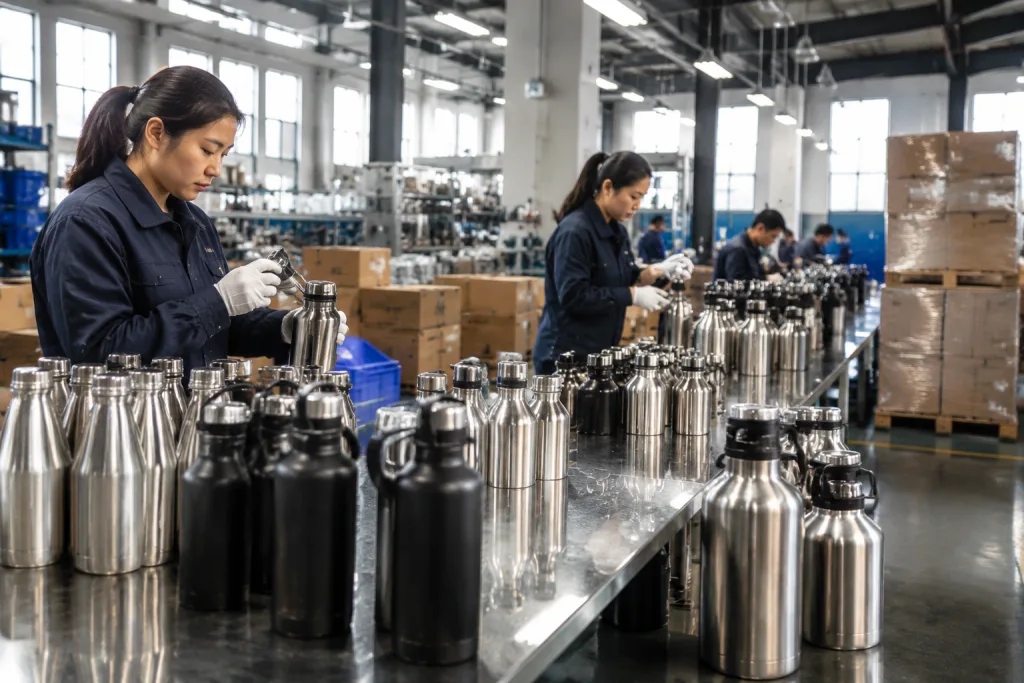
At our Zhejiang facility, output can reach 300,000 units/month across core stainless lines, but every SKU does not carry the same economics. A straight-wall 20 oz tumbler is efficient. A narrow-neck alcohol flask wholesale bulk project with custom embossing is not. If you want a clean quote comparison, ask each supplier to break out FOB unit price, decoration, packaging, tooling, and test cost line by line. If they roll everything into one number, you cannot see where the quote is fat, and the buyer flagged this exact issue on a 5,000-piece flask RFQ we shipped last season.
MOQ tiers that change your options
MOQ is not a punishment. It is factory math. On the line, the same screen setup, pad-print plate, and carton mark take almost the same labor whether we run 300 pieces or 3,000. For drinkware bulk sourcing from China, including Zhejiang and nearby clusters, the practical MOQ bands usually look like this.
Low MOQ: 300-500 units
This band fits stock molds, stock colors, and one simple logo. We usually run this for an existing beer tumbler in bulk, a travel tumbler, or a wholesale canteen based on a house shape. The tradeoff is simple: fewer lid colors, fewer decoration options, and a higher FOB price because setup gets spread over fewer units. On a stock 30 oz tumbler, one-color print at 500 units is usually workable; below that, the math doesn't work unless the buyer accepts plain white cartons and a standard PP lid.
Mid MOQ: 1,000-2,000 units
This is the range most buyers should price first. At 1,000-2,000 units, we can often mix 2-4 body colors, offer standard lid options, and pack cartons more efficiently—say 24 pcs per master instead of wasting cube with split assortments. A canteen wholesale order at 1,000 pieces often lands 6%-12% better than 500 pieces. QC pulled the sample on one run last month because the PO said “mat black” instead of “matte black,” and that small typo matters once you start splitting colors.
Higher MOQ: 3,000-5,000 units and up
This is where custom work starts to make sense. Special powder color, custom color box, accessory bundles, even dedicated tooling for a cap insert or straw collar can move forward once volume supports it. We ship plenty of retail programs in this band because landed margin looks better after freight and duty are added back in. If you want the best wholesale drink bottle economics, this is the tier to test first, not the lowest MOQ tier buyers ask for.
For stock stainless items, our normal MOQ starts at 500 pieces per SKU. For custom color box programs or non-standard lids, 1,000-3,000 pieces is more realistic.
Special categories need separate planning. A growler bulk order, beer growler wholesale bulk program, or alcohol flask in bulk run often carries a higher MOQ because closure parts, leak testing, and polishing are less standardized, and the neck finish tolerance might be checked at 0.2 mm on the gauge. We've seen this go sideways when a supplier quotes a complex item at 300 pieces. Check if they are mixing production lots, burning through old packaging stock, or buying accessories from two sources with different fit.
A realistic lead-time map
Most delays happen before mass production starts. Buyers often watch the 30-day production window and miss the first 10 days lost on spec sheets, lid options, logo files, and sample comments. For import drinkware in bulk, treat the schedule as a chain of release points, not one ship date. We see this on the line all the time: a PO says “matte black,” but the Pantone code is missing, and sample approval stalls for 3 days.
- Quotation and spec confirmation: 2-5 days
- Pre-production sample: 7-12 days for stock molds, 15-30 days if tooling or custom color matching is involved
- Artwork approval and deposit: usually 1-3 days after sample signoff
- Mass production: 25-45 days for most stainless and plastic orders
- Inspection and booking: 3-7 days
- Transit: air 5-12 days, rail 18-28 days to parts of Europe, sea 22-35 days depending on port pair
If you are buying canteen bulk for an event, or wholesale growler units for a seasonal beverage launch, add buffer. Before Chinese New Year and in late Q3, we’ve seen approved orders slip 7-15 days just because powder coating slots were full. Decoration changes the math fast. Powder coating needs line scheduling and oven cure time at around 180°C to 200°C. Laser engraving is steady. Full-wrap transfer and metallic finishes are where the line gets jammed, and the buyer flagged this more than once after seeing sample timing beat bulk timing. That is the wrong question to ask.
Custom packaging stretches the timeline too. A plain export carton moves fast. A retail-ready color box with barcode panel, FSC paper request, and drop-test revision can add 5-10 days on its own, especially if the first dieline comes back with a 2 mm panel shift or a barcode typo on the PO. If you need FNSKU labels, carton marks for Amazon, or multi-language manuals for Europe, state it at RFQ stage. Not after deposit. QC pulled a sample last month where the outer carton mark showed the old item code, and that small miss cost 2 days.
The practical move is simple: count backward from warehouse receiving date, not vessel ETD. Factories in Zhejiang can finish on time and still lose 3-6 days waiting on truck booking, customs cut-off, or a vessel rollover at Ningbo. We ship this route every week. Procurement teams that hold a 10-14 day buffer usually avoid the airfreight rescue plan, and the math works better than paying to fly 8,000 units because one approval email sat overnight.
Cost examples by common product type
Steel cost moves, MOQs move, surface finish moves. Still, buyers ask for numbers, and they should. The FOB China ranges below are normal reference points for medium-grade factory supply. Not premium retail. Not clearance stock. On our line, a 0.08 mm wall change can shift cost faster than most first quotes show.
- 500 ml single-wall stainless bottle: USD 0.90-1.60 at 1,000 pieces
- 500 ml double-wall vacuum bottle: USD 2.20-4.80 at 1,000 pieces
- 20 oz travel tumbler: USD 1.80-3.40 at 1,000 pieces
- 30 oz beer tumbler wholesale bulk style: USD 2.40-4.20 at 1,000 pieces
- 64 oz beer growler in bulk: USD 4.50-8.50 at 1,000 pieces depending on cap system
- 6 oz alcohol flask bulk: USD 1.10-2.40 at 2,000 pieces
What moves the range? On a beer tumbler bulk order, the lid is usually where the quote spreads. A low-cost slider lid is not equal to a tri-mode lid with a better gasket and tighter fit tolerance. QC pulled one sample last month with a 0.6 mm lid gap, and the buyer flagged wobble right away. On wholesale growler projects, closure performance and leakage standard matter more than most buyers expect. A good growler program needs pressure tolerance, stable packing in transit, and clean thread fit on every neck. If your customer fills carbonated drinks, say it on day one. We have seen this go sideways.
Retail packaging changes the math fast. A USD 2.60 bottle can become USD 3.10 after color box, insert, barcode labeling, and stronger master carton protection. For wholesale canteen orders, custom powder color can add USD 0.12-0.35 depending on finish and color match requirements. We run color cards against Pantone under the light box, and metallic shades usually cost more than buyers expect. The logo is rarely the expensive part. The presentation is.
If you compare factories, compare the same spec sheet: same steel grade, same wall thickness, same leak standard, same packaging, same AQL level, and same Incoterm. This is the wrong question to ask: “Why is this supplier USD 0.28 cheaper?” Ask what they removed. We ship quotes every week where the cheaper offer skipped the inner tray, cut carton from 5-ply to 3-ply, or ignored AQL 2.5 entirely.
Quality control that protects margin
Bulk drinkware failures eat margin fast because the defect usually shows up after arrival, not at loading. You need a QC plan that matches the item and the risk. For most wholesale drinkware orders, the baseline we run is incoming material check, in-line inspection during forming and coating, and final random inspection to AQL 2.5 for major defects and 4.0 for minor defects. For higher-risk retail programs, some buyers tighten major defects to AQL 1.5. On our line, QC pulled the sample every 2 hours during powder coat changeover because a 0.2 mm dust nib is enough for a retail buyer to reject the front-facing panel.
For stainless vacuum items, ask one direct question: how is insulation checked, by batch and by record? Visual check is not enough. A serious factory should perform vacuum retention or heat retention checks by batch, not only visual inspection. Lid leak testing also needs a written method: upside-down test duration, hot water use if relevant, and pass/fail rate. We have seen buyers write “no leakage” on the PO, then flag 3 units after 30 minutes with 85°C water because the test condition was never defined. Powder coating should include adhesion and scratch review. Logos need rub testing. If you buy alcohol flask wholesale items, watch weld smoothness, cap tether strength, and inner cleanliness; QC often finds polishing dust left in the shoulder area.
- Compliance documents to ask for: food-contact declarations, REACH screening where relevant, LFGB/FDA depending on target market, and packaging material statements.
- Factory system indicators: ISO-style process control, BSCI or social compliance audit if your brand requires it, and traceable lot coding.
- Inspection timing: do not wait only for final inspection if you have a custom finish or retail box.
At BottleForge Industrial, we recommend one sealed golden sample, one approved packaging sample, and one written defect standard before production starts. This part is basic. It also stops most arguments. We have seen this go sideways over a carton typo, a lid color gap against Pantone, or a logo placed 3 mm higher than the approved sample. In China, especially across mixed supplier chains for lids, straws, and boxes, a written standard beats a verbal promise every time. Good QC does not just cut defects. It protects re-order consistency, and that is what distributors in Europe and North America usually care about most.
Shipping, duties, and landed cost math
FOB price is the starting point. The real call is landed cost per sellable unit. On bulk drinkware, freight can eat more margin than a 5% unit-price cut, especially on low-value SKUs under about USD 2.00. We run this math on a carton-cbm sheet before quoting, because the wrong question to ask is “what’s your best FOB?”
Drinkware is bulky. Dead space in the carton gets expensive fast. A bottle packed at 24 pcs/ctn with a 68 x 45 x 32 cm master can cost more to move than a heavier item that nests tighter at the same MOQ. One 40HQ will load far more straight-wall bottles than handled growlers or gift-boxed tumblers. On the line, we check insert fit with a drop test and carton gauge. Reducing carton size by 8% often beats a USD 0.05 unit-price concession. The math doesn’t lie.
Your landed-cost worksheet should include:
- FOB unit price
- Tooling or sampling amortized over order quantity
- Export carton and retail packaging cost
- Ocean or air freight per unit
- Insurance, customs clearance, duty, and broker fees
- Inspection and testing cost
- Expected defect allowance, often 0.5%-2.0%
For Amazon or DTC programs, add prep costs: carton labeling, FNSKU, polybag warnings if needed, and destination-specific pallet rules. We’ve seen this go sideways over a 10 mm barcode shift or a carton mark typo on the PO. For Europe, check EPR-related obligations where packaging applies. For North America, lock carton marks and barcode placement before production, not after packing, or QC pulled the sample for nothing.
If you source from Zhejiang, China, sea freight from Ningbo or Shanghai is usually the standard route. For Europe, rail fits selected programs when timing matters and product value covers the extra spend; think 18 days vs 32 days port to hub, not miracles. Airfreight is for samples, partial launch stock, or a late vessel that would cost more than the freight premium. We ship this way only when the buyer flagged a hard launch date. For routine beer growler wholesale bulk replenishment, air usually makes no sense unless margin is unusually high.
The buyer who wins is rarely the one with the lowest FOB. It is the one who controls cubic volume, packaging complexity, and reorder timing. That’s how you protect margin shipment after shipment.
Get a workable bulk drinkware quote fast
Send your target quantity, product type, decoration, and delivery date. We will break down MOQ, FOB price, lead time, and packaging options clearly.
Frequently asked questions
What is a normal MOQ when I import drinkware in bulk?
For stock-mold products, 500 units per SKU is a common starting point in China. A plain 20 oz tumbler or standard sports bottle may work at 500 with one logo and stock colors. If you want a custom Pantone body color, retail color box, or special lid, expect 1,000-3,000 units. New molds usually push MOQ higher because tooling cost must be recovered. For categories like wholesale growler or alcohol flask wholesale bulk, 2,000 units is not unusual because closures and polishing steps are less standardized. Ask for MOQ by SKU, by color, and by decoration method. Some factories quote 1,000 units total, but that may still mean 250 units per color and one shared carton spec only.
How long does production usually take after sample approval?
A realistic mass-production lead time is 25-45 days after approved sample and deposit. Stock-color items with simple silkscreen can be closer to 25-30 days. Double-wall vacuum bottles with powder coating, laser marking, and custom packaging are more often 35-45 days. Add 7-12 days for pre-production samples, and 3-7 days for final inspection and booking. Transit then depends on mode: air 5-12 days, rail around 18-28 days to parts of Europe, and sea roughly 22-35 days. If your order falls before Chinese New Year or peak holiday export season, add a 10-14 day buffer. Buyers who plan only around the factory date usually end up paying for expedited freight.
What is the safest Incoterm for a new drinkware supplier?
For most new B2B buyers, FOB is the safest starting point. Under FOB, the factory handles export clearance and delivers the goods to the named port, while you control freight booking and downstream cost visibility. It is easier to compare suppliers because the quote stops at a clear point. EXW can look cheaper but shifts local China charges to you, which often makes quote comparison messy. DDP can be convenient for small test orders, but you lose cost transparency and may face compliance gaps if documents are incomplete. For larger wholesale drinkware programs into Europe or North America, FOB Ningbo or FOB Shanghai is usually the most practical balance of control and simplicity.
How do I compare quotes for bulk canteen and tumbler orders accurately?
Build a like-for-like comparison sheet. Fix the material grade, capacity, wall thickness, finish, logo process, lid type, leak standard, carton spec, and Incoterm. If one supplier quotes 304 inside and outside, and another quietly uses 201 on the outer wall, the price gap is not a real saving. Ask for FOB unit price plus separate lines for packaging, tooling, testing, and sample charges. Also ask for carton dimensions and units per carton because freight efficiency changes landed cost. Finally, compare lead time and defect standard. A quote at USD 2.10 with weak packaging and AQL left undefined is often worse than USD 2.24 with clear QC, approved samples, and stable re-order terms.
What tests or documents should I request before shipping?
For drinkware touching beverages, ask for food-contact compliance evidence relevant to your market, such as REACH-related material screening, LFGB or FDA-style testing where required, and declarations for inks, coatings, and silicone parts. For children’s items, additional standards may apply depending on design and accessories. Ask for leak-test criteria, insulation performance data for vacuum items, and a final inspection report with AQL level stated. If your brand requires it, request BSCI or similar social audit records and packaging material information. A lab test can cost USD 300-1,500 depending on scope, which is cheap compared with a customs issue or retailer rejection. The right time to define the test scope is before mass production, not after the goods are packed.