Key Takeaways
- For a standard 18/8 double-wall flask, define vacuum hold, leak, coating, and drop-test criteria before deposit; MOQ is often 1,000-3,000 pcs per size/color
- A $0.08-0.20 saving per unit from thinner steel or lighter lids can create 2%-5% claim rates if torque, weld, and insulation specs are not locked
- Use AQL 2.5/4.0 final inspection plus 100% leak and vacuum checks on high-volume runs above 20,000 pcs
- China lead time for custom wholesale drinkware is typically 30-45 days after sample approval, plus 7-12 days for lab tests or packaging validation
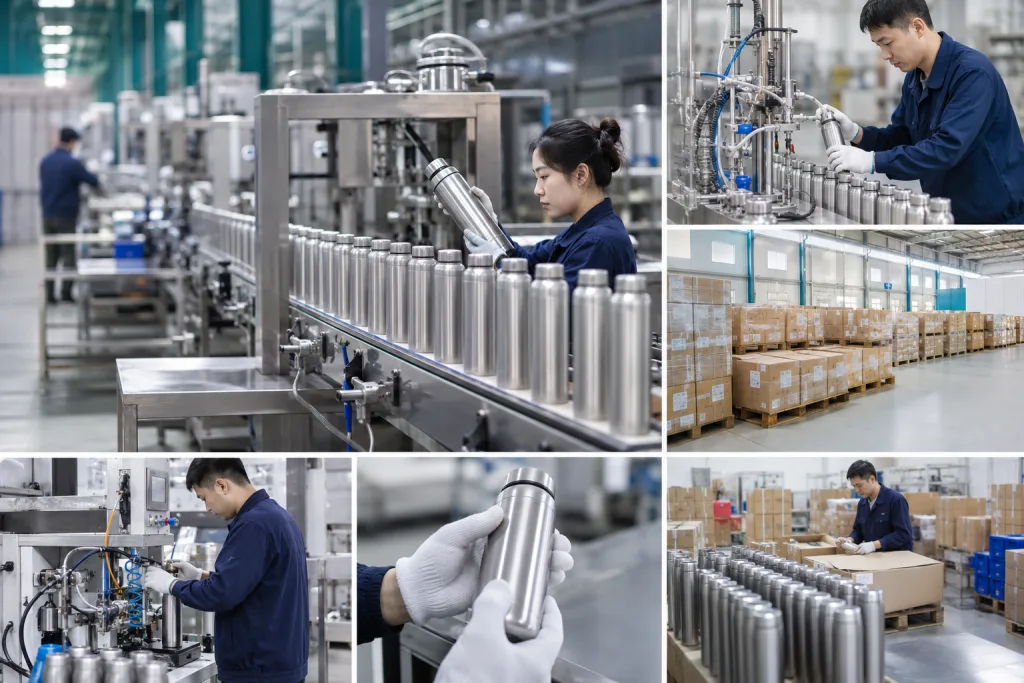
You do not usually lose money on a hydration flask wholesale order because the showroom sample looked good or bad. You lose it later: the production bottle leaks after a 1.2 m drop test, the body sweats after 40 minutes on the dock, the logo scratches in a tape test, or the master carton comes out 18 mm wider than the PO and blows up your freight plan. We have seen this go sideways on the line. Most of these failures are not random. They start with loose specs, optimistic assumptions, and weak control between tooling, painting, assembly, and final inspection.
If you are buying from Zhejiang or elsewhere in China, the practical question is not who offers the lowest unit price. This is the wrong question to ask. The real question is which failure modes are most likely for your SKU, and how early you lock them into the spec sheet before sampling closes. We ship against this every week. That matters whether you are buying hydration flasks, a bulk canteen line, wholesale drinkware for retail, or a beer growler wholesale bulk program for hospitality, where one typo on a carton size line can turn a clean freight plan into 12 days instead of 18 days on replenishment.
Where flask programs actually fail
New buyers in hydration flask wholesale usually start with shape, Pantone, and unit price. Fair enough. But the expensive failures show up later on the line. In our Zhejiang plant, we see the same issues repeat across stainless hydration bottles, canteen wholesale programs, and adjacent items like wholesale growler or beer tumbler bulk orders. Last month QC pulled a sample where the PO color was correct, but the cap thread gauge failed on 3 of 20 pieces.
The common failure modes are predictable:
- Vacuum loss from weak weld consistency or poor vacuum sealing
- Leakage from cap thread mismatch, gasket hardness variation, or bad torque control
- Condensation caused by false double-wall claims or partial vacuum failure
- Coating defects such as orange peel, color drift, chipping, and poor adhesion after curing
- Flavor and odor complaints from silicone, straw parts, glue, or poor passivation
- Transit damage because carton burst strength and divider design were under-specified
- Compliance surprises when materials paperwork does not match the actual lot used
If you buy drinkware bulk, the fix is not more meetings. It is a tighter technical package. For a routine 32 oz flask, you should specify steel grade as SUS304 inside and outside or 304 body with 201 outer only if your market accepts it. Wall thickness should be stated, for example 0.4 mm inner and 0.5 mm outer, not described as “premium steel.” That wording causes arguments. Cap resin should be named, such as PP or Tritan. Gasket should state food-grade silicone with REACH and LFGB or FDA alignment depending on your market. We’ve seen this go sideways because a buyer wrote “silicone seal, black,” and the supplier switched shore hardness without updating the file.
Once those basics are fixed, every QC checkpoint gets simpler. A factory making 600,000 units per month can still ship bad product if the buyer leaves too much open to interpretation. This is the wrong question to ask: “How big is the factory?” Ask what they control on the line. We run thread gauges, vacuum hold checks, and adhesion cross-hatch tests; capacity alone tells you none of that. Capacity is not the same as control. You need both.
Vacuum failure is the expensive one
A hydration flask can pass visual check and still fail in the field if the vacuum is unstable. This is the defect that gets the ugliest reviews, because the bottle feels fine on day one and then stops holding temperature after a week or two. On the line, we usually trace vacuum loss to bottom weld inconsistency, weak evacuation on the vacuum station, or dust and oil left in the seal area. QC pulled the sample once and found metal fines sitting right on the sealing ring.
Ask for a measurable retention spec. For a 500 ml double-wall flask, a practical target is hot retention from 95°C filled water to at least 50°C after 12 hours, and cold retention with ice water under agreed room conditions for 24 hours. If your sales channel claims more, test to that claim. This is the wrong question to soften. Marketing copy is not a spec, and we have seen buyers copy "keeps hot all day" into the PO with no test method attached.
What to put in the PO and QC plan
- Vacuum test method and pass/fail threshold
- 100% vacuum inspection on finished bodies before coating or before assembly
- No surface sweating after 30 minutes with ice water at 23°C ambient
- Bottom weld appearance standard with approved sample photos
For higher-risk items like a large bulk growler or beer growler in bulk with a wide body, thermal stress is less forgiving because of the shape and the handle weld area. We run a 50-100 pcs pre-production lot first, then cut one body for cross-check if needed. That small trial is cheaper than replacing a 10,000-piece shipment. The math doesn't work any other way.
If a supplier says “same as previous order,” ask if they still run the same vacuum machine, the same steel source, and the same bottom process. We have seen this go sideways after a line change in Yongkang, even though the PO looked identical.
If you are comparing FOB Ningbo or FOB Shanghai offers from Zhejiang, remember that stronger vacuum QC can add $0.03-0.07 per unit. That usually covers 100% vacuum check before powder coating, and that is money well spent.
Leaks usually start at the lid
Most complaint photos show a wet laptop bag, not a cracked bottle body. Lid systems drive a big share of after-sales trouble in wholesale drinkware. We see the same failures on the line: thread play too loose, silicone gasket variation of 0.3 mm, a straw tube pinched at assembly, or closing torque that shifts from operator to operator because no torque screwdriver was set.
A hydration flask wholesale brief should read more like an engineering drawing. For a screw-top canteen bulk program, call out thread type, gasket cross-section, Shore hardness, and the target torque range. For example, a common screw cap may need 12-16 kgf·cm closing torque. Without that number, operators tighten by feel. Then overtime starts, a new worker joins the line, and QC pulled the sample with seepage at the thread start.
Leak testing needs more than a “visual check.” Use an inverted leak test for 30 minutes, a side-lay test for 2 hours, and random drop-leak validation after a 1.0 m fall in retail packaging. For a sports lid, add cycle testing at 500 to 1,000 open-close cycles based on the sales channel. This is the wrong question to ask: “Does it leak?” Ask under what angle, after how many cycles, and at what fill level.
- For wholesale canteen orders: keep cap interchangeability across the size family only after thread tolerance is proven; we’ve seen 500 ml and 750 ml caps mix on a PO, then fail on the go/no-go gauge
- For alcohol flask wholesale or alcohol flask in bulk: verify cap seal compatibility with ethanol exposure and odor transfer; the buyer flagged a rubber smell once after 72 hours with high-proof fill
- For beer tumbler wholesale bulk: if using slider lids, define splash resistance honestly and do not market them as leakproof; the math doesn't work once the cup tips in a car cup holder
If a supplier quotes a low lid price, ask whether the mold is single-cavity or multi-cavity and whether thread gauge checks are used. Ask what the cavity balance looks like too. Cheap lids often cost more later because claim rate can jump above 3%. We would rather add $0.05 to a lid than spend 12 days on return claims from Europe instead of 2 days closing shipment files.
Coating, logo, and color go wrong quietly
Visual defects rarely stop a shipment. They do hurt repeat orders. On matte powder coat bottles, QC usually finds orange peel, gloss mismatch, pinholes, thin film near the shoulder radius, and chips at the base after carton vibration testing on the shaker table. Printed logos fail more quietly: Pantone drift, 1-2 mm misalignment, then abrasion after dishwashing or normal retail handling. The buyer flagged this on a 12,000-piece run last summer because navy printed closer to purple under store lighting.
For best wholesale drink bottle programs, a PDF proof is not enough. Approve a signed golden sample with exact print position tolerance, for example ±1.5 mm, and set a color tolerance if your brand team is strict. If you buy custom logo bottles from China, ask which process the factory will run: silkscreen, heat transfer, water transfer, UV print, laser engraving, or pad print. They fail in different ways, and this is the wrong question to ask too late. We have seen POs marked only “logo in white,” then the line used UV print on a curved panel and the edge sharpness came back soft.
Powder coating needs a controlled cure window. Under-cure kills adhesion. Over-cure shifts color and texture. A coating spec that works on the factory floor should include:
- Cross-hatch adhesion test result
- Alcohol rub resistance for printed logo, such as 50 double rubs minimum
- Salt spray expectation if applicable for coated carbon steel accessories
- Carton pack-out method to avoid bottle-to-bottle abrasion in transit
This gets harder if your range includes drinkware wholesale across multiple forms: hydration flask, drinkware bulk tumblers, canteen wholesale, and growler wholesale. Mixed runs on the same coating line raise the chance of batch-to-batch color drift when powder lot numbers change or the oven setting moves from 185°C to 195°C. We run into this on MOQ-sharing orders, and the math does not work if you expect one shade to match across 4 body shapes with different surface areas.
At BottleForge Industrial in Zhejiang, we usually tell buyers to approve one master color chip and one sealed retain sample per SKU. If your replenishment cycle is 60-90 days, this saves arguments later when someone says “the blue looks close enough.” It is not. QC pulled the sample, put it under a D65 light box, and the difference was obvious in under 30 seconds.
Material shortcuts trigger compliance and odor claims
The quickest way to build a hidden claim into drinkware wholesale is to treat all food-contact materials as the same. They are not. We’ve seen a flask body pass, then the buyer flagged odor from the silicone ring, PE straw, spray paint, or polishing residue left inside after the line. For North America and Europe, lock the bill of materials to your target compliance list at the start: REACH, LFGB, FDA, Proposition 65 where relevant, and product-specific ASTM checks for kids items.
For standard hydration flask wholesale, ask for the exact BOM by part: body steel grade, lid resin, seal material, straw material, paint system, and any adhesive. Then match that BOM to the test reports and the production lot code on the carton. This is where orders go sideways. We still see buyers accept a generic “food grade” statement that has no link to the actual lot we run.
This problem is not limited to flasks. In alcohol flask wholesale bulk, ethanol will pull odor out of weak silicone fast; one buyer pushback we got was “empty flask smells fine, filled flask smells like glue after 48 hours.” In beer growler bulk programs, cap liner compatibility matters because carbonation and acidity expose weak material fast, especially on repeated open-close cycles above 30 psi. In beer tumbler in bulk orders, under-cured rim coating shows up in two ways: smell and cosmetic complaints, and QC pulled the sample after a 95°C hot-water soak.
Your QC plan should include incoming material verification, not only finished goods checks. A solid baseline is:
- Mill certificate review for stainless steel
- Random XRF grade check on steel if risk is high
- Silicone odor check after hot water soak
- Migration or contact-material test by accredited third-party lab on first order and after major material change
Factories in China that ship volume usually have the paperwork ready, but paperwork alone proves nothing. The wrong question is “do you have certificates?” Ask if the documents match your live SKU, lid version, and colorway, down to the seal hardness if the gasket changed from 50 to 60 Shore A. If the supplier hesitates on part-level traceability, or the PO has a lid material typo nobody caught, treat that as a warning sign.
Packaging failures erase factory savings
Buyers fight for $0.12 on a bottle, then lose $0.24 with bad packaging. We see it every season. For retail, e-commerce, or Amazon FBA wholesale drinkware, pack-out is part of the product. Not a side task. Flasks get rejected for dented bases, coating rub on the shoulder, crushed cartons, and barcodes placed 8 mm off the scan window, which turns into relabel fees fast.
Start with carton engineering. Specify master carton dimensions, gross weight limit, burst strength, drop standard, and divider type. A typical export carton for stainless bottles may target under 15 kg gross weight and use 5-layer corrugate, but that spec alone is thin. We run into this on the line: the buyer says “5-layer is enough,” then QC pulled the sample and the corner crush failed after one clamp move. If the shipping channel is rough, use stronger board and dividers that were actually tested, not just quoted.
For FBA or DTC programs, define the unit box in writing: suffocation warning if needed, scan position, FNSKU placement, carton label format, and barcode readability. This is where POs go sideways. Last month a buyer flagged cartons because the outer mark said “12 PCS/CTN” while the PO typo showed “12 PS/CNT,” and Amazon held the load. The same rule applies whether you buy hydration flask wholesale, canteen bulk, or a wholesale growler line. Larger vessels like growler bulk and beer growler wholesale usually need custom inserts, because handle stress and sidewall dents show up after long-haul shipping.
Ask your supplier in Zhejiang to run a packaged drop test before mass production. Do it early. One ISTA-style internal validation will show weak points fast, and the math doesn’t work if you find them after 2,000 sets are packed. Ask for palletization photos too. A bottle can pass factory QC and still arrive damaged if pallet overhang is 20 mm or strapping pressure caves in the outer carton.
Lead time gets hit here too. A custom color bottle might be ready in 35 days, but printed boxes can add 7-10 days if dielines are not signed off early. We ship this every month, and this is the wrong question to ask: buyers ask for bottle lead time, not full pack-out lead time. If your MOQ is 2,000 pcs per color and the box printer requires 3,000 pcs, clear that mismatch before deposit.
How to write a tighter sourcing spec
The buyer document that saves projects is not a 12-page wish list. It is a tight spec sheet, usually 3-5 pages plus CAD drawings and packaging artwork, with no room for the factory to guess. For hydration flask wholesale, this is the wrong place to sound broad. We’ve seen one PO with “matte black” only, no Pantone, no gloss note, and the buyer flagged the full batch after coating.
A usable spec package should spell out SKU dimensions in mm, capacity tolerance, net weight tolerance, steel grade, wall thickness, insulation expectation, cap construction, gasket material, coating code, logo process, packaging method, carton standard, compliance requirements, and inspection plan. Then add the commercial terms: MOQ, lead time, Incoterm, claim window, and remake or credit rules. On the line, 0.2 mm on the neck thread or a missing Shore A note for the silicone ring is enough to create trouble later.
For example, a practical sourcing target in China might look like this: MOQ 1,000 pcs per size per color for a standard flask, sample lead time 7-10 days, mass production 30-45 days after approval, AQL 2.5 for major and 4.0 for minor defects, 100% leak test, and random vacuum retention verification each lot. We usually run leak testing with 0.03 MPa air pressure and QC pulled the sample again if bubbles showed at the cap seat. If you are buying drinkware bulk across several shapes, split the risk points by SKU family. A wholesale canteen is not checked the same way as an alcohol flask bulk order or beer tumbler wholesale item. The math doesn’t work if one inspection standard tries to cover all three.
Use a pre-shipment checklist that matches your sales channel, not a generic template. Outdoor retail buyers usually want leak, dent, and coating rub resistance first; gifting buyers care more about logo position, print sharpness, and master carton presentation. We ship repeat orders where the buyer accepts a 1.5 mm logo shift on promo items but rejects a crushed inner tray on gift sets. If you are building a broad wholesale drinkware range from Zhejiang and other parts of China, replenishment consistency is the real scorecard.
Good sourcing does not mean chasing zero defects on paper. It means deciding which defects you will not pay for, then locking those limits into the process early, before tooling release, first sample sign-off, and inline QC. We’ve seen this go sideways when buyers wait until pre-shipment inspection to define what a dent or color shade issue actually is.
Send your flask spec and we will stress-test it
Share your target size, lid, market, MOQ, and price band. We will flag likely failure modes and suggest a practical China production spec.
Frequently asked questions
What MOQ should I expect for hydration flask wholesale?
For a standard stainless steel double-wall flask, the normal MOQ is 1,000-3,000 pcs per size per color in China. If you use an existing mold, some Zhejiang factories will accept 500 pcs for a trial order, but unit cost will rise by about $0.20-0.50. Custom lids, new molds, or special finishes like gradient powder coat usually push MOQ higher, often 3,000-5,000 pcs. Printed gift boxes can create a second MOQ issue because packaging vendors may require 2,000-3,000 boxes per design. Ask for MOQ by component, not only by bottle, especially if you are mixing a canteen wholesale line with beer tumbler bulk or growler wholesale SKUs.
What is a realistic FOB price for bulk stainless hydration flasks?
A common FOB China price for a 500-750 ml double-wall stainless hydration flask is roughly USD 2.80-5.80 depending on steel thickness, lid type, coating, packaging, and order volume. A simple screw-cap bottle with one-color print and egg-crate packing sits near the lower end at 5,000+ pcs. A powder-coated bottle with carry loop, retail box, and multi-color decoration will be higher. Large 64 oz styles, wholesale growler formats, or premium lids can move above USD 6.50. If a quote is unusually low, check whether the outer wall is thinner than 0.4 mm, whether the cap is simplified, and whether leak and vacuum tests are done 100% or only by sampling.
How should I inspect hydration flask wholesale orders before shipment?
Use a written inspection plan, not a generic final check. For most wholesale drinkware orders, we recommend AQL 2.5 for major defects and 4.0 for minor defects, plus 100% leak testing at the factory. The pre-shipment inspection should cover quantity, assortment, dimensions, net weight, finish, logo position, carton marks, barcode readability, leak check, and random vacuum verification. If your SKU has moving lids or straws, add functional cycling. For first orders from China, it is smart to inspect during production at 20%-30% completion and again at final packing. That catches cap, coating, or packaging drift before all 10,000 pieces are finished.
What compliance documents do European and North American buyers usually request?
For stainless drinkware sold in Europe and North America, buyers commonly request REACH declarations, LFGB or FDA food-contact alignment, and Proposition 65 information where relevant. If the product is for children, ASTM or CPSIA-related checks may apply depending on category and market. You should also ask for part-level material declarations for body steel, lid resin, silicone gasket, paint, and any straw parts. A BSCI or Sedex-style social compliance audit is often requested by larger retailers, while ISO 9001 helps show process control. Do not rely on generic certificates. Make sure the documents match your actual BOM and current production lot.
Can one supplier handle hydration flasks, canteen wholesale, and growler bulk together?
Yes, but only if the supplier has process control across different SKU families. A factory can be strong at standard hydration flask wholesale and still struggle with larger beer growler wholesale bulk items because wide bodies, handles, and specialty caps create different welding and packaging risks. Ask for monthly capacity by line, not just total output. For example, 600,000 units per month sounds strong, but you need to know how many are double-wall bottles versus tumblers or growlers. Also confirm whether the same QA team covers all categories and whether spare lid molds and replacement gaskets are stocked for repeat orders. Shared sourcing saves time only when execution is consistent.