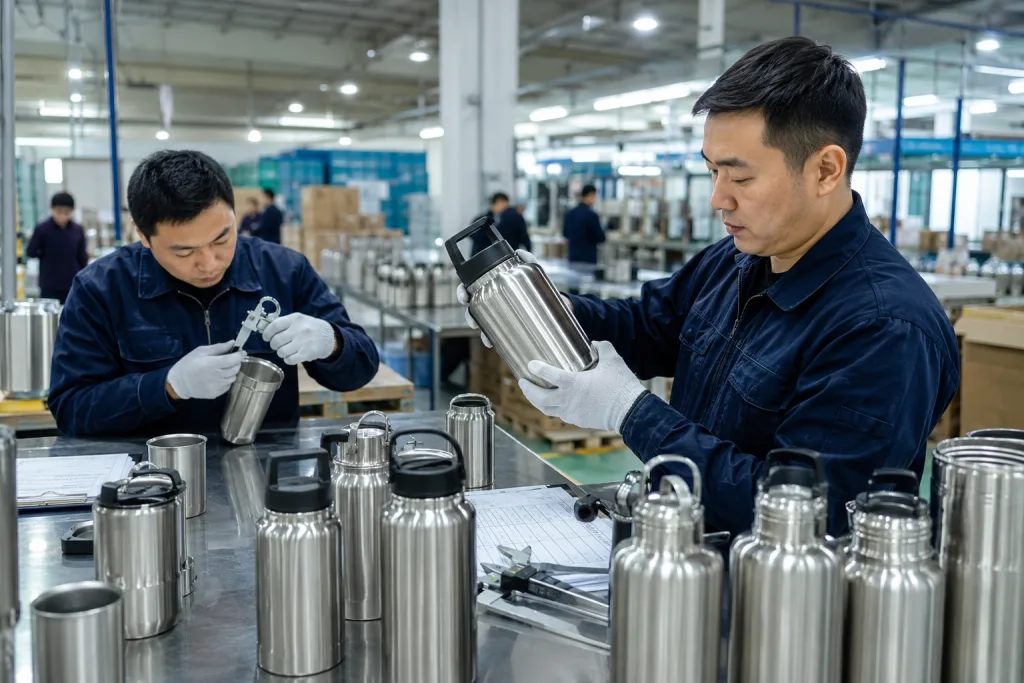
Key Takeaways
- Most hydration flask wholesale bulk programs start at MOQ 500-1,000 pcs per SKU, with repeat orders often dropping to 300 pcs in China
- Double-wall 18/8 stainless flasks typically add USD 1.20-2.80 per unit over single-wall versions, but reduce surface condensation and improve perceived value
- Standard sampling takes 7-10 days, mass production 25-35 days, and custom packaging can add 5-7 days to lead time
- For export control, ask for REACH, LFGB or FDA contact material testing, plus AQL 2.5 final inspection before balance payment
You are not buying a bottle. You are buying a failure rate, landed cost, lead time, and the next PO after the first shipment. Projects in hydration flask wholesale bulk usually go wrong when the buyer starts from shape and color and leaves the use case, wall construction, decoration method, and carton loading for later. We see this on the line. A 32 oz flask for an outdoor retail brand is not the same product as a 500 ml promo canteen bulk order, even if the render looks close on a screen. One takes a thicker powder coat, the other might need to hit a lower target price with a 0.4 mm outer wall.
From Zhejiang, the pattern is clear after a few hundred RFQs a year: buyers who compare drinkware wholesale options by spec get better results than buyers who treat bulk drinkware as the same item with different artwork. If you are quoting hydration flasks, wholesale canteen styles, beer growler bulk SKUs, or alcohol flask wholesale bulk programs, start with a hard spec sheet first. This is the right first move. QC pulled a sample last month because the logo sat 3 mm off-center, and the buyer flagged it only after packing layout was approved. That is how margin gets eaten—through complaint rates, rework after sampling, and cartons that ship at the wrong cube.
Start with use-case, not shape
If you source from a photo alone, you usually pay too much or end up with the wrong build. We hear buyers ask for the best wholesale drink bottle every week. That is the wrong question to ask. The right bottle depends on where you sell it, how people use it each day, hot or cold fill, logo area, and the retail price you need to hit. On our sample bench, the first thing we check is body diameter in mm, because a nice-looking bottle that does not fit a car cup holder gets rejected fast.
A hydration flask wholesale bulk order for gyms or outdoor retail usually comes down to three hard points: powder coat that survives bag rub, a lid that passes leak testing, and a carton that does not burn cubic meters. We run vacuum and tilt tests on the line, and QC pulled a sample last month because the lid leaked after a 1.2-meter drop. A canteen wholesale order for gifting or lifestyle branding is a different animal. Those buyers care more about silhouette, hand-feel, and whether the logo panel sits flat enough for screen printing. A growler wholesale program shifts again. Carbonation pressure, larger volume, and handle weld strength matter more, and we’ve seen this go sideways when a buyer treated a beer growler like a standard water bottle.
- Hydration flask: best for daily water carry, sports, commuting, outdoor use.
- Bulk canteen: better when style and slim silhouette matter more than maximum thermal hours.
- Bulk growler: suited to beer, cold brew, and larger-volume fill scenarios.
- Alcohol flask bulk: niche gift or barware item, usually smaller capacity and different compliance focus.
At our Zhejiang, China factory, output is typically 300,000 units per month across insulated and non-insulated drinkware bulk lines, but capacity only matters if the spec is correct on day one. A 64 oz beer growler wholesale bulk order packed 12 pcs per carton behaves differently in freight cost from a 500 ml wholesale drinkware flask packed 24 pcs per carton. The math does not work the same. We ship both, and the carton drop result, gross weight in kg, and container loading plan change right away. Before you ask for pricing, define the use case in one sentence. That sentence usually decides 80% of the spec.
Head-to-head spec table that matters
Most buyers do not need a 40-page catalog. You need a short comparison that shows where each format sells, what it costs, and where it fails on the line or after shipment.
| Type | Typical Capacity | Material | MOQ | FOB China Price | Best Fit |
|---|---|---|---|---|---|
| Hydration flask | 500 ml-1,000 ml | 18/8 SS single or double wall | 500-1,000 pcs | USD 3.20-6.80 | Outdoor, gym, retail |
| Wholesale canteen | 350 ml-750 ml | 18/8 SS, usually curved body | 500-1,000 pcs | USD 2.90-5.90 | Gift, lifestyle, promo |
| Beer growler bulk | 1.2 L-2.0 L | 18/8 SS double wall | 300-500 pcs | USD 8.50-15.00 | Beverage, brewery, outdoor |
| Beer tumbler bulk | 12 oz-30 oz | 18/8 SS double wall | 500 pcs | USD 2.80-5.20 | Barware, events, DTC |
| Alcohol flask wholesale | 5 oz-8 oz | 201 or 304 SS | 1,000 pcs | USD 1.10-2.40 | Gift, souvenir, bar accessory |
The numbers above are normal China sourcing ranges, not a blanket quote for every SKU. Tooling, lid style, powder coat, and packaging move price fast. We see this on the line all the time: a hydration flask with straw lid, silicone boot, laser logo, and single color box lands 20% to 35% above the same bottle with a plain screw cap and master carton pack. One PO even came in with "straw lead" typed by mistake, and yes, we had to stop and confirm before sampling.
Use-case fit is the part that matters. If your core SKU needs to take daily drops and hold cold for 12-24 hours, double-wall flask is the safer pick than a single-wall canteen style. If the project is shelf display or event gifting, a single-wall body or lighter insulated body often makes better sense because freight math changes fast at 0.08 kg per unit. If you are buying beer growler in bulk, check handle weld strength, lid sealing torque, and whether the customer expects carbonation retention. This is the wrong question to ask late in sampling. QC pulled a growler sample last season with a weak side-handle weld after a 1.0 m drop test, and that risk profile is not the same as standard wholesale drinkware.
Material and wall construction trade-offs
For hydration flask wholesale bulk orders, material choice hits complaint rate and margin first. On actual RFQs, we usually quote 18/8 stainless steel, 201 stainless steel for budget builds, borosilicate glass for some drinkware wholesale programs, and BPA-free plastics for lightweight sports promos. We check steel grade with a handheld XRF gun on the line. For most branded hydration flasks, 18/8 stainless is still the safest mainstream option. This is the right baseline.
Single wall vs double wall
Single-wall stainless is lighter and usually USD 0.80-1.50 cheaper per piece. That gap is real. It fits cold water, promo giveaways, and tight target prices where the buyer already told us, “stay under $3.00 landed.” The trade-off shows up fast: the bottle sweats, the body gets hot with warm fill, and shelf feel is weaker. Double-wall vacuum fixes that and gives a cleaner retail story, so for retail-facing drinkware bulk, we usually push buyers there. The cheaper bottle is not always the cheaper project.
- Single wall: lower price and lighter shipment weight; production is simpler, but thermal performance is limited.
- Double wall vacuum: better value perception and no condensation; heat retention improves, but FOB goes up.
- Copper-coated vacuum layer: premium upgrade that can add 5% to 12% to cost; on our temperature test, QC pulled the sample and the hold time was usually stronger.
Wall thickness matters more than some buyers expect. A common outer wall thickness is 0.4 mm, with some heavier premium bodies moving to 0.5 mm. Inner wall thickness often sits around 0.3-0.4 mm depending on mold and capacity. We measure this with an ultrasonic thickness gauge after forming. Thinner bodies might save a few cents, but they dent faster in drop tests and during container loading. If your brand sells above USD 20 retail, the math doesn't work.
If you are reviewing alcohol flask in bulk or alcohol flask wholesale items, verify the grade carefully. We have seen low-cost projects run 201 stainless on the outer shell, which may pass for budget gift channels, but 304 contact surfaces are the safer export spec. The buyer flagged rust risk on one PO after a salt-spray discussion, and they were right to ask. For beer tumbler wholesale bulk and beer growler wholesale, 18/8 stainless plus vacuum structure is usually the benchmark because these products sell on durability and insulation, not entry price alone.
Decoration, packaging, and landed cost
Buyers often squeeze ex-factory price by USD 0.08, then give it back on packaging, decoration, and warehouse handling. We see this on drinkware wholesale orders every week. The visible unit price is only one line on the sheet; carton size, pack-out method, and label work usually decide the real margin.
The first call is decoration. Screen printing is still the cheapest option for 1-color or 2-color logos, especially once the order is above 1,000 pcs and we run the same screen across the line. Laser engraving costs more, but on powder-coated stainless it holds up better after tape pull and rub testing. Heat transfer or 360-degree wrap graphics sell well on lifestyle programs, though reject risk climbs fast if artwork registration is tight—QC pulled one sample last month that was off by 1.5 mm and the buyer flagged it right away.
- Silkscreen: low cost, suits simple logos, usually makes sense above 1,000 pcs.
- Laser engraving: premium feel, durable, fits stainless steel retail positioning.
- Digital or heat transfer: stronger graphics, tighter process control on the line.
Packaging is the next cost bucket. A plain polybag plus export carton works for a lot of distributor programs, and the math is usually better there. A printed white box typically adds around USD 0.18-0.35. A full-color gift box can add USD 0.40-0.90 depending on board grade and insert complexity. If the shipment goes to Amazon FBA, the requirement list gets longer: barcode labels, suffocation warning bags, drop-test-ready inner packs, and exact carton weight limits. We have seen a PO held up over one carton coming in at 15.4 kg instead of the buyer’s 15 kg cap.
Container loading matters more than first-time buyers expect. A taller 40 oz flask with handle lid might look cheaper on unit price than a wide-body 32 oz bottle, but landed cost goes up if the master carton takes fewer pieces and wastes container space. This is the wrong question to ask: “What is your best unit price?” Ask for the full shipping math. The same issue shows up on canteen bulk, growler bulk, and beer tumbler in bulk programs. When you compare China quotes, get three numbers on one sheet: FOB unit price, units per carton, and carton dimensions in centimeters. Without that, you are not comparing cost.
Compliance and quality checkpoints buyers skip
If you buy for Europe or North America, compliance is a gate, not a nice-to-have. For hydration flask wholesale bulk, ask for the test scope by sales market, not by whatever report the factory already has on file. LFGB fits Germany and gives wider EU confidence, REACH covers chemical compliance relevance, FDA supports US food-contact alignment, and CPSIA or California Proposition 65 review applies where your category and channel require it. For kids-related drinkware, ASTM-related considerations may also apply depending on design features. We’ve seen buyers send a PO that just said “food safe,” then the lab came back asking which lid straw, which paint, which seal ring. That costs days.
Factory paperwork is only one layer. You still need a live inspection plan on the line. In Zhejiang and elsewhere in China, plenty of factories can show ISO 9001, BSCI, or audit reports, but shipment quality comes from process control, sample lock, and in-process checks, not the certificate in a PDF. Last month QC pulled the sample and found a 0.8 mm logo shift against the signed artwork; the audit report did not catch that, the line check did.
A basic control plan
- Pre-production sample approval with signed spec sheet
- Color standard confirmed by Pantone or physical sample
- Vacuum test for insulated bodies
- Leak test at defined angle and duration
- Coating adhesion and cross-hatch check
- AQL inspection before balance payment
AQL 2.5 for major defects and 4.0 for minor defects is a common starting point for wholesale drinkware, though some retail programs go stricter. The wrong question to ask is “Do you do AQL?” Ask what the factory counts as a major defect. Write it down before production starts: leakage, sharp edge over the rim, wrong logo size, visible dent on the body, missing accessory, failed thermal performance, or an unstable base that rocks on a flat table. We usually set the table on tempered glass because a warped carton top hides wobble.
This matters more for wholesale growler and beer growler wholesale bulk because larger vessels take more hits in transit and expose weak welds faster. For alcohol flask wholesale bulk, check hinge quality, cap fit, and inner cleanliness closely; a low-FOB item still turns into a claim if plating peels or the smell test fails when the carton is opened. The buyer flagged this on a 5,000-piece run last year: outside looked fine, but 12 units had oil residue near the cap thread. Small item. Big headache.
How to build the right SKU mix
The strongest sourcing programs do not bet on one bottle. We usually run one core SKU, then add adjacent sizes or formats that share the same lid thread, powder coat code, or master carton size. That cuts tooling spend, speeds reorders, and keeps the line cleaner. On our floor, one shared lid platform can remove 1 extra leak-test setup per run, and that saves real time.
A practical mix for a hydration-led brand might look like this: 18 oz, 32 oz, and 40 oz hydration flask bodies built on one lid platform; one curved wholesale canteen style for gifting; one 64 oz beer growler in bulk item for outdoor or beverage crossover; and one 20 oz beer tumbler wholesale SKU for entry pricing. Keep the powder coat colors and logo method shared across the set. We have seen buyers add 6 print methods to 5 shapes, then wonder why the sample room stalls. The math doesn't work.
You do not need the biggest catalog. You need the smallest catalog that covers 80% of your demand without creating supply-chain noise.
For most procurement managers, the best starting point is 2 to 4 SKUs. That is enough. If you are testing a new brand, 500 pcs per SKU is usually smarter than 5,000 pcs split across too many colors. If the factory MOQ is 1,000 pcs, ask if mixed colors are allowed within one body style. This is the right question to ask early. We ship plenty of orders with 2-4 colors under one body, as long as decoration position, carton pack, and insert card stay the same. Last month a buyer flagged color mixing, but the real issue was a PO typo on the carton mark.
Lead times improve when the spec stays tight. A common custom order flow is 7-10 days for pre-production sample approval, 25-35 days for mass production, and another 3-7 days if you need custom gift boxes or Amazon prep. Repeat orders move faster if the body, lid, and artwork stay unchanged. On repeat programs, we often see 12 days vs 18 days on purchasing cycle time because the gasket, lid mold, and screen artwork are already locked. QC pulled the sample, matched it to the golden sample, and the order moved.
If you are balancing drinkware bulk across hydration, canteen wholesale, and growler wholesale projects, prioritize the components that repeat. Shared lids, shared coatings, and standard carton footprints usually save more over 12 months than the lowest unit quote on a one-off SKU. We have seen this go sideways when a buyer saves $0.08 on one model but adds a new cap, a new carton die line, and a new drop-test standard.
Get a workable hydration flask quote fast
Send your target capacity, lid style, quantity, and market. We will match the right bulk drinkware spec, MOQ, compliance path, and lead time.
Frequently asked questions
What is a realistic MOQ for hydration flask wholesale bulk orders?
For standard stainless steel flasks, a realistic MOQ is usually 500 to 1,000 pcs per size and color. If you choose an existing mold with standard lid and stock coating, some factories in China can go as low as 300 pcs for repeat orders. Custom body shapes, unique lids, or gift-box packaging usually push MOQ back up. For larger items like beer growler wholesale bulk, 300 to 500 pcs is common because the unit value is higher. Always ask whether the MOQ applies per SKU, per color, or per order total. That detail changes your inventory risk much more than buyers expect.
How do I choose between hydration flask, canteen, tumbler, and growler formats?
Start with the end use. A hydration flask is the safest all-round option for sports, commuting, and outdoor retail, especially in 32 oz or 40 oz insulated stainless. A wholesale canteen shape works better when appearance and gifting matter more than long cold-hold performance. Beer tumbler bulk programs fit bars, events, and lower-ticket retail because the cost is usually around USD 2.80 to 5.20 FOB China. A bulk growler is for larger-volume beverage use, usually 1.2 L to 2.0 L, with stronger focus on handle strength and sealing. If you are unsure, test two formats instead of four and compare sell-through before expanding.
What compliance documents should I ask from a China drinkware supplier?
For Europe, ask for LFGB-relevant food contact testing and REACH declarations where applicable. For the US, ask for FDA food-contact compliance support and review Proposition 65 risk depending on materials and decoration. If the product targets children, additional safety review may be needed. Beyond test reports, request the factory's quality process: leak testing, vacuum testing for insulated bottles, coating adhesion checks, and final inspection under AQL 2.5 or stricter if your retail channel demands it. Certifications like ISO 9001 or BSCI are useful background, but they do not replace product-specific testing tied to your exact SKU.
What FOB price range should I expect for wholesale drinkware from China?
For a standard 500-750 ml single-wall stainless bottle, FOB pricing is often around USD 2.20 to 3.80 depending on finish and decoration. Double-wall vacuum hydration flask wholesale bulk items usually land around USD 3.20 to 6.80 FOB China. Curved canteen wholesale styles often sit in a similar range, slightly lower if the body is smaller. Beer growler bulk products are higher, commonly USD 8.50 to 15.00 because of size, handle structure, and heavier packing. Alcohol flask wholesale can start near USD 1.10 for basic models. Always compare price together with packaging spec, weight, and carton size, not as a single number.
How long does custom bulk drinkware production usually take?
A normal timeline is 7 to 10 days for samples, then 25 to 35 days for mass production after approval and deposit. If you need custom molds, add 20 to 35 days depending on complexity. Packaging can also extend timing: a standard export carton adds little, but custom color boxes or gift sets can add 5 to 7 more days. During peak season from August to November, some Zhejiang factories in China will quote 35 to 45 days for insulated stainless programs. If your launch is fixed, lock the specification early and avoid changing lid style or artwork after sample approval.