Key Takeaways
- A workable first run for custom drinkware is often 3,000-5,000 units per SKU, with stainless vacuum flasks around USD 3.20-6.80 FOB Zhejiang depending on steel, lid, and finish.
- Ask for 18/8 stainless, inner wall 0.4 mm, outer wall 0.5 mm, vacuum retention data, and AQL 2.5/4.0 before approving production.
- Normal lead time is 7-12 days for pre-production samples and 30-45 days for bulk after deposit and artwork approval.
- For Europe and North America, confirm REACH, LFGB or FDA contact compliance, drop testing, carton specs, and barcode requirements before mass production.
You are not buying a bottle. You are buying an ex-factory date, an AQL result, a landed cost, and no ugly call from your sales team 6 weeks after launch. That is why picking hydration flask vendors is harder than circling shapes and colors on a PDF. On the line, the same 750 ml flask can quote at USD 2.85 or USD 4.90, and both numbers can be right if the spec changes on steel grade, wall thickness, powder coating, or test scope. We have seen buyers miss a 0.2 mm wall change and then argue over dents after drop test. The wrong question is not “who is cheaper,” but “what exactly is included.”
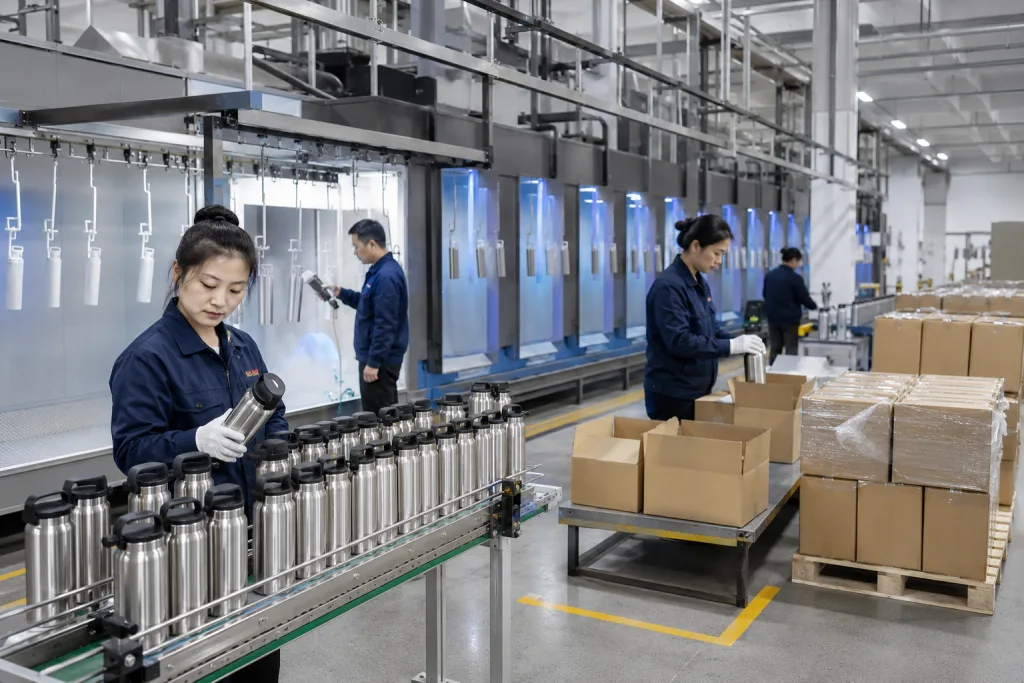
We build custom drinkware in Zhejiang, China, and most buyers come in with a hand sketch, a target price, and a PO that still has one typo in the logo size. A workable order starts with end use and then moves through MOQ, tooling, logo method, packaging, compliance, and AQL in that sequence, because the math does not work if you start from decoration before structure. We run projects this way every week: QC pulled the sample, the buyer flagged the lid fit, and the drawing changed before mold release. If you are screening a canteen factory or canteen supplier in China, this is the order flow you should expect.
The order starts with your brief
Picture the actual buyer. A German distributor is sourcing a 750 ml insulated hydration flask for a retail chain, plus a parallel gym canteen promo program. Landed cost is tight. Returns need to stay under 1.5%. You send the RFQ to three hydration flask vendors. Two send pricing in 6 hours with a polished catalog and little else. One comes back with 14 questions about fill volume, drop test standard, logo position, and carton spec. That "annoying" supplier is usually the one who saves you trouble on the line.
A proper RFQ for a custom canteen or customizable growler should include the points below. If not, the quote is guesswork, and we’ve seen this go sideways after the first pre-production sample:
- Capacity: 500 ml, 750 ml, 1,000 ml, measured to brim and practical fill
- Construction: single wall or double wall vacuum
- Material: 18/8 stainless steel, PP lid, silicone seal, Tritan straw if needed
- Wall thickness: inner 0.4 mm / outer 0.5 mm is common for stable vacuum flasks
- Finish: powder coating 60-80 microns, spray paint, electro-polish, or brushed
- Logo: silk screen, laser engraving, heat transfer, or UV print
- Packaging: egg-crate, white box, color box, PDQ, master carton drop standard
- Compliance: REACH, LFGB, FDA contact, California Proposition 65 if relevant
- Incoterm: FOB Ningbo, EXW Hangzhou, or DDP if your forwarder asks for it
At BottleForge Industrial in Zhejiang, China, our practical MOQ for a standard vacuum flask is 3,000 units per color, and monthly capacity is about 450,000 units across flasks, tumblers, and sports bottles. On our side, that means we run the powder line, laser marking, and vacuum inspection in batches that make the setup cost work. If a canteen manufacturer offers 500 units on a fully custom body, custom lid color, gift box, and three logo positions, the math doesn't work. You will pay a high unit cost, or QC will later pull a sample with a color mismatch, weak carton, or logo shift of 2 mm.
The first filter for canteen vendors is not who says yes to everything. This is the wrong question to ask. Ask who can tell you what each yes adds in mold cost, lead time, and risk before you place the PO. We ship smoother projects when the brief is tight, even down to small details like practical fill volume or a typo in the shipping mark.
Where quotes diverge without warning
Quotes are back. Vendor A at USD 3.05 FOB. Vendor B at USD 3.62. Vendor C at USD 4.18. Do not compare them yet. First, normalize the build sheet. We’ve seen new buyers lose margin here after they approve a “cheaper” flask that comes in 70 g lighter on the line.
For a 750 ml customized drinkware flask, quotes usually move for six reasons:
- Steel grade: 18/8 costs more than 201 or mixed-grade parts. The price gap is real. So is the risk. We’ve had buyers push for lower cost, then QC pulled the sample and found tea odor hanging in the liner after 24 hours.
- Weight: a flask at 320 g and another at 410 g are not the same product. Ask for gross weight and net weight, and ask body weight by itself. A 0.4 mm body does not feel like a 0.5 mm body in hand.
- Vacuum process: copper plating on the inner outer-wall surface improves heat retention and raises cost slightly. On our side, this shows up as an extra station before vacuum sealing, not magic language on a quote.
- Lid design: simple screw lid versus flip straw lid can add USD 0.25-0.70. If the lid has a custom handle, spring, or bite valve, check spare-part policy too. This part gets flagged fast.
- Coating: powder coating with texture and Pantone matching usually costs more than plain spray paint. Texture is not just a look issue. The line has to control coating thickness, often around 60-80 μm, or the color shifts batch to batch.
- Pack-out: barcode label, instruction sheet, and color box can add USD 0.18-0.55 per unit. Sounds small. It is not. We once saw a PO typo on the barcode suffix hold carton printing for a full day.
A reliable canteen supplier should break out those costs. If they do not, ask for a costed specification sheet. This is the right question. For example, a sound FOB Zhejiang price for a 750 ml double-wall flask with 18/8 body, powder coat, one-color silk screen logo, and white box might land around USD 3.80-4.60 at 5,000 units. Add a custom mold handle lid and a printed gift box, and you can reach USD 5.40-6.80 fast. The math does not work if someone offers the full second version at the first price.
If one canteen factory is 20% cheaper, do not ask, “Can you match?” Ask, “Which line item is missing?”
The same issue comes up with canteen distributors or a canteen distributor acting as a trading layer. A trader is fine if they add project management value. We ship through traders on some accounts and it runs smoothly. The problem is not the trading layer itself. The problem is whether your quote includes factory-level controls, replacement policy, and test responsibility. If nobody owns the failed drop test at AQL 2.5, this goes sideways.
For custom growler or customizable canteen projects, also verify mouth diameter, cap thread standard, and whether the vessel is intended for carbonated beverages. Ask for the thread drawing if needed—38 mm and 42 mm get mixed up more than buyers expect. Many stylish bottles are not designed for pressure.
Sampling is where specs become real
After you shortlist a canteen manufacturer or canteen vendors, go straight to samples. There are 3 sample stages. Skip one, and rework shows up fast on the line.
1. Stock sample
This stage checks shape, hand feel, and basic workmanship. We ship it in 2-5 days if the mold is already running. QC pulled the sample and should catch uneven powder coating, weak threads, or a wobbling base on a flat steel table before it leaves. If those defects show up on a stock sample, stop there. The math doesn't work if the base item is already off.
2. Pre-production sample
This is the sample that matters. It uses your exact color, logo process, and packaging setup, not a close substitute from the shelf. Lead time is normally 7-12 days after artwork approval, and on our side that usually means color matching under a D65 light box, then logo position check with a digital caliper. You should review:
- Pantone color tolerance under D65 light
- Logo placement in millimeters from base and seam
- Lid torque consistency and seal compression
- Vacuum retention after 6 and 12 hours
- Condensation behavior on exterior
- Barcode scan readability if retail packed
For a canteen custom order, ask for a signed sample approval sheet with photos and revision notes. That sheet becomes the production standard. We've seen this go sideways: the buyer says “same as sample,” the factory says “same artwork,” and then the PO has no note on logo height or carton insert direction. Those are different standards, and this is the wrong question to ask if you only ask for “final sample” with no written checkpoints.
3. Packaging sample
If you sell to Amazon FBA, club stores, or large distributors in North America, review packaging as its own sample. Confirm carton dimensions, carton gross weight under your warehouse limit, FNSKU label location, and ISTA-style drop expectations. We have seen good bottle factories miss pack-out details because the inner tray shifts 8 mm or the master carton lands at 23.5 kg and the buyer flagged it. Product is fine. Carton is not.
At this stage, ask your hydration flask vendors for a sample test plan. For Europe, common requests include LFGB migration testing and REACH SVHC screening on coatings or soft parts. For the US, buyers often request FDA food-contact statements and Proposition 65 review where applicable. A serious canteen factory in Zhejiang should not promise every certificate in one email. They should tell you which tests are product-specific, which are material-based, and who pays, because that cost split is where arguments start.
Mass production needs control points
After you approve the sample and pay deposit, usually 30%, the order moves into the risky middle stage. This is where control points matter more than a promised ship date. On a 5,000-unit customized canteen run, standard lead time from deposit to shipment is 30-45 days in China, depending on season and coating line load. On our line, a one-day delay at the powder booth often turns into 4 days lost by packing.
For this scenario, use a control plan that matches how the factory actually runs:
- Incoming material check: steel grade declaration, lid resin confirmation, gasket hardness, color masterbatch review. Ask for the supplier batch record and Shore A reading for the silicone gasket.
- In-process check: body forming dimensions, thread fit, vacuum leak test, coating adhesion, print cure. QC pulled the sample with a thread gauge and a vacuum tank test before lunch on one of our last 5,000-unit runs.
- Final inspection: AQL 2.5 for major defects and 4.0 for minor defects is common for drinkware export. This is the right checkpoint, but not the only one; if you wait until final inspection, we've seen this go sideways.
What counts as a major defect on customizable drinkware? Leaking lid, weak vacuum, sharp edge, severe color mismatch, wrong barcode, wrong logo, dented body, unstable base. We also treat a rolled rim out by 0.4 mm as major if it creates a cut risk. Minor defects are small specks under a reasonable standard, slight logo variation within approved tolerance, or carton scuffing that does not affect retail presentation. One buyer flagged a tiny silver dot under the coating; QC measured it at under 0.5 mm and logged it as minor.
Ask your canteen manufacturer for production photos at three stages: raw body, after coating, and after packing. Photos do not prove quality. They show whether the factory is following your spec. If your approved custom drinkware sample has a matte textured powder coat and the in-line photos show glossy spray paint, you catch the problem before 5,000 units are boxed. We had one PO where the finish code was typed wrong, and the buyer caught it from the coating-stage photo before the full lot went through curing.
Independent inspection in Zhejiang or nearby Ningbo is cheap insurance. A third-party final random inspection can cost roughly USD 250-350 per man-day, which is nothing next to a rejected container. If you buy from multiple canteen suppliers, use the same checklist across all of them so your data is comparable. The math doesn't work if one factory uses its own pass standard and another uses yours. We ship plenty of repeat orders this way, and the defect data is cleaner from factory to factory.
The QC checklist buyers actually use
Most first-time buyers ask for “good quality.” That is the wrong question to ask. On the line, “good” means nothing unless QC can measure it with a gauge, a timer, or a pass/fail sample.
For our buyer scenario, your final inspection sheet should include at least these points. QC pulled the sample by carton number, not by guesswork:
- Leak test: fill 90% with water, invert 5 minutes, no leakage from lid or straw port
- Insulation test: hot water from 95°C start, target above 55-60°C after 6 hours for a typical 750 ml vacuum flask
- Coating adhesion: cross-hatch tape test per agreed internal standard, no significant peeling
- Logo durability: rub test 50 cycles with dry cloth, no obvious loss for cured silk screen; laser marking should remain stable
- Dimension check: height, diameter, mouth opening, thread fit within approved tolerance
- Weight check: within agreed range, often plus or minus 3-5%
- Odor check: no strong paint or plastic smell after 24-hour airing
- Drop test: packaged unit survives agreed carton drop sequence without functional failure
For customized growler or custom growler formats, add cap retention and pressure suitability if end use includes sparkling drinks. We have seen this go sideways when a buyer used a standard screw cap for carbonated fill and then flagged seepage after transit. For kids or sports items with straws, ask for bite-valve and straw assembly checks; on one PO, the straw cut length was off by 2 mm and the flow rate dropped enough for the buyer to reject the pre-shipment sample.
A strong canteen vendor should also spell out what is not inspectable after shipment. Example: microscopic specks inside the powder coating texture that are only visible under intense angled light from 10 cm should not become a claim issue if your approved sample shows the same standard. This part matters. Our inspectors use a normal viewing distance standard, and the math does not work if production is judged under phone flash at nose distance after arrival.
If you are working with canteen distributors in North America who private label imported goods, insist on a written claim window. Common practice is 15-30 days after arrival for visible defects and a longer period for functional issues supported by photos, lot code, and quantity count. We ship with lot tracing on the master carton for this reason, and once the claim is late or missing counts, nobody can pin down whether the issue came from 12 cartons or 120.
Shipping, claims, and the second PO
The order is packed, inspected, and ready. Before balance payment, ask for the final packing list, carton marks, and inspection report tied to the PO number and lot code. Put all three on one file set. We’ve seen this go sideways when a distributor canteen account reports leakage from Warehouse 3, while stock from Warehouse 1 is clean, and nobody can trace which lot the line packed on Tuesday.
For FOB Ningbo shipments from Zhejiang, verify these points before release:
- Master carton size and cubic meters for freight planning; if the carton changed from 58 x 39 x 32 cm to 61 x 41 x 34 cm, your loading plan changes with it
- Carton gross weight, ideally below 18-20 kg if your customer has handling limits; QC pulled the sample once at 21.4 kg and the buyer flagged it fast
- Pallet rule if your customer needs euro pallets or slip sheets; this should be fixed before the line starts palletizing
- HS code usage consistent with your broker’s guidance; this is the wrong question to leave for shipping day
- Barcode and retail label placement before sealing cartons; we’ve had a PO with one label position typo, left panel instead of short side, and rework cost real money
When the goods arrive, don’t wait for the full sell-through cycle to judge the canteen manufacturers you used. Score them on four numbers: on-time delivery, inspection pass rate, claim rate, and response speed. Make it plain. For example, 12 days late, AQL 2.5 pass on first inspection, 0.8% claim rate, 18-hour reply time. Buyers who track this for two quarters usually see the same result: the cheapest canteen factory is not the cheapest supplier. The math doesn’t work.
A workable claim policy for custom drinkware should split issues into three buckets: factory defect, transit damage, and misuse. If 2% of units leak because the lid gasket was not seated flat and the inspection report missed it, that is a factory claim. We check that point with a leak tester on the bench, and misses there are hard to defend. If outer cartons are crushed and bottles are dented in one corner of the container, that points to freight. If a retail consumer puts a non-dishwasher-safe printed flask into a commercial dishwasher, that belongs in the care instructions, not on the factory debit note.
The real target is the second PO. If your first order was 5,000 units, the second often moves to 12,000-20,000 units across colors once the canteen customizable program proves itself. That is where a stable canteen supplier in China earns its keep: same color, same lid fit, same carton spec, no drama. We run color checks against the approved chip, and lid-fit drift of even 0.3 mm will show up fast on the line. Buyers in Europe and North America rarely need a miracle. You need repeatability.
Send your flask spec and target price
We will review your brief, flag risk points, and quote a realistic MOQ, FOB Zhejiang price, sample plan, and lead time within 2 working days.
Frequently asked questions
What MOQ should I expect from hydration flask vendors for a custom order?
For a standard stainless vacuum flask using an existing mold, a realistic MOQ is 3,000 units per size and often 1,000 units per color within that total. Some canteen manufacturers in China will accept 2,000 units, but your FOB price may rise by USD 0.20-0.50 per unit because coating setup, logo setup, and carton printing are spread over fewer pieces. If you need a fully custom lid or body mold, tooling can add USD 2,000-8,000 and the MOQ may move to 5,000-10,000 units. Be careful with very low MOQ offers on canteen customized projects. Low quantity usually means using stock colors, generic packaging, or mixed production slots rather than a true dedicated run.
How do I compare quotes from different canteen suppliers fairly?
Ask every vendor to quote on the same build sheet. At minimum, list capacity, material grade, wall thickness, unit weight, lid structure, finish type, logo method, packaging, test requirements, MOQ, and Incoterm. For example, one canteen supplier may quote 18/8 stainless with 0.4 mm inner and 0.5 mm outer walls, while another quietly uses lighter gauge steel and a simpler lid seal. The quote looks cheaper but the flask may dent more easily or fail leak tests. Also ask whether the price includes sample cost credit, export carton printing, spare gaskets, and third-party inspection support. When two hydration flask vendors differ by more than 15%, there is almost always a specification gap hiding inside the quote.
Which compliance tests matter for Europe and North America?
For Europe, buyers commonly ask for REACH SVHC review and food-contact testing such as LFGB when the product contacts water directly. For North America, many importers request FDA food-contact declarations and may also review Proposition 65 exposure risk depending on coatings, inks, and components. If the item is sold for children, ASTM-related considerations can become relevant based on product design and age grading. Do not buy a generic PDF certificate and assume it covers your SKU. Testing should match your actual material stack: bottle body, lid plastic, silicone ring, paint, and logo ink. Budget roughly USD 300-900 per test package depending on scope and lab. A capable canteen factory in Zhejiang should tell you what can be supported by material data and what needs finished-product testing.
What defect rate is acceptable on a custom drinkware order?
For export drinkware, many buyers work with AQL 2.5 for major defects and 4.0 for minor defects at final random inspection. That does not mean you should accept 2.5% leaking bottles. It means the lot is judged by an agreed sampling plan, not by checking every piece. In practical terms, strong hydration flask vendors should deliver final claims well under 1% on functional issues for mature SKUs. Cosmetic claim rates can vary by finish. Matte powder coat tends to hide small marks better than glossy paint. Define major defects clearly before production: leaks, poor insulation, wrong logo, color mismatch beyond tolerance, dents, unstable base, or barcode errors. If you leave defects undefined, arguments start after arrival, when they are most expensive.
How long does a custom hydration flask order usually take from sample to shipment?
A normal timeline for an existing-mold stainless flask is 2-5 days for stock samples, 7-12 days for pre-production samples with your logo and color, and 30-45 days for bulk production after deposit and approval. Add another 3-7 days if you require color box revisions or extra lab testing before mass production. Peak-season pressure in China, especially before major retail shipping windows, can push bulk lead time to 50-60 days. If a canteen vendor promises 18 days for a fully customized canteen with Pantone powder coat, retail packaging, and third-party inspection, ask how they plan to compress coating cure, assembly, and packing. Fast promises are easy. Credible schedules include sampling, test hold points, and rework buffer.