Key Takeaways
- Set measurable specs early: 304 inner/201 outer or 304/304, ±2 mm dimensions, 12-24 hour retention targets, and AQL 2.5 before deposit
- Most MOQ for decorated stainless steel bottles starts at 1,000-3,000 pcs per SKU, with mass production lead time around 25-40 days in Zhejiang, China
- Common failure costs come from coating adhesion, leak issues, logo misalignment, and carton compression damage rather than from raw steel price alone
- Ask hydration flask suppliers for REACH, LFGB or FDA contact material declarations, drop-test standards, and vacuum inspection records on every order
You rarely lose money on a hydration flask order because the sample on your desk looked rough. You lose it 45 days later, after vacuum retention fails on the line, powder coat chips after a 1.2 m carton drop test, logo placement walks 3 mm, or your importer asks for REACH paperwork that was never packed with the file. At that stage, the unit price you pushed hydration flask suppliers down to does not matter. The real cost is rework, a delayed launch, and stock you cannot ship.
If you are buying custom drinkware from China or comparing one canteen factory in Zhejiang with another canteen supplier, asking who has the lowest quote is the wrong question. Ask what fails in production, how often QC pulled the sample for the same issue, and what must be written into the spec before the 30% deposit. We have seen this go sideways: one PO had the logo position typed wrong by 2 mm, and the buyer flagged the full batch after packing. That is usually where a clean order turns into an expensive lesson.
The sample passed, production failed
The first trap is thinking a pre-production sample makes the order safe. It doesn’t. A hand-built sample usually comes from the most careful technician, off a slower bench setup, with selected parts pulled from the good bin. Mass production is different. We run some bottle lines at 6,000 to 12,000 units per day, with different operators on the line, new paint batches, and lids from an outside vendor if the schedule is tight. QC pulled the sample from one setup; your bulk order ships from another. We’ve seen this go sideways. One canteen manufacturer can show a clean sample and still ship uneven production if the control plan is thin.
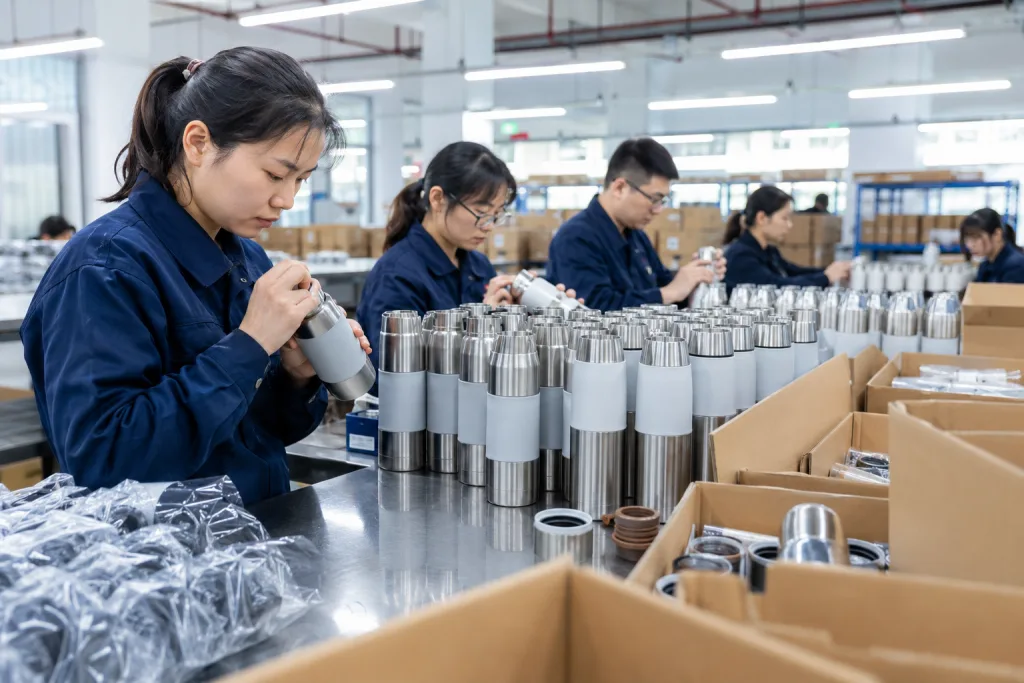
Compare hydration flask suppliers by control points, not photo sets. This is the right question to ask. A capable canteen factory in Zhejiang should show incoming inspection, in-process checks, and final random inspection, with the actual form the line uses, not a sales slide. Ask who checks it, how often, and what gets blocked. On our floor, that usually means caliper checks every 2 hours and a signed first-piece sample at line start. For stainless vacuum bottles, that usually means:
- Raw material confirmation: SUS304, SUS316, or SUS201 by agreed body part
- Vacuum retention test: sample size and hold time, for example 95°C fill, then check after 6, 12, and 24 hours
- Leak test: 100% air-pressure or inverted water test on assembled lids
- Decoration check: logo position tolerance, color match, and cure adhesion
- Packing audit: barcode scan, carton drop test, and assortment verification
If your PO only says “same as approved sample,” too much stays open. We ship against written standards, not memory. Put the measurable requirement into the purchase order and artwork sheet. For example, “logo centerline tolerance ±1.5 mm,” “powder coat cross-hatch adhesion minimum 4B,” or “vacuum retention minimum 45°C after 12 hours from 95°C fill at 20°C ambient.” Add the check method too. The buyer flagged a logo shift once, and the PO only had a JPG with no mm tolerance, so the argument went nowhere. That language protects you whether you buy a custom canteen, customizable growler, or distributor drinkware line.
Good buyers do not ask a supplier to promise quality. They ask the supplier to define how quality is measured.
Steel grade shortcuts and wall issues
Material substitution is one of the costliest quiet failures in custom drinkware. Buyers write “stainless steel” on the PO and assume every body is the same. It is not. In China, a common entry-price insulated flask build is 304 inner and 201 outer. That setup is fine for a lot of projects if the factory states it clearly. Trouble starts when you think you are buying 304/304, but the quote was built on 304/201, or the supplier trims wall thickness to make the target price work. We have seen this go sideways after sampling, when QC pulled the sample and the XRF gun did not match the approved spec.
Typical body thickness on a retail-grade hydration flask is around 0.4 mm to 0.5 mm for inner and outer walls. Some promotional models drop under that. The saving is small per piece, but the dent risk jumps fast, especially on tall 32 oz or 40 oz bodies that take side impact in transit. We run drop checks with a simple height gauge and dent caliper, and thinner shells show it fast. For canteen promotional items handed out at an event, that tradeoff may be acceptable. For a brand line you want to repeat next season, this is the wrong place to save money.
What to lock down in the spec
- Body material by component: inner, outer, lid plate, filter, straw, handle pin
- Steel grade: 18/8 stainless, SUS304, or SUS316 where needed
- Wall thickness: for example 0.45 mm inner / 0.45 mm outer
- Bottle weight tolerance: for example ±5%
- Food-contact plastics: PP, Tritan, silicone grade
A serious canteen supplier or canteen vendor should be able to provide mill certificates or at least an internal material declaration. On orders above 10,000 pcs, some buyers add third-party XRF spot checks on 5 to 8 pcs per lot. That makes sense, especially for a customized canteen or customized growler with a higher landed cost. We have had buyers flag a 2-letter typo on a PO that changed the requested steel callout, so the paperwork needs the same attention as the sample.
In Zhejiang, China, large-scale plants can run more than 500,000 units per month, but volume does not guarantee consistency. If your target price on a heavy insulated bottle comes in 8% to 12% below the next two quotes, assume something moved. Usually it is steel grade, wall thickness, lid build, or coating. Ask what changed, line by line. The math does not work otherwise.
When lids leak after arrival
Most field complaints are not about the bottle body. They start at the lid. Threads bind, straws kink, seals roll, flip spouts crack, and handles back out after 2 to 4 weeks on use tests. A hydration flask is only as good as its closure. Buyers still spend 80% of sourcing time on bottle shape and logo finish, then the line gets hit with lid claims later. We see this a lot.
Leak failures usually come from four points: silicone gasket fit, thread engagement, lid warpage after molding, or assembly torque drifting off spec. On one custom canteen order with 4 lid colors, the black masterbatch changed shrink enough that QC pulled the sample and found a 0.3 mm gap at the seal seat. That is enough to cause trouble if the mold tolerance is already tight. A disciplined canteen manufacturer will validate the lid on its own, not sign it off just because the body passed.
You should require:
- 100% leak test for finished units, not body-only test
- Torque spec for screw lids, especially when liner and gasket compression matter
- Cycle test for flip lids, buttons, and hinges, such as 3,000 to 5,000 open-close cycles
- Spare gasket policy or replacement lid support for repeat programs
If you buy from canteen distributors instead of a canteen factory, ask who owns the lid tooling. This is the right question. We have seen a distributor keep the same SKU photo, then move production to another plant and the closure feel changed lot to lot. Same look, different fit. We ship against approved samples, but if the upstream mold owner changes, consistency can move without warning. The same problem shows up in some canteen vendor and distributor growler programs.
For higher-risk lids, ask for a pilot run of 200 to 500 pcs before full production, especially on canteen customizable projects with extra accessories. It usually adds 5 to 7 days versus shipping blind, and the math works. On one EU order, the buyer flagged a 3% leak rate only after goods reached the warehouse, and the claim cost beat the pilot cost by a wide margin. At FOB values of USD 3.80 to USD 7.50 per insulated unit, even a small defect rate turns into a margin problem fast.
Coating, logos, and color drift
Decoration failure is where sellable stock dies. Buyers fixate on Pantone and miss the harder production question: will the finish survive carton loading, sea freight vibration, shelf scuffing, and the first dishwasher test a retail customer runs at home? On our line, QC pulled a sample after a 1.2 m drop-to-carton edge test and the coating looked fine until the neck thread started chipping. That is the wrong question to ask if you only care about color. Even for hand-wash-only bottles, end users test harder than most factories do.
Powder coating is standard on insulated bottles because it adds grip and hides small body marks from transfer racks. It still fails for simple reasons: weak surface prep, dust in the spray booth, under-cure, or film build that gets too thick around threads and necks. We check coating thickness with a dry-film gauge, and once it creeps past about 80 μm on the neck, capping starts to go sideways. Silkscreen scratches. UV print can crack on a radius if adhesion is weak. Laser marking holds up better, though it changes the look, and some canteen custom briefs reject it on sight.
A practical decoration spec for customizable drinkware should include:
- Color standard: Pantone reference or signed swatch
- Logo position tolerance: usually ±1 to 2 mm
- Adhesion standard: cross-hatch 4B or 5B after cure
- Abrasion check: 20 to 50 rubs with dry and wet cloth, or defined in-house method
- Salt spray or humidity exposure if hardware parts are painted
Peak season is where variation shows up. A lot of canteen manufacturers in China outsource decoration steps in August to November, and the buyer usually finds out after the second color batch lands 12 days later than the first. Outsourcing is not the problem by itself; blind outsourcing is. Ask straight: is painting in-house, is screen printing in-house, is laser in-house, and what extra lead time gets added if one step goes outside? A Zhejiang plant shipping 300,000 to 600,000 units per month should answer that in five minutes. If they cannot, we've seen this go sideways.
For canteen promotional items or a customized drinkware program for retail, split “appearance acceptability” from “functional acceptability.” AQL 2.5 for major defects and 4.0 for minor defects is common, but the math doesn't work unless you define the defect itself. Is a 1 mm pinhole on the back minor? Is the same defect on the logo side a reject? We had one PO where the buyer flagged “logo centered” but forgot to define tolerance, and the print house ran a 3 mm shift that passed their own standard. If you do not write these calls down, the inspection report says little.
Packaging failures nobody budgets for
Good bottles get damaged by bad packaging every week. We see the same claims on repeat: scuffed bases, dented shoulders, crushed gift boxes, mixed cartons with the wrong color count. QC passed the bottle, then the packing failed. That is not bad luck. It is packaging engineering done wrong.
For export from Zhejiang and other China production hubs, the bottle needs to survive forklift moves, container vibration, carton stacking, and rough unloading at destination. A tall, narrow flask usually fails on top-load compression before buyers expect it. We run compression checks because this is where the line gets caught out. If the base is heavy and the divider board is only 2 mm, units rub through the inner box during transit. We have seen 40 oz bottles wear a clean ring into the paper after one container run.
What helps:
- Defined drop test: for example 1A carton drop, 6 faces and 4 corners, depending on pack format
- Carton spec: 5-ply export carton, burst strength or edge crush standard
- Inner protection: EPE bag, tissue, molded pulp, or partition inserts
- Barcode control: shipping mark, FNSKU if needed, carton label position
- Pallet rules: pallet size, wrap direction, overhang prohibition
Do not approve packaging from a flat artwork file alone. This is the wrong question to ask. Ask the supplier to send a packed-drop sample or at least a 30-second packing video from the line. We ship both retail and Amazon orders, and the buyer flagged carton weight more than once after the bottle spec was already locked. If you are buying for Amazon FBA or omnichannel retail, write labeling rules and carton weight limits into the PO. A master carton over 15 kg may pass for one account and fail for another. We once saw a PO typo switch black and navy on the outer mark, and the warehouse split the shipment by mistake.
This matters even more when you buy through canteen distributors or a canteen distributor model where the trading layer does not control final packing directly. The more handoffs, the more carton details get missed. We have seen this go sideways with simple items like label position and pallet overhang. Packaging is a product component. Treat it that way, or budget for claims later.
Compliance gaps that delay customs
Most B2B buyers ask for compliance files after production. That's backwards. If you sell into Germany, France, the UK, the US, or Canada, lock the document list at quotation stage, before the first sample hits the line. The requirement changes by material and market, but for hydration flasks we usually get asked for REACH, LFGB or FDA food-contact declarations, plus component testing for straws, seals, and coatings. We’ve had a buyer send the PO first and ask for LFGB later, after tooling approval. That adds days fast.
The weak spot is often the mixed-material lid. The 304 stainless body is usually clean; the lid might carry PP, silicone, Tritan, paint, and a small spring that weighs 3 g. If one subcomponent file is missing, customs can still hold the shipment. Claims language is another trap. If your artwork says “BPA free,” “dishwasher safe,” or “24 hours cold,” the factory needs a test basis behind it. This is the wrong question to ask after mass production. We’ve seen this go sideways when QC pulled the sample and the coating report covered the bottle, not the painted lid ring.
Ask canteen suppliers for:
- Factory certifications such as BSCI or ISO 9001 where relevant
- Product-specific declarations for each SKU, not generic files only
- Latest lab reports tied to material families or exact articles
- Country-of-origin marking confirmation
- Restricted substance review for coatings and prints
A solid canteen factory in China will not promise every global standard on every item. That's a good sign. Honest suppliers will tell you what is already on file, what needs fresh lab work, and whether that takes 5 working days or 10. For a new customized canteen or customizable growler project, if third-party testing is needed, plan the time before bulk packing starts. We ship plenty of orders where the buyer flagged one line of artwork late, like “dishwasher safe” on a color box, and the math doesn't work once goods are packed and vessel space is booked.
How to spec a safer first order
If you are opening a new canteen manufacturer, build the first PO to expose risk early, not to pack in extra SKUs. Start with 2 to 4 colors, 1 or 2 lid variants, and 1 packaging format. Simple first. On the line, we watch whether the supplier can hold steel forming, vacuum, coating thickness, and packing flow in the same run without cross-mixing cartons or scratching bodies at the turntable.
A sensible first order with hydration flask suppliers might be 1,000 to 3,000 pcs per SKU, depending on model and decoration. In Zhejiang, typical sample lead time is 7 to 12 days and mass production is 25 to 40 days after deposit and sample approval. Custom tooling for a new lid can add 20 to 35 days. Those are normal numbers. We have seen buyers push for 18 days mass production on a painted flask with a new cap; the math does not work unless the factory already booked stock tubes, spare molding time, and carton print slots.
Your purchase order should include a one-page spec summary covering:
- SKU photo or drawing with capacity, dimensions, and weight
- Material list by component
- Color, logo file, print method, and tolerances
- Retention target, leak requirement, and test method
- AQL standard and defect definitions
- Packing method, carton spec, pallet rule, and labeling
- Document set required before balance payment
Also add what the factory floor will actually read: body diameter tolerance in mm, logo position from the base, carton drop standard, and the exact barcode version. QC pulled the sample on one order because the PO said “matt black” while the approved swatch was fine texture black, and that small typo cost 6 days. This is the wrong question to ask: “Can you match my sample?” Ask for the measurable limit instead.
If you buy through canteen vendors, canteen distributors, or a distributor drinkware program, ask the same questions you would ask a direct canteen factory. The sales path changes. The factory risk does not. A reliable canteen supplier in Zhejiang or elsewhere in China should welcome a tighter specification because it cuts rework, balance-payment disputes, and the usual buyer flag on mixed lid torque.
The best sourcing result is not the lowest FOB. It is the order that lands on time, passes incoming inspection, and reorders cleanly at the same cost structure. We ship plenty of projects where the cheaper quote lost money later through dent claims, weak vacuum rate, or 3 mm logo drift that got rejected at destination. Disciplined specs win.
Send your flask spec for a factory-level review
Share your target size, MOQ, decoration, and market. We will flag likely failure points, compliance gaps, and realistic lead times before you place the PO.
Frequently asked questions
What MOQ should I expect from hydration flask suppliers for custom branding?
For standard stainless insulated bottles, most factories in China quote 1,000 pcs per color per size for simple silkscreen or laser decoration. If you want a fully custom body shape, molded lid, or gift box set, MOQ often moves to 3,000-5,000 pcs. Some canteen suppliers offer 500 pcs on stocked shapes, but unit cost rises fast and color options narrow. For example, a 500 ml stock bottle with one-color print may be USD 3.20 at 3,000 pcs and USD 4.10 at 500 pcs FOB. Always ask whether MOQ is driven by body stock, coating batch, print setup, or carton requirements, because the real constraint is rarely just the bottle itself.
How do I compare a canteen factory with a trading company or canteen distributor?
Start with control, not price. A direct canteen factory usually gives you better visibility on tooling, in-line QC, and production scheduling. A canteen distributor or trader can still work well if they manage inspection tightly and have stable upstream factories. Ask who owns the molds, who performs final QC, and whether decoration and packing are in-house. Request a factory profile, monthly capacity, and example lead times. For instance, a real plant may state 400,000 units per month, 7-10 day samples, and 30 day production. If a trading company cannot name the actual production site in Zhejiang or another China cluster, you have less control if defects or delays appear.
Which tests matter most for customized drinkware before shipment?
For insulated hydration flasks, focus on four groups: vacuum retention, leak testing, coating adhesion, and carton integrity. A practical baseline is 100% leak test on assembled units, random vacuum checks against your retention target, cross-hatch adhesion at 4B or better, and packed carton drop testing. If the product uses flip lids or straws, add cycle testing of 3,000-5,000 openings. If the item is for children or sports use, consider impact and handle pull tests too. Ask for inspection records, not verbal confirmation. A factory saying “we test every batch” is weak. A factory sending actual data for 12-hour heat retention and leak results is useful.
What documents should I request for food-contact compliance in Europe and North America?
At minimum, ask for product-specific declarations covering stainless steel, plastics, silicone, and coatings that contact the user or beverage path. For Europe, buyers commonly request REACH and LFGB-related support depending on the market and product design. For North America, FDA-related food-contact declarations are common. If the flask has a complex lid, ask for documents on every component, not just the steel body. Also confirm country-of-origin marking and carton labeling before production starts. If fresh third-party testing is needed, allow about 5-10 working days and a few hundred USD per test scope. That is cheaper than customs delay or a failed retailer compliance review.
What lead time is realistic for a first custom canteen order?
For a standard customized canteen using an existing mold, expect 7-12 days for samples and 25-40 days for production after deposit and sample approval. Peak season can push that beyond 45 days, especially from Zhejiang, China before holiday shipping windows. New tooling changes the schedule: a custom lid or base can add 20-35 days for tooling and validation. Packaging with custom gift boxes may add another 5-7 days. If a supplier promises 15-day mass production for a new decorated model, ask how they will secure materials, coating slots, and packing space. Short promises without a production plan are often where delay starts.