Key Takeaways
- A usable RFQ should lock 12-15 production points before pricing, including capacity, steel grade, wall type, logo method, packaging, and AQL 2.5
- Most custom stainless projects start at MOQ 1,000-3,000 pcs per color, with sample lead time around 7-10 days and bulk lead time 25-40 days
- Decoration cost can swing by USD 0.18-1.20 per unit depending on silkscreen, laser, UV print, wrap, or powder coat complexity
- A Zhejiang, China supplier with 300,000+ units/month capacity is useful only if carton specs, barcode rules, and testing responsibility are confirmed on the PO
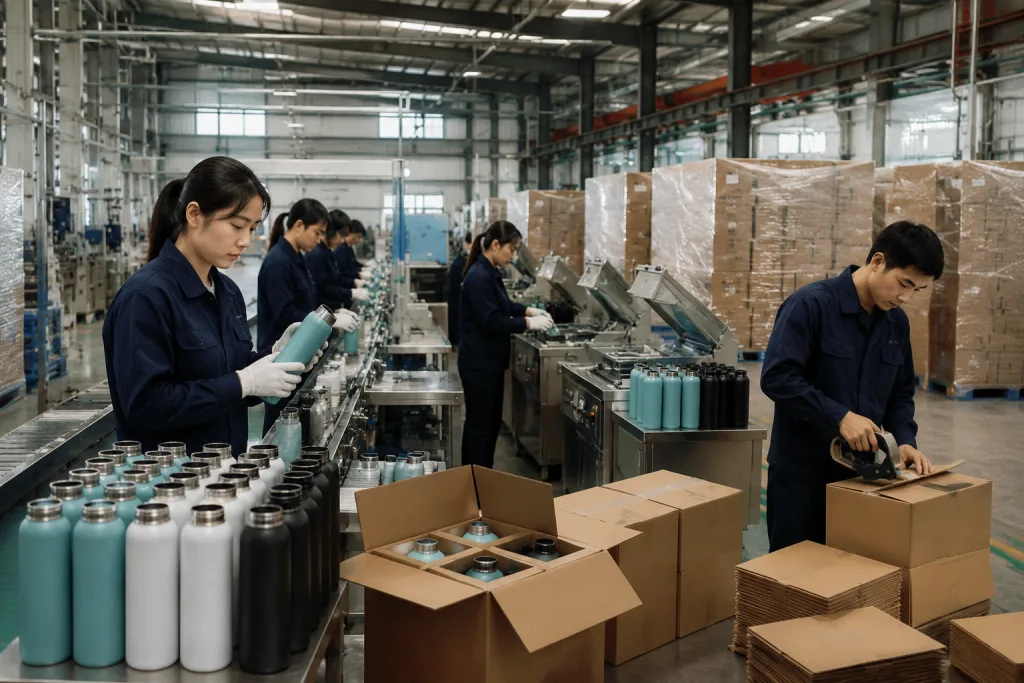
You can burn 2 to 3 weeks on a drinkware project before the first sample leaves the factory. We see the same mess on the line: a vague RFQ, 304 stainless assumed by one side and not the other, AI artwork that fails prepress, then a quote that looks clean until inner box, drop test, and carton mark costs land later. If you are buying from a hydration flask supplier in China for Europe or North America, a loose process usually costs more than a stricter one. We’ve seen this go sideways.
The fix is simple, but you need to lock decisions early: bottle construction, logo method, compliance, packaging, AQL, and shipping terms. This is where buyers save time or lose it. One PO typo on color code or lid finish can hold sampling 4 days while QC pulled the sample and sales rechecked the BOM. Whether you buy custom drinkware for retail, corporate gifting, a canteen distributor program, or a seasonal promotional launch, a factory in Zhejiang, China can run fast if your PO line items are specific enough to build from.
Start with an RFQ that can price
Buyers ask for pricing too early. “500ml insulated bottle with logo” is not an RFQ a hydration flask supplier can price cleanly, because on our side that could mean 20 different builds on the line. If you need a number your purchasing team can sign off, the RFQ must pin down the spec so the factory is not filling blanks from habit.
At minimum, specify bottle type, capacity, construction, finish, decoration, packaging, compliance market, and target quantity. For stainless steel hydration flasks, the normal baseline is 304 inner / 201 outer or 304/304 if your brand position is higher. Wall thickness usually falls around 0.4 mm inner and 0.5 mm outer; we check this with an ultrasonic thickness gauge when QC pulls the sample. For premium outdoor or sports lines, some buyers shift to thicker material or copper-plated vacuum insulation, and cost moves the same day because weight, cycle time, and carton loading all change. This is the wrong question to ask: “What’s your best price?” Ask what build the price is based on.
Put these line items in your RFQ
- Capacity: 500 ml, 750 ml, 1,000 ml
- Construction: single wall, double wall vacuum, copper coating yes/no
- Material: SS304, SS316, tritan, glass, lid PP or stainless
- Color: Pantone reference, matte or gloss powder coat
- Logo: 1-color silkscreen, laser engraving, UV print, wrap decal
- Packaging: egg crate, white box, color box, PDQ, master carton qty
- Testing market: EU REACH, LFGB, US FDA, California Proposition 65 if needed
- Trade term: EXW, FOB Ningbo, FOB Shanghai, DDP
- Inspection level: AQL 2.5/4.0
If you are also comparing a canteen supplier, canteen manufacturer, or custom growler source, keep the RFQ structure identical across all vendors. That is the only fair comparison, and we have seen this go sideways when one supplier quotes egg-crate packing and another hides a color box in the unit price. A serious canteen factory in Zhejiang or elsewhere in China will usually return a first quote within 24-72 hours if artwork and quantities are clear; if the PO says “1,000 pcs” in one line and “1,200 pcs” in another, the quote stops right there. If a supplier sends back one line with no assumptions, expect re-quotes later, usually after artwork review, drop test packing check, or carton size confirmation.
A quote is only useful when you can trace every number back to a physical feature, a decoration step, or a packaging decision.
Build the PO around real specs
After the quote range is approved, the next miss is a loose PO. Put the real specs on it. Quantity and unit price are not enough. Your PO should read like a short production contract, especially for customized drinkware, a customizable canteen line, or a customized growler program where 4 or 6 SKUs, two lid types, and mixed finishes run on the line together.
A usable PO for a hydration flask supplier usually lists SKU code, mold reference if any, unit price, quantity by color, packaging, barcode instructions, test requirements, and shipment window. If you sell into retail, Amazon FBA, or distributor channels, add carton dimensions and gross weight limits before production starts. We have seen cartons come out at 62 x 41 x 29 cm and 18.6 kg, while the buyer limit was 17.5 kg on the routing guide. The bottle spec was right. The shipment still got flagged. This is the wrong question to ask: “Can you match the sample?” Ask whether the factory can match the sample, the carton rule, and the label file on the same PO.
Typical PO line items buyers should lock
- Item: 750 ml double-wall vacuum flask, SS304 inner/outer
- Finish: Pantone 432C matte powder coat, food-contact safe
- Logo: laser engraving, 35 mm width, one side
- Lid: screw lid with PP inner and silicone seal, leak test 100%
- Packaging: 1 pc/polybag + white box, 24 pcs/master carton
- Carton mark: PO number, SKU, color, made in China, carton count
- Barcode: FNSKU or UPC placement file attached
- Inspection: pre-shipment AQL 2.5 major, 4.0 minor
- Shipping term: FOB Ningbo
- Delivery: 35 days after deposit and artwork approval
If you work with canteen distributors or a distributor drinkware network, write the assortment split by market on the PO. For example, 1,200 pcs black, 800 pcs navy, 1,000 pcs white. Sounds basic. It still gets missed. We have had POs where the total 3,000 pcs was approved, but the color split line still said “TBC,” and then the buyer flagged it after carton artwork was already plated. QC pulled the sample, but production could not run the full batch without the color ratio. At our end in Hangzhou, Zhejiang, buyers who lock color split, carton count, and barcode format early usually save at least 5-7 days of back-and-forth before mass production.
Sampling is where problems get cheap
The sample stage is not for admiration. It is where we catch problems while they still cost USD 30, not USD 3,000. If you are sourcing from a hydration flask supplier, ask for the right sample at the right time. Buyers still ask us for a fully branded pre-production sample before they have locked a 0.5 mm body diameter change or approved the lid thread. That slows the project, ties up the line, and the math does not work.
We usually run three sample stages, and this is enough for most custom programs. First is an existing-stock reference sample to confirm shape, hand feel, and approximate construction; QC will often check wall thickness with a caliper on this stage. Second is a logo sample to verify artwork size, color, and how the finish behaves on the coating. Third is a pre-production sample made to final packaging standard. For a custom canteen or customizable drinkware project, these checkpoints cover the failures we actually see before mass production.
- Stock sample: often USD 0-20 each plus freight, ready in 2-3 days
- Logo sample: usually USD 30-80 depending on print method, ready in 5-7 days
- Pre-production sample: USD 50-150 with final pack-out, ready in 7-10 days
What should you check? Start with weight and weld quality. Then check thread smoothness, leak performance, odor, coating consistency, logo position, base stability, and carton fit. QC pulled one sample last month because the logo sat 3 mm high on the powder coat panel, and the buyer flagged it at once. For insulated product, ask how long the supplier tests heat retention and at what fill temperature. A typical internal benchmark might be hot above 45°C after 12 hours or cold retention 24 hours, but this must be written on the sample approval sheet, not assumed.
If you are reviewing a canteen custom program or customized canteen for school, sports, or gifting, also test lid use with one hand, handle durability, and whether replacement lids are available under the same SKU. We have seen this go sideways when a PO listed the wrong lid code and the spare parts did not match the shipped bottle. A good canteen vendor or canteen manufacturers group in China should give you the spare-part policy up front. That matters for distributor canteen business, because one broken lid claim can wipe out the margin on the original unit.
Price differences usually come from these details
Buyers compare 3 or 4 offers from different canteen suppliers and assume one factory is charging more for the same bottle. That is the wrong question to ask. In our line, a USD 0.60 gap on a 750 ml flask usually comes from build details the PO does not spell out clearly: steel grade, copper coating, lid structure, powder thickness, or pack-out. We have seen buyers flag a quote as “too high,” then QC pulled the sample and found the other factory was quoting a lighter body and simpler inner cap.
For reference, a mainstream 500-750 ml double-wall vacuum flask in China may sit around USD 2.80-4.80 FOB at 3,000 pcs, depending on construction and decoration. A simpler single-wall sports bottle can be under USD 1.50-2.20 FOB. A customized growler with larger capacity, handle lid, and heavier body will price higher because material weight rises fast. On the factory floor, even a 60-90 g weight increase per piece moves the math fast at this volume.
Cost drivers to challenge before approval
- 304/304 versus 304/201 body structure
- Plain vacuum versus copper-plated vacuum
- Standard powder coat versus multi-layer texture or gradient finish
- One-color silkscreen versus wrap print or multiple logo positions
- Standard white box versus retail color box with inserts
- Common lid tooling versus new custom cap or accessory
An experienced hydration flask supplier should be blunt here. If your target is USD 3.20 FOB and your spec is behaving like a USD 4.10 bottle, the factory should point to the 2 or 3 features causing the overrun. We run this backward one variable at a time: steel combination first, decoration next, lid style after that, packaging last. Last month a buyer wanted to cut cost by changing all four at once; we pushed back because that is how projects go sideways and nobody knows which change caused the complaint rate.
If a supplier cannot explain a USD 0.30 change per unit, assume the production control is just as loose.
Compliance, testing, and inspection need names
Buyers often write “food-safe” on the inquiry sheet. That wording does not protect you. A hydration flask supplier shipping to Europe and North America should spell out the exact requirement, who books the test, and when the lab sample is taken—before production, from pilot run, or from finished goods. We have seen POs with one loose line and no test owner, then the buyer flagged it after mass production started.
For EU projects, buyers usually ask for REACH, and some retail channels also require LFGB. For the US, the usual ask is FDA food-contact compliance, plus California Proposition 65 screening if the program calls for it. For children’s items, CPSIA and ASTM points may apply by product type and age grade. A kids canteen for retail is not the same job as an adult flask with a one-color logo. This is the wrong question to ask: “Is your bottle food-safe?” The right question is which regulation, which component, and which market. On the line, even a 2 mm silicone straw tip change can trigger a fresh review.
Inspection terms need the same level of detail. “Factory will check goods” is filler, not a control plan. Write the AQL, name the defect classes, and state the pass standard. The usual commercial level is AQL 2.5 major / 4.0 minor. For big promotions or tight retail programs, buyers often narrow appearance limits on logo position, scratch length, or lid color variance, and some set zero tolerance for leakage. If you book a third-party inspection, tell the supplier before production starts. We run carton drop checks differently when SGS or BV is coming, and QC pulled the sample from sealed cartons, not from the rework table.
- Leakage test: 100% for screw-lid insulated bottles
- Vacuum test: per batch, with agreed method
- Appearance inspection: coating, dents, scratches, logo shift
- Drop or transit check: retail box and master carton integrity
- Lab test responsibility: buyer nominated or supplier arranged
Social compliance also shows up in real orders. Distributor groups and larger retailers may ask for BSCI, ISO 9001, or audit records before they approve a canteen manufacturer. Those papers do not replace product testing. They do make sourcing move faster. We have seen multi-country programs lose 12 days on document re-approval because one factory audit expired mid-project. If a canteen distributor or distributor growler buyer is building that kind of program, get the audit pack early and check the factory name on each file—the math does not work if the report is issued to a trading company and the goods ship from another site.
Mass production works when handoff is controlled
After sample approval, the job is handoff control. Your hydration flask supplier may have the machines, but orders still get bent between sales, artwork, purchasing, coating, assembly, and packing. We’ve seen this go sideways over one old AI file or one missed note on a carton mark. The safest buyers ask for one final approval sheet before the line starts. One file. One version. Not 10 email threads and a WeChat screenshot.
A practical handoff pack should show approved sample photos, the exact logo file version, Pantone reference, carton artwork, barcode placement, and the final PO table. For repeat orders, call out every change from the last shipment in bold wording such as “logo size increased from 28 mm to 35 mm” or “master carton changed from 20 pcs to 24 pcs.” This is not picky; this is where mistakes get blocked. On our floor, QC pulled the sample once because the PO said “navy lid” while the artwork sheet showed black, and 2,000 pcs were already queued for assembly. Factories in China run dozens of similar SKUs at the same time. What looks obvious on your side is often missed at line setup.
Lead time follows season, finish, and pack-out details. For common vacuum flasks, 25-35 days after deposit and full approval is the range we usually quote. Add color box printing, two decoration steps, or pre-holiday congestion, and 35-45 days is the safer call. The wrong question to ask is total monthly capacity. A plant rated at 300,000 units per month may still jam on one lid type, one silk screen station, or one shrink-wrap spec at 0.06 mm.
For procurement teams handling canteen promotional launches or customized drinkware across several channels, ask for mid-production updates with real stage markers: body forming complete, powder coating complete, assembly percentage, packing percentage. We ship these updates against the production board because “on schedule” tells you nothing. This matters fast if you buy from several canteen manufacturers or canteen distributors and need containers to land together. Good suppliers in Zhejiang and across China do not just give an ETA; they tell you where the order sits on the line and what is still waiting.
Send your RFQ and get a production-ready quote
Share bottle specs, artwork, target quantity, and delivery window. We will review the build, flag cost drivers, and quote with clear MOQ, lead time, and FOB terms.
Frequently asked questions
What MOQ should I expect from a hydration flask supplier?
For standard stainless steel vacuum bottles, the practical MOQ is usually 1,000-3,000 pcs per model, often split by 2-4 colors. Some factories in China will accept 500 pcs for plain stock colors with simple laser marking, but the unit price rises noticeably. If you need a custom lid, color box, or a new mold feature, expect MOQ to move higher. For example, a standard 750 ml flask may start at 1,000 pcs, while a custom growler or fully customized canteen with exclusive tooling may need 3,000-5,000 pcs. Ask whether MOQ is per SKU, per color, or per order. Those are not the same thing, and many quote misunderstandings start there.
How long do samples and bulk production normally take?
A stock sample is often ready in 2-3 days. A branded logo sample usually takes 5-7 days, and a pre-production sample with final packaging often needs 7-10 days. Bulk production for a standard custom drinkware order is commonly 25-35 days after deposit, artwork approval, and sample sign-off. In peak periods, especially before Q4 promotions, allow 35-45 days. If your project includes color boxes, multiple print positions, or retail barcode labeling, add extra buffer. From Zhejiang, China, ocean transit to Europe may add roughly 30-40 days port to port, and to the US around 20-35 days depending on route.
What should be written on the PO besides quantity and price?
Your PO should include SKU code, product size, capacity, material grade, wall construction, finish, logo method, logo position, packaging method, carton quantity, carton marks, barcode rules, inspection standard, test requirement, shipment term, and delivery date. If you buy for Amazon or retail, also state master carton maximum gross weight and any FNSKU or UPC placement instructions. A good PO for a hydration flask supplier acts like a short manufacturing contract. It reduces avoidable disputes over details worth USD 0.10-0.50 per unit, which adds up fast on a 3,000 or 10,000 piece order.
How do I compare quotes from different canteen suppliers fairly?
Use one RFQ sheet and send the exact same specification to each canteen supplier or canteen vendor. Lock the bottle size, steel grade, vacuum type, lid style, finish, decoration, packaging, testing market, and Incoterm. If one canteen manufacturer quotes 304/201 and another quotes 304/304, their prices are not comparable. The same applies to white box versus color box and laser logo versus silkscreen. Ask each supplier to state assumptions clearly and break out extra costs such as mold fee, sample fee, and test fee. That gives you an apples-to-apples comparison and makes it easier to explain supplier selection internally.
When should I use laser engraving instead of silkscreen printing?
Laser engraving is usually the safer choice for durability, especially on powder-coated stainless bottles used outdoors, in gyms, or in corporate gift programs. It resists rubbing better than most surface prints and often costs around USD 0.08-0.25 more per unit depending on size and position. Silkscreen is still useful for bright brand colors and lower-cost canteen promotional orders, but it is more sensitive to abrasion and curved surfaces. If your order is for a premium hydration flask supplier program, laser often gives a cleaner long-term result. For retail shelves, some buyers use silkscreen for color impact on entry SKUs and laser for premium lines.