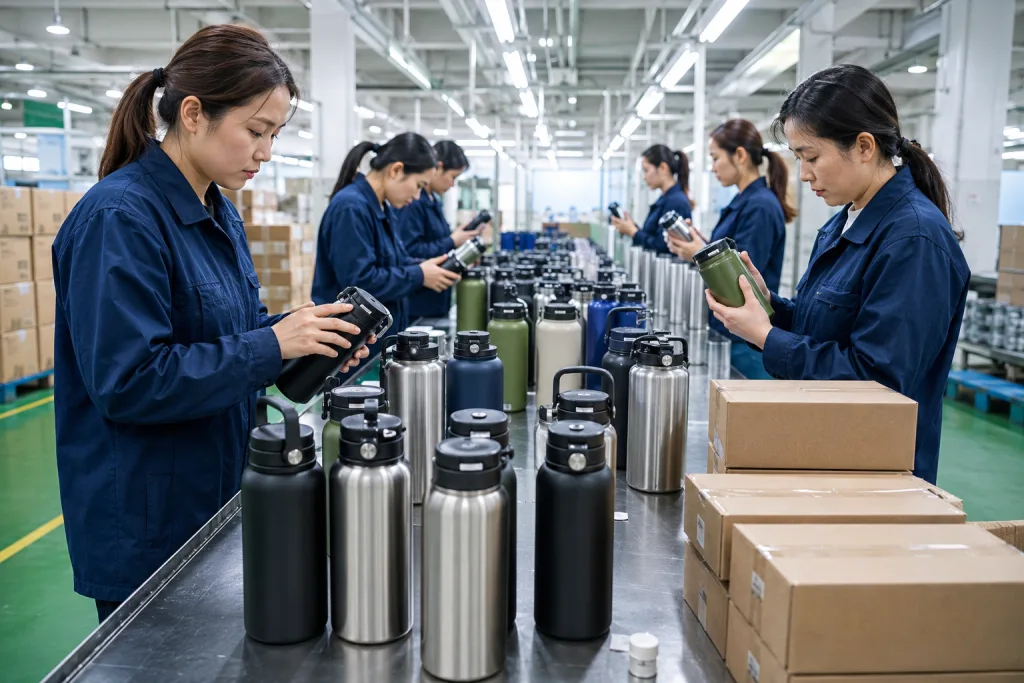
Key Takeaways
- Cut your hydration flask supplier list to 3-5 qualified factories before sampling to save 10-15 days
- Typical MOQ is 500-1,000 pcs per color for stock molds, while new mold programs often start at 3,000 pcs
- Production lead time is usually 25-45 days after sample approval and 30% deposit
- Use AQL 2.5 for major defects and lock PO line items like logo method, wall thickness, carton marks, and test requirements
You do not need a 20-name hydration flask supplier list. You need 5 that still make sense when target cost is tight, the logo size is capped at 45 mm, the gift box spec changes, the lab asks for retest samples, and the vessel booking moves three days. We see buyers start with 20 factories and still compare apples to bolts because one quote is for a 304 stainless bottle with powder coating, another is for spray paint and a plain polybag. The problem is not finding suppliers in China. The wrong question is asking for “best price” before you lock material, decoration, packing, and ship date. That is how bad samples, vague quotations, and expensive revisions show up.
If you buy custom drinkware for retail, promotional, or distributor channels in Europe or North America, the sourcing process needs order. A canteen manufacturer in Zhejiang may look the same as the next one on paper, then the gap shows up after the PO hits the line: MOQ is 3,000 instead of 1,000, QC pulled the sample and found a weak weld at the shoulder, or the export carton mark does not match the PO typo the buyer flagged. This is where disciplined buying pays off. We have seen this go sideways fast.
Start with a usable shortlist
A hydration flask supplier list works only when every factory quotes the same build under the same conditions. We see RFQs go out missing 4 or 5 basic specs, then the buyer tries to compare numbers that are not talking about the same bottle. One canteen supplier prices 18/8 stainless steel, another slips in 18/0. One quotes single-wall, another quotes double-wall vacuum. One includes an individual box, another leaves it out. QC pulled this exact issue on a 500 ml flask program last month. The lowest price is usually the loosest quote.
For a first shortlist, keep it tight: 3 to 5 factories. That is enough to check cost, tooling fit, and response speed without dragging the project. In Zhejiang, China, 20 factories may show the same silhouette in a catalog, but this is the wrong question to ask. The real screen is process depth and export discipline. We run into this on the line all the time: two suppliers show the same shape, but one has automatic laser welding and one is outsourcing half the job. Ask each canteen factory for:
- Business scope and export markets
- Main materials: 18/8, 18/0, Tritan, borosilicate glass
- Monthly capacity, for example 300,000 to 500,000 units/month
- MOQ by SKU, color, and logo method
- Audit status such as BSCI or ISO 9001
- Compliance experience with REACH, LFGB, FDA, ASTM
- Typical lead time in low and peak season
If you sell through a canteen distributor or distributor drinkware channel, ask if the supplier handles barcode labels, FNSKU, retail packs, and master carton drop tests. Put numbers on it. Ask for carton spec, drop height, and lead time in low season versus peak season—12 days vs 18 days tells you more than "fast delivery." A solid canteen manufacturer answers this cleanly, usually in one sheet, without three rounds of follow-up. If replies come back slow, partial, or mixed up, cut that name from your hydration flask supplier list before you spend money on samples. We have seen this go sideways over a PO typo on label placement.
A short list with comparable data is more valuable than a long list with hopeful promises.
Write an RFQ that forces clarity
Your RFQ should read like a PO draft, not a casual email. That is the quickest filter. A real canteen supplier will answer line by line; a trading middleman usually guesses by the third spec, and we see it fast when the buyer flagged “same as last order” but the old PO even had the lid code typed wrong. If you want custom canteen, custom growler, or customizable drinkware programs, put every assumption on the page.
Include a simple specification table in the RFQ with fixed line items. At minimum, state:
- Product type: hydration flask, sports bottle, growler, or customized canteen
- Capacity: 500 ml, 750 ml, 1,000 ml
- Construction: single-wall or double-wall vacuum
- Material grade: SUS304 inner / SUS201 outer or full 18/8
- Wall thickness: for example 0.4 mm inner / 0.5 mm outer
- Lid style: screw lid, straw lid, flip lid, or spout
- Finish: powder coat, spray paint, base polish, electroplating
- Logo: silk screen, laser engraving, heat transfer, UV print
- Packaging: polybag, white box, color box, PDQ, mailer
- Order quantity by color and by logo
- Target price term: FOB Ningbo or FOB Shanghai
- Required compliance and test reports
Add a second table called PO line items to confirm at quotation stage. This is where custom jobs break. We have seen approved artwork go into bulk packing with the wrong carton mark or no spare straw ratio listed, then QC pulled the sample and stopped the line. Confirm carton size, gross weight limit, carton marks, spare parts ratio, replacement policy, sampling cost, tooling fee, and who owns the mold. If this canteen customized program is for a promotion, give the in-store date and count back from it—sample approval on Day 12 versus Day 18 changes whether we ship on time.
Across Zhejiang sourcing clusters, factories move faster when the RFQ is concrete. We run feasibility first: can the customizable canteen design hold the print area, does the custom growler handle need a new mold, does the target price still work at 3,000 pcs MOQ, what did the caliper read on the wall thickness sample. You get cleaner feedback and fewer surprises. Chasing another $0.08 off an unclear quote is the wrong question to ask; the math doesn't work if bulk goods fail at packing stage.
Compare quotes beyond unit price
Once quotations come back, new buyers usually stare at the FOB number first. Fair enough. It is still the wrong question to ask if you stop there. Rank your hydration flask supplier list by total landed cost and failure risk, not unit price alone. We have seen a USD 2.85 quote lose to USD 3.10 after the buyer added lab testing, inner boxes, and a lid seal that actually passed a 1-meter inverted leak check on the line. A canteen manufacturers group that runs more steps in-house often saves money later, even if the opening quote looks higher.
Build a comparison sheet with these columns:
- Unit price by quantity break: 500 / 1,000 / 3,000 / 5,000 pcs
- Sampling fee and refund terms
- Tooling fee for lid, handle, or bottle body
- MOQ by color and packaging style
- Lead time for sample and bulk
- Vacuum retention claim, for example 12 hours hot / 24 hours cold
- Leak test method and percentage checked
- Coating warranty or scratch resistance standards
- QC standard such as AQL 2.5/4.0
- Payment terms: 30/70, LC, or OA if available
This is where weak canteen suppliers usually show themselves. QC pulled the sample, and the gaps are obvious fast. Some suppliers will not state wall thickness in mm, will dodge the seal material, or will write “customizable” and skip print size limits, wrap angle, or logo position. We have also seen POs with a color typo that turned navy into black, so decoration limits and approval points need to be written down. If you buy for canteen promotional orders, ask whether they can hold Pantone variance within a practical production tolerance across lots. If you buy for a canteen distributors network, ask whether they can mix SKUs in one container and how they check carton assortment accuracy at the carton label stage.
A quoting exercise like this also tells you if you are talking to a real canteen factory or a sales office passing orders out. Ask where welding, powder coating, and laser marking are done. Ask which machine they run and which step leaves the building. If welding is in-house but coating is outside, say it plainly. That setup can still work, but we have seen this go sideways when subcontracted parts arrive 12 days late and bulk moves from 35 days to 47 days before anyone tells the buyer. You need that disclosed before samples start and before PO drafting gets locked.
Move to samples with purpose
Sampling is not for admiration. It is for cutting risk. Once your hydration flask supplier list is down to 2 or 3 finalists, order samples with a score sheet and pass/fail points. If you do not, you end up with nice-looking bottles on the desk and no decision. We have seen this go sideways when a buyer approved by photo, then QC pulled the sample and found the net weight was 8 g off spec.
For each sample, score the following:
- Weight tolerance versus spec, such as plus or minus 5 g
- Lid fit, thread feel, and leak resistance after inversion
- Base stability and dent resistance
- Powder coat adhesion and color match
- Logo sharpness, position tolerance, and durability
- Odor from gasket, paint, or internal cleaning
- Packaging protection and barcode readability
Ask for three sample stages on any program with real volume; below 3,000 pcs, the math often does not work. Stage 1: existing stock sample to confirm shape, hand feel, and general build. Stage 2: pre-production sample with your actual logo, finish, and the right carton. Stage 3: golden sample approved against final packaging and artwork, then sealed as the line standard. For a customized growler or customizable growler with new tooling, ask for 3D drawings and dimension sign-off before steel is cut. A 0.3 mm shoulder change looks small on screen and turns into a bad lid fit fast.
Write sample requirements like PO line items. Example: “500 ml double-wall vacuum flask, SUS304 inner/SUS201 outer, 0.4/0.5 mm body, powder coat Pantone 432C, 1-color silk screen logo 35 mm width, white box with barcode label, leak test 100%.” This is the right habit. We ship against lines like that every day, and it cuts the usual arguments about logo position, box style, or whether the gasket smell was accepted. We once got a PO with “5000 ml” typed instead of “500 ml”; that typo would have wrecked production if nobody stopped and checked.
If you source from China for Amazon or retail distribution, test the sample like your customer will use it. Run dishwasher warnings, drop a packed unit from 76 cm if your standard requires it, verify scan quality, and check whether the base fits cup holders at 74 mm ID. Buyers often ask only about price first; that is the wrong question to ask at sample stage. A canteen customized correctly here is much easier to scale in bulk, and a weak barcode label or loose insert tray is exactly where returns start.
Lock the bulk PO line by line
Once you place the order, treat the purchase order as the control sheet on the line, not a loose quantity note. We have seen too many disputes start from one lazy line: “same as approved sample.” That wording is the wrong shortcut. A solid bulk PO for custom drinkware needs to state exactly what we run, what QC checks, how goods are packed, and what we ship.
Your PO should include these line items in writing:
- SKU code and full product name
- Approved drawing or photo reference number
- Capacity and tolerance
- Material grade and wall thickness
- Color code and finish method
- Logo method, color, size, and placement
- Lid, gasket, straw, and accessory specifications
- Packaging structure and insert requirements
- Carton quantity, carton dimensions, and gross weight cap
- Inspection level: AQL 2.5 major / 4.0 minor
- Required testing: leak, vacuum, coating adhesion, migration if needed
- Shipping term, ex-factory date, and port
Be literal here. If the body is 550ml with a ±5ml tolerance and the wall is 0.5mm 304 stainless, write that. If the logo sits 35mm from the base and prints in Pantone Black C, write that too. QC pulled a sample last month where the buyer PO said “matte blue,” but the approved chip was one shade off and the buyer flagged the whole batch. If you buy from a canteen manufacturer in Zhejiang, China on FOB Ningbo terms, state the cargo ready date and document deadline. If you need outer carton marks for a distributor canteen program, include the exact text and barcode format. If the order is for canteen promotional use with a fixed event date, add a late-shipment clause or at least weekly milestone reporting.
New buyers miss spare parts all the time. This goes sideways fast with custom lids. If your lid uses a custom gasket or straw, specify a spare ratio such as 1% extra components packed separately. On one PO, the buyer even typed the lid code wrong by one letter, and the line almost packed the wrong straw set before final check. That one small line protects the distributor later. For canteen customizable projects with several lid options, assign each variant its own SKU and carton mark. Do not rely on visual distinction alone.
Control production and final inspection
After deposit payment, stay on the order. Don’t go silent until the balance notice shows up. This is where a supplier list turns into an actual supply base, or falls apart. Ask for a plain timeline with dates: artwork confirmation, pre-production meeting, raw material cut date, body forming, welding, vacuuming, coating, assembly, packing, and inspection. On our line, a normal stock-mold program is often 25 to 35 days. New mold or peak-season programs can stretch to 45 to 60 days. We usually pin the coating queue by day 12, and if that slot slips, the whole shipment feels it.
Use checkpoints. At minimum, request:
- Pre-production approval of golden sample and packaging file
- In-line photos during coating and logo application
- Mid-production update on completion percentage
- Pre-shipment inspection once 80% to 100% packed
This is the wrong question to ask: “Can you just update me when it’s done?” Ask for control points instead. We’ve seen this go sideways when the buyer approved a logo PDF, but the PO had a typo in the color code and the line printed 3,000 pcs before anyone caught it. For drinkware, the checkpoint that gets flagged most is logo position after coating, because a 2 mm shift is easy to miss in phone photos and easy to reject at destination.
If you use a third-party inspector, align the checklist with the PO line by line. QC pulled the sample against one PO where “matte black” was written, but the carton mark still said “rubber finish,” and that mismatch wasted half a day. For drinkware, inspection commonly covers appearance, logo position, capacity, weight, leak test, vacuum retention spot check, barcode scan, carton drop condition, and assortment accuracy. Acceptance should follow the agreed AQL, not a general “looks okay” standard. If AQL 2.5 is on the order, run to that standard and write it down.
Ask the canteen vendor for traceability on problem lots. At minimum, cartons should connect to a production date or lot code. Better canteen manufacturers also keep records on gasket material batches and vacuum test sampling. In our factory, the lot code links back to the shift, the vacuum station, and the gasket batch within a few minutes. That sounds boring until a buyer in Germany flags 48 leaking units. If you ever face a claim in Europe or North America, traceability is worth more than a slightly lower FOB price.
If the supplier misses one milestone, don’t panic. Ask what actually moved: material arrival, coating line congestion, or rework from logo defects. We ship late for reasons, not magic. The right move is deciding early whether you need partial shipment, air freight backup for 200 to 500 pcs, or a revised in-store date. The math doesn’t work if you air ship the full order, but 2 cartons to protect a launch date can save the program.
Build a supplier list you can reuse
After shipment, most buyers stop tracking. That is a mistake. This is the point where you grade the supplier and decide if they stay on your hydration flask supplier list. A supplier is not qualified because the sales rep replied fast during sampling. They are qualified if they held spec, hit the promised ship date, packed the cartons right, and dealt with problems without the usual factory excuses. We have seen this go sideways over a 0.8 mm logo shift that looked small on screen and failed at inbound check.
Score each canteen supplier across five areas: quotation accuracy, sample accuracy, production consistency, communication speed, and claim handling. Run a simple 100-point sheet. If a canteen manufacturers candidate scores below 75/100, keep them only as backup. If they score above 85/100, you likely have a source worth building in China. Put numbers behind each score: quote revision count, sample change count, reply time in hours, and whether QC pulled the sample against the sealed approval before mass production.
Write down where each supplier actually fits. One canteen factory may be strong in low-MOQ custom canteen orders from 500 to 1,000 pcs, where the line can swap silk screen artwork fast and still keep carton marks clean. Another may be better for customized drinkware at 10,000+ pcs with automated coating lines and stable color control from lot to lot. Another may suit customizable canteen or customized growler projects because they manage tooling and welding in-house, and that saves 12 days versus sending neck tooling outside. General rankings look neat, but this is the wrong question to ask.
This matters if you sell through canteen distributors, a canteen distributor network, or promotional import channels. The right supplier for a premium retail flask is often the wrong canteen vendor for a fast-turn campaign item. We ship both types, and the buyer pushback is different every time: retail checks thread feel and powder finish; promo buyers care about price breaks and delivery windows. Keep factory notes, approved sample photos, complaint history, and latest prices. Add small things too, like the PO typo that caused the wrong lid color or the inspection finding on a crushed 5-layer export carton. Then your next RFQ starts from records, not memory.
In Zhejiang and elsewhere in China, plenty of factories can make a bottle. Fewer can run a repeatable B2B program. That gap shows up on the floor: leak test pass rate, welding consistency, AQL pull results, and whether the same supplier can repeat the job 6 months later without a fresh round of mistakes. Your job is to find the factories that can do it twice. Once is easy.
Need a shorter, better supplier shortlist?
Send your target SKU, quantity, logo method, and packaging brief. We will review feasibility, MOQ, lead time, and factory-fit options from Zhejiang, China.
Frequently asked questions
How many factories should be on a hydration flask supplier list before I ask for samples?
For most B2B programs, start with 8 to 12 names, then cut that to 3 to 5 qualified factories before sampling. More than that usually slows decisions and creates noisy pricing. Use hard filters first: MOQ, product type, compliance experience, audit status, and lead time. For example, if you need 1,000 pcs with custom logo and retail boxes in 35 days, any canteen manufacturer quoting 3,000 pcs MOQ or 50-day lead time should be removed early. After comparing RFQ responses, sample only 2 or 3 finalists. That keeps sample cost controlled, usually under USD 150 to 400 total for standard projects, while still giving you enough benchmark data on build quality, decoration, and communication.
What is a normal MOQ for custom hydration flasks or custom canteen orders?
For stock molds, a normal MOQ is often 500 to 1,000 pcs per size, with color-specific minimums such as 250 to 500 pcs per Pantone on powder coating. Logo-only programs can sometimes start at 300 pcs if the bottle is a standard model and the packaging is simple. For new tooling, customized canteen, or customizable growler programs, MOQs usually jump to 3,000 to 5,000 pcs because the factory must recover mold and setup cost. Lids with complex mechanisms may have their own component MOQ. Always ask for MOQ by body color, logo version, and packaging type, not just total order quantity. A quote saying “MOQ 500 pcs” can still hide a 1,000-pc minimum for a custom box or special lid.
What should I put on a purchase order for bulk custom drinkware?
Treat the PO like a manufacturing specification. Include SKU, capacity, material grade, wall thickness, finish, Pantone color, logo method, logo size and position, lid type, gasket material if critical, packaging format, carton quantity, carton marks, barcode rules, inspection standard, shipment term, and ex-factory date. If you need compliance, list it directly: REACH, LFGB, FDA, or ASTM depending on your market. For QC, many buyers use AQL 2.5 for major defects and 4.0 for minor defects. Add spare parts where relevant, such as 1% extra straws or seals. If you rely on “same as sample,” disputes become much harder to resolve because the supplier and buyer may interpret the sample differently.
How long does production usually take from sample approval to shipment?
A realistic bulk lead time for standard hydration flasks is 25 to 35 days after deposit and final sample approval. During peak season, especially from August to November in China, that can move to 40 to 50 days. If the project includes a new mold, custom lid, or complex retail packaging, expect 45 to 60 days including pre-production work. Sampling itself usually takes 5 to 10 days for existing models and 10 to 20 days for more customized drinkware. Do not plan from factory completion alone. Add time for inspection, booking, port handling, and ocean transit. For Europe or North America, total door timing often matters more than the quoted production days.
How do I know whether I am dealing with a real canteen factory or just a trading company?
Ask specific process questions that a real factory can answer quickly. For example: where are the bodies formed, where is vacuuming done, is powder coating in-house, what is monthly capacity, and what is the normal defect rate after final packing. A canteen factory should also provide photos or video of welding, coating, assembly, and packing lines, plus practical figures like 300,000 units per month or 30-day lead time on stock models. A trading company is not automatically bad, but you need transparency. If decoration, assembly, and inspection are split across multiple subcontractors, your risk rises unless one party clearly owns quality control. The issue is not label; it is who controls the process when something goes wrong.