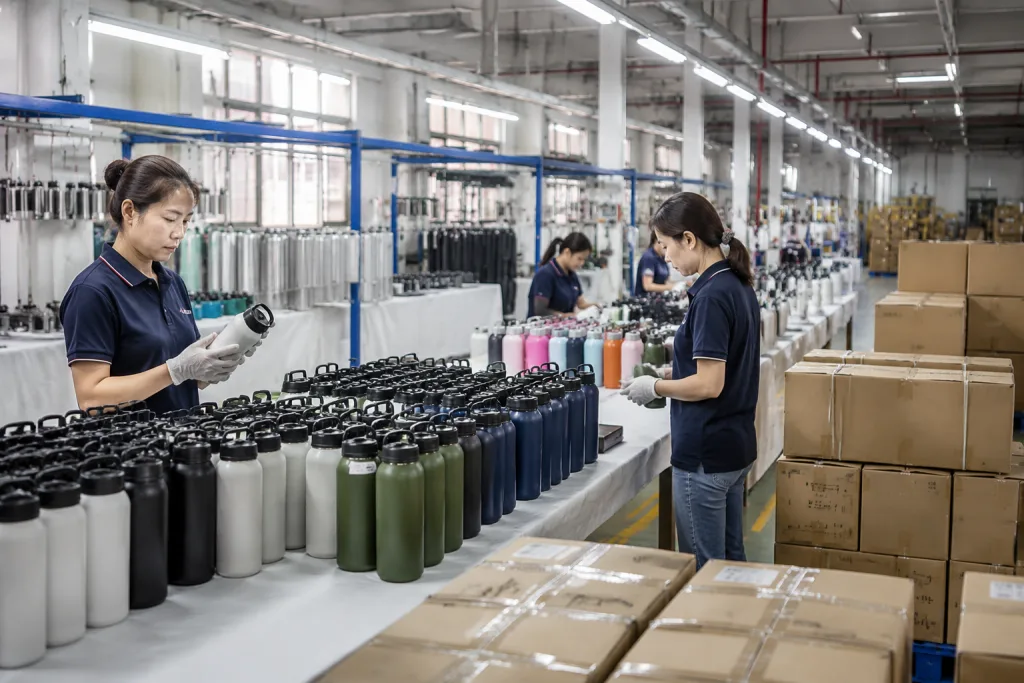
Key Takeaways
- Shortlist suppliers by 4 decisions first: body material, decoration, factory fit, and shipping model before you compare unit prices
- For custom stainless steel flasks, practical MOQs usually start at 1,000-3,000 pcs per color, with sample lead time around 7-12 days
- A reliable canteen factory should state AQL level, REACH/LFGB testing support, and production lead time such as 30-45 days in writing
- FOB China pricing can shift by USD0.20-0.80 per unit depending on coating, logo process, and packaging detail
You do not need a longer hydration flask supplier directory. You need a shortlist that survives sampling and production. Most B2B buyers already have 20 to 40 names from Alibaba, trade shows, LinkedIn, and referrals. The hard part is filtering down to the canteen supplier or canteen manufacturer that can hit your exact spec, target price, and ship date without trouble at sampling, on the line, or at customs. We have seen this go sideways over a 0.3 mm wall thickness change that never made it onto the final PO.
If you buy custom drinkware for retail, promo, or distribution, start with four decisions: material and structure, decoration method, factory fit, and shipment model. Those four choices cut weak canteen vendors fast. This is the right place to be strict. In Zhejiang, two factories can look the same on paper and run totally different in practice on MOQ, weld bead finish, powder coat color drift, and export documents. QC pulled the sample on one 32 oz flask project and found the lid thread fit was off by 0.4 mm; that one check saved 18 days of rework.
Start with the four buying decisions
Open a hydration flask supplier directory and skip the lowest quote first. Start with the 4 decisions that set cost, claim risk, and whether the item fits your channel at all. We have seen this go sideways: a buyer compares 12 factories, then changes the lid spec after sampling and resets the whole quote sheet.
The four decisions are simple:
- Product architecture: single wall, double wall vacuum, insulated growler, straw lid sport bottle, or wide-mouth custom canteen. On the line, these are different builds with different tooling, from necking dies to vacuum stations.
- Commercial target: retail margin, event-driven canteen promotional volume, or long-term distributor drinkware business. MOQ, decoration method, and carton math change fast once the target is clear.
- Supplier type: real canteen factory, trading company, mixed model, or a canteen distributor sourcing from several plants. This is where buyers get tripped up, especially when the sample came from one plant and mass production ships from another.
- Delivery model: bulk master cartons, gift box, Amazon FBA prep, or direct-to-distributor labeling. A 1.2 mm E-flute gift box and an FNSKU label sound small on paper, but they change pack-out time and damage rate.
For example, if you need a 32 oz powder-coated vacuum flask for outdoor retail, shortlist canteen manufacturers that run automatic powder lines, 100% vacuum testing, and recorded leak-test data. QC pulled one sample last month with a cap torque drift at 1.8 N·m, and that is exactly the kind of issue you want caught before shipment. If you need 5,000 low-cost event bottles, a single-wall customizable canteen is usually the smarter call. Forcing a vacuum spec to hit a promo budget is the wrong question to ask.
Buyers in Europe and North America also need to separate what the market wants from what the supplier is built to run. A factory in Zhejiang, China may be strong on 500 ml tumblers but weak on larger customizable growler projects because neck forming, handle welding, and pressure hold performance are different jobs. Ask each supplier what share of monthly capacity comes from the exact item family you need. If a supplier makes 600,000 units per month but only 5% are hydration flasks, that number tells you less than a 250,000-unit plant that mainly runs custom drinkware and stainless canteens. We ship both kinds of programs, and the math does not work the same.
Choose the right flask construction
Construction has more impact on performance, landed cost, and defect risk than logo artwork. A solid hydration flask supplier directory entry should show the bottle type, steel grade, insulation method, wall thickness, and lid system up front. If those basics are missing, quotes usually drag past 3 days, and the sales replies get fuzzy fast. We see this on the line all the time: buyers ask for a price first, then find out the supplier never stated whether the body is 0.4/0.5 mm or 0.5/0.5 mm.
Material and structure basics
- 304 stainless steel: the standard choice for most food-contact inner and outer walls; on our side, this is still the default for over 80% of flask POs.
- 316 stainless steel: used when you need higher corrosion resistance, usually at a premium of about 8-15%; common for saltwater, electrolyte, or medical-related use.
- Single wall: lower cost and lighter weight, but no insulation; easier to run at higher output on the line because there is no vacuum step.
- Double wall vacuum: the mainstream build for retail and premium corporate gifting; vacuum retention depends on weld quality and the vacuum chamber setup, not just the steel grade.
- Growler format: usually 64 oz or 128 oz, and it needs a stronger handle plus a closure that holds up under weight; QC pulled a 128 oz sample last month with handle play over 1.5 mm, and that unit was rejected.
For a customized canteen or customized growler, ask for actual thickness, not “good quality stainless steel.” Typical retail-ready vacuum bottles use 0.4 mm inner wall and 0.5 mm outer wall, while heavier outdoor SKUs may move to 0.5/0.5 mm. Thin steel saves money. It also dents faster and can throw off thread consistency at the neck after forming. Heavier steel feels better in hand, but the freight math does not always work once the packed weight jumps by 0.12 kg per unit.
Lids matter just as much. A flask can pass vacuum testing and still fail in market because the gasket, thread pitch, or hinge pin is weak. Ask whether the supplier runs 100% leak testing or random sampling only; on our line, 100% air-pressure leak testing is standard for sport lids, while some factories still rely on AQL pull checks. For sport lids, ask cycle life for the push button or straw hinge—10,000 cycles is a useful starting point, not a fancy claim. For a custom growler, ask if the closure is tested under internal pressure variation during temperature change. We have seen this go sideways after hot-fill simulation, where the buyer flagged seepage at the silicone seal, not at the bottle body.
A practical buyer question: if your channel is outdoor, gym, school, or promo, what is the real failure mode? Usually it is not insulation loss. It is leakage, coating scratches, denting, or logo durability.
If you are sourcing from China for Europe, also confirm the supplier can support REACH and LFGB-related testing through a recognized lab. For North America, depending on the item and channel, ASTM and CPSIA-related checks may matter more for kids products. A real canteen manufacturer should tell you which reports are available and which need renewal for your exact SKU. Ask for the report date and SKU match. We have seen POs with a lid code typo by one digit, and then the old report no longer covered the shipped item.
Know which supplier type you need
Not every name in a hydration flask supplier directory does the same job. Some are direct canteen manufacturers running their own lines, some are trading vendors quoting across 6 or 8 categories, and some are local distributors holding stock in-market. None of these models is wrong by itself. The wrong move is picking a supplier model that does not match your order, your timeline, or your quality risk.
If you need fast replies, engineering feedback, and control over customized drinkware details, go to a direct canteen factory. We see this on projects where the buyer wants a 0.3 mm logo position change, a new lid mold, or a powder coat color matched to Pantone. If you need one booking with glass, plastic, kids items, and stainless, a solid sourcing company can cut the back-and-forth. If you need weekly replenishment from local stock, a distributor can fix cash-flow and warehousing pressure, even if the unit cost lands 12% to 20% higher. This is the wrong question to ask if you only compare FOB price.
- Direct factory: best for custom canteen, custom growler, and ongoing OEM work where the line needs to hold the same spec month after month.
- Trading company: fits mixed sourcing or smaller annual volume, such as 3 SKUs packed into one container with separate carton marks.
- Local distributor canteen model: fits programs where speed beats margin, like a 7-day replenishment window instead of a 35-day import cycle.
- Hybrid supplier: factory for core SKUs, outsourced for edge items like kids tumblers or glass add-ons.
Ask blunt questions. How many hydration flask units do you make per month—200,000 or 2 million? What is your MOQ for one color and one logo: 500 pcs or 3,000 pcs? Do you own the powder coating line? Is laser marking done in-house or sent out? Can you show a BSCI or ISO 9001 record? What AQL standard do you inspect to before shipment? QC pulled the sample on one job last month and found the PO said “mat black” while the artwork file said “matt black”; small typo, real delay.
At BottleForge Industrial in Hangzhou, Zhejiang, buyers often ask why one canteen supplier quotes USD3.20 and another quotes USD3.95 for what looks like the same 500 ml vacuum bottle. Usually the gap sits in process control. One factory runs in-house coating; another sends it out 40 km away. One does 100% vacuum inspection with a pressure test rig; another spot-checks 5 pcs per batch. One uses thicker steel, a tighter lid fit, and AQL 2.5 for major defects. The other does not. We have seen this go sideways after the first repeat order, when claims start eating the savings.
Also ask where the real factory is. Zhejiang and nearby clusters in China have deep stainless drinkware supply chains, but “office in one city, production in another city, coating outsourced to a third city” changes lead time and accountability fast. We ship from Hangzhou, but buyers still ask for the process map, and they should. You do not need every step in-house. You do need a clear answer on who controls tube cutting, welding, coating, lid assembly, and final inspection before shipment.
Compare quotes beyond unit price
Price comparison is where buyer teams slip. We see it on the line all the time: two customized canteen quotes look close, but one factory priced 0.5 mm outer wall steel and the other priced 0.4 mm. Those are not the same quote. Your RFQ sheet needs to lock down capacity, size, steel grade, finish, logo process, packaging, test requirements, and Incoterm. If those assumptions move, the math doesn't work.
Here is where price usually moves:
- Body finish: spray paint usually lands below powder coating; special Pantone matching adds cost because we run extra color checks and often approve against a physical swatch, not just a screen image.
- Decoration: one-color silkscreen costs less than 360-degree UV print; on stainless items, laser engraving often sits in the middle, and the buyer flagged this before when the logo looked lighter on curved walls.
- Packaging: white box may add USD0.10-0.18; color gift box may add USD0.28-0.65 depending on insert structure, especially if the EVA insert thickness changes by 2 mm.
- Accessories: tea filter, paracord handle, silicone boot, spare straw, all change margin, and small add-ons get messy fast once MOQ on each accessory starts at 1,000 pcs.
- Testing and compliance: new lab work can add several hundred to several thousand USD depending on scope, and we've seen one LFGB retest triggered by a lid gasket compound change.
For a typical 500 ml double-wall flask ordered at 3,000 pcs, FOB China pricing might sit around USD2.80-4.60 depending on construction and finish. A 64 oz custom growler will be much higher because of material weight and handle complexity. If a canteen customizable quote is far below market, ask what was removed. Usually it is steel thickness, coating quality, lid quality, or inspection depth. QC pulled the sample once and found the lid thread fit was loose after a 1-meter drop test. Cheap quotes often hide there.
Make suppliers break out tooling and setup charges. New screen charges may be USD20-40 per color per design. Laser setup may be lower. Mold charges for a new lid or bottle base can run into several thousand USD. If you want a truly canteen customized shape rather than a catalog item with your logo, treat tooling amortization as part of the first-year business case. Not as an annoying one-time fee. We have even seen PO typos switch a stock lid to a new mold request, and that mistake cost 18 days.
For buyers working with canteen distributors or distributor growler programs, also calculate claim cost. This is the right number to chase. If your average claim rate drops from 3.0% to 0.8% because the supplier improved leak testing and packaging, the freight-adjusted total cost usually beats the cheapest quote. One buyer pushed back on a higher FOB price, then came back after their old supplier had 42 leaking units in one shipment. That is the number your finance team should care about.
Audit operations before you place PO
Before your first purchase order, audit the operation, not just the sample. You do not always need a flight to China. You do need proof: business license, workshop video, audit report, and 3 dated inspection records from the line. If a supplier cannot show how they run, document, and release goods, we’ve seen this go sideways fast when leakage claims start.
Start with these checkpoints:
- Factory profile: exact location, legal entity name, audit status, export markets, monthly output, and whether they run in-house welding or outsource body forming. Ask for the registration name on the invoice—one buyer caught a one-letter typo on the PO and customs held the shipment.
- Quality control: IQC, in-process checks, final inspection, AQL standard, leak and vacuum testing method. Ask what pressure they test at, how long the hold time is, and whether QC pulled the sample from live production or from a handpicked set.
- Social and system audits: BSCI, Sedex, ISO 9001 if relevant to your channel. Ask for the report date, expiry, and factory name match, because the buyer flagged one report last year that belonged to a sister company, not the shipping site.
- Compliance support: REACH, LFGB, FDA-contact declarations, and children’s product testing where needed. Get the test report tied to the actual material set—304 stainless body, lid PP, silicone seal—not a generic file from 2 years ago.
- Traceability: date code, lot control, carton mark, and complaint handling process. If 1 lot has coating peel, you should be able to trace it back to a shift, a coating batch, and a carton range within minutes, not 2 days.
A serious canteen manufacturer should show sample inspection records and explain defect categories without dancing around the question. For drinkware, major defects usually mean leakage, vacuum failure, logo offset beyond 2 mm, unstable base, coating peel, wrong color, or burrs at the thread that catch a finger during assembly. Ask how they define critical, major, and minor defects, who signs the release, and what happens if a pre-shipment inspection fails. This is where the math often breaks: if they say “we will rework everything” but cannot tell you rework capacity per day, the answer is not solid.
Lead time is another audit point. A supplier saying “25 days” tells you nothing unless they break down the route. For a custom canteen with a new color box, realistic lead time from sample approval is often 30-45 days. Peak season can stretch to 50-60 days. Reorder lead time can shorten if packaging and color stay unchanged. Ask for the split: body production, vacuuming, powder coating, logo print, packing, and vessel booking. We usually see 12 days for body and surface work, 5 days for packaging prep, and 7-10 days buffer if the lid supplier slips.
In Zhejiang, China, 100+ plants run stable drinkware programs because the upstream base for steel, lids, silicone, printing, and cartons is mature. That helps. It does not replace process discipline. A factory cluster can save 3-5 days on sourcing, but if your supplier will not commit to written specs, carton marks, and acceptance criteria, the cluster will not save your PO. This is the wrong question to ask: “Are you near the supply chain?” Ask instead, “Show me how this order is controlled from raw material to final carton.”
Match shipping model to your channel
The last buying decision is logistics. This is where 3 good SKUs out of 10 go sideways. Your hydration flask supplier directory shortlist should only include suppliers that understand your channel from day one: retail chains, promo orders, Amazon, or wholesale distribution. We see this on the line all the time. A clean bottle spec does not save a bad shipping setup.
For brick-and-mortar retail, carton consistency, barcode placement, and shelf-ready packaging decide whether goods flow or get held. One buyer flagged a barcode drifting 6 mm off the print box, and the warehouse stopped the intake. Online sellers care more about drop-test resistance, label accuracy, and FNSKU placement than a gift box with a matte finish. For canteen distributors, pallet efficiency and mixed-SKU labeling matter more. This is the wrong question to ask: “Can you make the bottle?” The better question is, “Can you pack it for my channel without claims?”
- FOB China: best if you control freight, book in volume, and already know your carton loading target by CBM.
- Ex works: only practical if your forwarder handles local pickup, customs filing, and export documents without missing a cutoff.
- DDP samples: good for fast approvals in 5 to 7 days, but not a clean way to judge mass-production cost.
- Amazon prep: requires carton limits, FNSKU labels, and routing rules that the packing team follows carton by carton.
Ask for packed carton dimensions, net and gross weight, and units per carton before confirming the PO. We ship too many orders where this check came late. A flask that saves USD0.12 in manufacturing can lose that edge fast if carton utilization is poor. We have seen insert changes lift container loading by 8-12%, and the math beats a small decoration saving almost every time. QC pulled the sample once and found the inner tray added 14 mm of dead space on all four sides.
For promo and seasonal business, split shipments cut risk. You might approve 10,000 pcs, then ship 5,000 by sea and hold 5,000 until final packaging sign-off. That gap has saved launches. For distributor canteen programs, annual blanket orders with release schedules help stabilize production and usually improve pricing once the MOQ per color is clear. We run these programs with monthly release sheets, and if the forecast is soft, the plan falls apart fast. We have seen this go sideways when the PO had one SKU code typed wrong.
The best supplier is not the one saying yes to everything. It is the one that tells you early that your MOQ, target price, testing scope, and launch date do not fit together. That conversation saves weeks. A solid supplier will push back before sampling if the lead time is 12 days on decoration approval but you want shipment in 18 days. That is the supplier you build with, whether you need a customizable drinkware line, a customized growler, or a repeat private-label flask program.
Shortlist the right flask supplier with fewer surprises
Send your target spec, MOQ, price range, and market. We will tell you quickly whether the project fits and which production route in China makes sense.
Frequently asked questions
What should I check first in a hydration flask supplier directory?
Check four items first: product type, MOQ, compliance support, and production ownership. You want to know whether the supplier is a real canteen factory or just a trader, whether MOQ is 1,000 pcs or 5,000 pcs, whether they support REACH or LFGB testing, and whether coating and logo work are done in-house. Then check lead time. For custom stainless flasks, sample lead time is often 7-12 days and bulk production is commonly 30-45 days after approval. If a listing does not show those basics, move it down your shortlist. A long directory is not useful if you cannot quickly separate true canteen manufacturers from general canteen vendors.
How do I compare a canteen manufacturer and a canteen distributor?
Compare them based on your channel, not just price. A direct canteen manufacturer in China usually gives you lower FOB cost, more control over customized drinkware details, and better options for custom canteen or custom growler development. A canteen distributor usually gives faster delivery, local stock, and easier small replenishment. If your annual volume is below 2,000-3,000 pcs per SKU, a distributor can be practical even if the unit cost is 20-40% higher. If you need private label, exact Pantone color, and long-term margin control, direct factory sourcing from Zhejiang or broader China is usually the better commercial model.
What MOQ is realistic for customized canteen orders?
For catalog-based stainless vacuum bottles, 1,000 pcs per size and color is a realistic opening MOQ with one logo position. Some factories will accept 500 pcs for stock colors, but the unit price normally rises by USD0.30-0.80 and decoration choices become narrower. For a fully canteen customized body or customized growler with new tooling, practical MOQs often start at 3,000-5,000 pcs, sometimes higher if you need a new lid mold. Packaging also affects MOQ. A plain white box is easier at lower volume than a custom color box with foam or molded pulp insert. Always ask whether MOQ applies per SKU, per color, or per shipment total.
Which quality checks matter most for custom drinkware?
For hydration flasks, the key checks are leak testing, vacuum retention, coating adhesion, logo durability, and carton drop resistance. Ask the supplier what percentage is leak-tested. Many better factories do 100% leak testing and 100% vacuum inspection or automated spot verification by batch. Confirm the AQL level for final inspection, typically AQL 2.5 for major defects and 4.0 for minor defects on general consumer goods. Also ask how they control color consistency and thread fit. A flask can look fine in photos but fail because the lid torque varies or the powder coat chips during transit. For Europe, REACH and LFGB-related support is also important depending on the product.
How long does a first custom drinkware order usually take?
A normal first order takes about 5-8 weeks from artwork and sample approval to FOB shipment. Pre-production samples usually take 7-12 days. Bulk production for 1,000-5,000 pcs is commonly 30-45 days, assuming the bottle mold already exists and packaging is straightforward. If you add a new gift box, third-party testing, or peak-season booking pressure, lead time can move to 50-60 days. A new mold for a customizable growler or customized canteen can add 20-35 days for tooling and validation. Buyers in North America should also leave buffer time for booking, customs, and inland delivery, especially in Q3 and Q4.