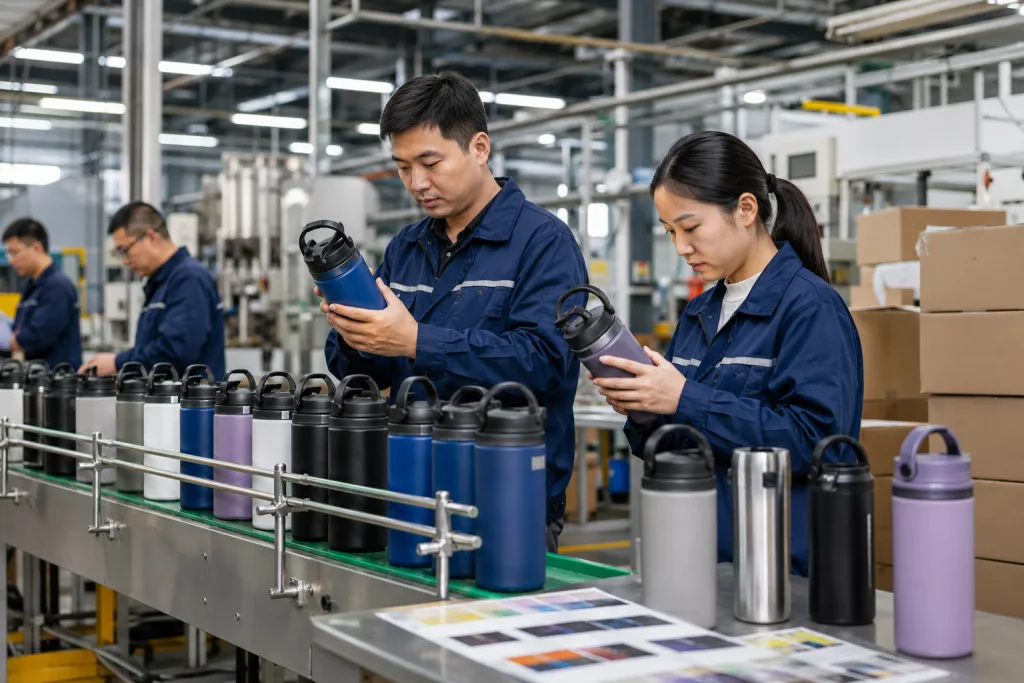
Key Takeaways
- A standard 500-750ml stainless hydration flask promotional order often starts at 500 pcs, with better unit pricing at 1,000 and 3,000 pcs
- Typical FOB China pricing runs about USD 3.20-4.80 for single-wall and USD 4.80-8.50 for double-wall vacuum bottles, before special packaging
- Normal production lead time is 25-40 days after sample approval and deposit; new color parts or custom molds can push total time to 45-60 days
- Decoration, packaging, and testing can add 12%-35% to project cost, so you should ask for an AQL-based quote with all add-ons listed
You usually see the real cost of a hydration flask promotional order after the PO is already moving. The quote looks clean, then sampling adds USD 80, packaging changes add USD 0.22 per unit, and a logo that looked simple now needs a second process on the line. If you are buying custom drinkware for retail, events, or distributor programs in Europe or North America, the gap between target cost and landed cost is where projects go sideways. We have seen buyers miss margin over a 1.5 mm EVA insert change that nobody priced on version one.
A practical buyer guide should start with the numbers: MOQ, tooling, decoration, testing, and transit days. This is the right place to be blunt. From Zhejiang, China, most cost and timing problems are visible early if your supplier gives you a line-by-line breakdown before sample approval, not after QC pulled the sample. That matters whether you are sourcing a custom canteen, a customized growler, or a hydration flask promotional run that needs to land in 28 days instead of 41 and still avoid air freight.
Where the real cost sits
For hydration flask promotional orders, the bottle body is just the base cost. Most B2B buyers start with the ex-factory or FOB number, fair enough, but that is not the right number to compare by itself. We quote this every week in Zhejiang, and the real cost usually sits in five buckets: bottle material, decoration, lid assembly, packaging, and compliance work. On our line, QC pulled a sample last month where the bottle price looked fine, but the retail box spec added more than the buyer expected because the insert card changed from 250gsm to 350gsm.
For a straightforward 600ml stainless steel custom drinkware item, you might see these FOB China ranges:
- Single-wall stainless bottle: USD 3.20-4.80 at 1,000 pcs
- Double-wall vacuum bottle: USD 4.80-8.50 at 1,000 pcs
- Powder coating upgrade: add USD 0.18-0.45
- One-color silkscreen logo: add USD 0.05-0.12
- Laser engraving: add USD 0.10-0.25
- Individual color box: add USD 0.18-0.60
If you are sourcing a canteen custom project, a customizable growler, or a customized canteen with multiple lid options, watch the assembly cost first. A basic PP screw lid is one thing; a lid with a TPU strap, stainless cap top, inner straw, and color inserts is a different build with more labor at the bench. Buyers often miss this gap by USD 0.25-0.70 per unit. We have seen purchase orders with a lid code typo that switched a standard lid to a straw lid, and the buyer flagged the total only after the PI came back higher.
A serious canteen manufacturer or canteen factory should also quote wall thickness. For example, 18/8 stainless outer wall at 0.4mm and inner wall at 0.3mm is common for mass promotional programs. If you want a heavier hand feel, thicker steel can raise cost by 6%-12%. This is where buyers ask the wrong question. Thicker is not automatically better if the order is for event giveaway units packed 24 pcs per carton and shipped on a tight budget. For retail shelves or loyalty campaigns, the math can work.
The practical move is simple: ask your canteen supplier or canteen vendor for a costed BOM-level quote, not just a headline price. We usually break it into bottle, lid, decoration, packaging, and testing so the buyer can see where each cent goes. If a supplier cannot separate bottle, logo, packaging, and testing costs, you are buying blind. We have seen this go sideways at sample approval, especially when the drop test standard or logo method was never priced clearly at the start.
MOQ tiers change the math
MOQ is where new buyers push back first, especially when they compare a custom canteen program with an existing stock model. The price gap is not mysterious. We run production around stainless tube buying, powder coating batch size, screen or laser setup, and carton pack count. On our floor, even a lid color change can stop the line for 20-30 minutes. Small orders are possible. The math usually does not work.
Typical MOQ levels for a hydration flask promotional project look like this:
- 300-500 pcs: workable on stock bottle shapes with stock lid colors; QC pulled the sample from existing molds, not a new tool
- 1,000 pcs: common starting point for competitive FOB pricing because coating runs and print setup spread better across the order
- 3,000 pcs: where coating yield, inner box planning, and freight booking start to improve; carton drop test prep is easier too
- 5,000+ pcs: stronger position for custom lids, exclusive Pantone-like colors, or retail-grade packaging with tighter packing specs
At BottleForge Industrial in Hangzhou, Zhejiang, our normal MOQ for a standard vacuum bottle is 500 pcs per model per color, while some packaging upgrades start at 1,000 pcs. Capacity is around 300,000 units per month across core drinkware lines, but that does not mean every SKU can be inserted into production instantly. A 0.4 mm paint tolerance issue or a different lid thread can reshuffle the plan for the day. The line has to match your finish, lid type, and inspection plan.
If you are a canteen distributor, distributor drinkware buyer, or one of several canteen distributors handling mixed customer demand, the better cost play is usually to standardize the body and change only decoration. We have seen buyers run one 600ml matte black body with three laser logos and cut dead stock risk fast. Last quarter, one buyer flagged a PO typo on carton marks after approval, and that small miss still cost a repack. Three separate bottle builds would have cost more.
For buyers asking about a canteen customized or customized growler program below 500 pcs, expect higher unit pricing, fewer color options, or a surcharge. That is standard factory logic, not a stall tactic. Setup efficiency is the issue. If a supplier offers 100 pcs on every option with no premium, check the details hard. We have seen this go sideways. Sometimes it is factory production, but often it is mixed consolidation with loose process control, and the first problem shows up at inspection—shade variation, logo position off by 2 mm, or lids packed from different lots.
Decoration choices add time and money
Decoration is where a hydration flask promo order either makes money or starts eating margin. The logo method changes unit cost, line speed, and reject rate. Treat decoration as a last-minute decision and the problems show up fast: rework on the line, 3-day approval slips, or a buyer flagging logo alignment after mass production starts.
The most common processes for customizable drinkware and custom growler projects are:
- Silkscreen printing: lowest cost for 1-2 solid colors; usually USD 0.05-0.12 per position
- Heat transfer: works for multicolor art; usually USD 0.12-0.30
- Laser engraving: durable and clean on powder coat or bare steel; usually USD 0.10-0.25
- Digital print or UV print: good for complex graphics, but slower and more sensitive to handling
If your logo wraps around the bottle, cost goes up and rejection risk goes up with it. Curved printing on a tapered body is a different setup from a straight tumbler; on our line, QC pulled the sample twice last month because the wrap seam drifted 1.5 mm on a narrow-shoulder bottle. Brand owners notice that fast. Ask for a decoration positioning drawing before sample approval. This is the right question to ask.
What usually delays approval
Most delays come from incomplete artwork and loose color instructions. Send vector files, Pantone references, print size, and logo orientation at the start. If your canteen supplier has to guess placement, you usually lose 2-4 days; we have also seen a PO typo flip a horizontal logo to vertical and hold sampling for 48 hours. If you need a customized drinkware finish with a soft-touch coating or metallic gradient, sample approval can take 7-10 days instead of 3-5. We have seen this go sideways when the buyer wants the coating first and the print test later—the math doesn't work.
For promotional orders, the safest route is usually one body color, one decoration process, one packaging style, and no lid mixing in the first PO.
This is even more true for canteen vendors or distributor canteen programs that need the same result order after order. Fancy decoration might help sell the first PO. Stable decoration is what gets the repeat order at 3,000 pcs when the buyer checks old samples against new stock under factory lights.
Lead times from approval to shipment
The lead-time question is not “How fast can you make it?” The better question is what sits behind that date. For a hydration flask promotional order from China, we break the schedule into sample stage, material prep, production, inspection, and shipping handover. On our side, once the PO lands, the first check is usually artwork size against the print jig and carton mark wording—we have seen one wrong logo width by 2 mm push a sample back a full day.
A realistic schedule for a repeat stock model from Zhejiang, China looks like this:
- Artwork check and quotation confirmation: 1-2 days
- Pre-production sample: 3-7 days
- Mass production after approval and deposit: 25-35 days
- Final inspection and carton marking: 1-3 days
- Booking and port handover: 3-7 days
If you need new tooling for a custom canteen shape, custom growler lid, or customized canteen cap component, add 15-30 days for mold work and validation. That part is not optional. We have seen buyers ask to compress mold work into 10 days, and the math does not work if you still want fit check, leak test, and cap torque verified on the bench. If you need retail packaging with inserts, barcode labels, or FNSKU application for marketplace fulfillment, add another 3-7 days depending on packing line load. A busy line with two hand-insert stations moves slower than a plain master carton run.
Buyers should separate production lead time from transit lead time. FOB Ningbo or FOB Shanghai only gets your goods to vessel handover. It does not mean the goods are near your warehouse. Ocean transit to Western Europe is often around 30-40 days port to port, while to the U.S. East Coast it may be 28-40 days and to the West Coast 18-25 days, excluding customs clearance and inland delivery. We ship this every month, and the buyer often flags the same point: “FOB” is a port term, not a door date.
A reliable canteen manufacturer or canteen supplier should not promise 15-day bulk production for a fully decorated vacuum bottle order unless the stock is already prepared. This is the wrong promise to chase. Sometimes it is true. Usually it is sales optimism. QC pulled the sample, then the line still needs print confirmation, vacuum hold check, and carton drop review before release. The safer planning window for most canteen promotional programs is 45-60 days total from sample sign-off to arrival window planning, excluding peak season disruptions around August to November and before Chinese New Year.
Quality checks that protect margin
Low pricing means little if 4% of units leak, dent on first handling, or lose the logo after a few rubs. We have seen buyers fight over USD 0.12, then lose margin on a rework claim because QC pulled the sample and found seepage at the lid after a 30-minute hold test. For experienced B2B teams, this is the wrong question to ask. Start with defect risk, then talk price. Whether you buy from canteen manufacturers, canteen suppliers, or a distributor growler channel, the commercial hit sits in the defect rate, not the quoted FOB.
For hydration flask promotional orders, the checkpoints that matter are the ones we run on the line, not nice wording in a spec sheet:
- Incoming material check: confirm steel grade, plastic resin, seal rings, and coating lot; we usually verify wall thickness in mm and cross-check the gasket hardness before production starts
- In-process leak and vacuum tests: especially for insulated bottles; on vacuum SKUs, the line should test body sealing before packing, not after 500 pcs are done
- Decoration adhesion test: tape test or rub test by finish type; one buyer flagged logo loss after 20 dry rubs, so now we check print method against the actual bottle coating
- Drop and carton check: especially for e-commerce or retailer programs; a carton that passes in the sample room can still fail after a 76 cm drop once master carton weight gets close to 12 kg
- Final inspection by AQL: commonly AQL 2.5 major / 4.0 minor; this is where shipment decisions get made, so the sample size and defect classification need to be written clearly on the PO
If you sell into the EU or North America, confirm the compliance path early. Depending on product type and market, buyers commonly request REACH, LFGB, FDA-contact compliance, CA Prop 65 screening, or ASTM-related checks for kids items. Not every test applies to every bottle. A 304 stainless sports bottle with a PP lid does not need the same test scope as a kids item with a straw assembly and printed silicone parts. Your canteen vendor should know what fits the SKU. If the answer is only "no problem" and there is no test scope, slow down. We have seen this go sideways after a PO typo changed a lid material callout.
BSCI or Sedex-style social compliance also comes up with larger retail customers. It does not improve bottle quality by itself. It does affect approval with a lot of brand owners and importers, and the buyer may block shipment before production starts if the audit report is expired.
The practical point is simple: quality control costs money, but failed shipments cost more. A third-party inspection in China may cost roughly USD 250-350 per man-day. On a 3,000-piece custom drinkware order worth USD 18,000-22,000 FOB, the math works. We ship plenty of orders where one inspection catches a lid crack, a weak carton seam, or mixed logo orientation before the goods leave Hangzhou.
How to quote apples to apples
If you are comparing canteen factory quotes, lock the assumptions first. If not, one canteen manufacturer looks cheaper only because the price skips packaging, spare straws, or the leak test. We see this every week on custom canteen and customizable canteen RFQs. Last month a buyer flagged a $0.28 gap, and the missing line was just the white box plus one extra gasket set.
Your RFQ for hydration flask promotional sourcing should specify at least these points:
- Capacity and structure: 500ml, 600ml, 750ml; single-wall or double-wall
- Material: 18/8 stainless, PP, Tritan, silicone seal
- Body finish: spray paint, powder coat, brushed, electroplated
- Logo method: silkscreen, laser, transfer, UV print
- Packaging: polybag, egg-crate, white box, color box, PDQ
- Inspection standard: AQL level and leak test requirement
- Trade term: EXW, FOB, CIF, DDP if applicable
Ask each canteen supplier, canteen vendors shortlist, or canteen distributors source partner to fill the same sheet line by line. Then you are comparing real numbers. We run side-by-side quote tables in Excel, and QC pulled one sample last quarter where the wall thickness was 0.4 mm instead of 0.5 mm—same drawing, different assumption. You will see one supplier is lower on steel, another is lower on decoration, and another saves money only on packing. For distributor drinkware programs, this helps you split projects with a clear reason. Treating every factory the same is the wrong question to ask.
If you are buying from Zhejiang or elsewhere in China for the first time, ask for two quote versions: 500 pcs and 3,000 pcs. The spread tells you what is setup cost and what is real production cost. On the line, a logo screen charge, mold tweak, or drop-test carton upgrade can change the math fast. We have seen 500 pcs come in at $4.10 and 3,000 pcs at $3.28 on the same bottle, which tells you more than a polished sales deck does.
Good sourcing is not chasing the lowest number. It is getting a repeatable bottle, at a workable margin, on a ship date you can sell against. If the quote is $0.12 lower but ships in 18 days instead of 12 days, the math doesn't work.
Get a costed quote before you commit
Send your target quantity, bottle size, logo file, and deadline. We will break out MOQ, FOB price, decoration, packaging, and lead time clearly.
Frequently asked questions
What is a normal MOQ for hydration flask promotional orders?
For stock models, 500 pcs per size or color is a normal starting MOQ in China, especially for stainless vacuum bottles. Some canteen manufacturers will accept 300 pcs if you use standard lid colors and simple one-color printing, but unit cost usually rises by 8%-18%. For more custom projects such as a customized canteen body color, new lid parts, or a customizable growler with special packaging, 1,000 pcs is a more realistic MOQ. If you need a fully custom mold, many canteen factories will want 3,000 pcs or more to spread tooling and setup cost properly. Always confirm whether MOQ is per model, per color, or per logo design, because that changes the quote quickly.
How much should I budget per unit for a custom promotional flask?
A practical FOB China budget for a hydration flask promotional item is USD 3.20-4.80 for single-wall stainless and USD 4.80-8.50 for double-wall vacuum construction at around 1,000 pcs. Add USD 0.05-0.12 for basic silkscreen, USD 0.10-0.25 for laser engraving, and USD 0.18-0.60 for an individual box depending on print coverage and box style. If you want premium powder coating, gift packaging, or compliance testing, the total project cost can rise by 12%-35%. For a custom growler or larger 1L bottle, expect higher steel and freight cost. Ask your canteen supplier to quote FOB and carton data together so you can estimate landed cost accurately.
How long does production usually take from approval to shipment?
For a repeat bottle shape with standard parts, most hydration flask promotional orders take 25-40 days for mass production after sample approval and deposit. A pre-production sample usually needs 3-7 days, and final inspection plus booking adds another 3-7 days. If your project includes a new mold, custom canteen lid tooling, or retail packaging with inserts and FNSKU labels, total factory time can extend to 45-60 days. Peak periods in China, especially before Chinese New Year and during the late Q3 shipping rush, can add another 7-15 days. If a canteen manufacturer promises 10-15 day bulk completion for a fully customized drinkware project, ask whether all raw materials and coating slots are already reserved.
Which decoration method is best for promotional drinkware?
For value-focused canteen promotional programs, one-color silkscreen is usually the best balance of cost and speed, often adding only USD 0.05-0.12 per unit. If you need stronger durability and a more premium look, laser engraving is often worth USD 0.10-0.25 extra, especially on powder-coated stainless steel. Heat transfer or UV printing works better for multicolor logos or more complex brand graphics, but those processes are slower and usually have tighter handling requirements during packing. For distributor canteen or distributor growler programs, the safest first order is one decoration process only. Mixing print techniques on one PO increases setup time, approval cycles, and defect risk.
What quality documents should I ask a canteen factory for?
Start with the basics: material specification for stainless steel and plastics, leak-test standard, and final inspection criteria under AQL, commonly 2.5 for major defects and 4.0 for minor. For EU and North American markets, many buyers also request REACH or LFGB-related documentation, FDA-contact declarations where applicable, and sometimes CA Prop 65 screening depending on the product and sales channel. If you sell into retail chains, BSCI or similar social compliance records may also matter. A reliable canteen factory in Zhejiang or elsewhere in China should tell you which reports are current and which need fresh testing for your exact SKU. If documents do not match the actual lid, seal, or coating used, they are not useful.