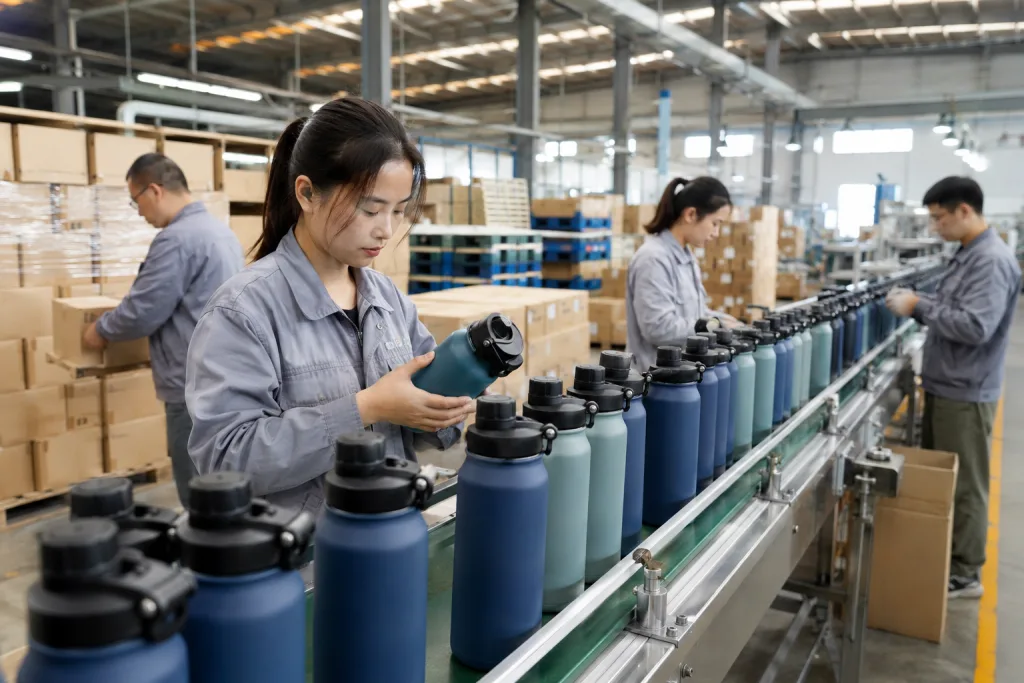
Key Takeaways
- For a 750ml double-wall flask, MOQ is commonly 1,000-3,000 units, with FOB China pricing around USD 3.20-5.80 depending on lid, coating, and print
- A workable production calendar is 7-10 days for pre-production sample plus 25-35 days for mass production after deposit and artwork approval
- Set QC limits before production: 0.3% leak failure target, logo position tolerance of ±1.5mm, and AQL 2.5 for major defects
- For EU and North America, ask for REACH, LFGB or FDA-contact compliance by material set, not just a generic test report
You are not buying a souvenir bottle. You are buying a production result: the right steel grade, a coating that passes cross-hatch tape test, logo placement within 1.5 mm of artwork, and export cartons that land in Europe or North America without corner crush or customs hold. We have seen hydration flask promotional products orders go sideways here. The pre-production sample looked clean, then bulk goods drifted on Pantone shade, leak test results, or screen print alignment after the line sped up.
A better approach is to run the order like an engineer, not a shopper. Start with one real buyer case, lock the technical spec, confirm compliance for your market, and inspect against a written standard before balance payment. That is how we run in Zhejiang, China, and this is the wrong question to ask if a buyer only wants the lowest piece price first. QC pulled the sample, checked lid torque and print position, and matched it to the PO before mass production, whether the order is for a custom canteen, customizable drinkware, or a customized growler for a retail launch.
Start with one real PO
Start with a PO that looks real. A European outdoor retailer is lining up a fall promotion and needs 2,500 units of a 750ml insulated flask in matte navy, laser logo on one side, packed in individual kraft boxes, with delivery in 45-55 days. The bottle sits in the middle of the range: above a cheap giveaway, below a premium retail SKU. So the hand feel matters. The landed cost does too. On our line, this is the kind of order where a buyer will flag the coating if the bottle feels light the moment they pick up the sample.
The weak brief is still common: “custom canteen, premium quality, best price.” We can’t quote that cleanly in Zhejiang, or anywhere else, because there is no fixed build behind those words. This is the wrong question to ask. You need a purchase specification that production, sourcing, and QC can all read the same way.
- Body: 18/8 stainless steel inner and outer, double-wall vacuum
- Capacity: 750ml, tolerance usually ±3%
- Wall: 0.4mm inner and 0.5mm outer is common for this size
- Mouth: standard wide mouth or narrow mouth, depending on cleaning and fill line
- Lid: screw lid with PP core and food-grade silicone gasket
- Finish: powder coating, 60-80 micron target thickness
- Logo: laser engraving, 45mm wide, centered ±1.5mm
- Packaging: 1pc/polybag + kraft box + 24pcs/master carton
Once the spec is written like this, the canteen supplier can quote like-for-like instead of guessing. At BottleForge Industrial in Hangzhou, Zhejiang, a project like this would usually sit at MOQ 1,000 units per color, with output capacity above 300,000 units per month across standard drinkware lines. That matters on repeat business. We run the same coating setup, the same laser jig, and the same carton pack-out standard, so the second PO is smoother than the first. QC pulled one sample last month where the logo sat 2mm off center; that is exactly why the spec needs a tolerance, not just “put logo on front.”
If your request adds a custom growler or customizable growler with a special cap, stainless handle, or bamboo trim, quote accuracy drops fast. Each added material changes testing, scrap rate, and lead time, and we have seen this go sideways when a bamboo insert cracks after a drop test or a cap supplier misses thread matching by 0.3mm. Keep the first PO simple. You will get fewer surprises, cleaner costing, and a better read on whether the factory can ship your repeat order without drama.
What the quote should include
Compare the full quote, not just the unit price. We see buyers lock onto one number, then get hit later by box cost, lid tooling, or a freight jump because the carton came out 6 mm taller than planned.
For the 2,500-piece scenario above, a realistic FOB China price might be USD 3.90 to 4.80 per unit for a standard 750ml insulated flask with one-position laser logo. Add USD 0.18 to 0.35 for a color gift box, USD 0.25 to 0.60 for a more complex lid, or USD 300 to 800 total if a new mold insert is required. Sample costs are often USD 50 to 120 for an existing model with custom finish and refundable against a bulk order. On our line, QC pulled the sample after oven curing to check logo position and coating match before we priced the repeat run.
Read these quote lines carefully
- Incoterm: FOB Ningbo or Shanghai is standard from Zhejiang, China. Ex-works looks cheaper on paper, but you take the local trucking, export doc, and port handling cost. We’ve seen this go sideways on a PO that missed the terminal cut-off by 1 day.
- MOQ: Bottle MOQ may be 1,000, but custom box MOQ can be 2,000 or 3,000. The math does not work if the buyer wants 1,200 bottles and 1,200 rigid boxes from the same run.
- Decoration: Silkscreen, heat transfer, UV print, and laser all have different durability and setup costs. A laser mark is stable; a full-wrap print needs tighter registration, and the buyer flagged a 1.5 mm seam shift on one recent order.
- Material statement: Ask for SUS304 or 18/8 in writing, not “food grade steel.” This is the wrong question to ask if you stop at the bottle body—check the inner wall, outer wall, and any part touching liquid.
- Carton data: Master carton size and GW affect freight more than buyers expect. We ship by carton count and cube every week, and a 0.8 kg jump in GW can change handling cost fast.
If you are a canteen distributor, canteen distributors group, or distributor growler buyer supplying multiple accounts, ask whether overrun/underrun tolerance applies. Most factories allow ±5% on custom production, and that is normal. If you need exact quantities for a chain-store rollout, say it before deposit, not after the packing list is issued.
You do not want the cheapest canteen customized quote. You want the quote with the fewest hidden assumptions.
A careful canteen vendor or canteen supplier should flag risks early. Dark powder coat shows scratches faster on the line, a large wrap print can cut yield, and a metallic finish can shift by half a shade between sample and mass production. We run a cross-hatch adhesion check on coated samples, and if the finish is touchy, we say so up front. That kind of pushback saves claims later.
Sampling before bulk commitment
Sampling needs to answer 3 questions: does the flask look right, does it work right, and can we run the same result on the line at bulk quantity? Too many buyers stop at appearance, and we’ve seen this go sideways.
For hydration flask promotional products, the usual sample path is simple: an existing stock sample in 2-3 days, then a pre-production sample in 7-10 days after artwork and color are signed off. If the project needs a customized canteen shape or a customizable canteen lid with new tooling, add 15-30 days. New lid tooling is where buyers get impatient, but the math doesn’t work if the first T1 tool trial comes back with a 0.3mm mismatch on the thread fit.
Your pre-production sample approval sheet should list checkpoints the QC team can measure with a scale, caliper, or heat-retention test setup. For example:
- Weight: 385g ±10g
- Height: 285mm ±2mm
- Base diameter: 74mm ±1mm
- Vacuum retention: hot water from 95C to at least 52C after 12 hours
- Leak test: no leak after upside-down hold for 30 minutes
- Coating adhesion: cross-hatch pass on flat area
- Logo color or laser depth: approved against signed artwork
If you are buying canteen promotional lines for events, some tolerances can be looser. If you are buying customized drinkware for retail, tighten them up from the start. This is the wrong question to ask: “What is your standard tolerance?” The better question is what tolerance this SKU can hold at your target MOQ and price.
Ask the canteen factory to send photos of the sample in production lighting, not only in studio light. We usually ask the team to shoot under the workshop’s 5000K lights plus one window-light shot, because matte navy can read premium in one room and turn grayish in another. The same problem shows up on custom drinkware and custom growler texture coatings, and buyers flag it fast.
One practical point new buyers miss: sample approval does not replace the written specification. Samples get lost, scratched, or read differently by the line, especially after packing trial and carton drop checks. The approved sample and the approved spec sheet need to move together through production, packing, and inspection, or QC pulled the sample for nothing.
Compliance is not a single PDF
If you sell into the EU, UK, US, or Canada, do not stop at “Do you have test reports?” Ask 3 things: which components were tested, which standard the lab used, and whether the BOM on your PO matches that sample line by line. We have seen one lid insert changed by 1.5 mm and the old report was no longer clean for the shipment.
A stainless flask is rarely just steel. On one 304 stainless program, the lab list covered PP, Tritan, silicone, exterior paint, powder coat, logo ink, adhesive, and even the inner carton ink because the buyer flagged odor transfer in storage. Your canteen supplier should separate food-contact parts from non-contact parts on the drawing and BOM, not guess after the PO lands. For Europe, buyers usually ask for REACH screening and LFGB or relevant food-contact migration testing. For the US market, FDA-contact alignment and, in some channels, California Proposition 65 review gets added. For children’s items, ASTM and CPSIA questions show up more often, though that is not the main issue for standard hydration flasks.
Here is the shop-floor rule: an old report for a different bottle or a different lid does not cover your current PO. This is the wrong question to ask. The right question is whether the tested sample matches the shipped unit. If you change from a standard PP cap to a canteen customizable lid with carry strap, the material set changes, the supplier code changes, and sometimes the glue changes too. QC pulled the sample on one run because the strap TPE was swapped without notice. Retest if needed.
- BSCI or Sedex: social compliance for factory audits; large retailers ask for this before they release the order
- ISO 9001: quality system indicator; useful for process control, but it does not guarantee the bottle in your carton passes inspection
- REACH: chemical compliance expectation for EU distribution; we usually map this to the finished BOM, not just the steel body
- LFGB/FDA: food-contact focus by market; the cap, seal, straw, and printed areas near the rim matter more than buyers expect
This is where experienced canteen manufacturers in China save lead time. We run into this every week. They know when a promo order can use an existing lab package and when the math does not work, especially after decoration changes like metallic ink or a soft-touch coating. On one house-brand order, the buyer's PO had the carton mark typo “made in Chnia,” and that was easier to fix than a mismatched user instruction for the destination market. If you are a canteen distributors network or distributor canteen buyer working under a house brand, make sure your own label, carton marks, and user instructions match destination rules before the line starts.
Production control on the factory floor
After the deposit lands, the job stops being a price discussion and becomes a production-control job. Standard lead time on this kind of order is 25-35 days after sample approval; in peak season, we see 32 days turn into 41 fast. In Zhejiang, China, September through November and the pre-Lunar New Year period usually squeeze drinkware lines, especially once the auto powder line and vacuum station are fully booked.
A solid canteen manufacturer does not wait until the last carton is sealed to find problems. We run the order through checkpoints: incoming material check, in-process confirmation, and final random inspection. That is the right sequence. If a factory says it will “check everything at the end,” we’ve seen this go sideways.
What to control during production
- Raw material: verify steel grade certificates, lid resin, gasket hardness, coating batch
- Vacuum process: spot-check insulation performance from every production lot
- Surface finish: color consistency under D65 or agreed light source
- Decoration: first-piece sign-off before full print or laser run
- Packing: barcode, carton mark, drop resistance of inner box
For a 2,500-piece run, expect at least one mid-line update with photos, quantity status, and a count like 1,200 bodies formed / 800 units powder-coated / 300 units packed. QC pulled the sample. If your product is FBA-bound, the factory also needs FNSKU placement rules, carton weight limits, and pallet or non-pallet instructions before packing starts. We have had buyers send the label file one day late, after 48 cartons were taped out. Fixing Amazon labels after packing is slow and expensive.
Agree defect categories before mass production, not on inspection day. Major defects can include leaking lids, visible dents, unstable base, wrong logo orientation, or carton barcode mismatch. Minor defects can include tiny coating specks under 0.5mm on the base area. This is where arguments start: the buyer flagged a tilted logo, the line said it was acceptable, and the inspector had no written standard to use. The wrong question to ask is whether defects are “serious.” Define them with photos, mm limits, and test method.
For custom drinkware projects with mixed colors or mixed logos, insist on line clearance between variants. One cleared table, one confirmed carton mark, then the next SKU starts. We ship cleaner that way. Carton packing errors are still one of the most common complaints from distributor drinkware buyers, and sometimes the cause is as small as one PO typo or one leftover inner box from the previous color run.
Final inspection and release
Before you release the balance, inspect against a written AQL plan, not a WhatsApp checklist. For most promotional drinkware orders, AQL 2.5 for major defects and 4.0 for minor defects is a solid starting point, and critical defects stay at zero acceptance. If a bottle leaks in a 30-minute inversion test, has a sharp rim burr above 0.3 mm, or carries the wrong compliance marking, the line does not ship.
On a 2,500-unit order, a final random inspection might follow ANSI/ASQ Z1.4 single normal level II, even if the third-party format looks different. The exact sample size matters, but the bigger issue is discipline: QC pulled the sample from top, middle, and bottom cartons, then checked the same points every time. We have seen this go sideways when inspectors skip the repack check and only look at display pieces.
- Function: leak test, lid fit torque, standing stability on a flat table, cap threading smoothness after 3 open-close cycles
- Appearance: dents, scratches, coating bubbles near the weld seam, logo alignment within the approved position
- Specification: size, weight, color, packing method, carton count against the PO
- Cartons: drop test, shipping marks, barcode scan, net/gross weight printed on the outer box
Ask for an inspection report with photos, defect count by category, and a clear pass/fail result. If the order fails, do not accept “we will pay attention next time.” That is factory noise. Require a rework plan with affected quantities, root cause, and a completion date; for example, 186 lids to be re-sorted and repacked by 18 May.
Strong canteen suppliers and canteen vendors in China know this routine and usually have the AQL table ready before the inspector arrives. Weak factories get defensive once QC starts pulling cartons from the back row with a cutter and tape gun. The buyer flagged this more than once in our projects, and it usually predicts trouble on the next PO as well.
Once goods pass, confirm booking terms, loading photos, and document accuracy. FOB shipments should have matching commercial invoice, packing list, and HS code data. A one-digit carton quantity typo on the PO or invoice can hold cargo 12 days instead of 3 at customs, and the math does not work in anyone's favor. For a canteen custom or customized growler reorder, keep the same master spec, carton marks, and inspection checklist. Repeatability is where a supplier starts earning the next order.
How buyers scale the second order
If the first order runs cleanly, don’t celebrate yet. Standardize it. On the second order, the buyers who move fastest already have the approved bottle drawing, logo position in mm, carton spec, and sealing sample on file, whether they run a custom canteen, a customizable drinkware set, or a custom growler program under one brand.
Build one supplier file and keep it tight: approved drawings, Pantone references, packaging dielines, carton marks, test reports, and inspection standards. Then split the list into what the line can repeat without risk and what needs a fresh review. QC pulled this up on one reorder after the PO typo changed a 38 mm cap to a 43 mm cap, and that kind of miss burns time fast.
- Usually safe to repeat: same bottle body, same laser logo position, same kraft box structure
- Needs review: new coating, new lid, new print process, new market destination
- Usually needs testing update: new food-contact component or new decoration touching the mouth area
On repeat POs, buyers usually get better pricing by locking annual volume instead of squeezing one shipment too hard. A canteen distributor committing to 12,000 units over 12 months may secure a USD 0.15-0.30 reduction per bottle and priority scheduling during peak season. We ship these programs every season, and this is the wrong question to ask: “Can you cut 20% on the second PO?” Most of the time, the math doesn’t work.
Good canteen manufacturers in Zhejiang, China also help trim the range. Three lid options across ten colors looks flexible on a sales sheet, but on the line it creates picking mistakes, slower assembly, and dead stock. We’ve seen this go sideways when one buyer flagged mixed straw lids in a 2,000-piece run. Fewer components usually mean better OTIF performance and lower claim rates.
That is the difference between buying one batch of canteen promotional goods and building a supply chain you can actually run. You want a canteen factory that quotes clearly, executes the same way every time, and logs each change in writing. The same logic applies whether you buy customized drinkware for retail, distributor growler packs for regional wholesalers, or a small canteen customized event run with a 500-piece MOQ that later scales.
Send your flask spec and get a real quote
Share capacity, finish, logo method, packaging, target market, and quantity. We will review feasibility, MOQ, lead time, and likely compliance points before sampling.
Frequently asked questions
What MOQ should I expect for hydration flask promotional products?
For a standard insulated flask using an existing mold, MOQ is usually 1,000 units per color and sometimes 500 units if the factory has flexible stock components. If you want a custom lid, special color box, or mixed decoration process, practical MOQ moves to 2,000-3,000 units. In China, many canteen manufacturers will quote a lower bottle MOQ but a higher packaging MOQ, so read both lines. For a custom growler or highly customized canteen shape, tooling economics can push the first run above 3,000 units. If you are a distributor canteen buyer with multiple logos, ask whether split decoration is possible on one body color to avoid opening a new production lot for every design.
How much should a branded stainless hydration flask cost?
A common FOB China range for a 500-750ml double-wall stainless flask is USD 3.20-5.80 per unit at 1,000-3,000 pieces, depending on steel weight, lid complexity, coating, and logo method. Laser engraving is usually cheaper and more durable than multi-color wrap printing. Add roughly USD 0.18-0.60 for upgraded packaging and USD 0.10-0.40 for more demanding finishes. Freight, duty, and local delivery are separate. If one canteen vendor is 20% below the market, check whether they downgraded steel thickness, omitted the box, or quoted ex-works instead of FOB. The cheapest customized drinkware quote often becomes the most expensive claim later.
Which tests and documents should I request before shipment?
Ask for a material declaration and the compliance set that matches your market and bill of materials. For EU orders, buyers commonly request REACH and LFGB or relevant food-contact migration reports. For the US, FDA-contact alignment is common, and some retail channels also ask about Proposition 65. If the project is retailer-facing, BSCI or Sedex audit status may matter. On the quality side, request a final inspection report using agreed AQL, plus vacuum and leak test records if available. Also confirm carton marks, barcode files, packing list, and commercial invoice before shipment. A generic old PDF from a different lid assembly is not enough if your canteen customizable design changed.
How long does a custom flask order usually take from China?
For an existing bottle style, plan 2-3 days for a stock sample, 7-10 days for a pre-production sample with your logo and finish, and 25-35 days for bulk production after deposit and sample approval. Add another few days for inspection and booking. Ocean transit then depends on route, but buyers into Europe or North America often build a total window of 55-75 days door to door. Peak season in Zhejiang, China can stretch production by 7-10 extra days. A customized growler or new mold project can add 15-30 days before mass production even starts, so lock artwork and packaging early.
What are the most common failure points on drinkware orders?
The top issues are usually leaking lids, inconsistent coating shade, dents from weak inner packing, wrong logo position, and carton mix-ups on multi-SKU orders. For Amazon or retail programs, barcode errors are also common. On stainless flasks, cheap silicone gaskets and poor cap thread fit cause a large share of claims. On appearance, dark matte colors show scratches easily if separators are weak. That is why buyers should define measurable standards: leak test pass, logo tolerance of ±1.5mm, coating acceptance rules, and AQL 2.5 major defects. A good canteen supplier in China will accept those controls because they reduce arguments after shipment.