Key Takeaways
- A realistic MOQ for stainless steel hydration flask private labeling starts around 1,000 pcs per color, with 35-45 day lead time after deposit and artwork approval
- Small spec changes such as 0.4 mm wall thickness or a different powder coat can move FOB price by USD 0.18-0.45 per unit
- Use pre-production sample approval plus inline and final AQL 2.5 inspection to reduce decoration and assembly defects before shipment
- For Europe and North America, ask for REACH, LFGB or FDA contact-material declarations, and packaging drop-test records before balance payment
You are not buying a sample for your desk. You are tying up budget, shelf space, and a ship date your sales team already promised to customers. This is where hydration flask private labeling usually breaks: capacity tolerance was never written in ml, the logo on the Pantone print card does not match the spray sample from the line, the FDA or LFGB file is missing, or the gift box approval sits for 6 days because the PO artwork code had one typo. A flask can look fine in a phone photo and still fail a 1.2 m drop test, ship with logo color shift, or miss your launch window by 18 days. We have seen this go sideways.
The better approach is to run the order like an engineering job. Not a catalog pick. If you source from Zhejiang, China, or anywhere else in China, set checkpoints from drawing approval to AQL inspection, and write them into the timeline before deposit. QC pulled the sample, checked neck diameter at 44 mm, and that kind of detail matters more than a polished render. Below is a practical buyer scenario showing how a B2B buyer specifies, prices, tests, and QC-checks one custom drinkware order with a canteen manufacturer before release.
The order starts with a real brief
Picture the actual job. You are a drinkware distributor in Germany supplying one fitness chain and two corporate gift agencies. You need a 750 ml insulated flask under your own brand, with retail-ready packaging for one channel and bulk-packed units for the promotional channel. This is not just a custom canteen order. You need one SKU platform that works for retail and promo without opening three tooling routes. We have seen this go sideways when a buyer tries to merge channels after sampling; the neck thread looked the same, but the cap fit was off by 0.3 mm.
Your first brief to the canteen supplier needs enough detail that the factory quotes the same bottle you think you are buying. This is the wrong question to ask: “What’s your best price for a 750 ml flask?” A usable RFQ normally includes the build spec, finish spec, packaging split, and market compliance, so the line is quoting one product instead of three versions hiding under one SKU.
- Body: 18/8 stainless steel, double wall vacuum, inner 304 and outer 304
- Capacity: 750 ml nominal, tolerance within plus or minus 3%
- Construction: body wall 0.4 mm outer, 0.4 mm inner, copper-coated inner wall optional
- Mouth: standard thread finish, leakproof screw lid with PP and silicone seal
- Finish: matte powder coat, Pantone-matched body color
- Branding: one-color silk screen or laser engraving, logo position with dimensions in mm
- Packaging: white box for 60% of units, export carton bulk pack for 40%
- Target compliance: REACH, LFGB or FDA depending on market
If your RFQ just says “customized canteen, 750 ml, black, logo,” the quote will look cheap and still be wrong. A vendor will often assume 0.35 mm steel, stock black powder, and a small standard logo panel. Then the pre-production sample lands on your desk and it does not match what your sales team sold. QC pulled one case like this last month: PO said matte black, artwork said Pantone Black 6 C, and the buyer flagged the gloss level after sampling. That gap burns margin fast.
At BottleForge Industrial in Zhejiang, China, the cleanest projects usually start with artwork, Pantone code, packaging dieline requirements, and destination market on day one. We run faster when those files come in early. In most cases, that cuts 3 to 5 days of email back-and-forth to 1 to 2 days, and it stops quotation drift before sampling starts. Even a small detail helps, like marking the logo area as 45 mm wide on the AI file instead of writing “front center” in the PO.
How the quote changes in practice
The canteen manufacturer comes back with a base offer first. Use real numbers. For 1,000 pcs of a 750 ml vacuum flask, FOB Ningbo, Zhejiang, China, the quote usually lands around USD 4.20 to USD 5.10, depending on lid structure, coating, and decoration method. On our line, a screw lid with one silicone ring quotes differently from a flip lid with 3 fitted parts and extra leak testing. This is the wrong question to ask if you want one fixed price early. A private label flask quote shifts every time the spec sheet changes by 1 detail.
Typical quote variables look like this:
- MOQ: 1,000 pcs per model, often 500 pcs per color if carton assortment is simple
- Sample time: 5-7 days for existing model with new logo; 10-12 days if color sample is required
- Mass production: 35-45 days after deposit and sample approval
- Master carton: 24 pcs or 36 pcs depending on bottle diameter and box style
- FOB uplift for powder coat: about USD 0.20-0.35 vs plain spray finish
- Laser engraving: often USD 0.08-0.15 more than one-color silk screen on medium runs
- Individual retail box: about USD 0.22-0.48 per unit depending on print and insert structure
If you ask for a custom growler or customizable growler format above 1,200 ml, freight efficiency changes fast because carton cube grows faster than the unit price. We have seen a 64 mm mouth flask pack cleanly at 24 pcs, then a wider-body growler drops to 12 pcs because the box fails drop test at the original stack height. That hits a distributor growler business harder than e-commerce singles, where the buyer usually watches parcel damage first. The same math applies to canteen customized projects with bamboo lids, carry straps, or molded handles. Nice features sell. They also add hand assembly, slower packing, and more places where QC pulled the sample for scratches, loose straps, or lid fit issues.
The cheapest unit price is often not the lowest landed cost. A USD 0.18 saving disappears quickly if the product packs inefficiently or your reject rate rises from 1.5% to 4%.
For larger programs, ask the canteen manufacturers for breakpoints at 1,000 / 3,000 / 5,000 pcs. On plenty of custom drinkware orders, 3,000 pcs cuts FOB by 6% to 11% against 1,000 pcs because setup cost, coating line scheduling, and carton purchasing run better. We ship this way all the time: one coating batch, one laser jig, one carton print run. If the buyer flagged a 1,000 pc price as too high, this is where we check first, because the math often works at 3,000 pcs and does not work at 1,200.
Sample approval is where money is saved
After price alignment, sampling starts. This is where a real canteen supplier shows up, and where a trader usually runs out of road. You need two approvals at minimum: a branding sample and a pre-production sample. Skip one, and the math doesn't work. We’ve seen a 0.8 mm logo stroke close up on the line, then 2,000 units had to be stripped and reprinted.
The branding sample confirms logo size, print sharpness, engraving depth, and color contrast on the actual surface finish. Matte powder coat behaves differently from glossy spray paint, and QC pulled samples where thin serifs filled in after curing at 180°C. White logos often need two passes on dark bodies. If you are ordering canteen custom products for retail, check the bottle under daylight and office lighting, not just a phone image. One buyer flagged a silver logo that looked clean outdoors but disappeared under store LEDs.
The pre-production sample should confirm the complete specification:
- capacity fill line and brimful volume
- net weight tolerance, usually within plus or minus 3%
- vacuum insulation performance, for example hot retention after 6 and 12 hours
- leakproof seal after inverted test for 30 minutes
- coating adhesion, often cross-hatch tape test
- barcode, FNSKU, carton marks, and box copy if applicable
If you are buying customizable canteen stock for Amazon FBA, check the package dimensions and final carton weight early. A 3 mm taller gift box or a carton moving from 14.8 kg to 15.2 kg can push you into a different fee band. We ship plenty of FBA orders, and one packaging revision is enough to blow the margin. If you are a canteen distributor selling to promotional resellers, confirm whether each carton can be mixed by color or must stay single-SKU for inventory control. We’ve had POs marked “assorted” while the outer carton print stayed single-color only, which turns receiving into a mess.
A serious canteen factory in China should also issue a sample sign-off sheet with revision history. That document matters later if production drifts. We run this sheet with sample date, revision code, and sign-off photo, and it saves arguments when the buyer flagged a barcode position 12 mm off from approved artwork. Hold mass production until all artwork, seal construction, and barcode placements are signed. Waiting 48 extra hours before bulk production is cheaper than reworking 2,000 printed bottles after a wrong Pantone callout.
Production control inside the factory
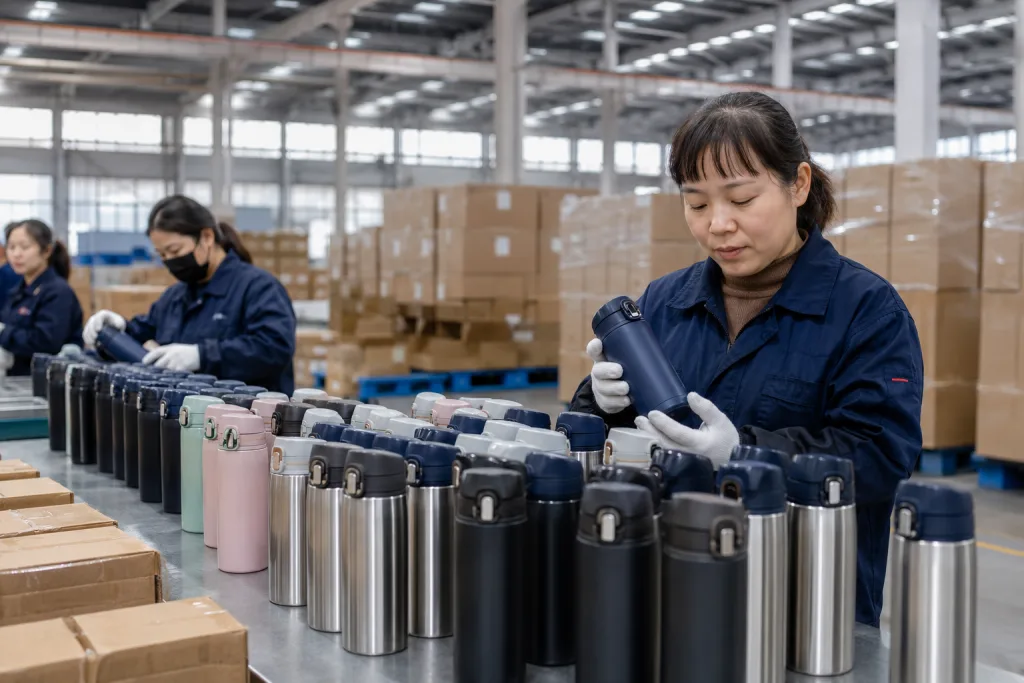
After PO release, the next risk is simple: assuming the approved sample will match the bulk run. It often won’t. We see this on the line all the time unless the canteen factory locks each process down with clear checkpoints. A stainless hydration flask moves through forming, seam welding, vacuuming, polishing, spray or powder coating, printing, assembly, and packing. Most defects start upstream. QC pulled the sample at final pack, but the root cause was often sitting back at welding or coating.
A workable production control plan for hydration flask private labeling should include three checkpoints. Not five. If the first three are weak, the math doesn’t work later.
1. Incoming material check
Check stainless grade, lid resin, silicone hardness, coating batch, and packaging board quality against the approved spec and PO. We normally verify wall thickness with a micrometer and spot-check component weight in grams. If inner wall thickness drops from 0.4 mm to 0.3 mm without notice, weight and dent resistance change at once. We’ve also had buyers flag a lid smell issue that traced back to one resin lot, not the finished flask.
2. Inline inspection
At 20% to 30% production completion, inspect weld appearance, neck threading, powder consistency, print position, and lid fit. This is where the line can still adjust oven temperature, screen position, or thread setting before 2,000 pieces pile up in rework. One common finding is logo print drifting 1.5 mm off center after the first shift change. Catch it here. Not at carton close.
3. Final random inspection
Use AQL. A common commercial level is ANSI/ASQ Z1.4, General Inspection Level II, with AQL 2.5 for major defects and 4.0 for minor defects. For a 3,000-piece lot, that usually means a sample size around 200 units, depending on the code letter. We ship against that standard often, and QC will record defects by count and type before release.
What counts as a major defect on customized drinkware? Leaking lid, missing vacuum, wrong artwork, sharp burr, mold smell, or carton marking error. Minor defects include slight specks under coating or small print position variation within agreed tolerance. We once saw a repeat order held because one carton mark had a PO typo—“NAVY” printed as “NAYV.” Small mistake, real claim risk.
Buyers often ask if they still need third-party inspection when the canteen factory already has QA staff. For first orders, yes. That is the right question to ask. By the third or fourth repeat PO, decide from the factory’s actual defect history, not promises. A factory running 600,000 units per month in Zhejiang with stable SOPs still needs proof on your SKU, and we’ve seen this go sideways when a new lid mold or new print file slips into production without enough control.
Compliance, testing, and paperwork before shipment
A hydration flask is easy to fill and ship. Importing it is where buyers get burned. If your canteen supplier ships to the EU or North America, get the paperwork ready before final payment, not after the vessel sails. We have seen this go sideways when the PO says “matte black bottle” but the lid changed from screw cap to straw lid at sample approval. The declarations need to match the exact build you bought: lid, seal, coating, print, all of it.
For Europe, buyers usually ask for REACH compliance and food-contact documents. LFGB often comes up for German retail and Amazon EU cases, even on runs of 3,000 pcs. For the US and Canada, buyers commonly ask for FDA food-contact declarations. If the product sits near kids’ channels, ASTM or CPSIA checks can get pulled into the file even when the bottle is not a toy. On our line, QC pulled a sample once because the silicone spout color changed and the old report no longer matched the shipped SKU.
Your document pack should normally include:
- commercial invoice and packing list
- test reports or declarations matching the SKU structure
- production order or approved specification sheet
- carton dimensions, gross and net weights
- inspection report with defect summary
- BSCI or social audit records if your retail customer requires them
Be careful with “similar product” reports. This is the wrong shortcut. A report for a customized growler with stainless cap does not fully cover a custom canteen with PP straw lid and silicone mouthpiece. The math doesn't work if the liquid-contact parts changed. We have had buyers flag this after document review because the gasket hardness was different and the cap assembly was not the same.
If you work with canteen distributors or a retailer that runs compliance audits, ask the canteen manufacturer to list every liquid-contact material: stainless, PP, Tritan if used, silicone, paint, adhesive, and any internal coating. We normally put this into a BOM summary tied to the approved spec sheet, down to the seal and straw connector. A missing lid-material declaration can delay shipping by 5 to 10 days. In one case, the lab asked for the silicone grade after pre-shipment inspection, and the booking moved from 12 days to 18 days.
Packing, shipping, and the first reorder
The last stage is where margin stays intact or leaks out one carton at a time. Too many buyers spend weeks on bottle shape and lid color, then miss the packing math. We’ve seen this go sideways. A solid flask in a weak box still turns into a claim. On our line, we check carton drop points, pallet height, and shipping marks before mass packout, because a 2 mm board change or a bad barcode position can cost more than the logo print.
For our buyer scenario, 3,000 units are split into 1,800 retail-boxed units and 1,200 bulk-packed units. The boxed version uses a 3-layer printed inner box and 5-layer export carton. The bulk version skips the inner box and uses dividers. The landed cost difference can be USD 0.28 to USD 0.55 per unit depending on print coverage and carton efficiency. QC pulled the sample on one run because the inner box crush line was off by 1.5 mm, and that small error changed the carton fit and pallet count.
If you are shipping by sea from Zhejiang, China, FOB Ningbo is standard on this kind of order. For urgent replenishment under 500 pcs, air freight is usually the wrong fix; the math doesn’t work unless the order value is high or the campaign date is locked. We ship plenty of repeat orders this way, and the difference is blunt: sea might be 18 days on water, while air can save time but wipe out margin on a low-ticket flask. Plan the reorder early. If the first run sells through, you do not want to reopen artwork, lab tests, and carton layout because someone typed the wrong PO number on the first label file.
Before you place the reorder, review the first PO with the canteen manufacturer and score it like an operator:
- Was the lead time kept within the promised 35-45 days, or did packing slip because the lid assembly line lost 2 days?
- Did the final inspection pass without rework, or did QC hold cartons for dented rims at AQL 2.5?
- Was the color within agreed tolerance from sample to bulk, or did the buyer flag a visible shade shift under D65 light?
- Did any canteen customized packaging fail during transit, especially corner crush or divider breakage?
- How many customer complaints per 1,000 units were reported—2, 8, or 20?
This is the point where you decide if the supplier is your long-term canteen factory or a one-off source. Good canteen suppliers in China do more than rerun the same bottle. They log what happened on the first order, down to the cap torque setting and the master carton mark size, then carry that into the next PO. That is how a customized canteen program scales for a distributor canteen line, a customizable drinkware retail range, or a custom growler extension for outdoor channels.
If the first order is handled this way, the second order is usually cleaner: same BOM, same test basis, fewer approval loops, lower defect risk. We run reorders faster because the dieline is approved, the pantone callout is fixed, and the packout photo standard is already on file. That is the point of disciplined hydration flask private labeling. You are not buying metal containers. You are buying repeatability.
Need a flask quote built around real production?
Send your target capacity, finish, logo method, packaging plan, and destination market. We will review MOQ, FOB pricing, compliance, and QC checkpoints clearly.
Frequently asked questions
What MOQ should I expect for hydration flask private labeling?
For a standard stainless steel vacuum flask using an existing mold, expect MOQ around 1,000 pcs per model and often 500 pcs per color if the packaging is simple. Some canteen manufacturers in China will accept 300-500 pcs for plain stock with a logo, but the unit price usually rises by 8% to 15% and color choices become limited. If you need a fully custom lid, molded strap, or custom growler shape, MOQ can move to 3,000-5,000 pcs because tooling, setup scrap, and component sourcing all increase. Always ask whether MOQ is based on model, color, decoration, or packaging configuration. That is where many first-time buyers misunderstand the quote.
How long does a private label flask order usually take?
For an existing flask body with custom branding, sample time is usually 5-7 days for a logo sample and 10-12 days for a color-confirmation sample. After deposit and signed sample approval, mass production normally takes 35-45 days. Add another 3-7 days if you require a third-party AQL inspection before shipment. If your order includes printed retail boxes, expect packaging artwork approval to add 2-5 days. During peak season from August to November in Zhejiang, China, lead times can stretch by 7-12 days, especially for powder coating and packing lines. If your launch date is fixed, work backward from vessel cutoff, not from the day you first requested a quote.
Which branding method is better: silk screen or laser engraving?
It depends on the finish, budget, and channel. Silk screen is usually the lower-cost option, often included or priced around USD 0.05-0.12 per color on volume orders. It gives strong visual contrast and is common for canteen promotional programs. Laser engraving usually adds about USD 0.08-0.15 per unit but gives a more permanent mark and cleaner premium look, especially on powder-coated bottles. On dark matte surfaces, engraving can look excellent. On certain glossy or thin-coated surfaces, contrast can vary. If you sell through retail or premium gifting, ask for both methods on actual samples. Approving from digital mockups alone is risky because line sharpness and logo brightness change by surface texture.
What quality checks matter most before I pay the balance?
The essentials are leak test, vacuum retention, decoration accuracy, coating adhesion, carton integrity, and correct labeling. Ask for a pre-shipment inspection using ANSI/ASQ Z1.4 with General Level II, typically AQL 2.5 for major defects and 4.0 for minor defects. On a 3,000-piece order, inspectors commonly check around 200 units depending on the lot code letter. Major defects should include leaking lids, no vacuum, wrong logo, deep dents, sharp edges, and incorrect barcodes. Also confirm that the tested samples come from packed production, not from a hand-selected bench sample. That one detail tells you whether the result reflects real shipment quality.
What compliance documents should I request for Europe or North America?
For Europe, request REACH declarations and food-contact documentation relevant to the bottle, lid, seal, and decoration. Many buyers also request LFGB when the channel is retail or supermarket. For the US and Canada, FDA food-contact declarations are common, along with component-level material statements. If you sell into big-box or audited retail, ask whether BSCI, ISO 9001, or social compliance records are required from the canteen factory. Make sure the paperwork matches the exact SKU structure. A report for a stainless lid does not fully cover a PP straw lid version. Get the document pack before final payment so there is still time to fix any missing reports without delaying the container.