Key Takeaways
- Specify 18/8 stainless steel, wall thickness such as 0.4 mm inner and 0.5 mm outer, not just “stainless bottle”
- Set AQL at 2.5/4.0, define leak and vacuum tests, and approve a golden sample before mass production
- Typical MOQ is 1,000 pcs per color, with 25-35 day lead time and 7-10 days for pre-production samples in China
- For EU and North America, ask for REACH, LFGB or FDA contact compliance, and transit packaging drop resistance before shipment
You can sign off a good-looking sample and still get a full container with leaks, easy dents, odor after filling, or labeling that gets flagged in Europe or North America. We’ve seen this go sideways after one drop test from 76 cm or one thread gauge check on the line. The gap between sample and mass production is where hydration flask private label projects usually break down. If you buy custom drinkware from China for retail, promotion, or distribution, choosing a color is the easy part. The real job is locking a spec that still holds at 10,000 pcs.
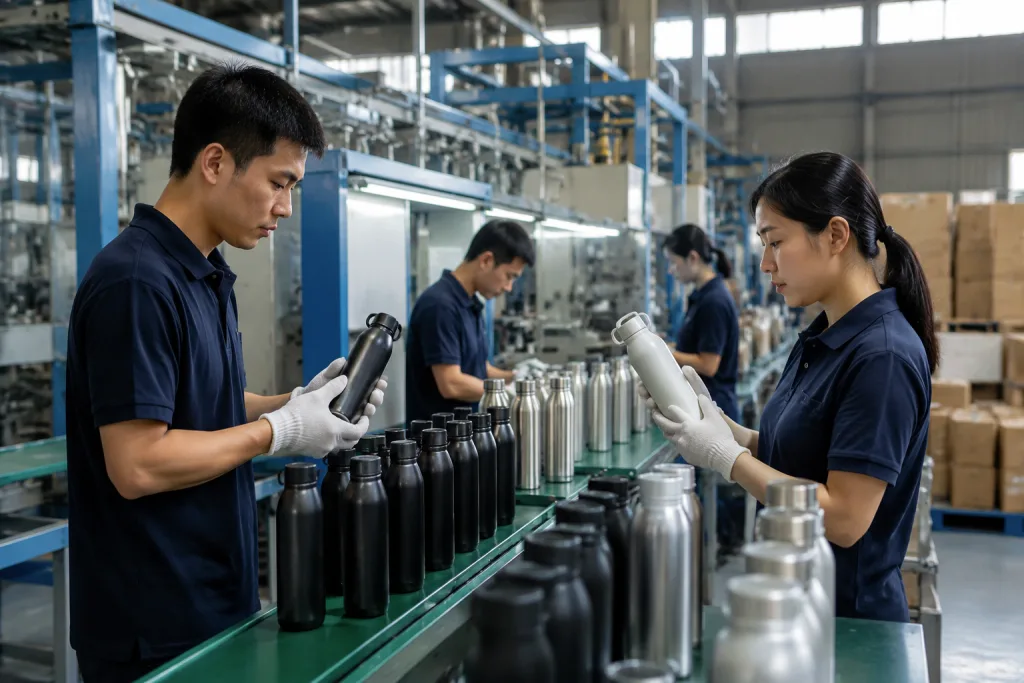
At factory level in Zhejiang, the failure points are not a mystery. QC pulled the sample, and the same issues kept showing up: steel wall thickness off by 0.1 mm, powder coat adhesion failing the tape test, lid thread mismatch, vacuum retention dropping from 12 hours to 8, logo position drifting 2 mm, and cartons too weak for ocean freight stacking. This is the right place to start. Whether you are sourcing a custom canteen, customizable growler, or a canteen promotional line for a canteen distributor network, you need clear test methods and the exact numbers to lock before PO approval. If those numbers are missing, the math doesn’t work.
The sample looked fine, production did not
The first failure is straightforward: you approved a hand-finished sample, then bulk ran under different controls. We see this a lot on hydration flask private label orders. The buyer looks at color and logo first; the line lives or dies on process control. A sample can be built by two senior workers at one bench, with the best body, the best lid fit, and extra hand polishing. Bulk is different. We run at line speed with 4 or 8 mold cavities, full coating racks, and separate assembly stations. If the process is not frozen, the approved sample is a reference piece, not the production standard. This is the wrong question to ask: “Does the sample look good?” Ask whether the same tooling, same coating route, and same packing method will run on the line.
Ask for a pre-production sample made from actual production tooling, actual decoration method, and actual packaging. If your custom drinkware order is 5,000 units, do not sign off on one polished show sample from the sales shelf. Approve a PPS after artwork sign-off and before deposit release for bulk materials. QC pulled one PPS here last month with a logo shifted 1.8 mm, and the buyer flagged it before we booked cartons. That saved a reprint. Then define what is locked:
- Material: 304 stainless steel inside and outside, or 316 interior if you sell premium insulated models.
- Thickness: for a 500-750 ml flask, 0.4 mm inner and 0.5 mm outer is a common durable range.
- Finish: powder coat, spray paint, silk screen, laser engraving, or UV print.
- Logo position tolerance: usually within plus or minus 1.5 mm.
- Packaging: white box, color box, master carton burst strength, and divider structure.
If you are buying from Zhejiang or elsewhere in China, ask the canteen manufacturer to tie the PO, artwork, BOM, and approved sample to the same internal product code. Sounds basic. It is not. We have seen this go sideways over one character on a PO suffix, and the line picked a similar lid with a different thread feel. That is how you get paint texture drift or lid swaps nobody reported. A capable canteen supplier should confirm inline QC, final random inspection, and traceability by date code or carton mark. If they cannot show the code on the carton print or on the packing record, the math does not work.
Steel grade confusion creates complaints later
Buyer complaints often start with one lazy phrase on the PO: “food grade stainless.” That tells nobody enough. For hydration flask private label, write the exact steel grade and where each grade is used. The standard commercial build is 18/8 stainless steel, also called SUS304, on both inner and outer walls. For a premium customizable canteen or customizable growler used for coffee, tea, electrolyte drinks, or light acidity, a SUS316 interior gives better corrosion resistance, but the upcharge is real. On our line, that gap is often USD 0.35–0.80 per piece at a 3,000 pcs MOQ. Ask the grade first.
Loose specs go sideways fast. A canteen vendor might switch to 0.4 mm steel instead of 0.5 mm, mix grades in the cap set, or use lower-cost stainless on strainers, threaded rings, or carry-loop pins. Then QC pulled the sample and found weld tint near the shoulder, or the buyer flagged a metallic taste after 2 weeks. We have seen rust spots start around the weld area after dishwasher abuse, even though the bottle body itself passed basic checks. This is the wrong place to save pennies.
What to lock on the PO
- Body material: SUS304 inner and outer, or SUS316 inner plus SUS304 outer.
- Cap contact parts: PP, Tritan, silicone, and stainless components must be listed separately.
- Wall thickness: specify minimum gauge, not target only.
- Mouth construction: rolled edge or threaded neck details.
- Weld finish: no sharp edge, no exposed burr, no heavy discoloration.
For a distributor drinkware program, this hits margin fast. Saving USD 0.18 per piece by dropping steel thickness looks good on the quote sheet and bad in month two. One return claim can wipe out the math on 200 units. If you run with 2 or 3 canteen suppliers or canteen vendors, keep one material spec sheet across all factories, down to the cap insert and the 0.5 mm minimum callout. We ship against that kind of sheet every week. A serious canteen manufacturer in China should show heavy-metal and food-contact test reports without drama, and should accept a written minimum thickness standard. If a supplier pushes back on that, the buyer already has the answer.
Cheap samples usually fail in the second shipment, not the first. The first shipment is often built carefully because the factory knows you are watching.
Vacuum retention claims are often overstated
Insulation claims get stretched all the time in custom canteen and private label drinkware projects. Buyers ask for “12 hours hot and 24 hours cold,” the factory says yes, but the test setup is missing. We have seen this go sideways. The retailer gets complaints because the product page promised one thing and the end user got another, and then the buyer flags the batch after goods already landed.
On double-wall vacuum flasks, retention comes down to the actual vacuum level, copper coating on the inner wall for some SKUs, stopper fit, lid structure, and how stable the line runs during vacuuming. A bottle can look clean at final packing and still fail on heat hold. QC pulled the sample on one 750 ml run last year and found no appearance issue at all, but the vacuum loss showed up in the retention check, not by eye.
Ask for a defined heat retention test. This is the right question. A workable method is hot water at 95 degrees C, ambient 20 degrees C, fill to a fixed level, then record the result after 6 and 12 hours. For cold retention, set the water-to-ice ratio first and keep it the same across samples. If your sales team wants aggressive claims for the carton or product page, get test data from production lots, not one development sample made off the line by the technician.
- Entry-level vacuum flask: acceptable if temperature loss matches the target price band and MOQ; the math does not work if you want premium retention on an entry quote.
- Mid-range retail bottle: lot-to-lot consistency matters more than one strong sample; we usually check mixed cartons because one carton can hide a weak batch.
- Premium customized canteen: request batch sampling and recorded results per lot, with a clear pull quantity such as 5 pcs per lot for review.
For large distributor growler or custom growler orders, especially 1.2 L to 1.9 L formats, lid design matters even more. Wide-mouth growlers lose heat faster, and carbonation drops faster too, if the cap seal is weak or the gasket fit is off by 0.5 mm. Buyers mix these claims together all the time, and that is the wrong question to ask. If you are buying a customizable growler for craft beverage gifting or outdoor channels, tell the canteen factory to separate “insulation retention” from “pressure or seal retention” in the spec. They are not the same test.
At BottleForge-style production scale, a realistic factory metric in Zhejiang is 600,000 units per month across mixed stainless programs, but capacity alone tells you nothing. We run lines where output looks fine on paper and the sampling setup is still weak. Ask for sampling frequency, reject criteria, and rework rules before production starts. AQL 2.5 on appearance is one thing; vacuum retention checks need their own record, or the buyer will be arguing over claims after shipment.
Lids and seals fail more than bodies
Most field failures in hydration flask private label are not in the stainless body. They show up in the lid set: leaks, cross-threading, loose handle joints, silicone odor after hot fill, or caps that crack in winter at 0°C to 5°C. If you are new to buying from a canteen supplier in China, spend your time here, not arguing over Pantone. On our line, QC pulled more lid complaints than body complaints on one 12,000-piece run, and that is normal.
Start with the use case. A gym flask, a school bottle, a corporate gift, and a worksite canteen customized for industrial users should not share one lid design. A screw cap with a 2.5 mm food-grade silicone ring is the safe choice for low-return retail. A flip straw lid is easier to drink from, but the math doesn't work if you ignore the extra hinge, straw, vent, and spring issues. A metal cap with a decorative top looks premium, yet we have seen dent marks straight out of the drop carton test. A carry loop might pass daily use, then fail at 8-10 kg pull force because the anchor point is too thin. We have seen this go sideways after the buyer flagged a broken loop sample before mass production.
Your written spec should include:
- Leak test: inverted for 30 minutes, no visible leakage.
- Thread test: cap starts smoothly within 1 turn, no skipping or bite.
- Seal material: food-grade silicone, odor check after hot water fill.
- Handle strength: minimum pull-force requirement based on filled product weight.
- Spare parts policy: define replacement rate for lids and straws.
If you sell through canteen distributors or a distributor canteen program, order extra lids at 2-3% of bottle quantity. That is cheap insurance. On a 10,000-piece order, 200 to 300 spare caps cost little compared with one customer-service issue across 500 retail shipments. Ask a direct question too: does the factory mold caps in-house or buy from outside vendors? We run into fit problems more often with mixed-source parts, especially when thread tolerance drifts by 0.3 mm. An integrated canteen factory usually controls cap-to-neck fit better than a plant assembling parts from 3 or 4 canteen suppliers.
For North America, ask whether the lid resin and gasket materials can support ASTM-related child use concerns if the product is targeted at kids, and for Europe ask for REACH-compliant materials. If the answer is vague, push harder before you place the order. This is the wrong place to accept a soft reply. We once saw a PO with the gasket material typed as “silicon” instead of “silicone,” and that small mistake turned into three rounds of material confirmation.
Decoration fails under real handling
Branding is where defects get caught first, and this is where buyers under-spec the job. We see it on the line all the time. A logo looks clean on the approval sample, then carton rub, Amazon FBA handling, and daily hand contact start exposing weak decoration. The failures are predictable: scratched print, off-center artwork, color shift, ghosting, or weak adhesion on textured powder coat. Last month QC pulled the sample after a 3M tape test and the edge of the white logo lifted on a rough black finish.
The right process depends on order volume, bottle finish, and artwork detail. Silk screen fits simple one-color or two-color logos and the unit math usually works better once you run larger quantities. Laser engraving holds up well and gives a cleaner premium look on powder-coated stainless. UV print handles gradients and fine lines, but adhesion control has to be checked batch by batch. Heat transfer works for full wraps, but seam alignment needs a clear tolerance in mm or the buyer will flag it. For canteen promotional orders, plenty of buyers pick the cheapest decoration first, then find out the print rubs off from carton friction at the master carton divider.
Spec decoration like a QC engineer
- Artwork tolerance: define location, width, height, and rotation, such as ±1.5 mm and a max 2° rotation.
- Color standard: lock the Pantone reference and state the acceptable visual delta on the approved sample.
- Adhesion test: require cross-hatch or tape test after curing, not before full cure on the rack.
- Abrasion check: set dry rub and wet rub cycles, for example 50 dry and 20 wet.
- Dishwasher disclaimer: if not tested, do not imply dishwasher-safe on the PO or retail insert.
For custom canteen and customized growler programs, textured powder coat is where decoration trouble starts if the ink system is wrong. Ask for a real production test. A visual mockup is not enough, and this is the wrong question to ask if the surface is rough matte with metallic ink. We have seen a buyer approve a gold logo on texture, then reject the lot because the metallic flake broke unevenly after curing. Also define acceptable defect limits under AQL. A common approach is AQL 2.5 for major defects and 4.0 for minor defects on final random inspection, but the defect list still needs to be written down: logo missing, unreadable print, severe shift, wrong color, exposed base metal, or coating peel.
In Zhejiang and across China, lead time for custom logo decoration is typically 25-35 days after deposit and artwork approval, with sample confirmation in 7-10 days. We usually see artwork approval drag because of one typo on a PO, one missing Pantone callout, or a revised logo width from 28 mm to 32 mm. If a canteen vendor promises five days for everything, the process has not been thought through. We have seen this go sideways.
Compliance paperwork can break the shipment
A bottle can pass drop test and leak test, then still get stuck because the paperwork is wrong. We see this on hydration flask private-label orders into the EU, UK, US, and Canada. The usual failure is simple: the spec says one material, the BOM shows another, or the test report covers only the raw resin and not the shipped SKU. QC pulled the sample once on a 32 oz flask and found the PO said Tritan lid, but the line had switched to PP after mold maintenance. Late requests for REACH, LFGB, FDA, CA Prop 65, or test reports are where this goes sideways, especially after bulk packing is done and 2,000 units are already in cartons.
The better way is to map compliance to the target market before tooling starts or before you place the bulk PO. For Europe, buyers usually ask for REACH and LFGB-related food-contact testing based on the product category and the retailer's own file standard. For the US, the standard ask is an FDA contact compliance declaration, and some buyers add CA Prop 65 screening for lids, prints, or silicone parts. If the bottle has a straw, infuser, or spray coating, the document set changes fast. This is the wrong question to ask at the end of production; by then, the math doesn't work if one part fails and you need to remake 5,000 lids.
- Body: stainless composition and food-contact suitability, such as 304 stainless matched to the actual mill cert.
- Lid plastics: PP or Tritan declarations tied to the exact lid version; even a 0.5 mm gasket groove change matters if the resin changes.
- Seals: silicone contact compliance, with the report linked to the same hardness grade the factory runs.
- Coatings and inks: relevant chemical restrictions for powder coat, logo ink, and any soft-touch finish.
- Factory audits: BSCI, ISO 9001, or social compliance as needed by your customer; some chain buyers will not open the vendor file without this.
If you are a canteen distributor or working with canteen distributors in chain retail, tie every document to the SKU and revision code. No shortcuts. One lid change can kill an older report. We had a buyer flag this after a small update from screw lid V2 to V3, and the only visible difference was a vent hole moved 3 mm. Ask the canteen manufacturer whether the reports are from finished product testing or only raw material statements. Finished product reports hold up better when the retail compliance team checks the file, because they match what you actually ship.
A capable canteen supplier in China should give you a document matrix before deposit, often in 1 sheet with SKU, material, test item, report date, and validity. If they cannot do that, the sourcing process is backwards. We ship cleaner orders when compliance is checked during supplier selection, not 3 days before ETD.
Carton damage starts at the packaging spec
Buyers often treat packaging as the easy line on the PO. It isn’t. On hydration flask private label orders, we see good bottles arrive damaged because the pack spec was too light: base dents, paint chips at the shoulder, crushed lids, scuffed logos. QC pulled the sample from one return lot last year and the issue was obvious—no inner support, carton loaded too tight, long sea transit to Europe, then parcel drops on the last mile.
For a custom growler or customized canteen with a heavier body, a single-wall white box with no support usually fails once pallets are stacked 4 layers high. The fix is not fancy packaging. It is the right packaging spec. Ask for carton drop standard, divider style, polybag or tissue, and a gross weight cap. A 20 kg master carton is safer on the warehouse floor than chasing 26 kg just to cut carton quantity; the math doesn't work once claims start.
Here is what buyers should define early:
- Unit packaging: white box, color box, mailer, or PDQ tray.
- Protection: egg crate, pulp tray, EPE sleeve, or cardboard divider.
- Master carton: wall strength, dimensions, gross weight limit.
- Marks: SKU, FNSKU, barcode, made in China, carton number.
- Transit tests: drop test, vibration check, pallet stability.
If you supply Amazon or other e-commerce channels, tell the canteen factory before quotation. We ship to Amazon prep standards every month, and adding FNSKU labels or suffocation warnings after production usually turns into handwork, relabel cost, and delays. The buyer flagged this on one PO where “FNSK U” was typed wrong in the packing note. For retail distributor growler or distributor canteen programs, ask the factory to load and test 1 full carton before the mass run. That one carton usually shows where damage will start.
Typical MOQ from a Zhejiang canteen manufacturer is 1,000 pieces per model per color for standard stainless programs, sometimes 3,000 pieces if you want a custom lid color or new mold adjustment. Put the packaging assumption into that MOQ from day one. If you switch from a white box to a gift box later, carton count, CBM, and freight can jump fast. We’ve seen this go sideways after the line already booked outer cartons at 5 mm spec and the buyer changed to a taller box.
Send your flask spec before you place the PO
We review drawings, materials, lid options, compliance needs, MOQ, and packaging risks so your hydration flask private label project is easier to quote and harder to get wrong.
Frequently asked questions
What MOQ should I expect for hydration flask private label orders?
For standard stainless models from China, a common MOQ is 1,000 pcs per color per size, especially for existing molds. If you want a fully customized canteen with new cap tooling, special powder coat, or gift box packaging, MOQ may rise to 2,000-3,000 pcs. Some canteen manufacturers will quote 500 pcs, but that often means fewer color choices, simpler logo methods, or higher unit cost. For example, a standard 500 ml insulated bottle might be workable at 1,000 pcs, while a customizable growler with a unique lid could need 3,000 pcs. Always ask whether MOQ applies by SKU, color, packaging style, or total order volume. That detail changes your landed cost.
How do I compare canteen suppliers without getting misled by low prices?
Use one written spec sheet and force every canteen supplier to quote against the same details. Include steel grade, wall thickness, lid structure, decoration method, packaging, compliance documents, and inspection level. A unit price that is USD 0.40 lower may come from thinner steel, outsourced caps, weaker carton packs, or no testing. Ask each canteen vendor for lead time, sample time, MOQ, monthly capacity, and whether lids are made in-house. Also request the defect standard, such as AQL 2.5/4.0, and confirm if the quote is FOB Ningbo or FOB Shanghai. Buyers comparing only appearance and ex-works price usually find the real difference after claims start.
What tests matter most before I approve mass production?
For insulated custom drinkware, start with leak testing, vacuum retention, coating adhesion, and packaging transit checks. A practical basic set is: 30-minute inverted leak test, hot retention test from 95 degrees C water at 20 degrees C ambient, logo adhesion tape test, and one packed carton drop test. If the bottle has a handle, add pull-force testing. If it has a straw lid, add cycle testing for opening and closing. For Europe and North America, also confirm food-contact compliance such as REACH, LFGB, or FDA-related declarations depending on the market. On production orders above 5,000 pcs, many buyers also book a final random inspection before balance payment.
How long does a private label flask project usually take?
For an existing model from a canteen factory in Zhejiang, expect about 7-10 days for custom logo samples after artwork confirmation, then 25-35 days for bulk production after deposit and sample approval. If you need new mold work, add 20-35 days depending on lid complexity. Shipping from China then depends on route, but ocean freight commonly adds several weeks. If you need compliance testing on finished products, build extra time into the schedule instead of treating it as an afterthought. A realistic sourcing calendar from first RFQ to goods ready can easily be 45-70 days, even without mold development.
Should I source from a canteen manufacturer or a trading company?
Either can work, but you need to know which one you are dealing with. A direct canteen manufacturer usually gives better control over engineering details, production timing, and corrective actions, especially for customized drinkware or custom growler programs. A trading company can still be useful if it manages several canteen manufacturers and handles communication well, but you should ask who owns the tooling, who performs QC, and where production actually happens. For orders around 1,000-10,000 pcs, the key issue is not the label; it is accountability. If a lid leaks at 3% of the shipment, you need one party clearly responsible for replacement, root-cause analysis, and timeline.