Key Takeaways
- A workable MOQ for custom stainless hydration flasks is often 1,000-3,000 units per color, with 35-45 day lead time after sample approval
- Most avoidable claims come from unclear specs: define steel grade, wall structure, leak test, coating, logo method, and AQL 2.5 before deposit
- For EU and North America, ask for REACH, LFGB or FDA-related material declarations, and packaging test records before balance payment
- Factory capacity matters: a Zhejiang, China plant running 600,000 units/month can still miss your ship date if artwork, inserts, and cartons are approved late
You rarely lose money on a drinkware order because a bottle leaks. You lose it earlier: the spec sheet left wall thickness blank, the logo proof got signed off in 20 minutes, the packaging did not match Amazon FBA or retail shelf needs, or the factory pushed QC to the last day. We see this on the line. A 0.3 mm change in silicone seal fit or a missed note on the PO can turn a clean project into claims, rework, and a late vessel. If you are buying from a hydration flask manufacturer, the wrong question to ask is “What’s your best price?” Early decisions decide whether you land on time and on budget.
We will follow one order from first inquiry to container loading, based on the way buyers actually work. Picture a procurement manager sourcing custom drinkware for a retail launch and a promotional program across Europe and North America. QC pulled the sample, checked fill volume against the stated capacity, and flagged a decoration position 2 mm off center—that level of detail is what keeps a reorder smooth six months later. Capacity, steel grade, coating, AQL level, carton drop test, REACH paperwork, and repeat-order consistency from Zhejiang, China all need to hold up on paper and on the floor.
Start with the order brief
Picture the actual order. You are sourcing 8,000 insulated flasks for a mid-market outdoor brand: 5,000 units for retail and 3,000 units for a canteen promotion through distributor drinkware channels. One bottle shape. Three colors. Two logo positions. Two packaging styles. We see this mix every month, and this is where orders start slipping if the brief is loose.
A solid hydration flask manufacturer should not throw out the lowest FOB and hope the details get fixed after PO. That is the wrong question to ask. First lock the commercial brief and the technical brief, then quote. In our Zhejiang plant, we run a quote sheet only after the sales engineer and line supervisor confirm the core specs, because a 0.35 mm inner wall and a different lid mold can change cost fast. We usually need these points before the price means anything:
- Capacity: 18 oz, 24 oz, 32 oz, or metric equivalent
- Construction: single wall or double wall vacuum
- Material: 18/8 stainless steel for bottle body, PP or Tritan lid parts, food-grade silicone seal
- Temperature target: for example 12 hours hot, 24 hours cold
- Decoration: silkscreen, heat transfer, laser engraving, powder coat, or full-wrap printing
- Packaging: white box, color box, PDQ, master carton count, barcode labeling
- Compliance: REACH, LFGB, California Proposition 65 screening if required, packaging rules
If this is your first order with canteen suppliers or canteen vendors, do not approve broad wording like “good quality stainless bottle.” We have seen this go sideways. That phrase turns into claims, rework, and email fights after goods land. Write the full specification. Example: 24 oz double wall vacuum flask, body in SUS304, inner wall 0.35 mm, outer wall 0.45 mm, copper-coated inner liner if required, powder-coated finish, leakproof screw lid with PP handle, one-color exterior logo, retail white box, ISTA-style drop test on shipper carton. QC pulled a sample last season where the PO said “mat silver” but the approved swatch was warm gray; that one typo delayed approval by 4 days.
This is where a serious canteen manufacturer earns the order. They should tell you straight if the target price does not work, if a Pantone will shift on textured powder coat, or if the mouth diameter needs to open from 45 mm to 55 mm for ice cubes and brush cleaning. A buyer flagged that exact point on a 32 oz flask after the first sample. That is factory feedback, not sales talk. It is the gap between a quote on paper and an order the line can ship.
Build the flask specification properly
The buyer brief now needs to turn into a production spec. If your target is a 24 oz customizable canteen for specialty retail, plus a customized growler-style version for a corporate gift program later, lock the build before you sign off samples. This is where projects drift. We have seen a PO say “matte black 24 oz” and miss the thread spec, then the second order cap would not fit the first run.
On stainless drinkware, the fastest cost drivers are wall structure, lid build, and decoration method. A single-wall bottle may land at around USD 1.60-2.20 FOB for volume orders. A double-wall vacuum flask with powder coat and printed logo might sit closer to USD 3.20-4.80 FOB at 3,000-5,000 units, depending on shape and packaging. Then the extras start stacking up: a carry loop, tea filter, molded lid insert, or premium carton. The math does not lie. On our line, one lid change alone can add 7-10 days if a new injection mold insert is needed.
What you should lock before sampling
- Steel grade: SUS304 is standard for food-contact interiors; SUS201 is cheaper but not what most North American and European buyers want for insulated premium bottles. Buyers still ask for SUS201 to hit a target price, then flag rust-risk concerns later.
- Wall thickness: many standard bodies use about 0.35 mm inner and 0.45 mm outer wall. Heavier gauges improve dent resistance but raise weight and cost. QC pulled the sample on one 0.4 mm outer-wall project because freight jumped once unit weight crossed the carton target.
- Mouth finish and thread: critical for cap interchangeability on reorders. A 0.3 mm thread tolerance issue is enough to create leaking complaints at receiving.
- Vacuum process: whether the factory uses standard vacuum sealing only or adds copper coating for better thermal retention. This is the wrong question to ask if you do not also define the heat-retention test standard.
- Base construction: anti-slip pad, spray base, or plain stainless base. We ship all three, and each one changes both look and drop-test performance.
- Logo process: a canteen customized by laser engraving behaves differently from a canteen promotional item printed on powder coat. Laser is cleaner on repeat orders; screen print gives stronger color pop but scratches easier if the coating cure is off.
If you are buying customizable drinkware across several SKUs, ask the supplier to issue a signed-off specification sheet with dimensions, weight tolerance, finish code, lid BOM, and approved logo artwork. Add carton packout, barcode position, and seal test standard too. This matters even more if you plan to work with canteen distributors or a canteen distributor network later. Once distributors reorder, they expect the same item, not “close enough.” We usually put neck diameter, body height, and net weight on one sheet, down to mm and g.
A sample is not the specification. The sample proves the specification can be made. You still need the written standard.
Plenty of canteen factories in China can make a decent pre-production sample. Fewer turn that sample into a controlled production standard with revision history, approved swatch, and AQL checkpoints. That paperwork is not glamorous. It saves claims. Last season, a buyer flagged a silver logo that looked fine by eye, but the approved file had the wrong Pantone callout from the original PO typo.
Price, MOQ, and timeline reality
Most buyers ask for price first. That is the wrong question to ask. A better one is this: with your MOQ, tooling setup, and lead time, can the factory ship the same spec again 6 months later without the line drifting? Take your 8,000-unit plan. You split it into black, navy, and off-white. Black goes to retail. The two lighter colors go to canteen distributors and a seasonal custom canteen campaign. On jobs like this, we usually see one color move 2x faster than the others, so the color split matters as much as the target price.
A typical hydration flask manufacturer in Zhejiang may quote like this for a standard 24 oz vacuum bottle:
- MOQ: 1,000 units per color for custom body color and logo
- Sample time: 7-12 days for pre-production sample after artwork confirmation
- Mass production: 35-45 days after deposit and sample approval
- Tooling: USD 0 if using existing mold; USD 1,500-4,000 if you need a new lid or body mold
- Payment: 30% deposit, 70% against inspection and before shipment
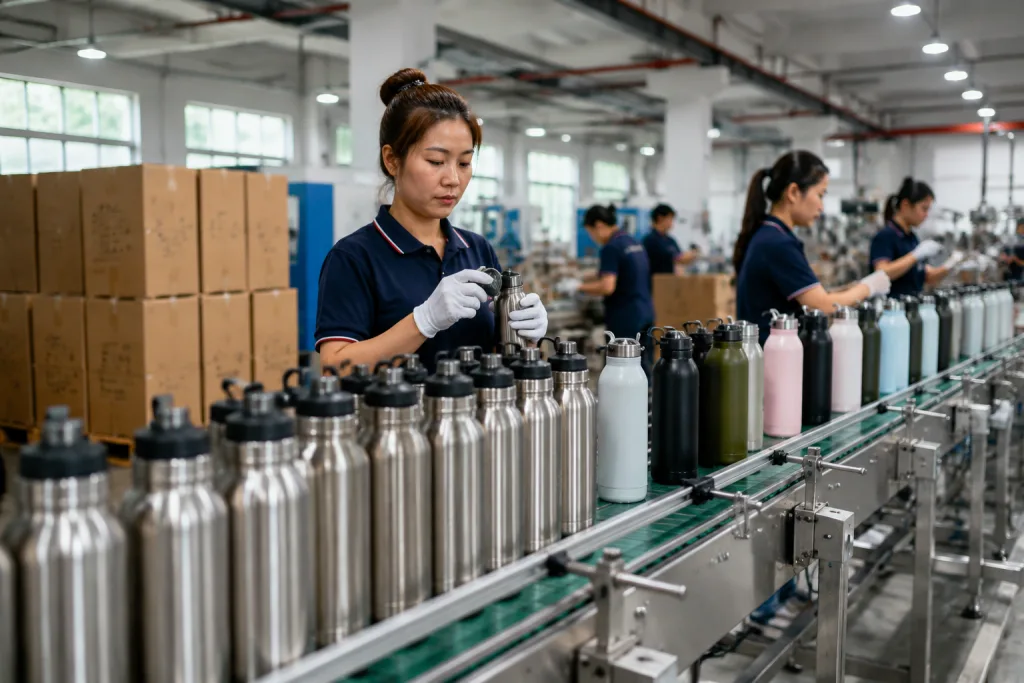
Our own planning in China runs around 600,000 units per month across tumblers, bottles, and flasks, and buyers hear that number and expect every order to move fast. It does not work like that. Body forming is often ready first; decoration is where the queue builds. If your canteen order needs silk print plus laser logo, packed with assorted inserts, then relabeled with Amazon FNSKU stickers, the line can slip 5-7 days. We have had QC pull the sample because the insert card was 2 mm oversized and jammed the packing jig.
Do not chase low MOQ on paper. We have seen this go sideways. A canteen supplier promising 300-piece MOQ on a fully customized canteen usually makes up the gap somewhere else: higher unit cost, loose color matching, or mixed production runs that come out less stable from batch to batch. For B2B buying, the math needs to fit your channel. If you are building a canteen customizable program for repeat yearly business, it usually pays to lock one body, one cap set, and one master carton size, then change color, logo, and carton print only. A new mold for every small order sounds flexible, but the math does not work.
Ask what the quote leaves out. This is where buyers get caught. Common missing items are third-party lab tests, barcode application, inner carton labels, export palletization, and spare lids. We also see small extras like 1% spare straws or replacement seals show up after the PO is issued. The buyer flagged one order last year over a USD 0.18 gap, and the missing cost was just palletization plus barcode labor. On the first quote it looked cheaper. On the final PI, it was not.
Sample approval before money gets trapped
The sample stage decides whether you control the order or the order controls you. We usually send 3 samples for a new flask program: one unprinted structure sample, one color sample, and one full pre-production sample. Don’t approve them as if they mean the same thing. That is where money gets trapped.
The unprinted sample is for ergonomics and function. Check actual fill capacity, opening diameter in mm, thread feel, handle comfort, gasket fit, and whether the bottle stands flat on a table. On our line, QC pulled one sample last month that rocked because the base was out by 0.8 mm. The color sample is for finish only. Check powder coat texture, gloss level, and Pantone approximation on metal, because paper chips and sprayed stainless do not read the same under light box inspection. The pre-production sample is your mass-production standard, full stop.
Here is what experienced buyers ask a hydration flask manufacturer to confirm in writing before mass production:
- Leak test standard: 100% testing during production, upside-down or vacuum/air pressure method
- Thermal performance: for example, fill with 95 degrees C water, after 6 hours not below agreed threshold under test conditions
- Logo placement tolerance: such as plus or minus 1.5 mm
- Color tolerance: approved against retained sample under daylight source
- Weight tolerance: for example plus or minus 3%
- Packaging standard: barcode location, carton marks, drop protection, insert orientation
If you are sourcing canteen customizable items for both retail and distributor canteen programs, insist on sealed golden samples. We normally seal 3 sets: one stays with the buyer, one stays at the factory, and one stays with QC. Put the PO number on each label and sign across the tape. We’ve seen this go sideways when sales signed off one navy tone and the line ran a darker one from the next powder batch.
For custom growler or customizable growler projects with swing caps or larger threaded lids, sample approval matters more because leakage claims get expensive fast. Ask for cap life-cycle testing in writing. A basic floor standard is 300 to 500 open-close cycles without thread damage or seal failure, checked with a torque gauge after testing. Some buyers push back on this and ask if 50 cycles is enough; the math doesn’t work. It is cheaper than replacing inventory in North America.
Production control and inspection points
After you pay the deposit, QC should stay on the order until final inspection. If a canteen manufacturer says, “we inspect at the end,” that usually means they catch defects after the money is already burned on coating, printing, and packing. We run this the other way. Problems should be stopped on the line, not argued over at the warehouse door.
For this type of flask order, the factory should check raw material certificates first, then track vacuum rate and weld consistency during production, then confirm coating adhesion and print accuracy before full packing starts. A weld gauge, a thread gauge, and a simple cross-hatch cutter tell you more than a polished PPT. You do not need every hourly report from the line, but you do need fixed checkpoints, signed records, and clear hold points. This is the right question to ask.
Minimum QC structure for a drinkware PO
- Incoming material inspection: steel, lids, seals, paints, cartons
- First article approval: first formed bodies, first coated parts, first printed units
- In-line inspection: dimensions, appearance, thread match, leak testing, coating defects
- Pre-shipment inspection: AQL sampling on finished packed goods
A lot of B2B buyers run AQL 2.5 for major defects and 4.0 for minor defects on drinkware. That works for promotional and standard retail programs. Premium retail is tighter, and we have seen buyers reject units over a 1.5 mm print shift or a small base wobble on a flat-glass table. Define critical defects up front: leaks, sharp edges, missing food-contact parts, or wrong artwork. Major defects usually mean visible dents, coating damage, crooked printing, or an unstable base. If this is not written on the PO, we have seen it go sideways.
Ask for records on these tests:
- 100% leak test
- Vacuum retention spot checks
- Coating adhesion cross-hatch test
- Dishwasher disclaimer confirmation if the product is hand-wash only
- Carton drop test especially for e-commerce and distributor drinkware shipments
A solid canteen vendor or canteen factory will not promise zero defects. No serious factory should. They should show how defects are found, tagged, separated, and pushed back to the process. QC pulled the sample, the buyer flagged the logo angle, the line fixed the screen position — that is what real control looks like. If your order ships from Zhejiang, China in peak season, book inspection slots 7 to 10 days early. We ship enough September and October orders to know the pattern: a 2-day inspection delay can turn into a 6-day vessel miss fast.
Compliance, packaging, and shipment handoff
The last stage is where custom drinkware orders still blow up. The bottle can pass inspection, yet the shipment gets stuck because the label copy is wrong, the box mark does not match the PO, or the paperwork is thin. We have seen 1 typo on a carton mark hold 5,000 units at the warehouse while the buyer and forwarder sort out who pays.
For Europe and North America, your hydration flask manufacturer should have the backup documents for every material claim, not just one sentence on the quotation. Buyers usually ask for REACH-related declarations, LFGB test support for EU food-contact expectations, and FDA-oriented material compliance statements for the US market. If the item is for kids, ASTM or CPSIA-related checks may apply based on the lid design and sales channel. QC pulled the sample and matched the silicone straw spec to the file more than once because the buyer flagged “food grade” with no document behind it. This is the wrong question to ask: “Can you print the claim?” Ask whether the factory can show the file set before mass production.
Now go back to our scenario. The 5,000 retail units need white boxes with EAN labels. The 3,000 promotional units need plain bulk packaging for canteen distributors. So the PO should split packaging by SKU and carton mark, not only by color. It should also lock in master carton quantity, net and gross weight limits, and pallet rules if your warehouse requires them. On the line, we usually check outer carton print against the packing list at first article stage, because one mixed-SKU carton is enough to wreck check-in at a DC.
For Amazon or 3PL programs, add these details before production starts:
- FNSKU or barcode format
- Label location and size
- Polybag warning text if any accessory is bagged
- Carton dimension limits
- Pallet height or slip sheet requirement
Freight terms matter too. FOB Ningbo or FOB Shanghai is common for Zhejiang suppliers. If you are comparing canteen manufacturers, compare freight readiness with ex-factory price. The math does not work if one supplier is $0.08 cheaper but misses the booking window and sends shipping docs 2 days late. We ship from Zhejiang every week, and the handoff usually breaks on simple things: carton count mismatch, missing HS code line, or gross weight over the warehouse cap by 1.5 kg.
When the order is finished, keep a reorder file: approved spec sheet, golden sample photos, carton artwork, barcode file, inspection report, and test records. That file saves repeat orders. Without it, each repeat PO starts from memory, and memory is expensive. We have seen buyers resend an old PO with the wrong lid code, then the line runs 304 stainless bodies correctly but packs the wrong accessory set for 3,000 pieces.
Send your flask spec for a factory review
Share your target quantity, size, logo method, and market. We will review MOQ, lead time, compliance, and packaging risks before you place the PO.
Frequently asked questions
What MOQ should I expect from a hydration flask manufacturer for a custom order?
For a standard stainless steel vacuum flask using an existing mold, expect MOQ around 1,000 units per color and 3,000 units total for a smooth custom program. Some factories in China will quote 500 units, but that usually means fewer color options, higher FOB pricing, or less efficient production planning. If you need a new lid, cap, or body mold, factories often want 3,000-5,000 units to amortize tooling. For promotional custom canteen projects with simple one-color printing and plain white box packing, MOQ can sometimes stay near 1,000 units. Ask whether MOQ applies by color, logo, packaging style, or total PO. Those details change the real number more than buyers expect.
How long does a typical custom flask order take from sampling to shipment?
A realistic schedule is 7-12 days for pre-production samples, 3-5 days for your approval cycle, and 35-45 days for mass production after deposit and final sample sign-off. If you need new tooling, add 15-25 days depending on whether it is a lid change or a full body mold. During peak export periods in Zhejiang, China, vessel space and inspection bookings can add another 5-10 days. If your order includes color boxes, multilingual inserts, or FNSKU labeling, lock those files early because packaging approval often delays shipment more than bottle production. Buyers who want goods on the water in 50 days should start with standard molds and keep decoration simple.
What quality checks matter most on insulated drinkware?
The big four are leak testing, vacuum retention, cosmetic inspection, and packaging integrity. You should expect 100% leak testing on assembled bottles, not random checks only. For vacuum bottles, ask for spot-tested thermal retention records and clear test conditions, such as water fill temperature and hour count. Cosmetic inspection should cover dents, coating defects, crooked logos, scratches, and unstable bases using an agreed AQL, often 2.5 major and 4.0 minor. Packaging matters more than many buyers think: crushed cartons, poor dividers, or weak inner boxes create claims even when the bottle is fine. For retail and e-commerce, ask for carton drop test records and barcode placement verification before the balance payment is released.
Which compliance documents should I request for Europe and North America?
Start with material declarations for all food-contact parts: stainless steel, PP, Tritan, silicone, paints, and coatings. For Europe, many buyers request REACH-related declarations and often LFGB test support for food-contact confidence. For the US market, ask for FDA-oriented material compliance statements and Proposition 65 screening if your program requires it. If the bottle is marketed for children, ASTM or CPSIA-related checks may also come into scope depending on design and accessories. Do not rely on a quotation note saying 'food safe.' Ask for dated reports or declarations tied to the actual materials used in your PO. Also confirm packaging compliance, especially inks, adhesives, and warning labels where applicable.
How do I choose between different canteen suppliers without just chasing the lowest price?
Compare five points side by side: specification accuracy, factory capability, QC discipline, compliance support, and communication speed. A supplier who quotes USD 3.35 FOB and clearly defines steel grade, wall thickness, logo tolerance, and packaging is usually safer than one quoting USD 3.10 with vague wording. Ask each canteen supplier about MOQ by color, lead time, monthly capacity, and whether they control coating and printing in-house. Request an AQL plan and example inspection records. Also check whether they understand retail labeling, distributor canteen packaging, and repeat-order consistency. A canteen vendor that answers technical questions in one day and flags risks early is usually worth more than a small unit-price saving that disappears in claims or delays.