Key Takeaways
- A practical MOQ for a custom hydration flask in bulk is usually 1,000-3,000 pcs per color, with 35-45 day lead time from Zhejiang, China.
- 18/8 stainless steel vacuum flasks typically land around USD 2.80-6.80 FOB China depending on size, coating, lid type, and decoration.
- For retail programs, AQL 2.5, leak test at 100%, and coating adhesion checks should be non-negotiable before shipment.
- Wide-mouth flasks sell well for outdoor and fitness channels, but narrow-mouth designs usually reduce complaint rates on leakage by 15-30%.
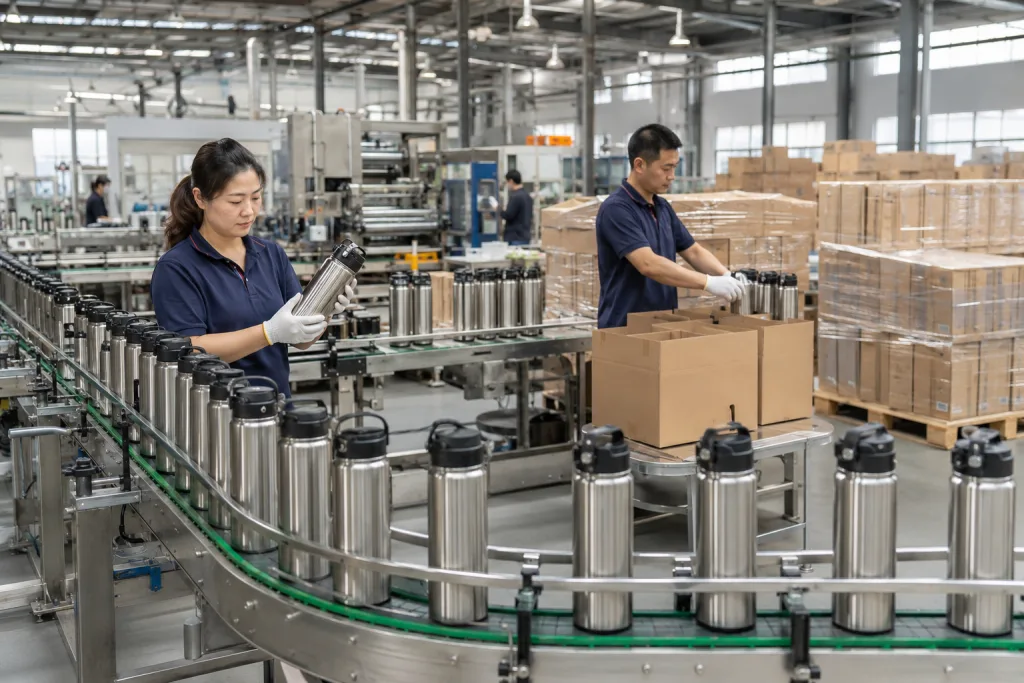
You are not buying a bottle. You are buying a defect rate, carton density, decoration ceiling, and your own margin. That is why bulk sourcing for a hydration flask gets messy fast. Two SKUs can look the same on a product sheet, then split hard on the line once you add powder coating at 60–80 μm, laser marking depth, drop testing from 1.2 m, and a 40HQ load plan.
For procurement managers and brand owners in Europe and North America, the practical question is not “which bottle looks good.” That is the wrong question to ask. The real question is which flask spec fits your channel without rework, claims, or late carton changes after the PO is signed. A gym brand, a corporate gifting program, and an outdoor retailer do not buy the same bottle, even if all three ask for 304 stainless. We run these projects every week in Zhejiang, and the buyer usually flags the same points first: MOQ, logo method, and lead time. Factories here can build all three, but you need to compare the details that actually move cost and risk before you commit.
Start with channel, not shape
Source the hydration flask by sales channel and actual use, not by the hero photo in a catalog. We see first-time buyers lose 10 to 14 days here. They start with color cards and lid styles, then later figure out whether the bottle is for Amazon, retail shelves, employee kits, or foodservice resale. This is the wrong question to ask at the start. On our line, the same body can pass one program and fail another just because the packed weight lands 0.18 kg over the courier target.
A 32 oz insulated flask with a carry handle can sell well in sporting goods and DTC, where buyers accept a bigger silhouette and a 1.2 m carton drop test. The same item can miss the target for corporate gifting once the packed weight pushes freight cost past budget; we have seen buyers flag this after sample approval, which is late. A slim 500 ml flask may fit office use and turn into a strong wholesale drink bottle for gifting, especially if the logo area holds 45 mm cleanly. In outdoor retail, that same size often underperforms because the shelf buyer expects 750 ml to 1,000 ml and a wider mouth for ice.
- E-commerce: Prioritize leak rate, carton drop resistance, barcode labeling, and low return risk. We usually run a 24-hour inverted leak check before pack-out.
- Retail chains: Prioritize shelf presence, color consistency, REACH documentation, and packaging compliance. QC pulled samples before where Delta E drift showed up under store lighting.
- Promotional programs: Prioritize low MOQ, fast logo setup, and stable decoration yield. A 500 pcs MOQ matters more here than chasing a custom lid mold.
- Outdoor and sports: Prioritize dent resistance, glove-friendly lids, and wider mouths for ice filling. The buyer usually asks for a mouth diameter around 50 mm to 55 mm.
In practice, buyers compare hydration flasks with adjacent categories such as bulk canteen, drinkware bulk, or even bulk growler programs because the distributor wants one supplier for several drinkware families. Fair enough, but the spec logic is not the same. A wholesale canteen or alcohol flask bulk item is often thinner, smaller, and less demanding on insulation; 0.4 mm single-wall stock is common there, while a vacuum flask is another build. A beer growler wholesale bulk program usually puts more pressure on cap seal and fill volume accuracy. We have seen this go sideways when one PO mixed flask and growler notes on the same page, even with a typo in the capacity line. If you lump these into one brief, your supplier in China will quote too wide and miss the control points that matter.
Your first sourcing decision is not “powder coat or spray paint.” It is “where will this SKU be sold, and how rough will the user be with it?”
Head-to-head spec table that matters
Here’s the comparison table most import buyers ask for after the first two emails. We cut it to four flask types that actually move, not 20 color-and-lid variants. These are standard export specs we see in Zhejiang stainless drinkware plants running 300,000-500,000 units per month, with wall thickness checked by micrometer on the line.
Core comparison
- Economy single-wall flask: 500-750 ml, 0.4 mm 201 or 304 stainless, non-insulated, screw lid, FOB USD 1.10-1.90, MOQ 3,000 pcs. Good fit for events, entry-level promotional wholesale drinkware, and canteen projects where buyers care more about landed cost than cold retention. We’ve had buyers push for 304 at the 201 price; the math doesn’t work.
- Standard double-wall flask: 500-1,000 ml, inner 0.4 mm / outer 0.45 mm 304 stainless, vacuum insulated, powder coat, FOB USD 2.80-4.30, MOQ 1,000-2,000 pcs. This is the volume runner for branded retail and online sales. Most lines run this spec daily, and QC pulled the sample first on vacuum hold and coating adhesion.
- Premium outdoor flask: 750-1,200 ml, thicker base, handle lid, copper-plated vacuum layer, silicone boot optional, FOB USD 4.80-6.80, MOQ 1,000 pcs. Built for outdoor, gym, and specialty retail where drop resistance gets checked, not just appearance. We’ve seen base dents drop sharply once the base is reinforced by even 0.2 mm.
- Multi-use wide-mouth flask: 650-950 ml, 55-65 mm mouth opening, straw or chug cap options, FOB USD 3.40-5.20, MOQ 1,500 pcs. Strong seller for active-use and family programs, but cap structure matters more than buyers expect. The buyer flagged leaks on one 64 mm-mouth project because the straw lid thread start was off by one turn.
Use-case fit beats unit price. Saving USD 1.50 per bottle on the economy version looks smart until the end market expects 12-hour cold retention and you start eating returns. Paying USD 1.80 more FOB on the premium model can support USD 8-12 more at retail. That spread is real.
This is where sourcing gets messy fast. If your distributor wants canteen bulk, wholesale growler, beer tumbler bulk, or alcohol flask wholesale bulk from one supplier, ask for separate spec sheets and separate QC plans. This is the right question to ask. A hydration flask is judged first on insulation and carry comfort. A growler bulk or beer growler in bulk item gets judged harder on seal integrity, carbonation handling, and handle geometry after shake testing. A beer tumbler wholesale bulk program gets more complaints about lip feel and stackability, and we ship those with a different carton drop standard. Keep the quotation matrix clean. We’ve seen this go sideways when one PO mixed “flask” and “growler” on the same line item.
Materials, insulation, and real durability
Most export-ready hydration flasks in bulk use food-contact 18/8 stainless steel, usually listed as SUS304. On cost-down jobs, some China factories quote 201 stainless for the outer wall or for single-wall bodies. We see this on POs from promo buyers at 3,000 pcs MOQ. It works for entry-level giveaways. For Europe and North America, most brand owners stay with full 304 because the buyer will ask for FDA or LFGB paperwork, and rust complaints start fast if the spec is loose.
Wall thickness is where the math gets real. A common retail-grade vacuum flask uses 0.4 mm inner and 0.45 mm outer wall. Move to 0.5 mm outer wall and dent resistance improves, but freight weight goes up. On our line, QC pulled two 32 oz samples and the heavier body added roughly 35-60 g per unit. Across 20,000 pcs, that matters. This is the wrong question to ask if the target is only “stronger”—ask how much drop resistance you need and what freight cost you will accept.
Insulation claims need a written test method. Too many suppliers print 12 hours hot and 24 hours cold on the quote sheet, then nobody can show the SOP. A usable factory check is simple: fill with 95°C water, measure after 6 and 12 hours at room temperature, then log the result with a probe thermometer. For cold retention, use 4°C water or an ice-water mix and record after 12 and 24 hours. If the line has no record sheet, the claim is sales talk, not engineering.
- Powder coating: Better scratch resistance and grip; usually adds USD 0.18-0.35. We run a cross-hatch adhesion test on coated samples before mass production.
- Spray painting: Lower cost, but color consistency and chip resistance are weaker. Buyers often flag ΔE drift between lid and body.
- Copper coating in vacuum layer: Improves thermal performance by around 10-20% in many builds. If the vacuum chamber process is unstable, we’ve seen this go sideways.
- Electropolished interior: Helpful for odor control and easier cleaning on premium lines. It also gives a cleaner weld area inside the bottle.
If you are also sourcing canteen wholesale or alcohol flask in bulk, do not assume the same material logic applies. A classic alcohol flask wholesale item often uses thinner steel and a flatter deep-draw shape, so tool wear at the forming die matters more. A beer growler bulk unit needs tighter control on cap thread stability and gasket compression; we check thread fit with a go/no-go gauge. Good factories in Zhejiang can make all of them, but each family has its own weak points.
MOQ, pricing, and freight reality
Most buyers ask for unit price first. That is the wrong question to ask. MOQ and carton density decide whether the quote still works after freight. For a custom hydration flask in bulk, a realistic starting MOQ is 1,000 pcs per size and color for an existing mold. We run this level every week. If you need a new lid, special base, or unique body silhouette, MOQ can move to 3,000-5,000 pcs and tooling may run from USD 1,500 to USD 6,000. On the line, even a 1.5 mm change at the lid seat can trigger new gauges and a fresh leak-test setup.
Typical FOB China pricing for 2025-style sourcing ranges looks like this:
- 500 ml single-wall: USD 1.10-1.70
- 600 ml vacuum flask: USD 2.80-3.60
- 750 ml vacuum flask: USD 3.20-4.20
- 1,000 ml handle flask: USD 4.20-6.00
- Logo add-on: silkscreen USD 0.05-0.12, laser USD 0.08-0.20, heat transfer USD 0.18-0.35
- Color box: USD 0.22-0.55 depending on print coverage and insert type
Lead time is usually 7-12 days for pre-production samples and 35-45 days for mass production after approval and deposit. In peak season from August to November, 6 out of 10 factories in our circle stretch to 50-60 days, especially when powder-coat lines are full. We have seen sample approval in 9 days turn into 18 days after the buyer flagged a Pantone mismatch on the second spray card.
Do not ignore carton efficiency. This is where the math breaks. A bulky lid can reduce loading quantity by 8-15%. That can erase the margin gained from a lower bottle cost. We have seen one cap revision drop a 40HQ load by 1,200 pcs after carton width increased by 12 mm. The same warning applies if you are bundling drinkware wholesale categories together, such as wholesale growler, canteen bulk, and beer tumbler in bulk. Mixed-container programs look efficient on paper, but they complicate carton planning, pallet heights, and inspection sequencing. QC pulled the sample once because three SKUs shared one master carton mark and the PO had the canteen color code typed wrong.
If you sell through Amazon or other marketplaces, ask for FNSKU labels, suffocation warnings where required, and outer carton marks aligned to your booking rules. We ship plenty of marketplace orders, and small labeling misses turn into expensive 3PL rework fast. One common pushback from buyers is, "we will label after arrival." Usually that costs more. A cheap ex-factory quote becomes expensive if relabeling is needed at a 3PL, especially if outer cartons fail scan because the mark size was printed at 18 mm instead of the requested 24 mm.
Compliance and QC checkpoints buyers skip
For Europe and North America, check compliance paperwork before mass production starts, not after the line has run 20,000 pcs. At minimum, ask for material declarations and recent test reports for all food-contact surfaces, including the silicone straw, PP lid insert, and any inner coating if the SKU has one. Depending on market and product type, this may include REACH, LFGB, FDA-related food-contact statements, and California Proposition 65 screening where applicable. For kids-oriented lines, ASTM or CPSIA-related requirements can enter the picture, but standard hydration flasks for adults are usually centered on food-contact and chemical compliance. Buyers often ask for the lowest unit price first; this is the wrong question to ask if the lab file is still missing.
Factory audits matter, but they do not guarantee the product. BSCI, Sedex, or ISO 9001 can show the supplier runs a usable system, yet you still need product-level controls at shipment stage. On our side, QC pulled the sample and checked cap torque after assembly because paperwork alone never catches a bad sealing fit. In our sector, the minimum shipment discipline should include:
- 100% leak test before packing
- Vacuum test sampling every production batch
- Coating adhesion test with cross-hatch or tape method
- Drop test on packed samples from 76 cm to 1 m depending on packaging claim
- AQL inspection typically General II, Major 2.5 / Minor 4.0
The most common avoidable issues are not dramatic. They are 1 mm logo shifts, lid-to-body color variance, silicone odor right after sealing, burrs on thread starts, and retail cartons that fail the corner drop. We ship plenty of orders where the buyer flagged none of this on the approved sample, then the arrival claim turns into hand-sorting 3,000 pcs. That is where the cost shows up. We've seen this go sideways.
If your supplier also quotes wholesale drinkware, alcohol flask wholesale, wholesale canteen, or beer growler wholesale, insist on separate defect criteria by SKU family. AQL should be consistent, but the inspection points should differ. We run different checks for each line: a dent on a powder-coated flask, a loose captive cap on a canteen bulk order, and a micro-leak on a growler wholesale unit are not the same failure mode. Last month one PO even mixed a canteen lid code with a growler body code, and the buyer only caught it after pre-production sampling. The math doesn't work if one generic checklist is covering four product types.
Match the bottle to the brief
Here’s the practical way we frame it on the factory side. If your brand is new and you need a broad-appeal hydration flask in bulk, start with a 600-750 ml double-wall 304 stainless model, powder coat, screw lid, and a one-color logo. MOQ around 1,000-2,000 pcs, FOB around USD 3.00-4.20, lead time around 40 days. We run this spec all the time because the line is stable: fewer lid parts, fewer leak points, and cleaner logo placement on a straight body. It is not flashy. It sells across gyms, gifting, e-commerce, and general retail.
If your audience is hikers, jobsite users, or premium sports buyers, step up to a 32 oz or 40 oz model with a handle lid, thicker outer wall, and an optional boot. Freight goes up fast on this size, and we have seen dent complaints jump when the master carton drops below a safer board grade. The buyer flagged this more than once after transit tests. For urban gifting or corporate programs, go smaller and slimmer, then spend the budget on color finish and packaging. A clean 500 ml bottle in a rigid box usually moves better than a large technical bottle in the wrong channel. This is where the math matters.
For buyers building a broader range, it is normal to source hydration flasks beside drinkware wholesale extensions such as beer tumbler wholesale, beer growler wholesale, growler bulk, or canteen wholesale. That saves back-and-forth if the factory has in-house tooling, decoration, and QA. We ship mixed programs like this, but each category needs its own costing sheet and QC sheet, or the numbers get muddy fast. We have even seen a PO typo roll a 500 ml flask into the wrong inner box size. Small mistake, big delay.
Good procurement is not about chasing the absolute lowest FOB. That is the wrong question to ask. The better spec is the one that survives transit, passes compliance review, lands on time, and still leaves margin after returns. QC pulled the sample, checked color against the Pantone card under the light box, and caught a lid seal issue before mass packing—that is what protects the order. That is why experienced buyers in Europe and North America often stay with stable factories in Zhejiang, China once they find one that can hold color, sealing, and lead time across repeated orders.
Get a quote with usable specs, not guesswork
Send your target size, market, MOQ, and logo method. We will suggest the right flask structure, compliance path, and FOB range for your program.
Frequently asked questions
What MOQ should I expect for a custom hydration flask in bulk?
For an existing bottle mold, most factories quote 1,000 to 3,000 pcs per size and color. If you want a standard body with only logo printing, 1,000 pcs is often possible. If you need a custom lid, unique body shape, or exclusive packaging insert, MOQ usually moves to 3,000-5,000 pcs, sometimes higher. In Zhejiang, China, sample lead time is commonly 7-12 days and production lead time 35-45 days after artwork approval and deposit. Always confirm whether MOQ is per color, per lid type, or per total order. Buyers get caught when a supplier says 2,000 pcs MOQ but means 2,000 pcs for each colorway, not the full program.
How much does a hydration flask in bulk usually cost from China?
A practical FOB China range is USD 2.80-4.30 for a standard 500-750 ml double-wall stainless flask with powder coating and one-color logo. Larger 1,000 ml handled models often land at USD 4.20-6.00 FOB. Single-wall economy bottles can drop to USD 1.10-1.90, but they are not true substitutes if your market expects insulation. Add roughly USD 0.05-0.12 for silkscreen logo, USD 0.08-0.20 for laser engraving, and USD 0.22-0.55 for a printed box. Freight, inspection, duties, and carton efficiency can change the landed cost more than a USD 0.20 factory price difference, so compare total landed margin, not just unit FOB.
What tests should I require before shipment?
At minimum, require 100% leak testing, visual inspection, and random vacuum performance checks by batch. For third-party final inspection, AQL General II with Major 2.5 and Minor 4.0 is a common baseline for bulk drinkware. Ask the inspector to check logo position, coating defects, thread smoothness, gasket fit, odor, and carton drop resistance. If the bottle is powder coated, include an adhesion check such as cross-hatch tape testing. For retail programs in Europe and North America, request current food-contact documentation such as REACH or LFGB-related reports where relevant. If you skip pre-shipment controls, even a 2% leak rate means 200 problem units in a 10,000-piece order.
Can one supplier handle hydration flasks, canteens, growlers, and tumblers together?
Yes, but only if the supplier has real experience across those categories. Many factories can quote hydration flask in bulk, canteen wholesale, growler wholesale, and beer tumbler wholesale from one showroom, but actual production may be split across subcontractors. That is not automatically bad, but you need transparency. Ask which items are made in-house, what the monthly capacity is, and whether QC is unified. A strong supplier should give separate spec sheets, pricing, and defect criteria for each family. Hydration flasks focus on insulation and portability, growlers on seal and volume, and tumblers on rim finish and stackability. Treating them as one product group usually creates avoidable complaints.
How do I choose between narrow-mouth and wide-mouth flask designs?
Choose based on user behavior, not appearance. Narrow-mouth flasks usually leak less, drink more cleanly on the move, and suit office, commuting, and general retail. Wide-mouth flasks are better for adding ice, cleaning, and outdoor use, but they depend more on lid design and gasket quality. In bulk orders, wide-mouth models can show 15-30% more complaint risk if cap engineering is weak or users overtighten threads. They also take more carton space when paired with handle lids. For first orders, many brand owners start with a 600-750 ml narrow-mouth vacuum flask, then add a wide-mouth premium version after validating demand and return data.