Key Takeaways
- A realistic MOQ for hydration flasks is often 1,000-3,000 pcs per color, while stock-color programs can start at 500 pcs
- Factory-direct savings are usually 8%-18% versus layered sourcing, but only if specs, AQL, and packaging are locked before deposit
- Standard lead time from Zhejiang, China is commonly 25-35 days after sample approval and deposit, plus 7-12 days for sea-ready booking
- For stainless custom drinkware, ask for 18/8 inner wall, vacuum retention data, REACH/LFGB testing scope, and AQL 2.5 final inspection
You are not buying a sample for a photo shoot. You are buying a production program that has to ship on time, pass compliance, and leave margin for your brand or distributor. That is why the phrase hydration flask factory direct matters. Buy well and you control decoration, packaging, and unit cost down to the carton spec. Buy badly and you own delays, leakage claims, and rework; we have seen a lid torque issue at 1.8 N·m turn into a full repack after QC pulled the sample.
Most buyers in Europe and North America ask the same questions on the first call: what MOQ is real, which steel grade should be on the PO, how do you compare a canteen manufacturer in Zhejiang, China with a trading company, and what must be locked before deposit. This is the right place to start, but not the only one. The wrong question to ask is just price. On the line, a 5,000-piece order with 304 stainless, one-color screen print, and plain white box runs differently from a 3,000-piece customized growler with laser marking and molded inserts. We ship both. This guide answers those sourcing points directly, using the checkpoints procurement teams actually use for custom drinkware, custom canteen, and customized growler projects from China.
What factory direct really means
Buyers use hydration flask factory direct as shorthand for fewer layers between your drawing and the line. Sounds straightforward. It often is not. We have seen suppliers with a clean catalog and a sharp sales deck, while the bottle body is spun in one workshop, the lid is assembled in another, and decoration is sent out again. That setup is not always a problem, but this is the wrong question to skip: what is actually controlled in-house, and what is subcontracted? Ask for the process sheet, not a brochure. If they cannot show a neck gauge or a weld inspection photo, start digging.
If you are buying from a real canteen factory or canteen manufacturer in Zhejiang, China, ask for direct answers on forming, vacuum processing, and decoration. No soft language. We ask the same questions when we audit upstream vendors. If the supplier runs bottle forming, seam welding, polishing, powder coating, and laser marking under one roof, project control is tighter and rework moves faster. If they only assemble bought-in parts, the opening price can look good, then QC pulls the sample and the accountability goes blurry once defects show up. We have seen a 0.3 mm lid-fit gap turn into a two-week argument because three workshops touched the same order.
For B2B buyers, factory direct should give you practical benefits, not sales language:
- Quicker quotation cycles because engineering, costing, and production sit in one chain, so a 40 oz flask revision can be priced in 24 hours instead of 3 days
- Lower MOQ flexibility on repeat orders, often dropping from 1,000 pcs to 500 pcs for stock-color bodies, especially when the line already has matching lids and cartons in stock
- Cleaner complaint handling because the same factory reviews welding, coating, and lid fit issues, instead of passing blame after an AQL 2.5 inspection finding
- Better customization for custom drinkware, custom canteen, and customizable growler packaging, with artwork checked against actual laser-marking position before mass production
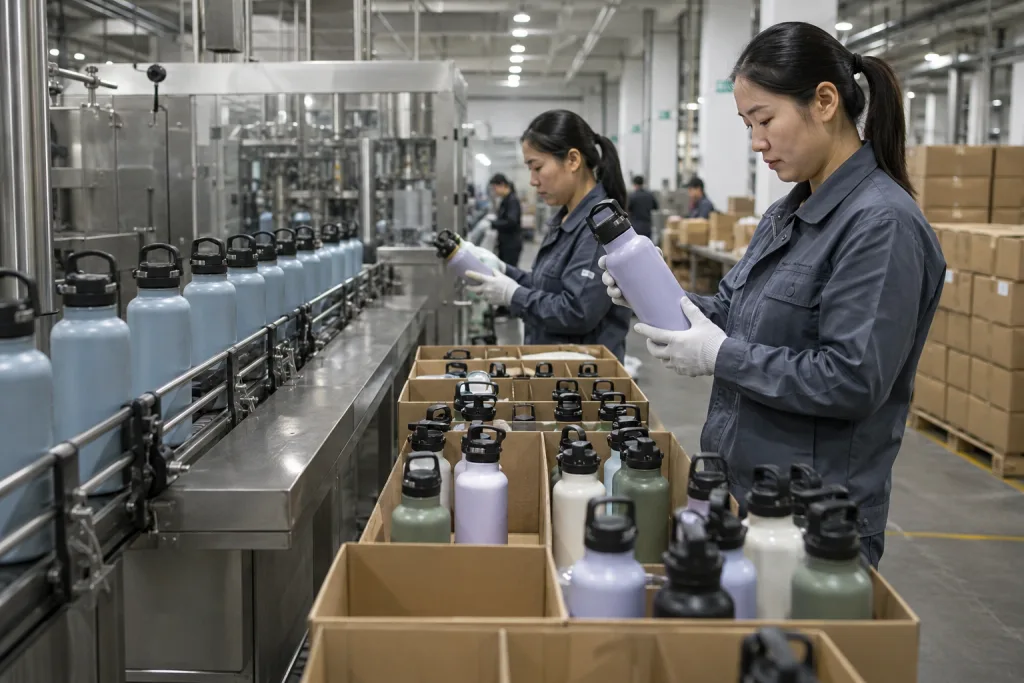
At BottleForge Industrial in Hangzhou, Zhejiang, our production planning is built around export programs rather than one-off domestic runs. We run output in the hundreds of thousands of units per month, and normal mass-production lead times stay at 25 to 35 days. That matters. A canteen distributor or distributor drinkware buyer does not need a lucky first order; they need the same body weight, the same coating window, and the same carton pack-out on the fifth shipment. Last month a buyer flagged a PO typo on carton marks 48 hours before print, and the line corrected it without moving the vessel ETD.
A useful rule: if a supplier cannot explain its process flow in 5 minutes, it probably does not control enough of it.
Questions to ask before quoting
The fastest way to get a bad quote is still the same email: “What is your best price?” We see it every week. The fastest way to get a usable quote is a short technical brief with the core specs filled in. If you are sourcing canteen custom items for retail, canteen promotional giveaways, or a customized drinkware line for e-commerce, price follows specification. This is the right place to slow down. On our side, the sales team usually checks your brief against the drawing and a 0.4 mm wall callout before we even ask the line for costing.
Start with the basics:
- Capacity: 350 ml, 500 ml, 750 ml, 1,000 ml, or 1.2 L
- Construction: single wall or double wall vacuum
- Material: stainless steel 18/8, 18/0 outer, Tritan lid parts, PP, silicone
- Body finish: spray paint, powder coat, rubber paint, electroplating
- Logo method: silkscreen, heat transfer, laser engraving, digital print
- Packaging: white box, color box, PDQ, mailer, barcode label, FNSKU
Then ask the questions new buyers skip. We have seen quotes go sideways because the PO said “mat finish” and the buyer meant powder coat, while the factory quoted spray paint. One word changed the cost and lead time. QC pulled the sample, and the color rub result was different from what the buyer expected.
Checklist for RFQ quality
- Wall thickness: for many vacuum bottles, 0.4 mm inner and 0.5 mm outer is standard; if a price comes in unusually low, ask whether the body has been thinned down. We check this with a micrometer on cut samples.
- Heat retention target: for example, 12 hours hot above 55°C and 24 hours cold below 10°C. Ask for the test method, not just the claim. This is the wrong question to ask if you only say “keep hot longer.”
- Leakproof standard: upside-down test for 30 minutes, full water fill, no seepage. The buyer flagged this on one sports lid project after thread tolerance drifted by 0.2 mm.
- Drop expectation: carton drop test from 76 cm or 1 meter depending on pack format. A mailer pack and a retail color box do not survive the same abuse, and the math doesn't work if packaging is underbuilt.
- Compliance destination: EU REACH, LFGB, BPA-free claims, US FDA-contact scope, ASTM where relevant. Tell the factory where you ship before sampling, because lid resin and ink selection can change.
If you are comparing a canteen supplier, canteen vendors, and canteen manufacturers from China, force all of them to quote on the same basis. FOB Ningbo or FOB Shanghai is common from Zhejiang. Unit price without packaging details is not a real unit price. For a 500 ml powder-coated vacuum flask, a factory-direct FOB range might move by USD 0.18 to USD 0.60 just on lid style and packaging alone. We ship both ways from Zhejiang, and we have seen 1,000 pcs quotes look cheap until the buyer asked for FNSKU, barcode label position, and a 5-ply mailer. That gap is your margin if you control it, or your surprise cost if you ignore it.
How to judge MOQ and pricing
MOQ is where deals get fuzzy fast. We hear “500 pcs” on the first call, then the buyer gets the real list later: printed logos at 1,000 pcs, custom colors at 3,000 pcs, custom lids at 5,000 pcs. That is not automatically a red flag. It usually comes from different cost points on the line—screen setup, paint changeover, mold amortization. Ask for the full MOQ breakdown on day one. We’ve seen a PO even say “500 pcs custom all same as sample” with no note on lid tooling, and that is where trouble starts.
For hydration flask factory direct sourcing from China, the usual MOQ structure looks like this:
- Stock model + one-color logo: 500 to 1,000 pcs
- Custom body color: 1,000 to 3,000 pcs per color depending on paint line setup
- New mold for lid or bottle base: 3,000 to 10,000 pcs plus mold cost
- Gift box with custom print: often 1,000 pcs minimum
Price moves faster than buyers expect once the specs pile up. A narrow-mouth 500 ml bottle may quote at USD 3.20 FOB, while the same body with a carry-loop lid, powder coat, individual polybag, color box, and bottom laser code moves to USD 3.85 or USD 4.10. Add a tea infuser or strainer and you may add another USD 0.20 to USD 0.45. On our side, powder coat alone means a separate run on the coating line and extra curing time; QC also checks finish consistency at spots like the shoulder radius. Small details. Real cost.
If you are a canteen distributor, distributor canteen buyer, or distributor growler importer, ask for a price ladder. This is the right question. If a factory will not show 1,000 pcs vs 3,000 pcs vs 5,000 pcs, the math usually does not work. For example:
- 1,000 pcs: USD 3.95
- 3,000 pcs: USD 3.62
- 5,000 pcs: USD 3.48
- 10,000 pcs: USD 3.31
This shows whether the supplier gets better line efficiency at volume or is just holding margin. It also tells you whether a custom canteen or customizable canteen launch should begin with fewer SKUs and deeper volume. In Zhejiang, we’ve seen first-time buyers split one 3,000-piece order into six colors—about 500 pcs per color—then ask why cost jumps and shade matching drifts. The buyer flagged this on one project after carton drop-test samples and production samples were already mixed by color code.
If your annual demand is 12,000 pcs, a cleaner plan is often 2 body colors x 2 lid colors, not 8 low-volume combinations.
Materials, testing, and compliance checkpoints
Most claim disputes in custom drinkware start with loose material wording. “Food grade” tells you nothing on the line. Ask for the exact resin or steel grade, the contact part list, and the matching test scope. For stainless hydration flasks, EU buyers usually ask us to state 18/8 stainless steel on contact parts and provide REACH or LFGB-related declarations. North American buyers usually ask for FDA-contact declarations, BPA-free statements for plastics, and California Proposition 65 screening where it applies. We have seen one PO say “304 inside, food safe outside,” which is the wrong question to ask and a bad spec to approve.
A serious canteen supplier or canteen manufacturer should be able to show a material bill and a test roadmap, not just a catalog sheet. QC pulled the sample, checked the lid resin mark, and matched it against the BOM before mass production. At minimum, your checklist should cover:
- Bottle body: SS304 for inner wall; outer wall can be SS304 or SS201 depending on program and market
- Lid plastics: PP or Tritan, with silicone sealing ring hardness and color defined
- Coating: adhesion, odor, scratch resistance, and migration risk where relevant
- Performance: vacuum retention report with test condition noted, not just a sales claim
- Inspection: AQL 2.5 for major defects is common for export final inspection
Ask the supplier how third-party testing is handled before you place the order. A mature canteen factory in China will usually support SGS, TUV, Intertek, or BV sampling from finished goods, and the lab sample should come from sealed cartons, not hand-picked units from the office shelf. For public-sector or school-channel canteen promotional projects, ask for BSCI or equivalent social audit records and ISO 9001 process control. These documents do not promise zero defects. They do cut avoidable risk. Last year, one buyer flagged a missing factory chop on a social audit file, and the shipment review stalled for 3 days over paperwork alone.
For custom growler, customizable growler, or customized growler projects, pay close attention to thread fit and carbonation claims. We run a simple cap-on, cap-off thread check during preproduction because a 0.3 mm mismatch on the neck finish can turn into leaking complaints fast. Most standard vacuum growlers are fine for cold beverage transport, but they should not be sold with open-ended pressure claims unless the closure was designed and tested for that use. The math does not work if marketing wants “sparkling safe” and the cap was built for still drinks. A small wording mistake on packaging has caused return cases before, and we have seen this go sideways.
Customization without expensive mistakes
The margin in factory-direct buying usually comes from customization. The claims usually come from the same place. On our line, most disputes start before production, not after it: the PO said “matte blue,” the buyer meant Pantone 7692C, and QC pulled the sample too late. If the artwork, color target, and packaging spec are loose before mass production, the math doesn't work.
For customizable drinkware or canteen customizable orders, lock these items before deposit:
- Color reference: Pantone code or approved sprayed sample
- Logo size and position: width, height, and distance from base or seam
- Print durability: hand-wash only or dishwasher-safe claim, plus test method
- Barcode format: UPC, EAN, FNSKU, carton shipping marks
- Master carton standard: pieces per carton, gross weight limit, carton dimensions
For e-commerce buyers, packaging is not a side issue. It drives damage rate, dimensional weight, and review risk. We have seen a cheap white box fail a 76 cm drop test and crush at the corner before the bottle was even scratched. One buyer pushed back on pulp inserts to save USD 0.18, then came back after chargebacks. If you sell through Amazon or DTC channels, ask for transit-safe packaging with corner support or pulp inserts, and check carton compression strength before we ship.
Decoration choice changes cost, speed, and scrap. Silkscreen is the low-cost option for simple one-color artwork, often adding around USD 0.05 to USD 0.12 per unit, and we run it fast once mesh and ink are locked. Laser engraving is slower but cleaner on powder-coated stainless and often adds USD 0.08 to USD 0.20; the beam gives a sharper edge on 304 stainless than buyers expect. Full-wrap transfer or digital print looks strong for customized canteen launches, but we have seen this go sideways when batch-to-batch color tolerance is tight and the first article was approved under different lighting.
Whether you are buying canteen customized products for a brand launch or working as one of several canteen distributors in your market, insist on a pre-production sample signed against a checklist. Put measurements on it: logo 38 mm wide, 45 mm above base, barcode on the right panel, carton under 18 kg. In Zhejiang export manufacturing, the buyers who write this down have fewer arguments later. The ones who approve from a chat screenshot, or miss a PO typo on item color, usually pay for ambiguity.
How production control should work
You do not need to stand over every welding station in China. You do need a control system that people on the line will actually follow. For a factory-direct flask order, we run 4 gates: sample approval, pre-production confirmation, in-line control, and final inspection. Skip one, and the savings disappear fast. We have seen this go sideways over a 0.8 mm logo shift that nobody signed off before mass production.
Here is a practical control flow for custom drinkware orders:
- Pre-production sample: locks body, lid, coating, logo, and packaging before the line starts
- Golden sample archive: one kept by you, one by the factory QA team, both stamped against the PO version
- In-line checks: vacuum performance, coating appearance, thread fit, logo position, leak test, with QC pulling the sample each 2 hours
- Final random inspection: based on AQL, with carton count and barcode verification before balance payment
Ask your canteen vendor or canteen factory how they handle defects on the floor, not in a brochure. You want direct answers with numbers. What scratch limit is accepted on powder coat: 1 mm, 2 mm, or reject? How do they grade pinholes in coating? What share of units gets 100% leak tested—5%, 20%, or every piece? Are laser codes traceable by date or by line? This is the right question to ask. Last month, a buyer flagged a PO typo on barcode suffixes, and QC caught it only because carton labels were checked against the approved file.
Lead time discipline matters as much as inspection. In Zhejiang, China, a repeat order is usually 20 to 30 days. A new custom project is usually 30 to 45 days, depending on packaging approval, print files, and whether the drop test passes on the first round. If your order includes a new customized drinkware mold, add tooling time, usually 15 to 30 days for sample-ready status. Book backward from your ship window, not from the day you start asking for prices. We ship plenty of orders that look fine on paper, then lose 6 days waiting on a revised gift box dieline.
Payment terms for new buyers are commonly 30% deposit and 70% balance before shipment against inspection approval. That is standard. If a supplier offers loose payment terms but gives vague QA rules, be careful. The math does not work. A soft payment deal will not fix scratched coating, weak vacuum, or a lid fit issue that shows up at 12 kg torque testing.
Supplier scorecard for your shortlist
If you are comparing canteen suppliers, canteen vendors, or canteen manufacturers, use a scorecard. Skip the 50-column spreadsheet. We run these reviews with 12 to 15 lines, enough to compare what affects margin, delivery, and complaint rate. It works for a custom canteen line, a distributor growler assortment, or a broad customizable drinkware range.
A workable scorecard includes:
- Commercial fit: MOQ, quoted FOB price, mold cost, sample charge, payment terms
- Operational fit: lead time, monthly capacity, export market experience, response speed
- Technical fit: material clarity, testing support, process control, decoration capability
- Risk fit: complaint handling, audit status, AQL acceptance, packaging reliability
Weight the categories. For a retail brand, technical fit and risk fit should often carry 60% of the score, because lid leak rate, coating adhesion, and carton drop performance hit you later. For a canteen promotional importer with event deadlines, this is the wrong place to chase catalog size; lead time and packaging accuracy matter more. We have seen buyers choose the cheaper quote, then lose 6 days because the inner box barcode on the PO was printed with one wrong digit.
Do not overvalue the cheapest sample. QC pulled the sample, polished the weld by hand, and packed it one by one; that does not tell you what the line will ship at 3,000 pieces, 10,000 pieces, and the reorder after that. The real question is repeatability. Ask what the neck tolerance is in mm, how they check vacuum, and whether the same finish holds after 2 production runs. Ask for references by market type if possible: promotional, retail, distributor drinkware, or private label. A canteen manufacturer that runs cleanly in one channel can still miss the mark in another.
When you shortlist suppliers from China, especially from Zhejiang where drinkware factories cluster, you are selecting a process partner. Not just a catalog. The best one is not the factory with 400 SKUs on a PDF. It is the one that gives straight answers, holds stable lead times like 12 days versus 18 days, and deals with a tolerance issue without excuses. We have seen this go sideways when a buyer flagged a 0.8 mm lid-gap issue and the supplier kept arguing photos instead of sending replacement parts.
Get a factory-direct hydration flask quote that is usable
Send your target capacity, decoration, packaging, and compliance market. We will quote MOQ, FOB pricing, lead time, and testing checkpoints clearly.
Frequently asked questions
What is a realistic MOQ for hydration flask factory direct orders?
For a standard stainless steel hydration flask using an existing mold, realistic MOQ is usually 500 to 1,000 pcs for stock colors with one-color logo decoration. If you want a custom painted body, MOQ often moves to 1,000 to 3,000 pcs per color because the coating line setup and paint matching need volume to make sense. A fully custom lid or bottle shape can push MOQ to 3,000 to 10,000 pcs plus tooling cost. Ask the supplier to break MOQ into body, lid, color box, and logo method. That gives you a real purchasing picture instead of one headline number that changes later.
How much can I save buying custom drinkware factory direct from China?
For many B2B orders, factory-direct sourcing from China can save around 8% to 18% compared with buying through extra trading layers, but only if you compare like-for-like specifications. A USD 3.40 bottle can quickly become USD 3.95 once you add powder coat, custom box, barcode labels, and stricter QA. The bigger savings are often in better control of decoration, carton packing, and repeat-order consistency rather than just the first quoted unit price. Buyers in Europe and North America should compare FOB terms, packaging detail, test scope, and defect standard. If those are not aligned, the apparent savings are usually not real.
What compliance documents should I ask a canteen manufacturer for?
Ask for documents tied to your market, not generic promises. For EU programs, request material declarations and testing support around REACH and, where relevant, LFGB-contact expectations. For North America, ask about FDA-contact basis for materials, BPA-free declarations for plastics, and Proposition 65 screening when needed. Also request stainless steel grade confirmation, coating information, and any third-party reports from labs such as SGS or TUV. On the factory side, ISO 9001 and BSCI can help as process and social-audit indicators. None of these replace your own product-specific testing, but they reduce sourcing risk and show whether the supplier works at export standard.
How long does a customized canteen order usually take?
A normal customized canteen order takes about 25 to 35 days after sample approval and deposit if you use an existing bottle mold and straightforward packaging. If the project includes a new lid, special gift box, or multiple print processes, lead time often extends to 35 to 45 days. New tooling can add 15 to 30 days before the mass-production clock even starts. From Zhejiang, China, you should also leave time for booking and port handling, usually another 7 to 12 days before vessel departure. For seasonal launches, work backward from the in-warehouse date, not the ex-factory date, or your timeline will be too optimistic.
How do I compare canteen suppliers if their samples all look good?
Assume samples are only the first filter. Then compare the suppliers on repeatability. Ask each one for MOQ by component, monthly capacity, standard lead time, defect standard, and whether final inspection runs to AQL 2.5 or another agreed level. Check how they describe materials: 'food grade' is weak, while 'SS304 inner, PP lid, silicone seal' is useful. Ask what percentage of units get leak-tested and how logo position is controlled in mass production. If you are a canteen distributor or distributor growler buyer, also compare replenishment support on repeat orders. The best sample does not always come from the best production partner.