Key Takeaways
- For most stainless hydration flask customized programs, realistic MOQ starts at 500-1,000 pcs per SKU, with 7-12 days for samples and 30-45 days for bulk
- A 304 stainless inner and outer body with 0.4-0.5 mm wall thickness is standard; 316 inner is usually a USD 0.30-0.80 upcharge per unit
- Decoration choice affects complaint rates: laser engraving is durable, while silk screen needs adhesion checks after 24-hour cure and dishwasher simulation
- Ask for AQL 2.5 inspection, REACH and LFGB/FDA material declarations, and barcode/carton mark verification before balance payment
You can place a hydration flask customized order online in 20 minutes. We have seen the cleanup take 120 days after that. Leaks at the lid torque test, logos rubbing off after 50 dishwasher cycles, wrong carton marks from one PO typo, and test files nobody checked before sampling — this is where projects go sideways. For a procurement manager, the hard part is not finding a canteen manufacturer in China. The hard part is filtering which canteen supplier can ship your exact spec, your compliance file, and your ex-factory date without excuses.
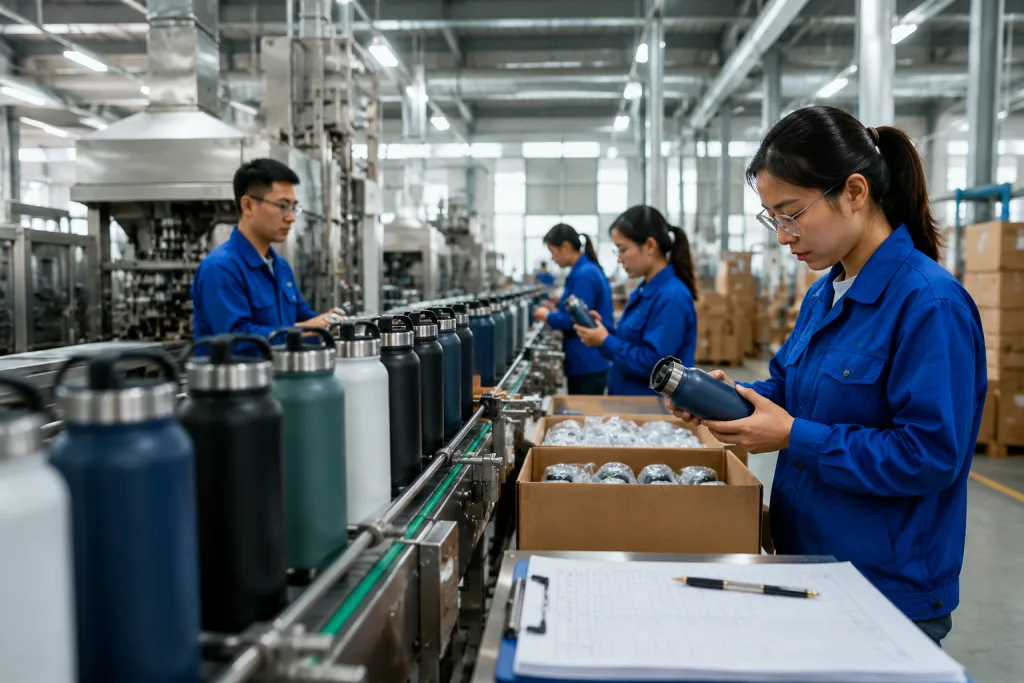
On the factory floor in Zhejiang, we usually start with six points: material grade, capacity, decoration method, test standard, packaging spec, and MOQ. Then the real work starts. A 1 mm logo shift, a cap weight outside tolerance, or an outer carton printed with the wrong item code is enough for a buyer in Europe or North America to flag the shipment. This is the wrong question to ask if you only compare price on a custom canteen or customized growler. If you are reviewing a broader custom drinkware program, you need a checklist that answers sourcing questions before deposit, before sampling, and before the line runs.
Start with the real purchase brief
For a hydration flask customized quote, a reference photo is not enough. We see this every week. If you send only an image and a target price, 8 suppliers will send 8 different offers, and the buyer cannot compare them line by line. One factory quotes a double-wall 304 vacuum bottle, another quotes a single-wall sports canteen customizable model at 0.5 mm body thickness, and one leaves out the box cost so the number looks better on the first page.
Your RFQ needs to lock five points first: capacity, construction, decoration, compliance market, and delivery term. This is the right starting point. A usable brief looks like this: 32 oz vacuum flask, 18/8 stainless steel, powder coated, laser logo, packed in an individual kraft box, shipped FOB Ningbo. “Premium custom canteen for retail” is the wrong question to ask, because the line still does not know what to run.
- Capacity: 500 ml, 750 ml, 1,000 ml, 40 oz, 64 oz.
- Structure: single wall, double wall vacuum, copper-plated inner for better heat retention.
- Material: 304/304 is common; 316 inner is requested for higher corrosion resistance.
- Use case: canteen promotional giveaway, retail shelf, gym channel, outdoor chain, or distributor drinkware program.
- Compliance: FDA for US, LFGB and REACH focus for Europe, plus packaging limits if required.
If you are a canteen distributor or one of several canteen distributors building an annual range, ask the factory to quote by tier: 500 pcs, 1,000 pcs, 3,000 pcs, and 5,000 pcs. That gives you landed-cost options you can actually use. We ship plenty of projects where 500 pcs and 5,000 pcs are not even close on packing math, carton count, or logo setup. A capable canteen factory in Zhejiang should also break out mold cost, sample charge, unit price, and packing cost. If everything is blended into one line, comparison gets muddy fast, and we have seen this go sideways after the buyer flagged a missing carton spec on the PO.
What specs actually change the price
Buyers fixate on bottle shape and miss the specs that move the quote. On a hydration flask customized project, we usually see the biggest price spread from 4 items: steel grade, lid structure, surface finish, and packaging pack-out. A plain 500 ml single-wall bottle can be under USD 2.00 FOB China at volume. A 1,000 ml double-wall flask with powder coating, carry lid, printed box, and straw assembly can land at USD 4.80-7.50 FOB, depending on quantity and spec. On our line, QC pulled one sample last month where the straw lid had 6 plastic parts instead of 3, and the lid cost jumped more than the buyer expected. That is usually where the math breaks.
Here is where quotes move fast:
- Vacuum vs single wall: vacuum construction adds material, extra welding on the bottom seam, and insulation testing. We run a vacuum hold check on each batch, and that step is not free.
- Lid type: simple screw cap is cheaper than flip straw, paracord, or multi-part chug lids. A basic PP screw lid might be 2 molded parts; a straw lid can reach 5 to 7 parts with a silicone seal.
- Surface finish: spray paint is lower cost; powder coating is more durable but costs more. Powder also needs tighter control on coating thickness, usually around 60-80 μm on the shell.
- Decoration: one-color silk screen is usually cheaper than full-wrap heat transfer or complex UV print. We have seen buyers flag logo registration at 1.5 mm off-center on wrap graphics.
- Packaging: PDQ trays, color boxes, inserts, and barcode labels all add measurable cost. A custom insert looks small on paper, but at 10,000 pcs MOQ it shows up fast in the total.
For a customizable growler or customized growler, steel thickness also matters because larger capacities need better dent resistance. A 64 oz body may use 0.5 mm outer wall where a smaller retail tumbler stays at 0.4 mm. Ask the canteen manufacturer to state thickness in the quote. Ask for the actual spec, not vague wording. We have seen this go sideways when the PO says "same as sample" but the approved sample was heavier by 38 g than mass production.
For buyers running distributor canteen or distributor growler channels, freight efficiency matters almost as much as ex-works price. A taller flask with wide protective carton partitions may raise cubic meter cost by 8-15%. In export work from Zhejiang, China, that can wipe out a small unit-price saving. We ship by the carton math first. Always ask for carton size, pcs/ctn, gross weight, and CBM before you sign off. One buyer pushed back on a quote last quarter, then found the outer carton was 58 x 39 x 32 cm and the freight difference was bigger than the product delta.
Which materials and tests you should request
If your product touches beverages, your technical file should be dull, complete, and easy to audit. That is good news. Dull files clear customs and retailer review faster. For custom drinkware, the standard body material is 18/8 stainless steel, which most factories label as 304 stainless. For sports formulas, electrolyte drinks, or acidic use, some buyers ask for 316 stainless on the inner wall only, not the full bottle. Lids in Tritan, PP parts, silicone seals, and food-grade paint should be listed by exact material in the BOM, not described as “black lid” or “soft gasket.” We’ve seen a PO with “silicon ring” typed instead of “silicone seal,” and that small mistake turned into a spec argument later.
A serious canteen supplier should be ready to provide or arrange:
- Material declarations: FDA, LFGB, REACH-related statements depending on market, tied to the actual resin or steel grade on the approved BOM.
- Migration testing: when retailer or importer requires third-party verification; QC pulled the sample from pilot run, not from a hand-built showroom piece.
- Thermal retention test: for vacuum items, often checked at 6, 12, or 24 hours, with fill temperature and ambient temperature written down.
- Leak test: 100% line check for filled and inverted bottles; on our line, this usually means a water-fill check after capping, not a quick dry squeeze.
- Coating adhesion: cross-hatch or tape test after curing, usually after the coating reaches the set bake window on the oven record.
- Salt spray: useful for metal exterior accessories if corrosion is a concern, especially for painted handle parts or exposed clips.
If you sell to the US, also ask whether any component triggers ASTM or CPSIA review for kids’ programs. For an adult flask, that usually does not apply the same way. Move that same bottle into a kids line with a straw lid or bright character print, and the test list changes fast. The buyer flagged this on one 12 oz program because the age grade on the retail box did not match the original quote. This is the wrong question to ask too late.
If a factory says “same as export standard” but cannot send an actual test report or specification sheet, treat that as missing data, not reassurance.
A lot of canteen manufacturers in China can pass lab testing if the sample is built correctly. The bigger risk is material substitution during production: a 60 shore seal instead of 50 shore, a different paint batch, or a cheaper straw resin. We’ve seen this go sideways after sample approval, then QC found odor on the first 200 pcs. That is why the approved sample, BOM, and test file should match line by line. For repeat canteen customized orders, ask the factory to keep one golden sample, one signed QC checklist, and one sealed retain sample for at least 12 months after shipment.
Decoration choices that survive the market
Your logo method should fit the sales channel, not just the artwork file. For canteen promotional orders, a one-color silk screen print is often enough and keeps setup clean at MOQ 500. For retail shelves or outdoor specialty programs, we see buyers switch to laser engraving, baked decal, UV print, or full-wrap transfer after the first scratch test on the line.
Here is the rule we use in the factory: if the bottle will be handled every day, dropped into cup holders, washed again and again, and sold at a premium price, pick the decoration with the lowest complaint rate after shipment. That is the right question. Laser engraving is usually the safest on powder-coated stainless because it removes the top layer cleanly and does not peel. Silk screen can look sharp, but QC pulled samples before where the ink passed color check and still failed tape adhesion because curing time was cut short by 15 minutes.
Questions worth asking before artwork approval
- What is the maximum print area in mm by mm?
- Is the logo centered to the seam or to the handle?
- Will Pantone matching be within a stated tolerance?
- What adhesion test is done after printing?
- Can the factory send a pre-production photo with ruler reference?
For customized drinkware sold through e-commerce, especially Amazon FBA, decoration consistency matters more than first-time buyers expect. A 3 mm logo shift may slide on a 5,000-piece giveaway order. It becomes a problem when 2,000 identical units sit side by side in complaint photos and the buyer flagged the whole lot. Same issue on custom growler and customizable growler runs: matte finishes show line marks and carton rub faster than gloss, and we have seen this go sideways during final pack-out.
If you are working with a canteen factory in China, ask for a decoration approval flow with exact checkpoints: digital mockup, physical pre-production sample, first-off-line confirmation, and final inspection reference. We usually add one marked sample with a ruler and seam position note because POs still arrive with artwork notes like “center logo” and no reference point. That process beats a cheap unit price from random canteen vendors promising “no problem.” The math does not work if 8 out of 2,000 units come back for print defects.
How to judge a factory beyond the quote
Most buyers do not need the biggest canteen manufacturer. You need a stable factory that matches your order size and sales channel. If your annual volume is 20,000 to 80,000 units across several SKUs, a mid-sized canteen factory running 300,000-500,000 units per month is often the better fit than a huge plant chasing one-off seasonal programs. Your PO stays visible on the line. Engineering replies also come faster; on one 32 oz flask project, we cleared a lid leak question in 2 days instead of 6 because the sample room was not jammed.
When screening canteen suppliers, ask direct questions:
- MOQ: Is it 500 pcs per color, 1,000 pcs per size, or 3,000 pcs mixed across one style?
- Lead time: Are samples 7-10 days and bulk 35-45 days after deposit and approval?
- Audit status: BSCI, ISO 9001, Sedex, or retailer-specific audit if needed.
- Inspection method: In-house QC plus third-party inspection at AQL 2.5 or your required level.
- Export terms: FOB Ningbo, FOB Shanghai, EXW, or DDP support.
A good canteen vendor will tell you what they do not do well. That matters. Some factories run powder-coated vacuum bottles all day but struggle with Tritan custom canteen development, especially when the buyer wants color-matched caps within a 1.0 Delta E target. Others do standard customized canteen bodies well but send complex lids to outside partners. We have seen this go sideways when the hinge pin fit is off by 0.3 mm and nobody owns the fix. Clear scope limits are a good sign, not a weakness.
For distributor drinkware programs, ask if the factory supports mixed packaging rules such as FNSKU labels, suffocation warnings, country-of-origin marks, and carton drop test requirements. This is not a small detail. A canteen distributor in North America may not care much about gift box aesthetics, but they care a lot about receiving accuracy. We ship to 3PL and retail DC programs where one carton mark typo or a missing FNSKU label gets the pallet rejected. The buyer flagged one PO because “Made in China” was printed on the insert card but missed on the master carton.
In Zhejiang, China, factories that export regularly should have a clear handoff from sales to merchandising to production and QC. Ask who owns your file after the PO is placed. Ask for the name, not the job title. If nobody can answer, the math does not work. Small mistakes sit between departments until shipment week, then QC pulled the sample and found the logo was centered on the artwork but running 4 mm low on the actual bottle.
The pre-PO checklist smart buyers use
Before you release the deposit, run a short checklist. It usually saves more money than pushing the last $0.08 off unit price. We have seen this go sideways: approved sample in matte navy, PO says blue, carton mark file says black, and the line stops while everyone checks the spec sheet. The job here is simple. Your sample, quote, and production order need to describe the same flask.
- SKU definition: list size, color, lid, logo method, packaging, barcode, and carton mark in one place. Put the basics in plain language, like 750ml, Pantone 2965 C, screw lid, laser logo, 1pc/polybag, not spread across 3 files.
- Commercial terms: confirm unit price, tooling fee, sample fee, payment term, trade term, and validity date before PO release. Buyers push back on sample fees all the time, but this is the wrong question to ask if the mold charge and price validity are still vague.
- Quality standard: write down AQL level, leak test requirement, cosmetic standard, and functional test method. Say if QC pulls the sample for a 100% vacuum leak test or a random check, and define what counts as a scratch in mm, not “minor acceptable.”
- Compliance file: collect material declarations, test reports, and any retailer forms before mass production. If the body is 304 stainless and the lid has silicone contact parts, get those files lined up early so the factory is not chasing signatures after packing starts.
- Approval chain: lock artwork approval, pre-production sample approval, and golden sample storage. We usually tag the golden sample with PO number and date, then seal it in the sample room; if the buyer flagged logo position later, we have a physical reference.
- Logistics details: check ship window, carton specs, pallet rule if any, and booking lead time. A 58 x 39 x 27 cm carton that passes factory stacking can still fail a retailer pallet rule, and that mistake shows up late.
If you buy custom drinkware every season, build a simple vendor scorecard. Track on-time sample delivery, bulk lead time accuracy, defect rate, response time, and claim handling across 3 purchase cycles. We run this internally too. A supplier who ships in 12 days instead of 18 and holds claims under 0.8% usually beats a new factory with one nice quote and no history.
For canteen promotional business, speed often matters more than a complicated finish. For retail custom growler launches, packaging drop resistance and shelf consistency usually carry more weight; one buyer sent back a whole review round because the side label sat 2 mm low. For a canteen distributor, fill rate and barcode accuracy are often the top KPI. Different channels set different priorities, but the pre-PO discipline stays the same.
The best sourcing relationships in China are rarely the cheapest on day one. They are the ones where the canteen manufacturer, buyer, and QC team agree on what will be produced, how it will be tested, and what is acceptable. The math does not work any other way. That is how a hydration flask customized program becomes repeatable instead of stressful.
Get a clear quote for your custom flask project
Send your target spec, artwork, quantity, and delivery window. We will review MOQ, decoration, compliance, and packing before quoting.
Frequently asked questions
What is a realistic MOQ for a hydration flask customized order?
For standard stainless models, 500 pcs per color per size is common, and 1,000 pcs per SKU is still a very normal export MOQ in China. If you need a custom color box, special lid color, or uncommon Pantone body finish, expect the workable MOQ to move closer to 1,000-3,000 pcs. Some canteen manufacturers offer mixed-color runs, but decoration setup and packaging rules still limit flexibility. For a fully new mold, MOQ is usually much higher and tooling can range from USD 2,000 to USD 8,000 depending on body and lid complexity. If your first order is small, ask the canteen factory for stock-body plus custom-logo options first.
How long should sampling and bulk production take?
For an existing body shape with standard decoration, pre-production samples usually take 7-12 days after artwork and color confirmation. Bulk production is commonly 30-45 days after deposit and sample approval. If you add new mold development, testing, or custom packaging inserts, total timing can extend to 50-70 days. In peak season from August to November, some Zhejiang factories add another 7-10 days because coating lines and packing lines get tight. You should also build in 3-5 days for third-party inspection and document review before balance payment. If a canteen supplier promises a complex order in 15 days, ask exactly what steps are being skipped.
Which logo method is best for customized drinkware?
It depends on channel and price point. Laser engraving is usually the most durable option for powder-coated stainless bottles and tends to generate the fewest post-sale complaints. Silk screen printing is lower cost and works well for canteen promotional programs, but it needs proper curing and adhesion control. UV print gives more color detail, though it is not always the best choice for heavy daily wear. As a rough guide, one-color silk screen can add around USD 0.05-0.12 per unit at volume, while laser can be around USD 0.10-0.25 depending on size and placement. Ask for a decoration test standard and an approved physical sample before mass production.
What compliance documents should I request from a canteen supplier?
For Europe and North America, start with material declarations for all food-contact parts and ask for supporting test reports where needed. Typical requests include FDA-related food-contact compliance for the US and LFGB or REACH-related documentation for Europe, depending on your importer and retailer requirements. If the product is for children, add any applicable ASTM or CPSIA checks for components and packaging. You should also request a BOM listing stainless grade, plastic resin, and seal material. For repeat orders, make sure the file matches the approved sample. A nice-looking custom canteen means very little if the test report covers a different lid or a different silicone formulation.
How do I compare quotes from different canteen manufacturers fairly?
Force every supplier to quote the same template. List capacity, material grade, wall thickness, lid style, finish, logo process, packaging type, MOQ, sample lead time, bulk lead time, trade term, and testing scope. Then compare the numbers line by line. A quote that looks USD 0.40 cheaper may exclude individual boxes, barcode labels, or even the logo setup. Ask for FOB price, carton size, pcs per carton, and gross weight so you can estimate freight as well. Also compare defect-control terms such as AQL 2.5 and leak-test method. The best canteen vendor is not the one with the lowest spreadsheet number; it is the one quoting the exact product you actually need.