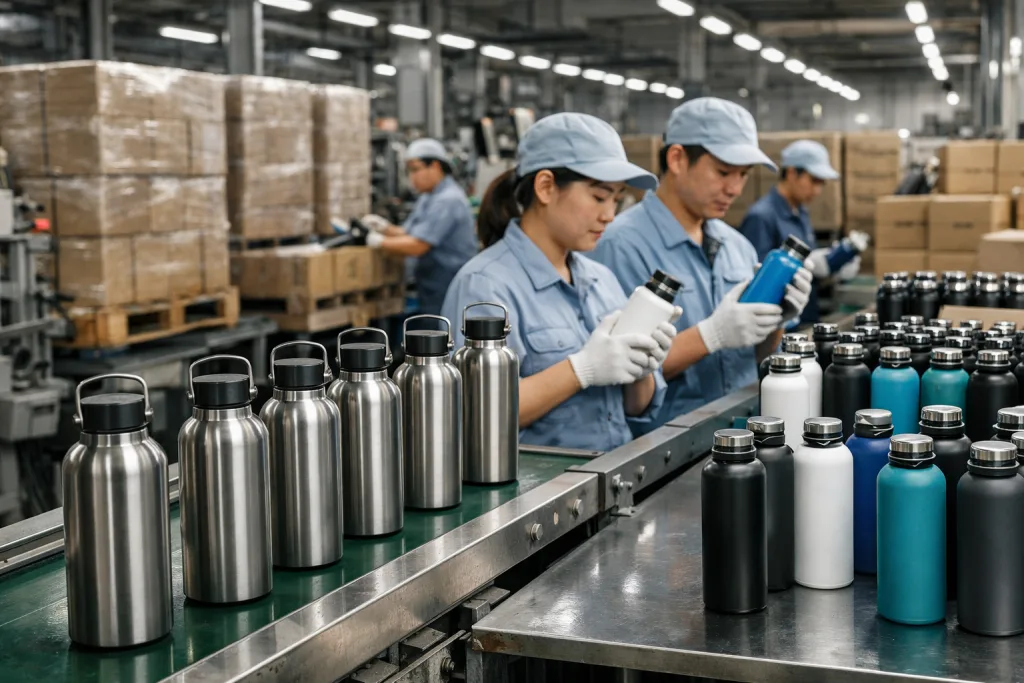
Key Takeaways
- For a 500 ml vacuum flask, 18/8 stainless with 0.4 mm inner and 0.5 mm outer wall is a practical baseline for durability and FOB control
- Most hydration flask customizable projects start at 1,000 to 3,000 units per color, while custom mold parts usually need 30 to 45 days and USD 1,500 to 6,000 tooling
- Decoration cost can move by USD 0.08 to 0.70 per unit depending on silk screen, laser, UV print, or powder coat base treatment
- Ask for REACH, LFGB or FDA contact-material files, AQL 2.5 inspection, and a 2-hour leak test before you approve mass production
You can approve a hydration flask customizable sample that looks clean on a desk, then give back margin when the production lot comes in 28 g overweight, picks up dents after a 76 cm drop test, or fails an EU migration check. We’ve seen buyers compare photos and unit price and skip the spec sheet; that is the wrong question to ask. If you buy custom drinkware for retail, gifting, or distribution, the shortcut gets expensive fast.
What matters is each line on the spec and what it does to cost, branding, compliance, and return rate. A 0.1 mm wall change, a lid thread that needs a new gauge check on the line, or the wrong logo process can shift FOB pricing by USD 0.18 to 0.90 per unit. In Zhejiang, China, where canteen manufacturers and canteen suppliers are packed into a few industrial belts, the best factory calls start with specs, not slogans, and QC pulled the sample for this exact issue last season.
Start with body construction
The first line to check on any hydration flask customizable spec sheet is not color. Check the body construction first: single wall or double wall, capacity, steel grade, wall thickness, mouth diameter, and net weight. If a canteen factory sends only a rendering and one loose note saying “stainless steel bottle,” you still have no clear buying basis. We’ve seen POs with the finish confirmed and the wall spec missing, and that is where projects drift.
For most B2B programs, 18/8 stainless steel means SUS304 on the body. That is the standard choice for custom canteen, customizable drinkware, and customized growler projects because the supply chain is stable and the line knows how it runs. A lower grade may save USD 0.12 to 0.25 per unit, but the math often does not work once corrosion claims start showing up, especially with acidic drinks or salty cleaning conditions. On premium outdoor or medical-adjacent use, some buyers ask for SUS316 inner walls. That usually adds 8% to 15% to body cost, and buyers do flag it when they compare against a SUS304 quote on the same drawing.
Thickness catches new buyers off guard. A common setup for a 500 ml vacuum flask is 0.4 mm inner wall and 0.5 mm outer wall. If you drop to 0.3/0.4 mm, you may cut weight by 20 to 35 g and save a few cents, but dent resistance drops fast; QC pulled the sample more than once after a 60 cm drop test and the shoulder showed a visible flat spot. If you go heavier, freight goes up and the hand feel changes. That is the wrong question to ask if you are only chasing the lowest unit price. Promotional canteen programs usually want lower shipped weight, while retail and distributor drinkware programs more often ask us to hold the body stiffer.
- 350-500 ml: common for office, gifting, and commuter programs
- 600-750 ml: stronger fit for sport and outdoor custom drinkware
- Mouth diameter 35-55 mm: changes cleaning access, ice loading, and cap compatibility; we check this with thread gauges before pilot run
- Weight tolerance: ask for ±5 g to ±8 g on mass production
At our scale in Zhejiang, China, a standard stainless bottle line can reach 300,000 units per month, but only if the structure stays close to proven tooling. Change the silhouette too far and lead time does not move a little; we’ve seen 12 days turn into 18 days once new neck tooling and balance testing are added. If you want a fully canteen customized silhouette, expect defect risk to climb as well. The buyer usually wants a fresh shape, but the line wants repeatable forming, and both sides need to see that trade-off early.
Insulation numbers that actually matter
Buyers love to ask for “12 hours hot and 24 hours cold,” but that line means nothing until the test method is written down. For a hydration flask customizable program, ask the factory for the exact setup: starting water temperature, fill rate, room temperature, and check points. We’ve seen two canteen manufacturers quote the same number and ship bottles that differ by 8°C at the 6-hour mark. On our line, QC logs this on a digital probe thermometer with the bottle filled by weight, not by guess.
A workable benchmark for a 500 ml double-wall vacuum bottle is hot water at 95°C filled to 90%, then checked at 6 and 12 hours at ambient 20°C to 25°C. Cold tests usually start with ice water around 4°C. If a supplier cannot send a one-page test table with time, temperature, and sample count, treat the claim as ad copy. This is the wrong question to ask: “How many hours does it keep hot?” Ask, “What was the drop after 6 hours under your test record?”
The vacuum process decides batch consistency. Better canteen suppliers control vacuum rate, copper plating on the inner outer-wall gap where applicable, and bottom sealing quality, often checking the weld area at the base cup before powder coating. A weak vacuum rarely shows on visual inspection. It shows up 2 months later as distributor complaints and debit notes. We’ve seen this go sideways after mass production passed a nice-looking pre-production sample. That’s why smart buyers ask for production testing, not sample-room promises.
Useful acceptance points
- Heat retention: at least 55°C to 65°C after 6 hours for mainstream retail spec
- Cold retention: under 10°C after 6 hours for standard daily-use flask programs
- Leak test: inverted 2 hours with no seepage
- Vacuum check: 100% spot control on line plus finished-sample verification
A cheap bottle that misses insulation claims by 15% can cost more in credits and reorders than a bottle that was USD 0.20 higher FOB from the start.
If you are buying for a canteen distributor network, write the thermal claim into the purchase specification. We ship against that sheet, and QC pulled the sample by PO line before when a buyer flagged a mismatch between “hot hold 12h” and the actual 6-hour acceptance point. That one typo on a PO can turn into a claims argument across 4 SKUs. Put the method, limit, and sample size in writing from day one.
Lids, seals, and failure points
The lid drives a big share of field failures. Buyers stare at the bottle body and treat the cap like an add-on. That is the wrong question to ask. On our line, more leak claims come from the lid set than the flask body, and the lid decides leak risk, hand feel, mold cost, and food-contact compliance for plastics and silicone.
Start with the material stack and map each part to its job. Common choices are PP, Tritan, ABS for visible plastic parts and food-grade silicone for seals. PP is the safe, cost-first option for standard flask lids, and we run it on a lot of 3-cavity cap molds because shrink control is easier. Tritan gives you better clarity and a more premium look for certain canteen customizable or customizable canteen concepts, but the math does not work for every mid-market program once the piece price moves up. ABS can work on outer trim areas, but buyers should confirm which parts touch the drinking path; QC pulled samples before where a PO note said “ABS lid” and the buyer actually meant ABS shell with a PP inner.
Thread design needs a hard look. A proprietary thread can lock in a differentiated custom canteen program, but it also locks you into one canteen vendor or one mold family. We have seen this go sideways when a buyer wanted a backup supplier after 8 months and found the neck finish was off by 0.3 mm. A more standard thread profile makes spare-part planning and second-source options in China easier, though you give up some exclusivity. For distributor growler and customizable growler programs, replacement lid continuity usually matters more than cosmetic uniqueness.
- Seal hardness: silicone around 50 to 70 Shore A is common; we usually check first-off samples with a Shore durometer before pilot run
- Torque spec: ask for cap open/close torque range so lids are not too tight or too loose; on one 63 mm lid, a buyer flagged 1.8 N·m as too stiff for retail testers
- Drop test: 3 to 5 drops from 80 cm to 120 cm depending on channel; the hinge pin and lock tab are the first places we watch
- Dishwasher position: body and cap may have different recommendations; some lids pass top-rack only while the body takes a harder wash cycle
If you need a straw lid, spout lid, tea filter lid, or infuser option, do not assume one lid fits every bottle neck in the catalog. Ask for compatibility by exact SKU code. We ship plenty of families that look interchangeable in a sales sheet, but real interchangeability is narrower once you check thread pitch and gasket seat depth. One buyer sent a PO with the lid suffix typed wrong by one letter, and the sample still threaded on but failed the inverted leak test after 20 minutes. For a canteen promotional order, a standard screw cap with carry loop is usually the lowest-risk option. For retail, ergonomic drinking lids can justify the extra tooling and QA work.
Decoration drives brand perception
Buyers asking for hydration flask customizable usually want four things: logo, color, surface finish, and packaging. That is where brand value shows up first. It is also where projects get stuck. We have seen artwork with 0.3 mm lines sent for a curved 500 ml flask, and the math does not work. Match the decoration method to the bottle shape, filling volume, and how the bottle will be used on the shelf or on the line.
For straight-wall bodies, silk screen printing is still the workhorse for simple one-color logos. We run this every week on 304 stainless models because setup is fast and the yield is stable. It is durable enough for routine use and usually adds about USD 0.08 to 0.20 per position, depending on volume and print size. Laser engraving gives a cleaner premium look on powder-coated bottles and often runs around USD 0.12 to 0.30. QC pulled the sample last month on a matte black flask, and the engraved logo looked sharper than the screen print from 600 mm away. UV digital printing handles gradients and multi-color artwork, but unit cost is higher and scratch performance is weaker. Full-wrap heat transfer can work well for canteen customized or customized drinkware retail launches, but curved shoulders cut usable artwork area, and buyers flag that point once the flat mockup becomes a real bottle.
Base finish matters before the logo goes on. Common options are spray paint, powder coating, rubber finish, metallic coating, and electroplating on limited models. Powder coating usually gives the best mix of grip and wear resistance. The line runs slower, and the cost is higher than plain spray paint, but return rates are lower on active-use products. We have seen abrasion tests where a powder-coated body held up after 500 rubs while a thin spray finish started showing through at the edge.
Questions worth settling before sampling
- What is the maximum logo width and height on this exact body?
- Will the Pantone match be on metal, powder coat, or plastic parts?
- Is there a seam line or curvature that interrupts the art?
- How many print positions are realistic at the quoted price?
If your sales channel includes canteen distributors or a distributor canteen private-label program, think about repeatability before you approve the first sample. A complex multi-process finish can look good on PO#1 and drift on the second or third run if different subcontractors handle coating and print in Zhejiang or elsewhere in China. We have seen this go sideways with metallic topcoats that shifted one shade between lots. Consistency beats novelty on repeat orders.
Compliance paperwork before deposit
If you sell in Europe or North America, sort compliance before deposit. Start with the parts that touch liquid: body steel, lid resin, straw, gasket, coating, logo ink. We ask for the BOM line by line, not a blanket “food grade” claim. A canteen manufacturer who says “we passed before” has missed the point. The report has to match the exact material set, decoration, and destination market. QC pulled one sample last month where the PO said 304 stainless, but the lid insert spec on the sheet was missing.
For Europe, buyers usually ask for REACH and, based on the item and customer requirement, LFGB contact-material testing. For the US and Canada, FDA food-contact compliance is standard, and children’s items can trigger extra checks such as CPSIA or relevant ASTM standards. If this is a kids line, do not borrow the adult bottle file and hope it clears. We have seen buyers flag a silicone straw hardness spec at 50 Shore A on kids SKUs when the adult version passed without questions.
Ask for factory system documents too, if your account needs them: BSCI or Sedex social audit, plus ISO 9001 if your vendor approval flow checks process control. These papers do not replace product testing. They do cut back-and-forth with retail and distributor accounts. One buyer in Germany held a 5,000-piece MOQ review for 4 days because the Sedex member ID on the file copy was outdated.
- Request bill of materials alignment: match body steel, lid resin, gasket silicone, paint, and logo ink to the report set
- Check report validity: many buyers want reports dated within 12 to 24 months, and some retail teams reject older files on sight
- Confirm laboratory source: use recognized third-party labs when retail compliance is strict; SGS or TÜV files move faster than house claims
- Match packaging claims: “BPA free” or dishwasher claims need support, or the buyer will flag the carton artwork before print
For a canteen supplier in Zhejiang, this is routine if the factory exports every month. Ask early. This is the wrong question to ask after artwork approval. A failed migration or coating test can push shipment by 14 days, sometimes 21, and the line just sits there waiting for cleared paper. We have seen this go sideways over a 1 mm paint band added near the rim.
MOQ, tooling, and landed cost
Buyers skip this part, then the quote blows up later. For a hydration flask customizable project, price is driven by MOQ, stock parts, new tooling, packaging, and freight terms far more than the word “customizable.” On our side, the line starts with a simple check: which parts come from existing molds, and which ones need new steel cut. If you want a quote you can use, convert each design change into unit cost, tooling cost, and days added.
For standard stainless bottles from China, the MOQ is 1,000 to 3,000 units per SKU or color. That is normal. If you stay with an existing mold, add a logo, and use a standard powder coat, most factories will quote near the low end, and we run these jobs with less setup waste. Ask for a custom lid, a new base, or an exclusive shoulder profile, and MOQ often jumps to 5,000 units or more, with tooling charges from USD 1,500 to 6,000 depending on complexity. Buyers push back on this point all the time, but the math does not work if the mold cost is spread over a small run.
Lead time breaks into separate blocks, and you need each one listed on the PI. Sample modification on stock bodies may take 7 to 12 days. New tooling can take 20 to 30 days. Mass production often runs 30 to 45 days after sample approval and deposit, assuming artwork and packaging are locked. In peak season, add 7 to 10 more days, especially if the PO has custom gift boxes or a lid with 3 silicone parts. We have seen this go sideways when a buyer approved the bottle but changed the carton mark after that, and the line had to stop.
Landed cost is not just FOB Ningbo or FOB Shanghai. Ask for carton count, carton gross weight, master carton size, and pallet efficiency, down to the carton measurement in mm if you are loading mixed SKUs. A bottle that is USD 0.10 cheaper ex-factory can cost more at final delivery if the packout wastes container space or pushes carton weight past your warehouse limit. QC pulled a sample on one order where the inner tray added volume but no protection, and the freight cost per piece went up. This matters for canteen distributors, canteen distributor tenders, and any distributor growler or customized growler project moving by sea freight.
- Sample fee: often refundable after order; on our side this is usually cleared after bulk PO confirmation
- Tooling deposit: usually paid before mold cutting; mold shop will not start on a verbal approval
- Payment terms: common structure is 30% deposit, 70% before shipment
- Incoterms: clarify FOB, EXW, or DDP assumptions in writing; one wrong term on the PO changes the whole cost sheet
If you are comparing canteen manufacturers, ask each one to quote the same spec, same packaging, same inspection level, and same shipping term. This is the right question to ask. We ship against AQL tables and confirmed pack specs, not guesswork. If one supplier looks cheaper, check whether they quietly changed carton count, steel grade note, or inspection basis, because the cheapest quote is often just the least complete one.
Quality control on the purchase order
A clean sample approval is not quality control. It is one checkpoint. Production quality comes from written tolerances, in-line checks, and acceptance criteria printed on the PO and the QC plan. If those points are missing, the line runs on memory, WeChat screenshots, and whatever the last merchandiser wrote in a chat at 11:40 p.m. We have seen this go sideways over a 2 mm logo shift that nobody put on the paperwork.
Start with a simple inspection standard and write it into the order. A lot of buyers run AQL 2.5 for major defects and AQL 4.0 for minor defects, but channel matters; Amazon, promo, and retail do not inspect the same way, so this is the wrong question to ask if there is no sales channel behind it. Define critical, major, and minor in plain words. Leaking after a 1-hour upside-down test, a sharp edge on the rim, or a wrong material claim is critical or major. A slight logo offset can sit in minor if it stays inside the approved range and QC pulled the sample against that standard.
The pre-shipment checklist should cover visual inspection, quantity count, barcode check if needed, drop test, leak test, vacuum retention spot test, and carton verification. Put the method on paper. For example, we usually run a random vacuum retention spot check with hot water and log the start time on the inspection sheet, and the buyer flagged one lot last year because the FNSKU print file on the PO had a transposed digit. If you supply Amazon or a large retail account, add packaging points like suffocation warning, country-of-origin mark, and any FNSKU or carton label format. These details stop shipments just as fast as a bad bottle.
- Color tolerance: define the acceptable variance from the approved Pantone or sealed sample; if the powder coat sample is signed, say that in the PO
- Logo position tolerance: for example ±1.5 mm to ±2.0 mm, measured from a fixed reference point instead of “centered”
- Capacity tolerance: specify the acceptable fill variation, such as full capacity versus rated capacity, so the math does not break at inspection
- Barcode scan rate: require readable labels on the unit and master carton where applicable, and state the scan check quantity
Good canteen manufacturers in Zhejiang, China, work with this level of detail every week. You do not need to be difficult. You need to be precise. A tight spec sheet cuts arguments, makes repeat POs faster, and gives you a clean way to grow from 1 custom canteen SKU to a wider customized drinkware program. MOQ, print position, carton mark, lid torque check—put it on the paper first, then we ship against it.
Send your flask spec and get a real factory quote
Share capacity, target price, logo method, quantity, and market. We will review the spec line by line and suggest the lowest-risk production route in Zhejiang, China.
Frequently asked questions
What MOQ should I expect for a hydration flask customizable order?
For a standard stainless model using existing molds, expect 1,000 to 3,000 units per SKU or color from many canteen suppliers in China. If you need a custom lid, unique body shape, or exclusive color parts, MOQ often rises to 3,000 to 5,000 units. Custom packaging can also lift the MOQ if the insert, gift box, or sleeve is printed separately. Sample changes on stock models usually take 7 to 12 days, while custom mold development can add 20 to 30 days before production. If your volume is under 1,000 units, ask whether the canteen factory has stock colors or leftover components you can use, but expect fewer customization options and a higher unit price.
Which material spec is safest for retail and promotional use?
For most retail, corporate gifting, and canteen promotional projects, 18/8 stainless steel body construction with PP or Tritan lid parts and food-grade silicone seals is the safest mainstream specification. On a 500 ml bottle, a 0.4 mm inner wall and 0.5 mm outer wall is a practical balance between durability, weight, and cost. If the bottle is for acidic drinks, heavy outdoor use, or a higher-end market, some buyers upgrade the inner wall to SUS316, but cost typically rises by 8% to 15%. Avoid vague quotes that only say “stainless steel” or “BPA free.” Ask the canteen manufacturer to list steel grade, plastic resin, gasket material, and which components have direct beverage contact.
How do I compare decoration options for custom canteen orders?
Start with the body finish, then choose the logo method. Silk screen is usually the lowest-cost option at roughly USD 0.08 to 0.20 per print position in volume and works well for simple 1-color logos. Laser engraving often costs USD 0.12 to 0.30 and looks better on powder-coated or painted surfaces for longer-term branding. UV print supports multicolor artwork but increases unit cost and can be less scratch resistant depending on use. For customized growler or customizable drinkware retail programs, always confirm artwork size, curve limits, Pantone matching, and abrasion expectations before sample approval. A good canteen vendor should show decoration limits by exact bottle model, not by generic catalog promise.
What compliance documents should I request before mass production?
For Europe, ask for REACH and often LFGB or equivalent food-contact documentation if your customer requires it. For the US market, FDA food-contact compliance is common. If the product is aimed at children, additional CPSIA or ASTM-related checks may apply depending on the design and sales channel. Beyond product reports, larger retail programs may ask the canteen supplier for BSCI, Sedex, or ISO 9001 records. The important point is matching the paperwork to the actual bill of materials: body steel, lid resin, silicone gasket, paint, and logo ink. Reports that passed on a different bottle or older coating system are not enough. Ask for current reports, ideally from the last 12 to 24 months.
How do canteen distributors reduce quality problems on repeat orders?
The best control comes from a written purchase specification tied to inspection rules. Use approved references for color, logo position, packaging, and performance. Many buyers set AQL 2.5 for major defects and AQL 4.0 for minor defects, then define exact failure points such as leakage, wrong logo, poor vacuum, dents, or unreadable barcodes. Require a 2-hour inverted leak test, spot vacuum testing, and carton verification before shipment. If you sell through distributor canteen or distributor growler channels, repeatability matters more than small cosmetic experiments. Keep the same body mold, lid family, and decoration process when possible. That approach usually lowers claim rates and makes reorders from China faster and cleaner.