Key Takeaways
- Choose material first: 18/8 stainless steel raises unit cost by about USD 0.90 to 2.20 versus single-wall plastic, but cuts return risk in premium channels
- Most hydration flask custom orders land at 1,000 to 3,000 pcs per SKU, while fully new molds usually need 5,000 to 10,000 pcs to make tooling pay back
- Silkscreen is usually USD 0.08 to 0.18 cheaper per unit than laser engraving, but laser holds up better on high-use corporate and outdoor programs
- For EU and North America, ask for REACH, LFGB or FDA as relevant, plus AQL 2.5 inspection and leak testing at 100% before shipment
You are not buying a bottle. You are locking in a cost structure, a defect risk, and a ship date your sales team will answer for over the next 6 to 12 months. We have seen this go sideways on the line over small early calls: a 0.3 mm logo stroke that fills in after powder coating, or a PO typo on lid color that turns 8,000 pcs into a claim argument.
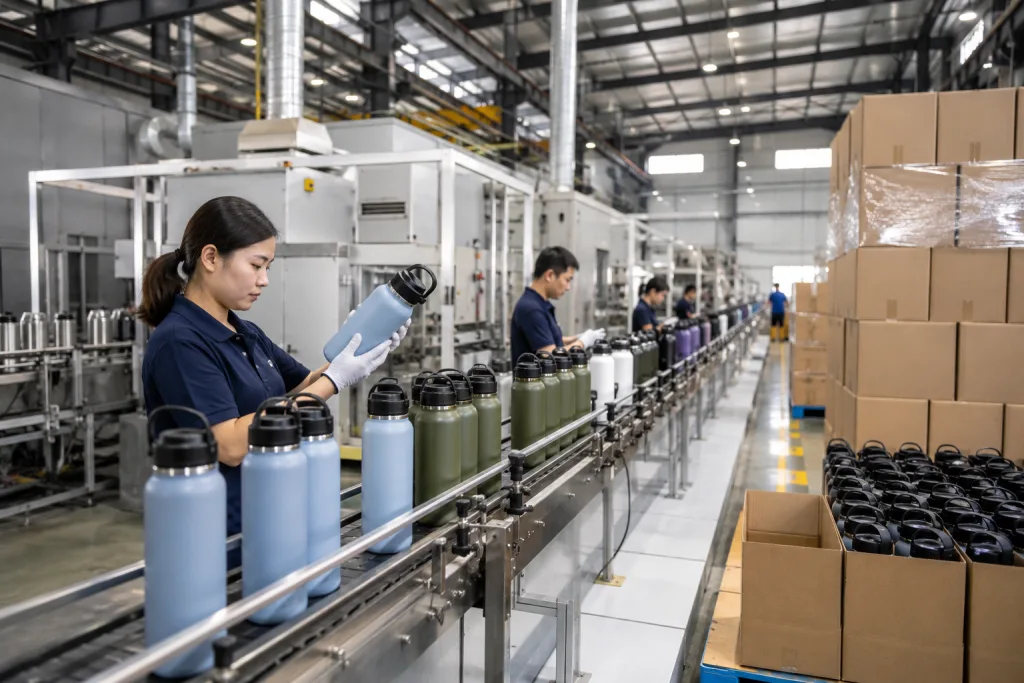
If you source from China for Europe or North America, start with the decisions that change margin and complaint rate: body material for the sales channel, decoration that still looks clean after 2,000 rubs, MOQ that works on the math, and the compliance papers your importer will ask for. This is the right question set. A capable canteen factory in Zhejiang moves fast only when the spec is tight and the buyer signs off key details early. At BottleForge Industrial in Hangzhou, Zhejiang, we run about 400,000 units per month with standard lead times of 25 to 35 days, and QC pulls pre-production samples before mass run, so the usual bottleneck is buyer decision quality, not factory speed.
Start with four buying decisions
The cleanest way to buy hydration flask custom is to lock four decisions in sequence: body construction, capacity range, branding method, and compliance package. We have seen this go sideways when a buyer approves Pantone first, then changes from single-wall to vacuum, and the whole carton plan shifts by 8-12 mm.
Decision one: body construction. Single-wall stainless, double-wall vacuum stainless, Tritan, and food-grade PP solve different cost and use cases. For outdoor retail, double-wall 18/8 stainless is usually the safe call because heat retention and shelf feel both matter. For a canteen promotional program chasing a sharp landing cost, single-wall or plastic often makes more sense. On our line, vacuum bodies add more process control, and QC pulled the sample fast last month when one weld ring showed pinholes under the leak test.
Decision two: capacity and form factor. The commercial sweet spots are 500 ml, 750 ml, and 1,000 ml. Past 1,200 ml, carton efficiency drops, freight per unit rises, and leakage claims get expensive because lids and handles take more stress in transit. This is the wrong question to ask if you only ask for "the biggest size." Ask for packed dimensions and units per carton. We ship plenty of 750 ml because the math works better than 1,500 ml on both freight and shelf space.
Decision three: decoration. If your buyer is a school, gym chain, or employer gift program, the logo has to survive dishwashing, abrasion, and hand oils. That drives the print choice: silkscreen, powder-coat plus screen print, laser, heat transfer, or UV print. The buyer flagged this more than once on dark bottles where metallic ink looked good on the approval photo but failed rub testing after 200 cycles. We usually ask for logo size in mm before quoting, because a 35 mm mark and a 90 mm wrap do not run on the same setup.
Decision four: paperwork. Europe and North America ask different questions, and the paperwork gap is where delays start. If you sell into Germany, France, or the Nordics, your canteen supplier should be ready for REACH and often LFGB-related testing. For the US and Canada, FDA-contact compliance, CPSIA issues for kids' items, and ASTM where relevant matter more. We have had POs held for a one-line typo in the consignee name while the lab report itself was fine, so document control is not admin fluff. It affects ship date.
You do not need the cheapest canteen manufacturer. You need the supplier whose weak point matches a risk you can tolerate.
That mindset also helps when you compare a custom canteen, a customized canteen, or a custom growler program. The vessel shape changes, but the buying logic does not: construction first, then capacity, decoration, compliance, and freight. We run this order for a reason. If you skip it, the sample stage usually gets slower, not faster.
Match material to channel economics
Material choice is where buyers keep margin or give it away. A good canteen manufacturer in China should show the cost with numbers: unit price, carton weight, and defect risk. On our line, QC pulled a 750 ml sample last month because the powder coat film came in at 58 μm instead of the 65–80 μm spec. That matters more than polished sales talk.
Stainless steel
18/8 stainless steel is still the default for premium custom drinkware. For a 750 ml vacuum flask with powder coating, you might see FOB China pricing around USD 3.80 to 5.90 at 3,000 pcs, depending on lid complexity and decoration. Wall thickness is commonly 0.4 mm inner and 0.5 mm outer. Buyers ask for thicker bodies all the time, and this is the wrong question to ask. More steel helps dent resistance, but it also pushes weight up, freight up, and sometimes turns a 40HQ loading plan messy by 1,200 to 1,500 pcs.
Tritan and food-grade plastics
If you need lower cost and lower weight, Tritan or high-grade PP can be the better fit, especially if the brief calls for bright translucent colors. A 700 ml sports flask may land around USD 1.20 to 2.20 FOB at 3,000 pcs. We ship these into value retail, event programs, and selected private-label e-commerce accounts. The pushback is predictable: the buyer flagged the product as looking "cheap" even after FDA and LFGB pass results were on file. That perception issue is real, and we've seen this go sideways at retail if shelf price gets too close to stainless.
Aluminum and specialty bodies
Aluminum still works for entry price programs and some distributor canteen projects, but the inner lining decides whether the program runs clean or turns into claims. If the internal coating is uneven, complaint rate climbs fast; one common inspection finding is a thin spot around the shoulder after the bake cycle. For a customizable growler or customized growler, stainless is usually the safer call because carbonation pressure and thermal expectations are higher. The math doesn't work if you save USD 0.40 on body cost and then absorb returns.
- Retail premium channel: double-wall stainless, 18/8, powder coat, 3,000 pcs+; buyers usually ask for a 1.5 m drop check and tighter color control on the coating batch
- Corporate gift channel: single or double-wall stainless, laser or durable print, 1,000 pcs+; logo position tolerance often gets held to within 2 mm on the sample approval
- Event and promo channel: Tritan or PP, basic screen print, 1,000 to 2,000 pcs; MOQ stays friendlier, and tooling decisions move faster
Zhejiang and broader China offer all three categories, but not every canteen factory is strong in each one. Some factories run welded stainless well but struggle on injection molding; others are the reverse. Ask what share of monthly output comes from the material you want. We ask the same question when we qualify a partner line. If stainless is only 15% of their line, they are not your best canteen vendor for a serious flask program. One more practical check: ask to see a recent PO copy with customer data hidden. If they even typed the lid spec wrong once, you know where problems start.
Use MOQ to control risk
MOQ is not just a factory rule. It is a risk filter on cash, stock, and reorders. New buyers often push MOQ down first. We’ve seen this go sideways. The unit price looks better on the quote, then the extra cost shows up in setup loss, slower packing, or leftover cartons with the wrong PO print.
For standard shapes on existing tooling, a professional canteen supplier or canteen vendors network will usually quote 1,000 pcs per model, and we normally split that into 2 to 4 colors if the logo process is simple. For vacuum stainless with custom powder coat and custom packaging, 2,000 to 3,000 pcs per SKU is a normal level on the line. For a fully new cap, body, or handle mold, expect 5,000 to 10,000 pcs plus tooling fees from roughly USD 2,000 to 8,000 depending on complexity. Last month, a buyer flagged a 0.3 mm lid gap on a new handle concept; fixing that in mold sampling cost more than the first MOQ argument.
Here is what buyers miss: cutting MOQ by 50% often pushes unit cost up by 8% to 20% because scrap, setup hours, packaging minimums, and decoration charges are spread over fewer units. The math doesn’t work otherwise. A short run from a canteen customizable program sounds flexible, but flexibility has a line cost. QC pulled the sample on one 600-pc run and the print setup alone already made the target price dead on arrival.
If you are a canteen distributor or one of several canteen distributors serving mixed customer accounts, use this framework:
- If demand is unproven, stay on existing molds and standard lid systems.
- If branding is the differentiator, spend on decoration, not new tooling.
- If the account is annual and forecastable, custom tooling can make sense by the second or third repeat order.
- If Amazon FBA or DTC is the channel, keep carton dimensions and insert complexity under control from the first quote.
At factory level in Zhejiang, we often see buyers save more money by simplifying packaging than by squeezing USD 0.10 off the bottle. This is the wrong question to ask. White box versus color box can change total program cost by USD 0.18 to 0.45 per unit. Custom EVA inserts can add another USD 0.30 to 0.80. On one 40HQ loading plan, switching insert structure cut carton weight by 1.2 kg per master carton and cleaned up the packout. Experienced China buyers check the full BOM, not just bottle price.
Branding methods change claim rates
Decoration is where brand intent meets abuse on the line and in the field. If you are ordering customizable drinkware or customized drinkware for daily carry, the wrong print method drives claims fast. We have seen buyers focus on logo color first and miss the harder issue: how that logo holds up after 3 months in a backpack cup pocket.
Silkscreen is the low-cost option for 1-color or 2-color logos. Typical add-on cost is around USD 0.05 to 0.15 per position. On smooth stainless or plastic, it prints clean. On rough powder-coated surfaces, this is where projects go sideways. Ink adhesion depends on the ink system, oven temperature, and cure time; on our line, QC pulled a sample last month where a 3M tape cross-hatch test failed after under-curing by 8°C.
Laser engraving usually adds around USD 0.12 to 0.30 per unit. The unit cost is higher, and the claim rate is usually lower. For office gifts, outdoor use, and corporate programs, the logo still needs to look acceptable after 12 months, not just at inbound receipt. This is the right question to ask. On 304 stainless, a 20W fiber laser gives a stable mark depth, and we see fewer rub complaints than with surface print.
Heat transfer and UV print handle retail artwork with gradients and small text. They also need tighter control. Surface cleaning, flame treatment on some plastics, and drying time all matter. We ship bottles 1,200 pcs per master carton batch for some programs, and decoration damage shows up during ocean transit if bags or dividers are cut to save USD 0.03. The buyer flagged this twice on a PO where inner bag spec was missing.
Ask your canteen vendor or distributor drinkware partner direct questions:
- What is the cross-hatch adhesion test standard?
- Do you do dishwasher simulation or only visual checks?
- Will you provide a pre-production sample in the exact Pantone and exact coating texture?
- What percentage of units are leak-tested and visually inspected?
A practical standard is 100% leak test, 100% basic visual sort, and final inspection to AQL 2.5 for major defects. For logo placement, define tolerance clearly, usually plus or minus 1.5 mm to 2.0 mm depending on the process. We check this with a digital caliper, not by eye. If your program includes a custom growler, make cap torque and pressure performance part of the approval because decoration quality means little if carbonation leaks in transit. The math does not work if the logo is perfect and 2% of caps vent on the water-bath test.
Compliance is not optional paperwork
Buyers often ask for “all certificates.” That is the wrong question to ask. Compliance papers are tied to the actual SKU: bottle type, sales market, and age group. The better canteen suppliers and canteen manufacturers start with three checks—where you sell, who uses it, and whether the flask has direct-contact parts like a straw or spout. On our side, the line cannot release a PP lid or silicone gasket without matching it to the BOM revision on the PO.
For Europe, REACH is the baseline buyers mention most. LFGB-style food-contact expectations come up fast for German-speaking markets, and buyers flagged this on 6 of our last 10 DACH inquiries. For the US, FDA food-contact compliance is the starting point. For kids' products, add the right CPSIA review. If a flask has a straw, silicone mouthpiece, or easy-carry handle, test the assembled SKU, not just the raw material declarations. We have seen this go sideways when a 2.0 mm silicone mouthpiece passed by material, then failed odor review after assembly.
Factory audit status matters too. BSCI, Sedex-related social compliance, and ISO 9001 are not product certificates, but retail buyers still ask for them before onboarding a new canteen manufacturer or canteen manufacturers shortlist from China. QC pulled the sample, yet the buyer still held the vendor setup because the audit expiry date on one report was 11 days overdue.
Ask for this minimum document stack before deposit:
- Material specification sheet for bottle body, lid, gasket, straw if any
- Recent relevant test reports for food-contact compliance
- Factory audit summary if your channel requires social compliance
- Inspection plan with AQL level and leak-test method
- Packing specification with drop-test or carton strength data
Fresh testing usually takes 7 to 14 working days. If 3 to 5 components need lab review, it can hit 21 days. So your canteen customized or canteen customizable launch plan should not treat artwork approval as shipment readiness. We run into this every season: artwork approved on Monday, then the buyer adds a new straw color on Thursday and the compliance clock resets. In Zhejiang, the factories that keep this under control usually have tighter engineering files, clear ECN records, and fewer last-minute material swaps.
Quote landed cost, not FOB only
The last screen is total cost ownership. Buyers line up FOB quotes from 4 or 5 canteen suppliers or canteen vendors and think the job is done. It isn’t. On our line, a USD 0.25 gap in bottle price gets erased fast by freight, carton density, dent claims, and retailer chargebacks. This is the wrong question to ask if you only look at FOB.
Take a 750 ml vacuum flask at USD 4.20 FOB from one canteen factory versus USD 3.95 from another. The cheaper quote loses if it packs 20 pcs per carton while the other packs 24, if QC pulled the sample and found 3 logo misses in a 200 pcs check, or if the carton drop test at 76 cm throws up dents on the shoulder. Ocean freight and local handling can easily add USD 0.35 to 0.90 per unit depending on season and destination. We’ve seen one missed vessel turn into an air shipment, and the math doesn’t work once margin has to carry it.
When you compare suppliers, build a landed-cost sheet with these columns:
- FOB unit price by SKU and color
- Packaging cost by unit and by master carton
- Carton dimensions, gross weight, and units per carton
- Expected defect allowance and inspection cost
- Tooling amortization across forecast volume
- Duties, freight, and destination handling
If you are a distributor growler, a distributor canteen, or managing wider custom drinkware lines, this is where repeat orders get decided. The buyer flagged one PO last month because the FNSKU label sat 12 mm too close to the bottom seam, and that small miss slowed inbound. A factory that answers clearly on cap interchangeability, spare gasket supply, barcode placement, FNSKU labeling, and pallet loading is usually easier to scale with. We ship smoother with suppliers who give straight answers early.
At BottleForge Industrial in Zhejiang, standard sample lead time is 5 to 7 days for existing models, mass production is usually 25 to 35 days after deposit and artwork approval, and typical MOQ starts at 1,000 pcs for stocked-body customization. We run those dates against artwork sign-off, carton mark approval, and final AQL booking, because one typo on a PO can cost 7 days. Those numbers matter because buyer confidence comes from operational predictability. If your supplier cannot define these basics in writing, keep looking.
Get a workable hydration flask custom quote fast
Send your target price, market, quantity, and logo method. We will flag the real trade-offs before you spend money on the wrong spec.
Frequently asked questions
What is a realistic MOQ for a hydration flask custom order?
For an existing bottle mold, 1,000 pcs per model is a realistic starting point in China, especially for single-color branding and standard packaging. For vacuum stainless with custom powder coat, special lids, or retail gift boxes, 2,000 to 3,000 pcs per SKU is more typical. If you want a fully custom body or cap mold, expect 5,000 to 10,000 pcs plus tooling of roughly USD 2,000 to 8,000. If a supplier offers 300 pcs on a highly customized program, check where the hidden cost sits: high unit pricing, weak decoration control, or mixed production with inconsistent color matching.
How do I choose between stainless steel and plastic for custom canteen projects?
Choose based on channel, not personal taste. For premium retail, outdoor, and higher-value corporate gifting, 18/8 stainless usually wins because it supports better perceived value and lower return risk. A 750 ml double-wall unit may run USD 3.80 to 5.90 FOB at 3,000 pcs. Tritan or PP works better for event campaigns, school programs, and budget-sensitive promotions, often around USD 1.20 to 2.20 FOB for a 700 ml model. Plastic reduces freight weight, but stainless usually improves shelf appeal and repeat-order potential. If your target retail price is above USD 19.99, stainless is often the safer commercial choice.
Which logo method lasts best on customized drinkware?
For durability, laser engraving is usually the safest choice on stainless bottles. It typically adds USD 0.12 to 0.30 per unit and handles abrasion better than standard silkscreen. Silkscreen is cheaper, often USD 0.05 to 0.15 per position, and looks clean for promo jobs, but it is more sensitive to poor curing and rough powder-coat textures. Heat transfer and UV print are useful for multi-color retail graphics, but you should ask for adhesion testing and transit protection. For daily-use bottles, ask your canteen supplier for a pre-production sample, cross-hatch adhesion results, and 100% leak-test confirmation before approving mass production.
What compliance documents should I ask a canteen manufacturer for?
Ask for documents tied to your market, not a generic certificate pack. For Europe, buyers usually start with REACH-related compliance and may require LFGB-oriented food-contact testing depending on the channel. For the US, FDA food-contact compliance is standard, with CPSIA attention if the item is for children. Also request the material spec for the body, lid, gasket, and straw if any. If your retailer requires factory social compliance, ask for BSCI, Sedex-related audit records, or ISO 9001 status. Fresh testing can take 7 to 14 working days, so build that into the timeline before you promise a ship date.
How long does a custom drinkware order usually take from sample to shipment?
For an existing model from a capable Zhejiang factory, pre-production samples usually take 5 to 7 days if artwork and Pantone references are clear. If you need fresh lab testing, add 7 to 14 working days. Mass production is commonly 25 to 35 days after sample approval, deposit, and packaging confirmation. Complex gift-box assembly or peak-season congestion can push that to 40 days. New tooling adds more time: often 15 to 25 days for tooling and validation before mass production starts. If you need Amazon FBA prep, barcode labeling and carton mark confirmation should be finalized before production, not after.