Key Takeaways
- A reliable hydration bottle vendor should quote MOQ, lead time, and defect standard clearly; typical MOQ is 1,000-3,000 pcs per SKU and lead time is 25-45 days
- For 18/8 stainless bottles, expect FOB China pricing around USD 2.80-6.50 depending on size, coating, lid complexity, and print method
- Set quality terms before deposit: common inspection level is AQL 2.5 major / 4.0 minor with leak, drop, and coating adhesion checks
- If you need retail-ready custom drinkware, allow 7-12 days for pre-production samples and 3-5 extra days for barcode, gift box, or FNSKU packing
You are not buying a bottle. You are buying repeatability: the same Pantone match on the second run, the same 0.8–1.2 N·m lid torque after the line packs 24 bottles per carton, and the same ship window your sales team already put on a PO. That is why choosing hydration bottle vendors gets harder the moment the sample looks clean. Product photos do not show if the factory can hold color, torque, and carton consistency at scale.
For buyers in Europe and North America, the real questions start after the sample is approved. Can a canteen manufacturer in Zhejiang hold decoration quality at 20,000 units, or does QC pull the sample at 3,000 pieces and find logo drift by 0.6 mm? Will a canteen supplier in China understand REACH, ASTM, or FNSKU labeling without three rounds of correction—or without shipping against a PO that says “FNSKU” and the artwork file says “FNsku”? If you are sourcing custom drinkware, custom canteen programs, or even a customized growler line, ask for numbers. This is the right question. A vendor should answer with AQL levels, lead times like 12 days vs 18 days, and defect records, not sales talk.
What are you really buying?
First-time buyers usually ask for a catalog and FOB price. Experienced buyers ask what the supplier actually controls from raw material to shipment. That question gets you to the right hydration bottle vendor faster, because QC pulled the sample is easy; keeping 5,000 pcs consistent on the line is the hard part.
If your program includes a custom canteen, customizable drinkware, or a custom growler, you are not just buying a bottle. You are buying six control points: material consistency, tooling accuracy, decoration stability, packaging execution, compliance documents, and shipping discipline. We have seen a pre-production sample pass, then bulk fail on 2 of those 6 points because the neck thread ran off by 0.3 mm and the outer carton burst on the warehouse drop test. This is the wrong question to ask: “Can you make this shape?” The better question is whether the factory can repeat it across 3,000 to 30,000 pcs.
- Material: 18/8 stainless steel, Tritan, glass, PP, silicone, and powder coating chemistry must match your market and claim language. A buyer once flagged “food grade” on a PO, but the market needed LFGB backing, not a generic claim.
- Construction: Single-wall, double-wall vacuum, copper lining, base thickness, neck threading, and lid seal design affect leak rate and durability. We check thread fit with a go/no-go gauge, because a lid that feels fine on 20 samples can start cross-threading in bulk.
- Branding: Silkscreen, heat transfer, laser engraving, UV print, embossing, and wrap labels each have different cost and failure risks. On one run, QC pulled the sample after the logo shifted 1.5 mm on curved bodies, and the buyer caught it before carton sealing.
- Packaging: Master carton strength, drop resistance, barcode placement, insert cards, and pallet pattern all affect warehouse claims. We have had Amazon-style outer cartons fail because the customer cut board grade too far and the math did not work.
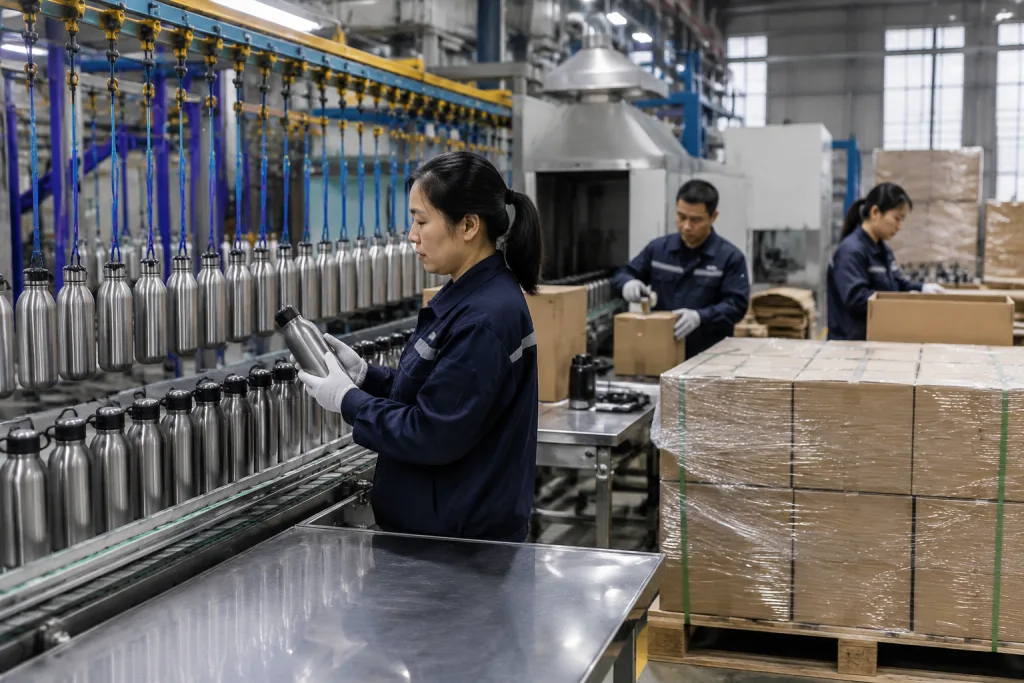
In Zhejiang, China, a capable canteen manufacturer usually handles some processes in-house and some through stable partner workshops. That is normal in this trade. What matters is whether the canteen vendor owns the quality checkpoints and signs off before goods move to the next step. At BottleForge Industrial in Hangzhou, Zhejiang, we run incoming steel checks, vacuum performance tests, coating adhesion by cross-hatch, and final carton audit as mandatory gates because this is where margin disappears later.
Before you compare canteen suppliers, define the program you are buying: promo giveaway, retail shelf item, distributor drinkware line, gym chain private label, or e-commerce pack. Those are not the same job. A 500-piece event order and a 20,000-piece retail launch need different carton specs, decoration tolerance, and replenishment timing. The right hydration bottle vendor for one channel may be the wrong one for another, and we have seen this go sideways when the buyer asked for retail finish on a giveaway budget.
How do you screen vendors fast?
You do not need 20 suppliers. You need 3 serious candidates and a tight screening sheet. We’ve seen weak canteen distributors and canteen vendors drop out fast once you ask shop-floor questions in the first email—monthly output, mold status, and whether QC pulled the sample or sales just forwarded old photos.
Use this first-pass checklist
- Can they state a realistic monthly capacity? A credible China factory should answer with a number such as 300,000 to 500,000 units/month, not “depends on order.” On our line, that answer usually comes with a filling schedule or welding count, not a vague promise.
- Do they give a clear MOQ by bottle and by logo? For example, 1,000 pcs for an existing 500ml bottle, 3,000 pcs for a custom color, 5,000 pcs for a new lid mold. If they skip the logo MOQ, the buyer usually gets hit later with a 2,000-print minimum no one mentioned.
- Can they explain sample timing? Typical is 3-5 days for stock samples, 7-12 days for logo samples, 15-25 days for new mold evaluation. Ask what happens on the bench: laser marking, spray color match, or a 3D-printed lid check before steel cutting.
- Do they know your market standards such as REACH, LFGB, FDA, California Proposition 65, ASTM, or retailer packaging rules? Ask for the latest test report date and which SKU used 304 stainless, because “we passed before” is not enough.
- Will they accept AQL inspection and define leak testing, vacuum retention, and color tolerance in writing? QC should be able to say 100% leak check, retention hours, and a Pantone tolerance target instead of “no problem.”
A canteen supplier that answers slowly before deposit usually answers slower after deposit.
Ask for one quote sheet with five fields filled in: MOQ, FOB Ningbo or Shanghai price, sample charge, mass production lead time, and carton details. Simple rule. If the reply comes back incomplete twice, move on. We ship quotations every day, and this is the wrong place for excuses. One buyer even sent a PO with the lid code typed wrong by one digit; the supplier that caught it won the order.
Watch whether the vendor speaks your channel language. This matters. A canteen distributor program often needs mixed-color flexibility and low inventory risk, sometimes 4 colors in one 1,000-pc run. A canteen promotional order usually cares more about budget and print area than 12-hour insulation. A customizable growler for specialty retail may require low-odor powder coating, matte Pantone matching, and carry-handle durability; we’ve had buyers flag ΔE drift after the first spray trial. Good hydration bottle vendors ask these questions early because product fit and line discipline beat a cheap quote that goes sideways.
What price ranges are normal?
Price confusion is normal. Buyers see two bottles online that look almost the same, then wonder why one quote is 18% higher. On the factory side, 0.1mm wall difference, 304 stainless vs a lower spec option, lid assembly parts, coating line yield, and pack-out all change FOB cost. In our shop, QC pulled two 500ml samples last month that looked identical on screen but had a 42g weight gap. That is where the money went.
For practical budgeting from China, these ranges are common for standard volumes with existing molds:
- 500ml single-wall stainless sports bottle: USD 1.60-2.40 FOB China
- 500ml double-wall vacuum bottle: USD 2.80-4.20 FOB China
- 750ml powder-coated vacuum bottle with carry lid: USD 3.80-5.20 FOB China
- 32oz insulated bottle with wide mouth: USD 4.60-6.50 FOB China
- 64oz custom growler or customizable growler: USD 6.80-10.50 FOB China
Decoration moves fast on cost. A one-color silkscreen logo may add USD 0.08-0.18 per unit, and laser engraving is often USD 0.12-0.30. A custom gift box may add USD 0.35-0.90. We run into this pushback a lot: the buyer flags the bottle print, but the mailer and insert card are what push the total up. On one PO, the Pantone code was typed wrong by one digit, and we had to stop the coating line before mass production.
Tooling catches buyers off guard more than it should. Some canteen manufacturers waive simple color development charges on orders above MOQ, but new lid molds, base changes, or unique handle structures can cost USD 1,500-8,000 depending on complexity. This is the wrong question to ask: “Why is tooling not free?” The better question is whether the new part will help you sell 5,000 more units or just make sourcing harder. We have seen a handle concept go sideways because the first drop test cracked at the hinge pin.
When comparing canteen factory quotes, ask whether the price includes:
- polybag or tissue wrap
- egg-crate or divider packing
- leak-proof lid assembly
- spare gasket policy
- export carton marks
- FOB port and loading terms
If one canteen manufacturer is 12% cheaper, check the steel weight in grams, gasket hardness, and carton spec before you get excited. We ship plenty of repeat orders where the buyer came back after a cheap trial run failed a 1.2m drop test or had seepage after 48 hours. The math does not work if you save USD 0.22 and lose the account on claims.
Which quality controls matter most?
For custom drinkware, the costliest defects are rarely cosmetic. We see claims come from leaks, vacuum loss, odor complaints, coating scratches, and logo shade drift between batches. That is where buyer screening needs to get technical. On our line, QC pulled three bottles from a 2,000-piece run last month because the lid thread started biting at 1.8 turns instead of the approved fit.
A decent canteen factory in Zhejiang or elsewhere in China should be able to show a written inspection plan, not just say “we check before shipment.” This is the wrong question to ask if you only ask for photos. Ask for checkpoints, method, frequency, and record form. At minimum, you should define these checkpoints:
- Incoming material: steel grade verification, plastic resin confirmation, gasket material check, coating batch traceability
- In-process control: weld inspection, thread fit, lid torque, paint cure time, logo position alignment
- Performance test: 100% leak check, random vacuum retention check, salt spray when relevant for coated parts, handle pull test for loop lids
- Final inspection: AQL 2.5 major / 4.0 minor, carton drop check, barcode scan, count verification
For insulated products, ask how vacuum is verified. Some canteen suppliers only test 5 or 8 samples for temperature retention from a full batch. We have seen this go sideways. Better hydration bottle vendors combine vacuum detection during production with retention spot checks, such as hot water hold performance over 6 or 12 hours depending on your spec. If the supplier cannot tell you whether they run a vacuum tester on the line or only do a late-stage heat test, that is a gap.
If you are selling to children, schools, or major retail, ask for the compliance package before mass production: REACH, LFGB or FDA as needed, BPA-free declaration where applicable, and test scope matching the actual components. A straw lid program may need different migration focus than a simple screw cap. We had one buyer send a PO with “PP straw” typed in, but the approved sample used a silicone mouthpiece, so the lab scope had to be corrected before we ship.
One practical point: define acceptable cosmetic defects by viewing distance. For example, a logo-centered bottle may allow no visible scratch from 50cm on the front panel, but minor base rub under the bottle may be acceptable. Use a clear rule like 50cm under daylight lamp inspection, not vague wording. Without that detail, “quality issue” turns into an argument instead of a measurable standard.
How much customization is realistic?
Buyers ask for a canteen customized everywhere—body, lid, finish, packout. On the factory side, the first question is cost impact, not imagination. Some changes drop straight onto an existing line in 1 day of setup. Others force new tooling, new sample rounds, and different MOQ math.
These are usually straightforward on existing bottle bodies:
- custom color by Pantone reference, with a sprayed panel signed off against the chip before mass run
- silkscreen, laser, or heat transfer branding, depending on artwork line width and placement area
- alternate standard lids already matched to the thread spec
- individual boxes, inserts, or sleeve cards, often with a carton drop test before shipment
- mixed designs within one carton plan, if the PO packing ratio is clear
These usually require more time, higher MOQ, or tooling:
- new lid architecture, because the hinge, leak test, and assembly fixture all change
- unique handle geometry, which sounds simple until the buyer flags weak pull strength at 8 kg
- base diameter change, since even a 2 mm shift can affect cup-holder fit and bottom tooling
- custom embossing on the bottle body, which needs new forming detail and sample confirmation
- new mold for a customized growler neck or cap system, where we have seen thread mismatch go sideways in pilot run
If you need a custom canteen for a distributor canteen line, the sweet spot is usually 80% standard structure plus 20% visible branding difference. We run this model all the time because the math works. You keep MOQ and lead time under control, and the shelf look still changes enough for the end customer. For distributor growler or distributor drinkware programs, an existing body with a proprietary lid color, finish, and packaging is often enough. This is the wrong question to ask if the team is chasing a full new mold only to get a different-looking cap.
Ask your canteen manufacturer to split customization into three buckets: no-tooling changes, minor-tooling changes, and full-tooling changes. QC pulled a sample last month where the PO said “mat black” and the artwork file said “matt black,” and the approval stalled for two days. A clean bucket list makes your internal approval faster and cuts that kind of back-and-forth.
A realistic lead time guide looks like this:
- existing model + stock color + logo: 20-30 days after sample approval
- existing model + custom color + custom box: 25-40 days
- new mold or major structure change: 45-70 days including pilot review
If a canteen vendor promises a fully customized canteen project in 18 days, treat that as a sales answer, not a production answer. We ship rush repeats faster than that on proven SKUs, but a real custom program still needs sample sign-off, line setup, and inspection time.
What should your PO lock down?
A purchase order should do more than confirm quantity and price. It should kill the gray areas before production starts. We see the same failure point on the line: a new canteen supplier wants the order, the buyer assumes the details are understood, and nobody notices the gap until QC pulled the sample and the logo is 6 mm off.
Your PO or sales contract should clearly state:
- SKU code, capacity, dimensions, net weight, and material spec
- approved artwork file version and logo position
- Pantone reference or approved color chip
- packaging layout, barcode placement, and carton marks
- AQL standard and inspection method
- shipment term such as FOB Ningbo, FOB Shanghai, or EXW Zhejiang
- deposit ratio, balance timing, and document set
For Amazon or e-commerce channels, include FNSKU label position, suffocation warning rules for polybags, and carton weight limits. Put the label position in mm, not “front side,” because that wording goes sideways fast. For retail, define shelf-facing orientation and who has print approval authority. For canteen promotional jobs, state if a 2 mm logo shift is acceptable and whether you need 20 spare units for event backup. We have even seen a PO typo on a barcode suffix hold packing for half a day.
If you work with multiple canteen distributors or canteen distributors under your brand, also define carton assortment logic. Mixed-color cartons look efficient on paper, but the math does not always work. They cut inventory risk, yet they slow packing on the line and raise picking mistakes; one buyer flagged a 12/12 color split that turned into repeated carton rechecks. In a lot of programs, solid-color master cartons are the cleaner call, then you mix later in your own warehouse.
Payment terms in China vary, but 30% deposit and 70% balance before shipment is still common for custom drinkware. On bigger annual programs, after 3 stable orders or 2 clean seasons, you can usually ask for a better structure. Do not push only on price. Push on service points you can measure: photo approval before sealing cartons, inspection booking notice 5 days before ready date, and rework responsibility for failed leak tests at 0.2 MPa.
The strongest POs make disputes boring because the decisions are already written down.
When is a vendor worth keeping?
The first PO shows whether a supplier can make the bottle. Orders two and three show whether they can support your account without drama. That is the test that counts for hydration bottle vendors. We run into this on the line all the time: one factory ships a clean 5,000-piece launch order, then misses the 8,000-piece repeat because the cap mold was not maintained.
After the shipment lands, review performance with a simple scorecard:
- On-time delivery: Did the shipment leave within the agreed window, such as plus or minus 3 days, or did 12 days turn into 18?
- Bulk quality: Did inspection pass first time at AQL 2.5, and what was the actual defect rate from the QC report?
- Communication: Did the team raise issues early, or did the buyer get bad news after cartons were already sealed?
- Document accuracy: Were the packing list, invoice, carton marks, and test files correct, or did QC pull the sample and spot a PO typo in the shipping mark?
- Repeatability: Did the reorder color and print match the approved batch, down to the Pantone callout and logo position in mm?
A capable canteen factory will miss something now and then. The real question is how they contain it. If they find a lid leak issue at 3%, do they stop packing, sort stock, run the vacuum leak tester again, and send an 8D corrective action report? Or do they keep loading cartons and hope you miss it? We have seen this go sideways, and the math does not work if the only advantage is a small FOB discount.
For long-term buyers, good canteen manufacturers in Zhejiang, China usually get sharper with each cycle because specs get locked, pack rules stop drifting, and forecasts become usable. One buyer flagged mixed lid torque on a 650 ml bottle run; after three production cycles and a fixed torque range, their claim rate dropped by more than 30%. The fix was not fancy. Standardized lid specs, master carton rules, and pre-shipment inspection points cleaned it up.
If a canteen distributor, canteen vendor, or canteen manufacturer gives you stable quality, realistic lead times, and clear problem handling, keep them close. Chasing the lowest number every quarter is the wrong question to ask. A supply base that ships clean paperwork, holds color on repeat orders, and stays honest when something breaks will protect your margin better than another $0.08 off the FOB.
Shortlist better hydration bottle vendors now
Send your target spec, MOQ, and market requirements. We will reply with practical options, FOB pricing, and realistic lead times from our Zhejiang, China team.
Frequently asked questions
What MOQ should I expect from hydration bottle vendors?
For existing models, most hydration bottle vendors in China will quote 1,000 to 3,000 pcs per SKU, depending on bottle size, finish, and decoration. A standard 500ml vacuum bottle with one-color logo may start at 1,000 pcs. If you need a custom color, gift box, or multiple lid parts, MOQ often moves to 2,000 or 3,000 pcs. New tooling usually pushes minimums higher, often 3,000 to 5,000 pcs, because the factory needs to amortize mold cost and manage production setup time. If you are a distributor drinkware buyer, ask whether mixed colors can share one MOQ. Some Zhejiang factories allow color splits like 500/500/500/500 within a 2,000-piece order, but only if all packaging and logo positions are identical.
How do I compare a canteen manufacturer and a trading company?
Ask operational questions that reveal control. A real canteen factory or tightly managed manufacturer should state capacity, lead time, process checkpoints, and inspection standard without hesitation. Ask for monthly output, for example 300,000 units, and whether vacuum testing, powder coating, and packaging are in-house or subcontracted. A trader is not automatically bad; some are excellent project managers. The issue is transparency. You need to know who controls AQL, sample approval, and rework. Ask for factory audit records such as BSCI or ISO-related documents where relevant, plus product test reports. If the supplier cannot explain who owns defects after final inspection, you are buying risk. For custom drinkware, control is usually more important than whether the invoice comes from a factory or trading company.
What tests should I request before approving bulk production?
Start with the tests that match actual failure risk. For insulated stainless bottles, ask for leak testing, vacuum retention verification, coating adhesion, and dishwasher warning consistency if the item is not dishwasher safe. For plastic parts and lids, request migration or food-contact reports relevant to your market, such as REACH or LFGB scope in Europe and FDA-related documentation for the US. For kids or school channels, add drop testing and bite or pull checks on straws and carry parts where applicable. A practical pre-production package usually includes 1 approved sample set, 1 packaging sample, and the current compliance file. During bulk, many buyers use AQL 2.5 major and 4.0 minor with a third-party inspection before balance payment.
How long does a customized canteen project usually take?
If you use an existing bottle body and standard lid, a customized canteen program can move fairly quickly. Stock sample shipment takes about 3 to 5 days, logo sample approval 7 to 12 days, and mass production 25 to 35 days after final approval and deposit. Add 3 to 5 days if you need retail box development or FNSKU labeling. If you need a custom color match, allow an extra few days for coating confirmation. A project with new tooling is very different: mold development plus pilot review can add 20 to 40 days, so total timing often reaches 45 to 70 days. Buyers in Europe and North America should also factor ocean transit and customs time separately from the China factory lead time.
What is the safest way to start with a new canteen supplier?
Start with one controlled SKU, not a full range. Choose a bottle that uses an existing mold, has straightforward decoration, and fits your core market. Keep the first order around 1,000 to 3,000 pcs if the MOQ allows it, and define the project tightly: approved Pantone, logo placement, packaging standard, AQL level, and shipment term such as FOB Ningbo. Request pre-production photos, then use a third-party inspection before final payment. This lets you test the supplier’s communication, carton accuracy, leak performance, and document handling without overcommitting. If the first order lands with low claim rate and on-time delivery, move to a second PO with either a new color or more complex packaging. That step-by-step approach is safer than chasing the lowest quote from unfamiliar canteen suppliers.