Key Takeaways
- A workable shortlist is usually 3 to 5 suppliers, not 20, compared on MOQ, lead time, insulation, compliance, and decoration limits
- For custom stainless bottles, common MOQs run from 500 to 3,000 units per SKU, with mass production lead times of 25 to 45 days
- Decoration and packaging can move cost by 12% to 35%, often more than small differences in base bottle price
- AQL 2.5, REACH documentation, and carton drop-test standards matter more than the cheapest FOB quote
You do not need a long hydration bottle supplier list. You need 5 to 8 names that still hold up after quoting, sampling, compliance review, and delivery booking. We see buyers lose 2 to 3 weeks on factories that look the same in a PDF catalog but run different jobs on the line: 500-piece promo canteen orders, retail-ready custom drinkware with barcode stickers, or 50,000-piece insulated bottle programs. This is the wrong question to ask: “Who makes bottles?” Ask who runs your volume, finish, and packing method without blowing the lead time.
If you buy for Europe or North America, the gaps usually show up fast: decoration limits, paperwork quality, and production control. One canteen manufacturer in China may quote USD 2.10 and another USD 3.40 for a similar bottle, and QC pulled samples like that last month with a 0.4 mm logo shift and a carton drop issue at the corner. One factory included REACH-ready coatings, AQL inspection, and drop-test packaging; the other did not. In Zhejiang, where a large share of China drinkware production is concentrated, the right comparison starts with specs, not promises on a sales sheet with the PO model number typed wrong.
What belongs on your shortlist
A useful hydration bottle supplier list is not a name dump. It is a working shortlist built around your sales channel, target landed cost, and how much risk you will carry. A retail buyer sourcing a custom canteen for shelf programs needs a different supplier setup than an agency buyer ordering canteen promotional giveaways for a 5,000-piece event. Same product family, different factory fit. The same split shows up if you are a canteen distributor, a distributor drinkware wholesaler, or a brand owner launching a premium line with a 0.3 mm tighter color standard.
Start by splitting suppliers into practical groups:
- Factory-first suppliers: the right fit when you need mold control, steady quality on the line, and repeat orders that match the approval sample.
- Trading-led suppliers: a better option when you need mixed materials, 3 or 4 item gift sets, or low-volume bundles from different workshops.
- Specialized makers: best for vacuum stainless, Tritan sports bottles, custom growler lines, or kids formats with smaller neck diameters and cap torque checks.
In Zhejiang, we see this every month: one canteen factory runs strong on 18/8 stainless double-wall bottles and weak on Eastman Tritan molding or glass sleeved SKUs. The buyer flagged one sample last spring because the sleeve fit was 2 mm loose and the logo seam drifted off-center. So the first filter is technical fit, not website design. This is the wrong question to ask if you start with who has the nicest catalog.
A serious shortlist usually includes these checkpoints:
- MOQ by body style and color, usually 500 to 1,000 units for stocked molds and 3,000+ for new tooling
- Lead time for pre-production sample, often 7 to 12 days, and bulk production, usually 25 to 45 days
- Decoration capability such as silkscreen with Pantone match limits, heat transfer for tapered bodies, laser engraving depth, powder coat adhesion, or digital wrap registration
- Compliance file depth: REACH, LFGB, FDA-contact material statements, BPA-free declarations, test reports
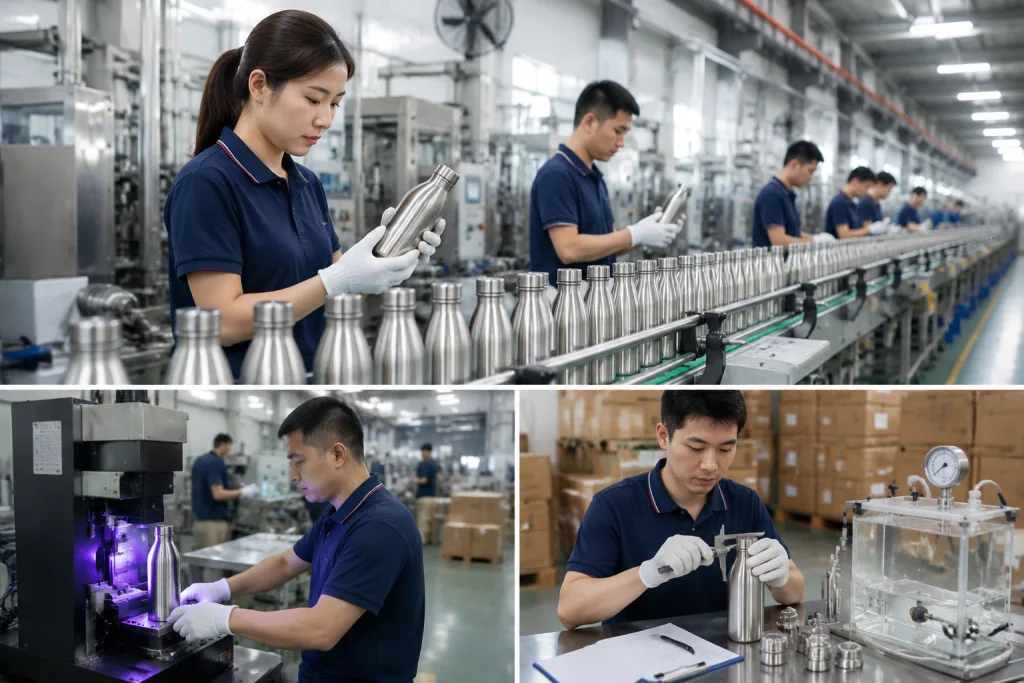
- Quality system: incoming inspection, in-line checks, leak tests, AQL final inspection; QC pulled the sample, checked lid torque, and logged vacuum hold on the report sheet
If a canteen supplier or canteen vendor cannot answer these points in one clean quote sheet, leave them off the shortlist. We ship better programs when every factory is compared on the same template, same MOQ break, same sample lead time. The math does not work if one vendor hides tooling cost in unit price and another has a typo on the PO for lid color.
Head-to-head spec table that matters
Most buyers sort bottles by photo and volume first. That misses the failure points. Compare suppliers on the production details that drive claims, returns, and margin after landing. We run into this every week: the buyer flagged two 750 ml bottles as “the same,” then QC pulled the sample and found different wall builds on the micrometer. Use a table like this when building your hydration bottle supplier list.
| Supplier type | Best fit | Typical MOQ | Lead time | Base FOB range | Main risk |
|---|---|---|---|---|---|
| Stainless vacuum canteen manufacturer | Retail, gifting, outdoor | 500-1,000 | 30-45 days | USD 3.20-6.80 | Coating and insulation consistency |
| Tritan sports bottle supplier | Gym, school, mass promo | 1,000-3,000 | 25-35 days | USD 1.20-2.80 | Scratch visibility, lid leakage |
| Aluminum custom canteen factory | Promotional campaigns | 3,000+ | 30-40 days | USD 1.10-2.20 | Dent rate and lining quality |
| Customizable growler producer | Brewery, outdoor retail | 500 | 35-45 days | USD 5.50-11.00 | Cap sealing and weight |
| Mixed-item canteen vendor | Importers, catalog programs | Low mixed MOQ | 20-40 days | Varies | Less process control |
A canteen customizable stainless bottle can look interchangeable across three canteen manufacturers in China. On the line, it often is not. One factory may run 0.4 mm outer wall and 0.3 mm inner wall, another 0.5/0.4 mm, and another swaps steel grade between body, neck, and lid parts. That changes dent resistance, net weight, and heat retention fast. We have seen a 500 ml sample lose a sale because the buyer expected a heavier handfeel, while the PO only said “double wall SS bottle.” A 500 ml double-wall bottle with copper plating and vacuum insulation should hold heat roughly 8 to 12 hours and cold 18 to 24 hours in ordinary lab conditions. If the quote omits the structure, ask. Frankly, this is the wrong question to ask late in the project.
At BottleForge Industrial in Hangzhou, Zhejiang, we usually tell buyers to compare six line items before discussing price reductions: steel grade, wall thickness, lid construction, finish type, packing spec, inspection standard. That cuts out most fake savings. We ship plenty of orders where the first quote looked USD 0.35 lower, then the extras came in: individual polybag, color box, barcode label, and third-party inspection. The math does not work if one supplier priced a plain export carton and another priced a full retail packout with a 32 ECT carton.
A supplier list is only useful when each supplier is measured against the same technical sheet.
Use-case fit beats broad catalogs
The best canteen suppliers are usually specialists, not giant catalog houses. Buyers get burned when they expect one factory to handle premium customized drinkware, low-cost custom growler runs, and rush event merchandise on the same line. We’ve seen this go sideways after sample approval, when the PO looked fine but the supplier’s silk-screen setup and vacuum line were built for a different job. Use-case fit should decide who stays on your hydration bottle supplier list.
Promotional and event orders
For campaigns, sports events, or employee kits, the main questions are unit cost and ship date. Premium finishes are secondary. A lightweight single-wall stainless or Tritan body is usually the right pick, especially when the buyer wants 2,000 to 10,000 units packed fast in standard export cartons. Look for a canteen distributor or canteen vendors who run 1-color logo printing, standard carton packs, and simple color assortments without slowing the line. Typical landed savings versus premium vacuum bottles can be 35% to 55%. If the buyer asks for retail-grade coating on a giveaway budget, the math doesn't work.
Retail and DTC programs
For shelf sale or e-commerce, decoration durability and packaging matter more than the opening quote. A canteen customized for retail may need powder coating, laser logo, insert card, EAN or FNSKU labels, and drop-tested mailer packaging. On these jobs, we watch coating thickness, logo position, and seal odor before mass production; QC pulled the sample more than once because the lid ring smell failed after 24 hours in a sealed bag. Choose a canteen factory with stable repeatability, not just a low quote. Return rates often come from chipped coating, odor complaints from poor seals, and logo misalignment.
Outdoor and specialty formats
If you sell to camping, brewery, or corporate gifting channels, a customizable growler or customized growler line often needs its own supplier track. Growlers, large-capacity bottles, and handled canteens have different welding points and leak-risk profiles than a standard 750 ml sports bottle. This is not a small difference. A distributor growler program should also check carrying comfort, cap torque range, and carton weight. We usually flag cartons once they pass about 12 kg because warehouse handling claims rise fast after that, especially on 64 oz and 128 oz formats with handle welds.
The same logic applies to customizable canteen and customized canteen projects. One supplier may be right for 5,000 basic bottles and wrong for a 500-unit gift-boxed set with foam insert and mixed lids. Another may support a canteen custom launch with mixed lid options and custom Pantone matching, but only if you accept a 35-day lead time and a higher carton cost. The wrong question is who has the broadest catalog. Match the supplier to the job.
How pricing really moves
Buyers fixate on the bottle body price. That is the wrong question to ask. On custom drinkware projects, the bigger swings usually come from decoration, packaging, and compliance work, not the base vessel. We see this on the line all the time: two factories quote the same 600 ml bottle, both in 304 stainless, and still end up 20% apart because one included a color box, barcode label, and drop-test carton spec while the other did not.
Here is where cost usually moves:
- Material structure: single-wall vs double-wall, 18/8 stainless vs lower-grade alternatives, Tritan vs standard plastic
- Finish: spray paint is cheaper; powder coat, rubber finish, gradient, and special effects cost more
- Logo method: 1-color silkscreen is low cost; wrap print, laser, embossed mold, and multi-position art add setup and reject risk
- Packaging: egg-crate bulk pack is cheapest; PDQ display, gift box, or mailer inserts add labor and carton volume
- Testing and inspection: third-party food-contact testing and pre-shipment inspection add direct cost but lower claim risk
As a working benchmark from China sourcing, a 750 ml single-wall bottle for promotion may sit around USD 1.40 to 2.30 FOB, while a 750 ml double-wall powder-coated bottle with custom logo and color box may reach USD 4.20 to 7.20 FOB depending on quantity. We usually see the lower end at 3,000 pcs and up, packed in bulk. The higher end shows up fast once the buyer adds a custom Pantone body, individual box, and tighter AQL pull. A customizable drinkware set with straw lid, flex handle, and custom box can go higher quickly. The math does not work if you expect gift-box packing at bulk-pack pricing.
If you are buying through a canteen vendor or canteen distributor, ask whether the quote is based on FOB Ningbo or FOB Shanghai, and whether barcode labeling, carton marks, and spare parts are included. We ship most Zhejiang orders through Ningbo because the trucking is shorter, often 180 km less from the factory side, and that gap matters once you load a full container. The buyer flagged this on one PO last season because the carton mark line was missing and the warehouse charged relabeling fees. Also ask for overrun and underrun terms. On logo orders, plus or minus 3% is common, and you should know whether billing follows actual shipped quantity.
Compliance, audit, and defect control
A good hydration bottle supplier list is a risk-control list. For Europe and North America, the question is not whether the bottle looks right on the screen. The real question is whether the supplier can prove, batch by batch, what it shipped. We’ve seen buyers ask for a nice render first and paperwork later; that goes sideways fast. On the factory floor, this usually shows up when QC pulled the sample carton and the label code on the lid bag did not match the PO revision.
Ask for a current compliance pack matched to the material and sales market, not a generic PDF from 2 years ago. If the bottle body is 304 stainless and the straw lid is PP plus silicone, the documents should match those parts.
- REACH and food-contact declarations for EU-bound products
- LFGB or relevant migration testing where applicable
- FDA-contact material statements for U.S. programs
- BPA-free confirmation for plastics and seals where claimed
- Factory audit status such as BSCI or equivalent social compliance if your retailer requires it
Quality control needs the same level of detail. A canteen manufacturer or canteen supplier should spell out leak testing pressure, coating adhesion method, vacuum retention hours for insulated bottles, and finish inspection standards under defined light. AQL 2.5 is common for major defects in final random inspection, but leakage and safety defects are usually held tighter. If a supplier only says “100% checked” and cannot show the record sheet, this is the wrong answer to accept. We run into this with new buyers all the time; the line says checked, but no one can show the worksheet, rework count, or reject photos.
For decorated custom drinkware, ask how they control color approval and print position tolerance before mass production. A workable logo position tolerance is often plus or minus 1.5 mm to 2.0 mm, depending on the process and bottle shape. For powder coat, ask whether they run a cross-hatch adhesion test and whether lids are assembled after cure so the thread area does not scuff. These are not small details. We ship plenty of bottles with zero structural issues, but buyers still flag cosmetic claims because a logo sits 2 mm high or the shoulder gets rubbed in packing.
At our Zhejiang operation, bulk capacity can reach 600,000 units per month across standard drinkware categories, but capacity only matters when the controls hold steady. The math doesn’t work any other way. If a factory can make 20,000 units a day but keeps finding loose gaskets at final inspection, output is just scrap at a faster speed.
Questions to send before sampling
If you want your hydration bottle supplier list to turn into a usable RFQ file, send the same question set to every supplier before sampling. We do this with an 8-line sheet, not a long brief. It saves 5 to 7 days in the first round and exposes weak vendors early. Whether you are talking to canteen distributors, a canteen factory, or a direct canteen manufacturer in China, keep the form tight and leave one blank column for notes like “PO typo on lid color” or “sample fee not refundable.”
- What is the MOQ by size, color, and logo method?
- What is the sample charge, and is it refundable after order placement?
- What are the body and lid materials, including seal and straw parts?
- What wall thickness do you use for single-wall and vacuum models?
- What compliance reports can you provide for EU and U.S. markets?
- What is your bulk lead time after artwork and sample approval?
- What is your standard packing spec and carton drop-test level?
- Do you accept third-party inspection and what AQL level do you follow?
Judge the replies on clarity. This is the wrong question to ask: “Are you a good factory?” Ask for numbers. Strong canteen suppliers send 0.4 mm or 0.5 mm body thickness, 1000 pcs MOQ, 12 days for pre-production sample, 35 days for bulk. Weak canteen vendors send adjectives. QC pulled a sample last month from one new source that said “high quality stainless steel,” but they gave no grade, no thickness, and no cap detail on the quote sheet. Move on. If you ask about a custom canteen and get a drawing, capacity tolerance like ±5%, carton size, and test references in one reply, keep that supplier close.
Sampling also needs to match the end use. For a customized growler, check cap seal after transport vibration; we run a simple shake test on the line and look for seepage after 30 minutes laid sideways. For a customizable canteen with powder coat, do a basic abrasion check in the office with a 3M pad or coin rub. For distributor canteen programs, test case-pack efficiency and warehouse scan labeling; the buyer flagged one job because the outer carton barcode sat only 12 mm from the edge and scanners missed it. By the time you approve production, your list should already be down to 2 or 3 vendors that answered precisely, sampled honestly, and priced within the same range. If one quote lands 18% low, we’ve seen this go sideways.
Send your RFQ and trim your shortlist fast
Share your target bottle spec, annual volume, market, and packaging needs. We will map the right factory fit, MOQ, lead time, and compliance path.
Frequently asked questions
How many suppliers should be on a hydration bottle supplier list?
For most B2B programs, 3 to 5 active suppliers is enough. More than that usually creates noise, not leverage. A practical mix is 2 direct factories in China, 1 backup canteen supplier for urgent replenishment, and 1 specialist for formats like a custom growler or kids bottle. Compare all four on the same RFQ sheet: MOQ, FOB price, sample time, bulk lead time, compliance documents, and AQL standard. If one supplier cannot quote within 3 business days or cannot provide a material declaration, remove them early. You want a shortlist you can actually sample and audit, not a long spreadsheet that never gets used.
What MOQ is normal for custom hydration bottles?
MOQ depends on material, color, and decoration. For stocked stainless vacuum bottles, 500 to 1,000 units per SKU is common. For Tritan or single-wall plastic items, 1,000 to 3,000 units is more typical, especially if you need custom color lids. A canteen customized with special mold changes, embossing, or exclusive components can push MOQ above 3,000 units. If you need mixed colors under one model, ask whether the MOQ applies per Pantone or per total order. Also check logo MOQ separately. Some canteen manufacturers allow 500 units total but require at least 250 per print layout.
How do I compare a factory quote with a trader quote?
Break both offers into the same six cost buckets: bottle body, lid, decoration, packaging, testing, and freight term. A trader may quote lower on the body but omit barcode labels, spare seals, or inspection fees. A direct canteen factory may look higher at first, then become cheaper once you add repeat-order stability and fewer defects. Ask each side for FOB port, carton size, gross weight, overrun policy, and lead time. If the quote is for Europe or North America, ask for REACH or FDA support by SKU. A reliable comparison usually takes one normalized spreadsheet, not a quick glance at unit price.
What compliance documents should I request for Europe and the U.S.?
For Europe, start with REACH-related declarations and food-contact documentation suited to the bottle material, plus LFGB test support where your customer requires it. For the U.S., request FDA-contact material statements and BPA-free declarations if marketed that way. For stainless steel models, ask for the actual steel grade, usually 18/8 or equivalent. For plastics, ask for the resin type such as Tritan. If the program is retail, also ask for factory audit status like BSCI and confirm whether third-party testing is done per shipment or per material family. Good suppliers in Zhejiang or elsewhere in China should provide document copies within 2 to 5 business days.
How long does a custom drinkware order usually take?
A normal timeline for custom drinkware is 7 to 12 days for a pre-production sample after artwork confirmation, then 25 to 45 days for mass production depending on quantity and finish. Basic single-wall bottles with simple silkscreen can be closer to 25 to 30 days. Double-wall powder-coated bottles with laser logo, gift box, and inspection booking are often 35 to 45 days. If you need new tooling for a customizable growler or customized canteen component, add 15 to 25 days for tool build and validation. Always ask when lead time starts: deposit date, artwork approval, or sample sign-off. That detail changes real delivery planning.