Key Takeaways
- A useful RFQ should lock 12-15 line items before sampling, including capacity, steel grade, logo method, packaging, and test standard.
- Most custom drinkware projects move from pre-production sample to bulk in 25-45 days, with typical MOQ from 1,000 to 3,000 units per color.
- For stainless vacuum bottles, a 0.3%-1.0% leakage complaint rate usually points to weak lid sealing control or poor incoming gasket inspection.
- Ask for AQL 2.5 inspection, REACH/LFGB or FDA support, and clear PO tolerances of ±5% quantity and ±2 mm key dimensions.
You are not buying a bottle. You are buying a process that repeats without surprises: correct steel grade, stable vacuum retention, decoration that survives transit, and a shipment that lands before your retail launch. On our line, QC pulled one sample last month with a 0.3 mm lid thread offset, and that single point is exactly why choosing a hydration bottle oem manufacturer should start with RFQ handling, sample control, compliance files, and bulk inspection instead of catalog photos.
Buyers in Europe and North America often arrive with a one-page brief and hit problems that should have been closed on day one: lid thread mismatch, unclear logo method, the wrong carton drop standard, or an MOQ split that looked fine at 3,000 pcs until production started. We have seen this go sideways. A practical sourcing flow lets you compare any canteen factory in Zhejiang or elsewhere in China on the points that change the math—cost, lead time like 12 days vs 18 days for samples, and claim rate after shipment.
Start with an RFQ buyers can price
If you want a usable quote from a hydration bottle oem manufacturer, write the RFQ like a buying document, not a mood board. A serious canteen manufacturer or canteen supplier in China can quote fast when the inputs are fixed. Send one reference photo with “best price,” and you will get 3 numbers from 3 factories that do not match on spec, packing, or term. We see this on the line every week.
At BottleForge Industrial in Zhejiang, most workable RFQs include 12 core points: capacity, body material, insulation type, finish, logo process, lid structure, color count, packaging, compliance market, target quantity, target incoterm, and delivery deadline. Miss 1 point, and the quote is usually provisional. QC pulled the sample on a 24 oz bottle last month, and the PO was missing carton packout, so the first price was off by $0.18 per unit.
- Capacity: 18 oz, 24 oz, 32 oz or metric equivalent.
- Material: 18/8 stainless steel, Tritan, glass, or aluminum.
- Wall structure: single wall or double-wall vacuum.
- Thickness: for many stainless bodies, 0.4 mm outer and 0.3-0.4 mm inner is common.
- Lid type: straw lid, screw cap, chug lid, flip lid.
- Decoration: silkscreen, heat transfer, powder coat, laser engraving.
- Packaging: white box, color box, PDQ tray, master carton packout.
Also say if the job is canteen custom, custom canteen, or wider custom drinkware under one campaign. If you are a canteen distributor, distributor drinkware buyer, or importer running 4 to 20 SKUs, ask the factory to break out tooling, sample fee, unit price, carton data, and optional accessories. That is the wrong question to skip. The buyer flagged this on one RFQ because the straw brush was buried inside unit price, and the comparison across Zhejiang suppliers went sideways.
A useful RFQ ends with a draft PO table. Before you place the order, list the commercial lines you expect: unit price, sample charge, mold fee, logo plate fee, export carton, palletization, and inland freight to port. Factories that reply line by line are easier to work with in bulk. We ship cleaner approvals that way, and we catch small errors early, like a PO typo showing FOB Ningbo on a project quoted EXW Hangzhou.
Filter factories before you sample
Once quotations come back, do not buy on unit price alone. This is the wrong question to ask. You need to know which hydration bottle oem manufacturer can hold your spec on the line at 5,000 pcs, not just make one clean pre-production sample. We usually tell buyers to shortlist 3 suppliers: 1 direct factory, 1 larger factory with stronger audit files, and 1 trading company that answers fast and owns the project. That gives you a real benchmark. One quote might be $0.18 lower, but if QC pulled the sample and found a 1.5 mm logo shift, the math doesn’t work.
Ask each supplier for a basic qualification pack. Skip the glossy deck. Ask for documents, process facts, and one live contact who can answer production questions without checking 4 times.
- Audit status: BSCI, Sedex, or equivalent social compliance if retail customers require it. Ask for the latest report date, not just the logo on a slide.
- Quality system: ISO 9001 is common and useful if it is actually implemented. Ask who signs the IPQC report and whether they run AQL 2.5 before shipment.
- Test support: REACH, LFGB, FDA, California Proposition 65, ASTM where applicable. We’ve seen buyers ask for LFGB after sample approval, and that costs 5-7 extra days.
- Capacity: for example 300,000 to 500,000 units per month for mixed drinkware. Ask how many lines are for vacuum bottles, not total factory output.
- MOQ: often 1,000 pcs per color for standard stainless bottles, 3,000 pcs for new molds. If the supplier says 500 pcs on everything, ask what part is being subsidized.
- Lead time: 7-10 days for samples, 30-45 days for bulk after approval. We ship faster on stock parts, but custom lids and new cartons usually add 3-5 days.
You should also ask how much of the process is in-house. A canteen customizable project with custom lid color, bottle painting, and branded pack often passes through 2 or 3 outside partners: powder coating, silk screen, and packaging. That is manageable if the factory controls the handoff. If not, we’ve seen this go sideways. One common problem is color drift between bottle body and cap because the cap was matched off a phone photo instead of a Pantone chip at the spray booth.
For distributor canteen programs and canteen promotional orders, ask one blunt question:
What are the top three bulk defects you see on this bottle type, and how do you control them?A real factory will answer fast and get specific. They will mention dents after vacuuming, color variance above the agreed standard, logo registration off by 1 mm, vacuum loss, thread fit, or gasket leakage. They may even tell you the buyer flagged a lid crack at drop test last season. If the answer is “no problem,” move on.
Before moving forward, build a supplier comparison sheet with commercial terms and PO-sensitive items: payment terms, sample lead time, FOB Ningbo or Shanghai basis, spare cap availability, and defect claim window. Add small details that break orders later, like barcode format, carton drop standard, and whether the PO says “matte black” or “matt black.” Yes, that typo shows up. This sheet matters more than polished catalog language like customizable canteen or customized drinkware.
Build the sample around PO details
The sample stage turns a rough idea into factory language. We treat it as page one of the PO, not a cosmetic step. If you are buying customized canteen products for retail, canteen promotional items for events, or a customizable growler for outdoor channels, the sample needs to prove look, fit, and function. On our line, QC usually checks the first sample with a gloss meter and caliper before we send photos out.
There are usually three sample types:
- Stock sample: checks size and hand feel; we ship these in 2-5 days if the model is already on the shelf.
- Pre-production sample: checks color, logo placement, and packaging; normal lead time is 7-12 days, and the buyer usually flags logo position first.
- Golden sample: approved reference sealed and kept by both buyer and factory before mass production, often with a signed label on the master carton.
Your sample PO or approval sheet should list exact line items, not scattered notes in an email thread. This is the wrong place to stay loose. We have seen one typo on a PO shift a logo from 70 mm to 7.0 mm, and then everyone argues about who approved what. For example:
- Item: 24 oz double-wall vacuum bottle, 18/8 SS inner and outer
- Body finish: Pantone 5483C powder coat, matte 15-25 gloss
- Logo: 1-color silkscreen, 45 mm W x 55 mm H, centered 70 mm from base
- Lid: black PP screw lid with matching carry loop, food-grade silicone seal
- Packaging: individual kraft box, 10 pcs/master, carton drop pass at 76 cm
- Testing: leak test 100%, vacuum retention benchmark 12 hours hot / 24 hours cold
If you are sourcing from China for Amazon FBA, club retail, or distributor growler business, define barcode placement, FNSKU label responsibility, carton weight limit, and pallet pattern at sample stage. These points affect labor cost on the packing line. They also affect packout speed. A 1-label vs 2-label carton sounds minor until the line has to stop every 40 cartons for relabeling.
For canteen customized and customized growler projects with new tooling, ask the factory to separate mold cost from sample charge. A standard lid color change often costs little beyond setup. A new cap mold can run from USD 2,000 to USD 8,000 depending on complexity, steel grade, and whether the cap needs moving parts. We have seen this go sideways when a buyer compares a low sample charge to a full tooling quote later; the math does not work.
The rule is simple: if it matters in bulk, put it on the sample approval form. If not, it turns into a "we assumed" argument later. One signed sheet with revision code, date, and sample weight in grams saves more time than 20 email replies.
Negotiate bulk terms without hidden gaps
After sample approval, the usual trouble is commercial, not technical. We see this on the line all the time: the buyer expects exact quantity, the factory books a ±10% shipment tolerance, and nobody catches it until the final packing list is out. One PO even said “3,000 pcs navy” while the approved artwork file showed black lid with navy body. Clear PO wording fixes that before money and production get stuck.
Your bulk purchase order should spell out the commercial terms in line items. For a typical custom drinkware order, that means:
- SKU code and revision: match the approved sample and artwork version, down to the file name or revision mark QC pulled on the golden sample.
- Order quantity: show quantity per color and total quantity, not “assorted colors.”
- Unit price: state FOB Ningbo or FOB Shanghai in USD, because this buyer pushback comes up every week once trucking is booked.
- MOQ split: for example 1,000 pcs per color, 3,000 pcs total.
- Over/under tolerance: usually ±5% unless your channel forbids it; if you need exact count, write 0% clearly.
- Payment term: common export term is 30% deposit, 70% before shipment.
- Lead time: counted from deposit, artwork approval, and sample sign-off; write the trigger, or 35 days suddenly becomes 42.
- Standard: leak-free, logo adhesion, carton mark, drop test, document set, with the exact carton spec if outer box size matters.
Ask the factory to confirm what is included in the price: spare gaskets, desiccant, instruction sheet, barcode labels, and export pallet. This is where the math gets missed. On custom drinkware, those small add-ons usually shift cost by USD 0.05 to USD 0.40 per unit, and on a 20,000-piece order that is USD 1,000 to USD 8,000. We have had buyers flag missing barcode labels after seeing the first pallet photo, and by then the goods were already stretch-wrapped.
If the project is canteen promotional, custom growler, or customized drinkware for a short campaign, add late-shipment liability or at least one delivery milestone. Zhejiang factories run production against vessel cut-off dates, carton booking, and print capacity, not against a vague “ship ASAP” note. Miss the vessel by four days and the retail launch can slip by four weeks. We have seen this go sideways over one delayed silk-screen approval.
Define claim handling too. A practical clause is inspection by AQL 2.5 before shipment, then a written quality claim within 30 days of arrival with photo and quantity evidence. That gives both sides something measurable: 12 leaking bottles out of 2,000 checked, not “quality not good.” The wrong question to ask is whether the factory promises “best quality.” Ask how claims are counted, who signs the inspection report, and which sample becomes the reference set.
Control production before cartons close
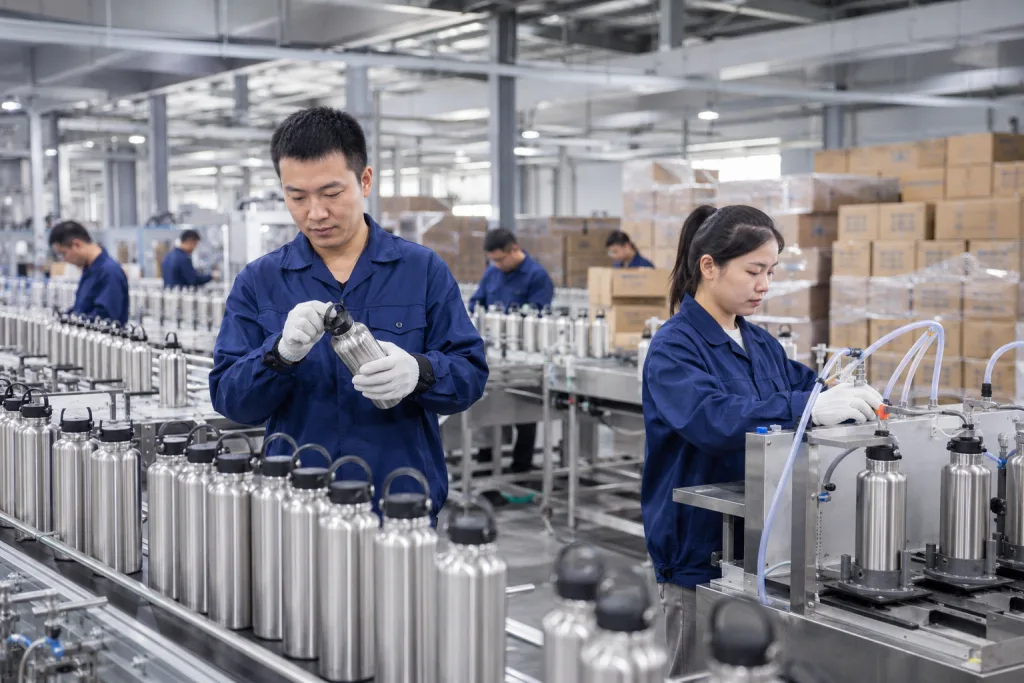
Once the PO is placed, stay involved. Not emotionally involved—just on the process. A solid hydration bottle oem manufacturer should send a production schedule with real checkpoints: raw material arrival, tube forming, seam welding, powder coating, logo printing, assembly, packing, and final inspection. We run this off the line sheet, not memory. If the first update comes on shipment day, the window to fix thread, color, or print problems is already gone.
For stainless bottles and canteen customizable programs, the risk usually sits in details buyers do not catch in supplier photos. QC pulled the sample, it looked fine, then the issue showed up on the line:
- Thread matching: lid and neck tolerance has to stay stable across all cavities. A 0.2 mm drift is enough to cause cross-threading complaints.
- Gasket fit: the wrong silicone hardness creates slow leakage. We have seen 50 Shore A specified and 60 Shore A delivered against the PO.
- Coating cure: under-cured powder coat scratches fast. A simple cross-hatch adhesion test will catch this before packing.
- Print registration: on curved bodies, multi-color logos shift if the jig is off. The buyer flagged a 1.5 mm logo shadow once, and they were right.
- Vacuum performance: weak evacuation or a bad weld cuts insulation hold time. This is the wrong place to trust photos.
Ask for in-line photos or short video from first production. Better, ask for a pre-shipment inspection report showing quantity checked, defect classification, and results by AQL level. For drinkware, major defects usually mean leakage, wrong color, wrong print, unstable base, sharp edge, and carton marking error. Minor defects are things like a small paint dot or light surface variation, but only if your signed standard allows it. We have even seen a carton PO typo carry through to mass packing.
A realistic inspection plan for 5,000 to 10,000 units is AQL 2.5 for major and 4.0 for minor defects, with 100% leak testing on assembled bottles. If the supplier says leak test is random only, ask why. The math does not work. In a canteen factory making vacuum bottles, 100% air-pressure or water leak verification is standard process control, not a premium service. On our side, the line usually runs a pressure check before final wipe-down and carton pack-out.
If you buy as canteen distributors or distributor drinkware importers, also confirm master carton dimensions and gross weight before booking freight. Get the actual numbers, like 58 x 39 x 27 cm and 12.8 kg, not “standard export carton.” We have seen this go sideways when the buyer assumed one loading plan and the finished carton was 2 cm taller. Oversized cartons change container loading and Amazon prep costs fast. Production control is not glamorous, but this is where margin is protected.
Ship, receive, and plan the repeat order
The job is not done at “goods shipped.” It is done when PO-002 becomes easier than PO-001. We see this on the factory side all the time: the first run takes 26 emails, the repeat takes 9, but only if someone closes the loop after receipt. Once cargo lands, log the receiving data against the PO line by line: actual quantity, carton crush, transit damage, leak rate, logo defects, and customer complaints in the first 30 to 60 days. Put numbers on it. “Some dents” is useless. “18 crushed cartons out of 1,240” gives the line and your freight team something to fix.
For most custom drinkware importers, a clean first shipment looks like this: shortage under 0.5%, transit damage under 0.3%, leak complaint under 0.5%, and decoration complaint under 1.0%, depending on product type and channel. If claims come in above that, changing suppliers on day one is the wrong move. First split the cause into 4 buckets: spec, production, packaging, or freight handling. QC pulled one sample last month with a 0.8 mm silicone gasket rolled at the lip; the buyer blamed assembly, but the real problem was a carton drop and poor inner fit.
This is also the time to clean up your repeat-order file with the exact lines that made the first PO work:
- approved artwork code and print method
- final Pantone reference and finish tolerance
- lid assembly code and gasket spec
- packaging dieline and carton mark layout
- inspection checklist and defect photos
- approved shipping mark, HS code, and document set
Do not keep this file vague. We run repeat orders faster when the buyer sends the same lid code, the same 5-ply carton spec, and the same outer mark placement at 70 mm from the bottom edge. If you are building a wider line with custom canteen, customizable drinkware, customized growler, or distributor growler items, a repeat-order library saves 2 to 3 weeks over a season. It also shows whether your current canteen manufacturer in China can handle gift sets, mixed-SKU containers, or retailer-specific packaging without the program going sideways.
The better factories in Zhejiang are chasing the second and fifth order, not just the first. That is where the math starts to work: lower setup scrap, fewer pre-production sample loops, and steadier lead time like 12 days instead of 18 days on a repeat decoration run. We ship smoother when the records are tight. If your supplier can show those gains with actual PO history, you are not only buying from canteen suppliers. You are building a sourcing system that holds up under volume.
Send your RFQ and get a practical quote
Share your bottle spec, target quantity, logo file, and delivery window. We will review feasibility, MOQ, sample timing, and bulk pricing clearly.
Frequently asked questions
What MOQ should I expect from a hydration bottle OEM manufacturer?
For standard stainless steel hydration bottles, a practical MOQ is usually 1,000 pcs per color per size, with 3,000 pcs total for an OEM order. If you use an existing mold, some factories in China can be flexible at 500 pcs per color for trial runs, but unit cost rises noticeably. For new lid tooling or customized canteen shapes, MOQ often moves to 3,000-5,000 pcs because the factory needs to recover mold and setup costs. Also check packaging MOQ separately. A custom color box may have a 2,000-3,000 pcs print minimum even if the bottle MOQ is lower. Always ask for MOQ by bottle, lid, color, and packaging, not one blended number.
How long does custom drinkware production usually take?
If the bottle uses an existing mold and standard components, stock samples can ship in 2-5 days, pre-production samples in 7-12 days, and bulk production in 25-35 days after sample approval and deposit. More complex custom drinkware projects with new molds, multiple logo methods, or retail packaging usually need 35-45 days. During peak season, especially from August to November in Zhejiang and other export areas of China, add 7-10 days as a buffer. If you need compliance testing before shipment, include that in the timeline too. A realistic PO should define lead time starting only after artwork approval, deposit receipt, and signed sample confirmation.
What certifications and compliance documents should I ask for?
That depends on your market and material, but most B2B buyers should ask for a basic set: ISO 9001 for quality system, BSCI or Sedex if social audit matters, and material or migration test support such as LFGB for Germany/EU, REACH screening, FDA food-contact statements for the US, and Proposition 65 when required. For kids' drinkware, ASTM or CPSIA-related checks may also matter. Do not just ask whether the factory is compliant; ask for recent report dates, test lab name, and which SKU or material the report covers. A 2021 report on a different cap resin is not enough for a 2025 PO. Match documents to the actual bottle, lid, straw, and decoration you are buying.
How do I compare a direct canteen factory with a trading company?
Compare control, speed, and accountability instead of assuming one model is always better. A direct canteen factory may offer better technical feedback, lower cost by USD 0.10-0.50 per unit, and faster answers on production issues. A strong trading company can still be useful if you need mixed sourcing, lower communication friction, or consolidated shipments across several drinkware categories. Ask both the same questions: who owns sampling, who manages bulk inspection, where decoration happens, what the actual monthly capacity is, and who handles claims. If the trading company cannot identify the plant and process flow, risk increases. If the factory has weak English support or poor export documentation, the trading company may add real value. Decide based on execution, not label.
What are the most common bulk problems with customized bottles?
The most common issues are leakage, logo inconsistency, paint defects, wrong accessory matching, and carton damage. Leakage usually comes from gasket installation or lid thread tolerance. Logo problems include position drift over 2-3 mm, weak adhesion, or incorrect Pantone match. Paint issues often show as dust points, scratches, or gloss variation outside the approved sample. Accessory mismatch happens when lids, straws, or color sleeves are packed incorrectly on mixed orders. Carton damage is often a packaging specification problem, not only a freight problem. To reduce claims, put measurable standards on the PO: 100% leak test, logo position tolerance, color reference, carton burst or drop standard, and AQL 2.5 pre-shipment inspection. That is more effective than asking for 'high quality'.