Key Takeaways
- A workable MOQ for custom hydration bottles is usually 1,000-3,000 pcs per color, while fully new molds often start at USD 3,000-12,000 plus 30-45 days
- Normal lead time from a Zhejiang, China factory is 7-12 days for samples and 25-40 days for mass production after artwork approval
- For stainless custom drinkware, 18/8 inner and outer walls with 0.4-0.5 mm thickness is the practical baseline for durability and vacuum performance
- Use an AQL 2.5 inspection plan, leak test 100% of units, and confirm REACH, LFGB or FDA-contact compliance before you pay the balance
You are not buying a bottle. You are buying repeatability: the same lid torque on every batch, the same Pantone match from pilot run to reorder, the same delivery window your warehouse already gave sales. That is why picking among hydration bottle manufacturers gets messy fast. Unit price matters, but leak rate, powder coating yield, carton drop results, and artwork consistency at 5,000 units versus 50,000 units matter just as much. On our line, QC pulled a sample last month because the lid gap was off by 0.3 mm, and that small miss is enough to turn a clean reorder into a claims problem.
For B2B buyers in Europe and North America, the hard part is not finding a canteen manufacturer in China. Zhejiang alone has 300-plus factories and trading companies around this category. The real job is cutting through trading noise and checking whether a canteen factory can run your channel—retail, promo, Amazon FBA, or a canteen distributor program. In Hangzhou, Zhejiang, we see the same mistakes again and again: vague specs, unrealistic MOQs, and no inspection plan before deposit. This is the wrong question to ask, but buyers still ask it: “Who is cheapest?” A better check is whether the factory can hold spec, pass drop test, and ship the same pack-out on PO002 and the reorder six months later.
What are you really sourcing?
Buyers looking for hydration bottle manufacturers often stuff 3 different jobs into one RFQ, and that is where pricing goes messy fast. Job one is the bottle itself: capacity, material, vacuum or single wall, mouth diameter in mm, lid structure, coating, and packing method. Job two is branding, which means screen print, heat transfer, laser engraving, embossing, or private-label packaging. Job three is channel fit. A bottle for retail shelf display is not packed the same way as an e-commerce parcel item, a corporate gift set, a gym chain program, or distributor replenishment stock. We see this every month: the buyer asks for one quote, then the PO line mixes 600 ml vacuum, gift box, and Amazon drop test in one sentence. If you do not split these jobs, the math does not work and quote-to-quote comparison is useless.
Start with the product family. A custom canteen for outdoor retail is a different build from canteen promotional giveaway pieces or a custom growler for brewery merchandise. A growler usually needs a wider neck, often 38 mm or more, a heavier body, and pressure-safe expectations confirmed before sampling starts. A sports hydration bottle usually puts more weight on low grams and handle pull strength; on our line, QC pulled one sample after a handle crack at the 12 kg hang test. A kids bottle sold into the US channel needs added ASTM or CPSIA attention, and this is not a paperwork detail. We have seen shipments stall because the buyer flagged the lab scope too late.
- Single-wall stainless: lower cost, roughly USD 1.80-3.20 FOB China for common 500-750 ml models at 3,000 pcs
- Double-wall vacuum stainless: roughly USD 3.20-6.80 FOB for standard shapes and lid options
- Tritan or RPET hydration bottle: often USD 1.20-2.80 FOB depending on lid and decoration
Ask a plain question: do you need a canteen customizable from existing molds, or a fully canteen customized item? Existing molds usually cut development time to about 12 days instead of 18 days for first sampling, and they keep MOQ and tooling risk under control. A new silhouette gives you stronger brand separation, but you also take mold cost, cap-and-body fit risk, and at least 1 extra sampling round. We run into this point a lot in Zhejiang. The factories that answer it directly are usually easier to work with than the ones promising every finish, every MOQ, and every lead time in one email. That promise usually breaks on the second sample.
How do you compare factories fast?
The fastest way to compare a canteen supplier, canteen vendor, or direct canteen factory is to force every quote into one sheet. We run this way with new buyers because “best price” gets you noise. Ask for a line-by-line offer covering material grade, capacity tolerance, net weight, packaging spec, printing method, MOQ, tooling charge, sample charge, production lead time, and FOB port. Put every item in one column. Same unit, same Incoterm, same pack-out. On our side, sales usually checks the 0.01 kg weight gap first because that number often exposes copied quotes fast. Weak suppliers drop out early.
A serious canteen manufacturer in China should give operating numbers without dancing around them. Ask monthly capacity, normal MOQ, sample lead time, mass production lead time, and the defect handling process. A mid-size stainless drinkware plant in Zhejiang may run 300,000-500,000 units per month, quote 1,000 pcs per color for standard vacuum bottles, and need 30-35 days for production after deposit. If the lid comes from an outside source, ask that too; we have seen one silicone ring delay a 35-day order to 41 days. If a supplier avoids numbers, that is the warning sign. This is the wrong question to soften.
Use this shortlist checklist
- Is the supplier a factory, trader, or mixed model?
- Can they provide BSCI, ISO 9001, or equivalent audit records if your channel requires them?
- Do they understand REACH, LFGB, FDA, Proposition 65, and packaging compliance?
- Can they support your print method at the required artwork size and Pantone tolerance?
- Have they supplied a canteen distributor or retailer with similar annual volume?
You do not need the cheapest canteen suppliers. You need one that repeats the same result on the second and third order without reopening every spec, carton mark, and claim standard.
For buyers building a distributor canteen line or managing canteen distributors, ask about spare lids, mixed-carton SKUs, barcode labeling, and reorder flexibility. This is where the buyer flagged problems on past projects: one PO had the wrong EAN suffix, and QC pulled the sample before the outer carton run. Ask if they can pack 12 pcs mixed color in one master carton, hold 2% spare lids, and relabel cartons without resetting the whole line. A 3% unit-price gap looks small on paper. Once the line is in market, the math doesn't work if replenishment is messy.
MOQ, tooling, and price without surprises
MOQ is where B2B bottle programs usually break. We’ve seen a buyer ask for 6 colors across 3 capacities and think it’s one 3,000-piece PO, then the supplier quotes MOQ by color, print position, and lid set, and the math jumps to 18,000 pcs. Break that out on day one. On our line, even a lid gasket change can split the count.
For standard stainless customizable drinkware on existing molds, the common MOQ in China is 1,000 pcs per model per color. Some factories will do 500 pcs if you take stock colors and a one-position logo; usually that means no Pantone match and no custom spray card. For plastic hydration bottles, 3,000 pcs is common once custom color injection starts, because the masterbatch fee and machine time have to be spread somewhere. A fully customizable canteen with a new cap or body mold usually needs 5,000-10,000 pcs. This is the wrong question to ask if you only ask for MOQ. Ask what MOQ applies to body color, lid color, print, and packout. We run into that confusion every month.
Typical cost structure looks like this:
- Existing mold sample: USD 50-150 each, usually refundable against bulk order
- Logo setup: USD 30-80 per artwork per position
- New mold: USD 3,000-12,000 depending on body, cap, and handle complexity
- Color box: USD 0.18-0.65 each depending on size, finish, and insert design
If you want a customized drinkware project to hit target margin, ask for 4 prices, not 1: blank bottle, one-color print, gift box pack, and landed cost estimate to your port or warehouse. Then ask the supplier to list every trigger for repricing in writing. The usual ones are steel cost movement, coating change, carton upgrade, and order quantity dropping below quote. QC pulled one sample last month where the PO said “matte black” but the art sheet showed “rubber black”; that single wording gap changed the coating cost. Small typo, real money.
This hits harder on customized growler and customizable growler programs because packaging weight and carton cube push freight up fast. If you buy for a distributor growler program, ask for master carton dimensions, gross weight in kg, and loading quantity per 40HQ before you sign off the design. We ship some growler sets where the gift box looks good, then the 40HQ load drops by 12%. The margin disappears. We’ve seen this go sideways more than once.
Materials, testing, and quality controls
Most hydration bottle buyers do not need exotic materials. They need materials the line can run, test results the buyer can verify, and specs that stay stable after the first 3,000 pcs. For stainless bottles, 18/8 food-contact grade is still the mainstream choice for a reason. A standard vacuum body often runs at 0.4 mm outer wall and 0.4 mm inner wall. On larger bottles, we sometimes move the outer wall to 0.5 mm after a dent test with a drop ball, but the math does not work for every project because weight and unit cost rise fast. For powder coating, 60-80 micron thickness is a solid control point if you want finish consistency and fewer color complaints at packing.
For lids, get specific early. Ask whether the food-contact parts are PP, Tritan, silicone, or stainless, and ask which migration tests are already done for EU or US sale. A reliable canteen supplier should speak clearly about REACH and LFGB for Europe, and FDA-contact expectations for the US. If the item is going into children's channels, ask about ASTM test coordination through SGS, TUV, or Intertek. We have seen buyers send a PO that says “silicon” instead of “silicone,” and that small typo can turn into a material argument later if the approved sample is not locked down.
Minimum quality plan worth putting on your PO
- 100% vacuum check or insulation verification for vacuum bottles
- 100% leak test before packing
- AQL 2.5 final inspection on appearance and function
- 24-hour salt spray or adhesion check if you use special coating claims
- Carton drop test from 76 cm for standard export packaging
Good canteen manufacturers in Zhejiang, China will not argue with these controls. They might offer an equivalent process, but the answer should sound like engineering, not sales talk. If you hear “no problem” with no method behind it, push. This is the wrong question to wave through. Ask how defects are split by critical, major, and minor, who pays if third-party inspection fails, and how replacement units ship on the next PO. QC pulled one sample last month with a weak hinge pin on a flip lid, and that was caught only because the check sheet named the function point.
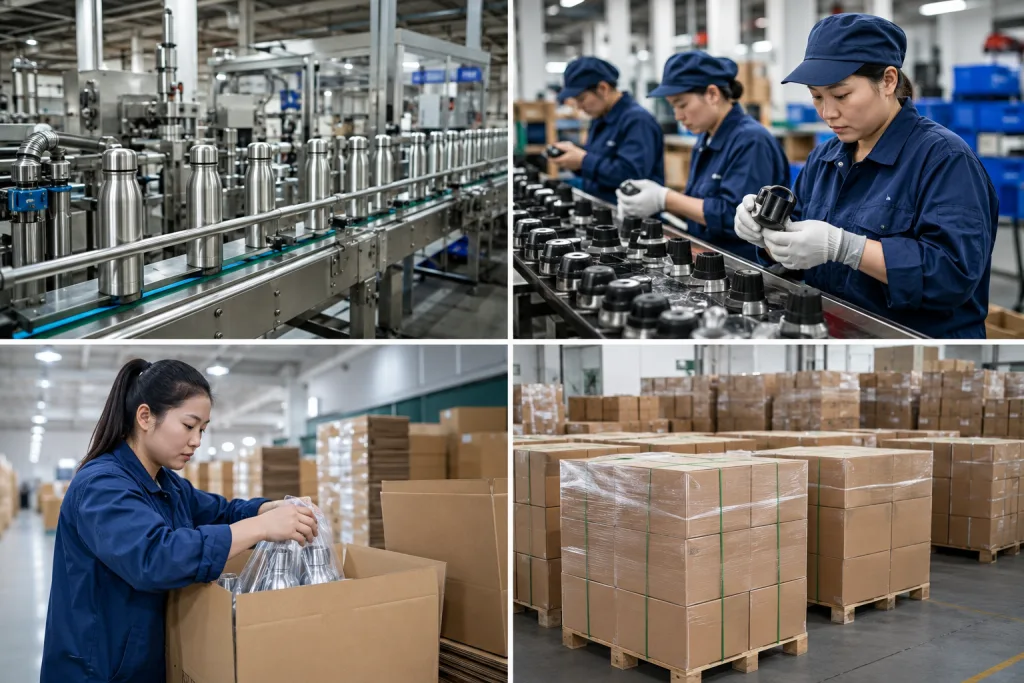
At BottleForge Industrial in Hangzhou, Zhejiang, for example, common export programs run with 1,000 pcs MOQ and 25-35 day lead time, but the bigger issue is process discipline on the floor. We run sample signoff first, then a pre-production sample, then in-line checks every 2 hours, then final AQL before balance payment. That sequence protects buyers more than a cheap opening quote. We have seen this go sideways when a buyer skips the sealed sample and only approves photos.
What customization actually changes lead time?
Not all customization hits lead time the same way. Buyers ask us if a logo change and a new bottle shape are “basically the same.” They are not. A one-color screen print on an existing bottle may add 2-4 days, and we run that on the line with a standard mesh screen. A Pantone-matched powder coat may add 3-7 days because QC has to check the sprayed panel against the approved chip under the light box. A new lid with a carry loop can add 20-35 days of development before production even starts, and that is before we finish cap fit checks on the first T1 sample.
For a normal custom drinkware order from China, sample timing usually breaks down like this:
- Existing sample with no branding: 2-5 days
- Pre-production sample with logo: 5-10 days
- Custom color or custom package sample: 7-12 days
- New mold prototype: 20-45 days depending on cap fit and tooling queue
This is where buyers mix up custom canteen, customized canteen, and canteen custom requests, and the math does not work if the brief is fuzzy. If the request is branding on an existing bottle, stay on existing molds and move faster. If the buyer wants a patentable appearance or exclusive geometry, accept the extra time and tooling cost. We have seen this go sideways when a PO says “new style” but the artwork file shows only a logo revision.
For customized growler projects, be stricter on handle welding, cap thread tolerance, and seal material. On our side, QC pulled samples before because the handle weld bead sat proud by 0.8 mm and the finish looked rough after coating. For customizable growler programs in alcohol retail, confirm early whether the coating and print hold up through repeated washing and cold condensation. That is a product-claim question, not a design question, and the buyer flagged this more than once after first shelf tests.
If you supply a canteen distributor network or manage multiple canteen vendors, set approval gates and keep them hard: CAD or photo confirmation, print position sheet, carton artwork proof, then golden sample signoff. This is the wrong question to skip. Without those gates, every reorder turns into an argument about what was “understood,” especially when carton marks, logo size, or even a PO typo changes between runs.
Can the supplier support your channel?
A bottle that works in wholesale often fails in e-commerce. A promo bottle can also feel too light on a premium retail shelf. This is where an average canteen vendor gets exposed. Ask operating questions, not sales talk. On our line, the same 750ml bottle may pass bulk club packing and still fail a 76cm drop test in an individual mailer.
If you sell into retail, ask about shelf-ready packaging, barcode position, multilingual warnings, and carton consistency. Get specific: barcode window 25mm from the base, outer carton size tolerance within 5mm, warning copy locked before print. If you sell online, ask for individual drop protection, FNSKU labeling, suffocation warning placement, and master carton weight below your warehouse limit. We ship Amazon-style packs under 15 kg for some buyers because the buyer flagged overweight cartons twice last season. If you are a canteen distributor or a distributor drinkware importer, ask whether the supplier supports mixed SKU loading and replacement parts. This is the right question.
Some practical examples:
- Amazon FBA: each unit may need scannable FNSKU, oversized carton avoidance, and tighter packaging checks; QC pulled the sample last month because one label sat across the carton seam and could not scan
- Promo distribution: low MOQs, fast logo execution, and acceptable cosmetic tolerance matter more than premium vacuum retention; we run 500 pcs per color for some event orders, and the math does not work if you ask for retail-grade finish on a rush budget
- Outdoor retail: durability, coating quality, and leak-proof lid performance matter more than the lowest price; a 1m hinge-lid drop test and 24-hour inverted leak test tell you more than a cheap quote
A dependable canteen factory should be able to tell you what percentage of output goes to each export channel and what pack-out changes they already handle. For example, 40% retail chain, 35% promo, 25% e-commerce is a real answer. “We export worldwide” tells you nothing. We have seen this go sideways when a factory knows bottle making but not channel rules, and then a PO even carries a simple typo on the FNSKU suffix. In China, factories with real distributor experience usually talk about SKU rationalization, reorder cadence, and dead-stock risk. That is the conversation you want.
For canteen promotional or seasonal gifting, ask how they manage color variance across batches. If your campaign requires two production lots, ask whether they hold coating panels or approved Pantone references from lot 1 to lot 2. Our coating room keeps signed color panels, and ΔE under 1.5 is a safer target if the sets ship together. For a distributor growler line, ask whether replacement caps and gaskets can be stocked for 12 months after delivery. We usually suggest a 2% spare gasket buy with the main order because waiting 90 days for a small reorder is where complaints start.
Questions to settle before paying deposit
Before you wire the 30% deposit, lock down the points that usually cause claims. If one answer is fuzzy, stop the PO and get it confirmed in writing. We’ve seen a lid thread mismatch of 0.4 mm turn into a full rework, and this is the cheapest stage to catch it.
- What is the approved specification on the signed sheet: capacity, material grade, wall thickness, finish code, lid structure, gasket material, print method, and packaging drop standard?
- What is the Incoterm: EXW, FOB Ningbo, FOB Shanghai, or DDP?
- What is the inspection method: factory QC only, third-party inspection, or both with a release standard before balance payment?
- What happens if the goods fail leak test or final AQL?
- Who owns the custom mold, and where is it stored? Ask for the mold number and rack location, not a vague promise.
- Are spare parts included at 1%-2% for lids or straws?
These are basic questions, but they separate disciplined sourcing from guesswork. A solid canteen manufacturer or one of the better canteen vendors in Zhejiang, China will answer fast, usually on the same spec sheet the line runs from. If the buyer flagged something and the supplier gets defensive, the math doesn’t work.
Settle payment timing at the same time. Common terms are 30% deposit and 70% against inspection approval before shipment. On first orders, most canteen suppliers will not give OA, even if the trial order is 3,000 pcs. On repeat business, we sometimes ship on delayed balance terms after 6 to 12 months of clean payment history. For high-volume customizable drinkware programs, buyers often ask us to reserve steel, paint, or packaging material so lead time stays at 12 days instead of 18 days.
Think past order one. Can the factory keep your print screens, hold your Pantone standard, and rerun at the same MOQ next season? QC pulled the sample on one reorder because the logo blue drifted from the approved drawdown, and the buyer was right to push back. If the supplier cannot control that, your first customized drinkware order is not a win. It becomes a cleanup job six months later.
Send your bottle spec and get a usable quote
Share capacity, material, target price, artwork, and channel. We will review MOQ, lead time, compliance risk, and packaging options before you commit.
Frequently asked questions
What MOQ should I expect from hydration bottle manufacturers in China?
For existing models, most hydration bottle manufacturers in China quote 1,000-3,000 pcs per model per color. A simple logo run on stock colors may drop to 500 pcs, but that is not standard. If you want a new body or lid mold, practical MOQ usually rises to 5,000-10,000 pcs because tooling and setup need to be absorbed. For vacuum stainless items, expect FOB pricing to improve meaningfully once you pass 3,000 pcs. If you are buying for a canteen distributor or distributor drinkware program, ask whether mixed colors can share one total MOQ. Many factories in Zhejiang allow that only if the decoration and lid stay the same.
How do I know if a canteen factory is really a factory and not only a trader?
Ask for three things: a factory address, production photos or live video of forming, vacuuming, coating, and packing, and a current business license matching the export entity. Then ask operational questions a trader usually struggles with: monthly output, normal wall thickness, powder coating line capacity, and what percentage of units get 100% leak tested. A real canteen factory in Zhejiang, China should answer with numbers, not generic sales language. You can also request audit records such as BSCI or ISO 9001 if relevant. Traders are not always bad, but if you think you are buying direct, verify it before deposit because it affects price, lead time control, and claim handling.
What tests matter most for custom drinkware orders to Europe and North America?
The minimum set depends on material and channel, but for most custom drinkware you should confirm food-contact compliance first. For Europe, buyers often ask about REACH and LFGB-related testing through labs such as SGS, Intertek, or TUV. For the US, FDA-contact expectations and sometimes Proposition 65 checks come up. Functionally, insist on 100% leak testing and vacuum verification for insulated bottles. At shipment level, use final inspection at AQL 2.5 for appearance and function. If the product is for children, ask about ASTM or CPSIA-related requirements before development. If coatings or durability claims are part of the sales pitch, add adhesion and basic salt spray checks to the quality plan.
How long does a custom canteen or customized growler project usually take?
If you use an existing bottle shape, the normal timeline is straightforward: 2-5 days for stock sample, 5-10 days for branded pre-production sample, and 25-40 days for mass production after deposit and artwork approval. A new packaging set may add around 5-7 days. A fully customized canteen or customized growler with new tooling usually needs 20-45 days just for prototype development, then another 25-40 days for production. If your supplier is in Zhejiang, China and peak season starts in August to November, add buffer. Buyers often underestimate cap development, gasket fit, and print proofing time more than metal body production itself.
What should I put on the PO to avoid disputes with canteen suppliers?
Put the full specification on the PO, not only a product name and price. Include capacity, dimensions, material grade, wall thickness, finish, Pantone if applicable, logo method and position, packaging details, barcode requirements, carton marks, spare-part ratio, inspection standard, and shipment term such as FOB Ningbo. Also state the approved sample reference and whether third-party inspection is required before balance payment. If you are buying customizable drinkware for retail or a canteen distributor program, add replacement policy for leaks, cosmetic defects, and missing accessories. Good canteen suppliers accept this because it prevents arguments. Vague POs are the main reason small defects become large commercial disputes.