Key Takeaways
- A 500 ml stainless steel bottle typically lands at USD 2.80-5.90 FOB China depending on steel grade, decoration, lid, and packaging
- Common MOQ starts at 500-1,000 units for stock molds, while fully new molds often need 3,000-5,000 units
- Sampling usually takes 5-12 days, bulk production 20-35 days, and custom packaging can add 5-10 days
- AQL 2.5 inspection, REACH testing, and drop-test standards should be confirmed before paying the 70% balance
You hear the same non-answer from bottle suppliers: pricing depends, lead time depends, MOQ depends. That does not help if you need to lock a launch calendar, compare 3 factories on the same sheet, or explain landed cost line by line to your team. The better questions are direct: what changes the unit price, what MOQ is workable on the line, and whether you should reserve 12 days or 18 days from sample approval to shipment. This is the right place to start.
At BottleForge Industrial in Hangzhou, Zhejiang, we see buyers lose more time on bad assumptions than on production. Last month a buyer flagged a PO typo on a 5,000-piece lid color callout, and that held the sample room for 2 days before mass production even started. A canteen custom project, a custom growler run, and a standard customizable drinkware order do not move on the same clock. The math does not work if you treat them the same. If you map the cost structure early, you avoid packaging rework, low-volume MOQ traps, and seasonal delays that hit Zhejiang factories and Ningbo port every year.
What actually moves bottle pricing
You ask for a bottle quote, but shape is just page one. The price moves on five things: steel spec, wall build, decoration method, lid parts, and packing. We see buyers compare a canteen supplier at USD 3.10 against a canteen vendor at USD 4.20 from one product photo, then find out one sample uses SUS304 inside only and the other runs full 18/8 on the line. Line up the spec sheet line by line. This is the right question to ask.
For stainless steel, the common split is 18/8 food-grade stainless steel, often called SUS304, versus lower-cost steel on outer walls or small accessories. A standard 500 ml single-wall bottle in SUS304 can sit around USD 1.60-2.40 FOB China at 3,000 units. A 500 ml double-wall vacuum bottle is more commonly USD 2.80-4.20. Add copper plating for better heat retention, a powder coat, laser engraving, and a leakproof carry lid, and the range moves to USD 4.30-5.90. On our floor, QC pulled one sample last month where the buyer expected copper coat but the PO only said "vacuum bottle matte black," so the quote gap started there.
- Wall construction: single wall is cheaper than double wall; typical outer wall thickness is 0.4 mm and inner wall 0.3-0.4 mm. We check this with an ultrasonic thickness gauge, because 0.1 mm off changes cost fast.
- Steel grade: full SUS304 costs more than mixed inner and outer specifications. Some buyers push for "304 bottle at 201 price," and the math doesn't work.
- Lid assembly: a simple PP screw lid may add USD 0.18-0.30, while a flip straw or metal cap can add USD 0.45-1.10. More parts means more assembly time, more leak testing, and more things the buyer flagged in pre-shipment samples.
- Decoration: one-color silkscreen is usually cheaper than heat transfer wrap, UV print, or embossed finish. A basic 1-color print runs clean; full-wrap artwork can raise scrap if registration drifts 1-2 mm.
- Packaging: a white box may cost USD 0.12-0.20, while a custom gift box can add USD 0.45-1.20 per unit. At 3,000 pcs, that packaging jump alone is noticeable before freight even starts.
This matters whether you are buying custom canteen products for retail, canteen promotional items for events, or customized growler lines for specialty channels. Ask every canteen manufacturer to quote the same Incoterm, usually FOB Ningbo or FOB Shanghai, and lock the same packaging assumption. We ship quotes fast in Zhejiang, but speed is not the point. If the bill of materials is loose, we have seen this go sideways by the second sample round.
MOQ tiers change your real unit cost
MOQ is where B2B buyers get caught. A canteen factory may quote 500 pieces, but that almost never means 500 pieces across every color, lid, print method, and box style. On our line, MOQ has layers. We’ve seen POs marked “500 pcs assorted” with no color breakdown, and that is the wrong question to ask.
For stock molds and standard colors, 500-1,000 units is common from a canteen supplier in China. That works for basic logo printing on an existing 500 ml or 750 ml bottle, usually after we confirm artwork size on a 180 mm wrap template. Once you ask for custom body color, mixed lid parts, retail inserts, barcode labeling, or a fully customized canteen shape, the efficient MOQ usually moves to 1,000-3,000 units. For a new mold, many canteen manufacturers will want 3,000-5,000 units minimum, plus mold cost. The math doesn’t work at 600 pieces if the factory has to open new spray color, new carton marks, and a separate packing setup.
Typical MOQ structure
- Stock bottle + 1-color logo: 500-1,000 units
- Stock bottle + custom color + custom box: 1,000-2,000 units
- Multiple SKUs in one order: often 300-500 units per color per SKU, with 1,000 units total
- New mold project: 3,000-5,000 units, mold fee often USD 2,000-8,000
Your unit cost drops at each tier because setup cost gets spread over more pieces. A customizable canteen quoted at USD 4.80 FOB for 500 pieces may drop to USD 3.95 at 2,000 pieces and USD 3.55 at 5,000 pieces. Packaging cost may stay close, but printing setup, line changeover, and scrap allowance shift fast. QC pulled the sample on one 1,000-piece run and found 26 cartons with mismatched lid assembly after a color switch, so yes, small runs carry hidden cost.
Treat low MOQ quotes carefully. A supplier can accept 300 pieces, then take margin back through higher decoration charges, poor carton fill, or lighter QA on the line. We’ve seen this go sideways.
If you are a canteen distributor, distributor canteen buyer, or distributor drinkware importer serving several accounts, it is often cheaper to consolidate one body style across customers and change only the logo. We ship programs like this at 1,200 units total with 4 logos split 300/300/300/300, using the same inner tray and master carton. That keeps MOQ under control while giving you a canteen customizable program that still looks tailored.
Sampling takes longer than buyers expect
The sample stage is where lead time stops being theory. If a hydration bottle manufacturer promises every sample in 2 days, ask what they are skipping. On our line in Zhejiang, 5-12 days is normal for pre-production samples on custom drinkware unless the order is an unchanged stock item pulled from shelf stock.
A plain stock sample usually ships in 2-4 days. Add powder coating and a logo print, and the clock usually moves to 5-7 days because we run coating first, then screen print, then oven cure. Add custom packaging, Pantone color matching, or a new lid part, and 7-12 days is the honest range. If tooling is involved for a customized growler or custom canteen cap, sample development usually takes 15-25 days before revision; we have seen a 0.3 mm thread mismatch hold a cap sample for 3 extra days.
- Stock sample: 2-4 days
- Logo sample: 5-7 days
- Color + packaging sample: 7-12 days
- New mold prototype: 15-25 days
The bottleneck is often not the bottle body. QC pulled the sample, and the delay was the artwork file, a CMYK vs Pantone argument, a label text fix, or an insert card revision with one PO typo in the barcode line. If you need ASTM, LFGB, REACH, or California Proposition 65 testing, reserve more time. Lab testing adds 5-10 working days depending on the protocol and whether the same material set already passed on a similar SKU. Buyers ask about bottle lead time first, but this is the wrong question to ask if the packaging file is still changing.
For Amazon FBA or retail programs, do not approve from photos alone. Ask for a full pre-production sample with the exact lid, exact coating, packaging, carton marks, and FNSKU placement if needed. We ship these checks as one set because the buyer flagged wrong carton marks before, and fixing 3,000 printed boxes after bulk production costs more than waiting 3 extra days at sample stage. Good canteen vendors in China know the math does not work any other way.
Bulk production is usually 20 to 35 days
After sample approval and deposit, the schedule gets clearer. On stock molds, most Zhejiang canteen suppliers run bulk in 20-35 days. That number moves with order quantity, decoration steps, and season. On our line, a missing lid color code on the PO can cost 2 days before we even release material.
A 1,000-piece order of standard sports bottles with one-color print is usually 20-25 days. A 5,000-piece custom drinkware order with powder coating, laser engraving, custom boxes, and mixed lid colors is more often 30-35 days. If the order has 4 SKUs with different inserts and carton marks, use the long end. We have seen buyers ask for one vessel date across all SKUs, then QC pulled the sample and found the wrong barcode on one inner box. That is how a clean plan goes sideways.
Where the days go
- Raw material booking: 3-7 days for steel, lids, and packaging components
- Body forming and welding: 5-8 days depending on quantity
- Vacuum process and insulation test: 2-4 days
- Surface finishing and decoration: 4-7 days
- Packing and final inspection: 3-5 days
At BottleForge Industrial, capacity planning matters more than headline speed. This is the wrong question to ask: “Can you do 15 days?” Better question: how many units do you run per month, which processes stay in-house, and where is the bottleneck this week? A factory with 300,000 units per month and stable coating and carton partners will ship more reliably than a small workshop promising 15-day production on every inquiry. On the floor, even a 0.5 mm logo position correction can hold decoration for a day if approval is slow.
China holidays also change the math. Orders placed before Chinese New Year or in peak Q3 gifting season often need an extra 7-15 days. Ningbo and Shanghai vessel space gets tight fast, and we have had buyers flagged for waiting too long to book after carton drop tests passed. If you buy for seasonal promotions, lock artwork and packaging at least 45-60 days before your cargo-ready target. Earlier is safer.
Tooling, decoration, and packaging hidden charges
The headline unit price is almost never the landed factory cost. Buyers comparing canteen manufacturers or canteen vendors should ask for a full cost sheet with tooling, setup, and one-off charges listed line by line. This matters most on canteen customized and customized growler programs, where a PO typo on artwork size or carton mark can trigger a rework fee fast.
Tooling is the first extra most buyers notice. A new lid, new base, or full new bottle silhouette can cost from USD 2,000 for a simpler accessory mold to USD 8,000 or more for a full body and cap development package. On our side, that usually starts with 1.5 mm wall-thickness checks and a fit test on the cap gauge before the mold is signed off. What gets missed more often is decoration and packing.
- Silkscreen setup: often USD 30-80 per color per artwork; if the logo has 2 colors and 2 print positions, the line will bill both
- Laser engraving setup: often USD 20-50; QC pulled the sample once because the logo sat 3 mm off-center on a powder coat bottle
- Custom color matching: sometimes included, sometimes USD 50-150; buyers often push back here, but Pantone approval still takes labor and sample spray cards
- Retail box artwork adaptation: USD 80-200 if the factory handles structure edits; the usual issue is a dieline revision after the buyer flagged the window size
- Drop test upgrade carton: can add USD 0.08-0.25 per unit; we run this when the packed set needs stronger corrugate to pass transit testing
- Barcode, sticker, or insert handling: USD 0.03-0.15 per unit; one extra insert sounds cheap until the packing line is feeding 5,000 units
If you want canteen promotional items at a low cost, keep decoration simple. One-position silkscreen on a stock coating is usually the cheapest route, and the math does not work if you pair a budget bottle with a custom gift box and two inserts. If you want a premium custom growler or customizable growler for specialty retail, better packaging and higher-end finishes usually hold up because the retail margin is wider.
Ask whether the quote covers master carton testing, spare parts allowance, and replacement policy for defect claims. This is the right question to ask. A serious canteen factory in Zhejiang should answer directly, with details like 1% spare lids, AQL 2.5 standard, or who pays freight on approved claims. If they cannot, the low price is usually buying uncertainty, not savings.
Quality control should be priced in
Cheap bottle buying stops looking cheap once leaks, chipped coating, or collapsed cartons show up at your warehouse. We see this on first orders all the time. A solid hydration bottle manufacturer should price QC into the quote from day one, not treat it as an extra after the PO is signed. If they do not, you pay later in claims, air rework, or replacement stock. The math does not work.
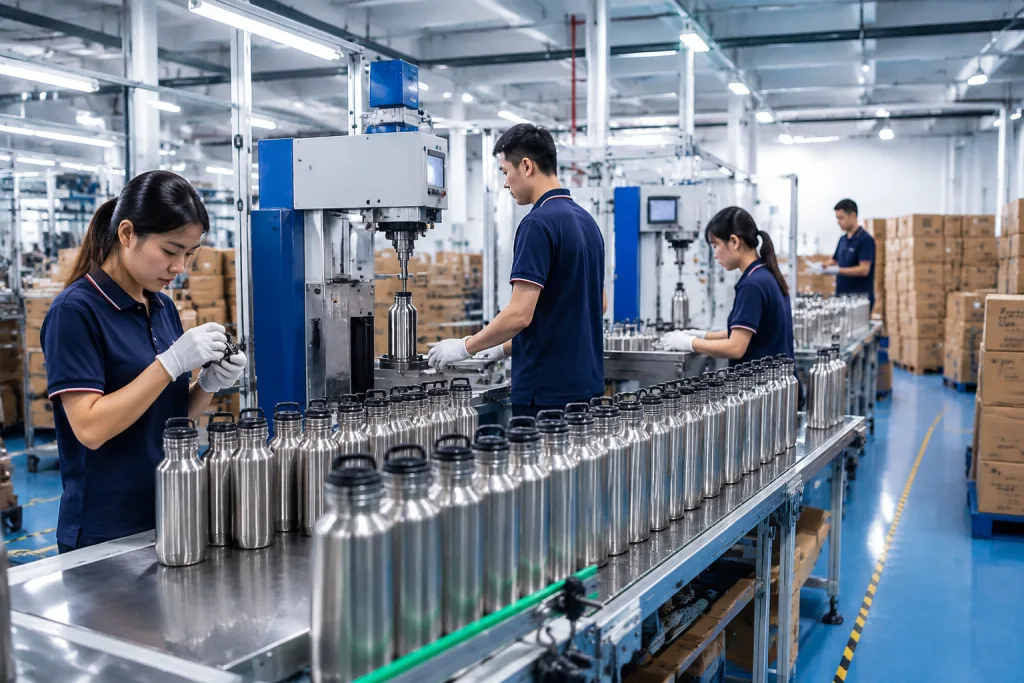
For stainless steel custom drinkware, the control plan should be clear before the line runs. On our floor, QC checks wall thickness with a caliper, verifies raw material against the mill cert, runs vacuum sampling after production, and pulls random finished goods by AQL standard. For most B2B programs, buyers set AQL 2.5 for major defects and 4.0 for minor defects. Retail programs are often tighter. We have had buyers flag a 0.3 mm paint miss at the rim, so this is not paperwork only.
- Leak test: 100% for assembled lids and seals; we run this station-by-station because one bad silicone ring can spoil a full carton
- Vacuum retention test: sample-based, often 6-12 hours depending on protocol; QC pulled the sample and logged temperature loss by batch
- Coating adhesion: cross-hatch or tape test on painted finish; this catches weak powder coating before shipment
- Drop test: especially for e-commerce and FBA packaging; carton failure at 76 cm is a common inspection finding
- Compliance review: REACH, LFGB, FDA-contact materials, or Proposition 65 depending on market; ask for the exact report set, not a vague promise
If you are buying from canteen suppliers in China for Europe, ask about REACH and LFGB at quotation stage. Ask early. If the supplier waits until mass production, we have seen this go sideways on ink, gasket, and coating reports. For North America, confirm FDA-contact material declarations and any retailer-specific testing. A canteen manufacturer already shipping to Europe and the US will usually turn documents in 3 days instead of 10, because the files and lab contacts are already in place.
Do not treat third-party inspection as optional on first orders. A pre-shipment inspection in China may cost around USD 250-350 per man-day, which is small against a 2,000-piece order value. On one order, the buyer flagged 18 cartons with wrong barcode labels because a PO suffix was typed as "A1" instead of "AI." That is the kind of simple mistake an inspection catches before loading. For new canteen vendors or canteen distributors building a private-label line, that spend is cheaper than one full defect dispute.
How to build a practical buying schedule
If you need a realistic purchase plan, count back from your in-warehouse date, not the ship date. This is the mistake we see most. Buyers track the 25 days on the line and miss 3 days for artwork sign-off, 5 days for sample comments, 4 days for vessel booking, and customs cutoff. For a standard custom canteen or customizable drinkware order from China, a safe total cycle is often 45-70 days from inquiry to FOB shipment, then add ocean transit. If your PO has 2 lid colors, a silk-screen logo, and a custom mailer, we tell buyers to build the longer side of that window.
A practical timeline looks like this:
- Quote comparison and spec alignment: 3-5 days
- Sample development and approval: 7-12 days
- Deposit payment and material booking: 2-4 days
- Bulk production: 20-35 days
- Inspection and balance payment: 3-5 days
- Export booking and loading: 3-7 days
For ocean freight from China, rough port-to-port timing is often 25-35 days to Western Europe and 20-35 days to North America, depending on service and congestion. Add 10 extra days if the delivery is tied to a fixed event date. We have seen this go sideways on promo launches. The schedule tightens fast with customized canteen packaging, customized drinkware sets, or a distributor growler program feeding 3 warehouses, because one barcode typo on a master carton can hold loading.
The best buyers send one clean tech pack: bottle size, steel grade, coating, logo method, packaging dieline, carton requirement, target Incoterm, and compliance market. Give the bottle diameter in mm, carton drop requirement, and print position from the base seam. QC pulled the sample last month on a project because the PO said “matte black” but the approved swatch was closer to Pantone Black 7 C. Clear inputs cut the quote cycle, reduce sample revisions, and help your hydration bottle manufacturer in Zhejiang hit the target the first time. Speed in sourcing comes from clarity, not pressure.
Get a clear quote before you commit volume
Send your target bottle spec, packaging, and quantity. We will quote MOQ, FOB pricing, sample timing, and production lead time with practical numbers.
Frequently asked questions
What is a realistic MOQ from a hydration bottle manufacturer in China?
For stock molds, 500-1,000 units is realistic for a basic custom logo order. If you need custom color, retail box, or several lid and body combinations, the practical MOQ usually becomes 1,000-2,000 units. For a fully new bottle mold or customized growler project, expect 3,000-5,000 units plus tooling charges of about USD 2,000-8,000. In Zhejiang, some factories will accept lower MOQs, but they often offset that with higher unit pricing or stricter color limits. Always ask whether MOQ applies per SKU, per color, per lid style, or total order, because those are very different commercial terms.
How much does a custom stainless steel bottle usually cost FOB China?
A standard 500 ml single-wall bottle often sits around USD 1.60-2.40 FOB China at 3,000 units. A 500 ml double-wall vacuum bottle is more often USD 2.80-4.20. Premium versions with powder coat, laser engraving, copper lining, and complex lids can run USD 4.30-5.90 or higher. Custom gift packaging may add USD 0.45-1.20 per piece. If you are comparing canteen suppliers, make sure the quote states steel grade, wall thickness, print method, packaging, and FOB port. A cheap quote without those details is usually not a true apples-to-apples number.
How long should I reserve from sample approval to shipment?
For a standard project, reserve 25-40 days from sample approval and deposit to FOB shipment. Simpler stock-mold orders can move in 20-25 days, while custom drinkware programs with mixed colors, custom boxes, or several SKUs usually take 30-35 days. Sampling itself often needs 5-12 days before that. If compliance testing or new tooling is involved, add another 5-15 working days. During peak production before Chinese New Year or year-end gifting season, build in a 7-15 day buffer. Buyers who need hard launch dates should plan on a full 45-70 day sourcing cycle before ocean transit.
What extra charges do buyers often miss on canteen customized orders?
The common missed costs are print setup, custom packaging, barcode application, carton upgrades, and tooling for lids or accessories. Silkscreen setup is often USD 30-80 per color, laser setup USD 20-50, and box artwork adaptation USD 80-200. A stronger export carton for drop-test compliance can add USD 0.08-0.25 per unit. Barcode stickers, inserts, and repacking can add USD 0.03-0.15 per piece. If you need a new cap or body shape, tooling can range from about USD 2,000 to USD 8,000. Ask for a full quote breakdown before placing the deposit so your landed cost is not distorted later.
What quality checks should I require from a canteen manufacturer?
At minimum, require 100% leak testing, vacuum performance checks for insulated bottles, coating adhesion tests, carton verification, and final inspection to an agreed AQL level such as AQL 2.5 for major defects. For Europe, confirm REACH and often LFGB support. For North America, ask for FDA-contact material declarations and any retailer testing requirements. On first orders, a third-party pre-shipment inspection in China usually costs about USD 250-350 per man-day and is usually worth it. Also confirm how defect claims are handled, what replacement percentage is offered, and whether spare lids or seals can be packed with the shipment.