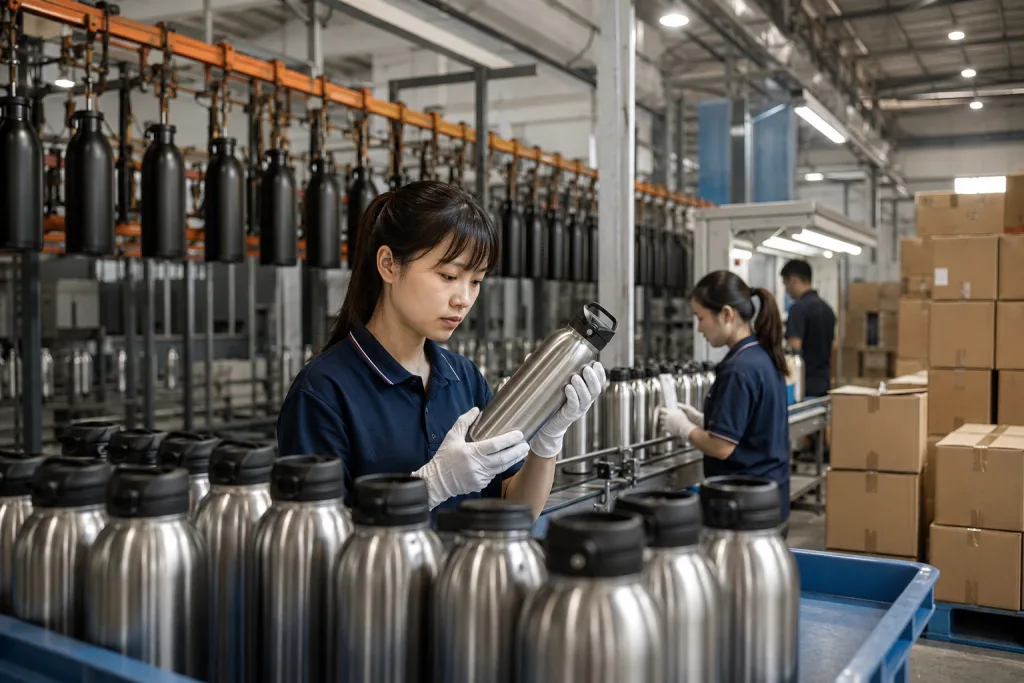
Key Takeaways
- A practical MOQ for a custom hydration bottle factory order is often 1,000-3,000 units per SKU, with 7-12 days for samples and 30-45 days for bulk production
- Lock core specs early: 18/8 stainless steel, 0.4-0.5 mm body wall, lid material, mouth diameter, logo method, and carton drop standard
- Use AQL 2.5 for major defects and AQL 4.0 for minor defects, with leak, coating adhesion, and barcode checks before balance payment
- FOB Ningbo or Shanghai pricing can shift by USD0.20-0.80 per unit depending on coating, lid complexity, and individual color box requirements
You are not buying “a bottle.” You are buying a repeatable production result: 32 oz capacity, no leaks at the lid torque spec, a logo finish that passes tape test, correct carton packout, clean test paperwork, and a ship date the line can hold. We have seen first orders go sideways even after an approved sample looked good on the desk. QC pulled the sample, it passed, but the bulk run followed the quote while key details stayed vague.
A serious B2B order in China needs more than a product photo and a target price. This is the wrong question to ask if the PO still misses wall thickness, MOQ, decoration limits, compliance scope, and the inspection plan before deposit. In Zhejiang, we ship smoother when the buyer locks a spec sheet early—down to carton dimensions in mm and even the common PO typo on color code or lid insert. The safest way to buy custom drinkware is to walk the order from concept to loading and catch risk while the fix costs 1 day and one sample, not 18 days and a full rework.
Start with the actual order brief
Say you are a brand owner in Europe buying a 32 oz insulated sports bottle for retail, or a distributor drinkware buyer in North America building a canteen promotional program for a chain customer. Start with the brief, not “best price.” This is the wrong question to ask. A Zhejiang factory can turn a quote in 24 hours, but a loose RFQ usually leaves 3 different assumptions on the table: yours, the sales rep’s, and the line’s. We have seen POs with “mat black lid” typed in one column and “gloss black” in the artwork note. QC pulled the sample, and the argument started there.
A usable brief needs the items that change tooling, yield, and inspection. If the neck finish is off by 0.3 mm, the lid fit issue will show up before mass production does. At minimum, you should send:
- Body type: single wall, double wall vacuum, or plastic hydration bottle
- Capacity: 500 ml, 750 ml, 1,000 ml, or 32 oz
- Material: 18/8 stainless steel, Tritan, PP, silicone
- Wall thickness: typically 0.4 mm inner and 0.5 mm outer for many vacuum stainless models
- Lid style: screw lid, straw lid, spout lid, carry loop, chug cap
- Decoration: silk screen, heat transfer, powder coating, laser engraving
- Packaging: polybag, egg-crate divider, white box, gift box, PDQ
- Market requirements: REACH, LFGB, FDA, California Proposition 65 where relevant
If you are also sourcing a custom canteen, custom growler, or customizable growler in the same program, separate the SKUs. Put them on different sheets. Buyers mix a hydration bottle, a growler, and a customized canteen into 1 enquiry, then push back when pricing moves. The factory is not being difficult. The lid mold, neck finish, powder-coating loss rate, and carton size are different, and the math does not work if all 3 items are quoted as one family. We ship programs where one growler takes a 5-layer mailer and the bottle runs in a standard 24-piece master carton.
A clean RFQ cuts sampling errors by more than half. Most bulk defects start as quoting gaps, not factory negligence.
For a medium-size export factory in Zhejiang, monthly output may be 300,000-500,000 units across bottles and tumblers. Big number. It still does not guarantee your slot. Custom orders run by schedule on the line, screen-print capacity, and vacuum lead time, not machine count alone. We have had buyers ask for shipment in 12 days when the normal decorated lead time was 18 days. If your customer needs a fixed ship window, tell the factory on day one.
Price the bottle the right way
Once the brief is clear, you can compare quotes without kidding yourself. A hydration bottle factory quote should show the cost drivers line by line, not bury them inside one FOB number. For example, a 750 ml double-wall stainless bottle may land around USD3.20-USD4.80 FOB China at 1,000-3,000 units depending on finish and lid. Add a complex flip-straw lid, custom pantone powder coat, and individual gift box, and the same bottle may move to USD4.60-USD6.20. We run into this on the line all the time: the body price looks stable, then a new lid with a 2.5 mm silicone straw and retail box shifts the whole quote.
Ask the canteen factory or canteen supplier to confirm these points in writing. Email is fine. A verbal “same as last time” is where orders go sideways, especially when QC pulled the sample and found the logo size on the PO did not match the approved artwork.
- MOQ by color: often 500-1,000 units per color
- MOQ by logo: sometimes shared across colors, sometimes not
- Sampling charge: typically USD50-USD150 for logo samples if no new mold is needed
- Mold cost: new lid tooling can run from USD2,000 to USD8,000
- Packaging adder: white box may add USD0.12-USD0.25; gift box can add USD0.35-USD0.90
- Decoration adder: laser engraving may be USD0.08-USD0.20; multi-color print can be higher
This is where new custom drinkware buyers get tripped up. They compare one quote from a canteen vendor using standard packaging against another from a canteen manufacturer using retail-ready color boxes and decide one supplier is expensive. That is the wrong question to ask. The quote is not expensive; the specification is different. We have seen buyers flag a USD0.48 gap, then admit one supplier packed 24 pcs per master carton and the other packed each bottle in a color box with an insert.
If you buy through canteen distributors or work as a canteen distributor yourself, margin protection depends on locking these extras early. The same logic applies if you sell as a distributor growler or distributor canteen account manager. Small packaging changes can erase 5-10 points of margin fast. The math does not work if you quote first and ask about the gift box later. One carton divider change can add USD0.07 per unit, and at 5,000 pcs that is money gone.
Do not skip logistics assumptions
Confirm whether the factory quote is EXW, FOB Ningbo, FOB Shanghai, or CIF. Zhejiang factories usually ship through Ningbo or Shanghai, and inland trucking, pallet rules, and booking timing all affect the final landed cost. We ship through Ningbo every week, and a one-day booking delay before ETD can turn into 12 days vs 18 days door-to-port during a tight season. If you need Amazon FBA prep, ask whether FNSKU labeling, carton limit compliance, and pallet labeling are included or charged separately. Buyers miss this one a lot. The buyer flagged it on one PO last month after seeing the carton height came in 6 mm over the FBA limit.
Sampling is where you catch trouble
Most order trouble shows up during sampling, not after the container lands. A solid hydration bottle factory should send a pre-production sample in 7-12 days for an existing model with standard decoration, and 15-25 days if the project needs new tooling or tricky artwork. We’ve seen buyers approve from one desk photo and then flag a 2 mm logo shift after mass production. That is the wrong question to ask. Approve the actual sample, not a flattering angle.
You should review the sample like a QC inspector:
- Capacity tolerance: verify stated volume at brimful and practical fill line
- Weight: confirm the sample is not lighter than quoted construction
- Leak test: invert filled bottle for 30 minutes, then do movement test
- Vacuum retention: ask for hot or cold retention data, such as 12 hours hot and 24 hours cold, with test method stated
- Coating: check color against Pantone and request adhesion test result
- Logo position: approve print size, angle, and distance from base seam
- Lid fit: open-close cycle, thread smoothness, odor, gasket seating
This matters even more on canteen custom and canteen customizable programs, where the end client often cares more about visual consistency than thermal performance. A custom logo line drifting 3 mm from piece to piece will still hold water, but the buyer will flag it fast. We ship plenty of customized drinkware for events, schools, and sports clubs, and cosmetic consistency is usually what decides whether the job is smooth or painful.
If you are buying a customizable canteen, customized growler, or customizable drinkware set, ask for a signed pre-production sample standard. Put the date, color code, and PO number on it; we once got a sample back with one digit wrong on the PO, and the whole approval trail turned messy. That signed sample becomes the inspection reference later. Without it, every defect call turns into opinion versus opinion.
If the factory says “bulk will be better than sample,” do not accept that as a process. Approve only what you are willing to receive.
Good canteen suppliers in China will flag risks you missed, like logo distortion on a curved body or weak contrast on textured powder coat. QC pulled one sample last month where the silk-screen looked sharp flat but stretched near the shoulder radius. That kind of pushback is useful. A supplier who says yes to everything without engineering comments is usually sending the problem down the line.
Set QC before production starts
QC needs to start before the first tube is cut on the saw, not after 2,400 cartons are taped shut. A solid hydration bottle factory runs incoming checks, line checks, and final random inspection, and each stage needs a written pass/fail standard. Your job is to lock that standard to your sales channel, shelf price, and complaint risk. We have seen this go sideways when a buyer approved the sample but never defined what counts as a major defect.
For a normal retail or promotional order, buyers often run an AQL plan like this:
- Critical defects: AQL 0, accept none
- Major defects: AQL 2.5
- Minor defects: AQL 4.0
Critical defects cover safety and compliance failures: sharp burrs on the lip, heavy leakage after the 30-minute invert test, mold contamination, wrong food-contact material, or failed paperwork. Major defects are sale killers but not direct safety issues, such as weak vacuum on insulated units, wrong logo size by 2 mm, incorrect carton markings, or a bottle that rocks on the flat plate. Minor defects are cosmetic: slight print offset, a small coating dot in a hidden area, or light carton scuffing. QC pulled one sample last month with the PO number typed wrong on the master carton label; the buyer flagged it as major because their warehouse scans by PO.
Tell the canteen factory which tests matter for your program, by SKU. This is the right question to ask. For stainless custom drinkware, the common checklist includes:
- 100% leak test
- Vacuum test for insulated models
- Salt spray or coating adhesion checks for painted surfaces
- Drop test for retail pack where required
- Dishwasher warning verification if the decoration is not dishwasher safe
- Barcode scan test on unit box and master carton
On our line, 100% leak test means every unit gets checked, not just first-off samples, and vacuum bottles should be verified before packing, not after palletizing. For painted bodies, cross-hatch adhesion tape testing is standard, and salt spray hours should match the claim on your spec sheet. If there is a retail pack, define the drop height up front—76 cm and 1.2 m are not the same result, and the math does not work if you leave packaging risk to guesswork. Barcode scans also need to be checked on both the unit box and the master carton with the actual scanner type your customer uses.
If your order is for schools or mass retail, ask about ASTM or CPSIA relevance where applicable for children’s products, and REACH or LFGB for the EU market. If the supplier claims BSCI, ISO 9001, or audit status, ask for the latest report summary with date, scope, and factory name, not a logo sitting in an email footer. We ship to EU buyers who check report validity line by line, and expired files get flagged fast.
Canteen vendors and canteen manufacturers are not equal on this point. Some run production well but struggle to pull a clean compliance file within 24 hours. Others send documents fast but outsource too much of the welding and painting. If you are managing a customized canteen or canteen customized launch for a serious retail account, you need both process control and document control, or you will lose time in pre-shipment review.
Manage production like a project
After the 30% deposit lands, the order should run on a dated schedule, not on chat messages. For an existing hydration bottle factory model with no new tooling, we usually quote 30-45 days after sample approval and deposit receipt. In peak season, from August to November, 45-60 days is normal for vacuum bottles and gift-box packing. The line gets tight then. We have seen one late color box approval push loading from 12 days to 18 days on the packing side alone.
A practical production timeline looks like this:
- Day 1-3: PO review, artwork confirmation, deposit receipt
- Day 4-10: raw material booking, packaging proof approval
- Day 11-20: body forming, welding, polishing, painting
- Day 21-30: printing, assembly, leak test, packing
- Day 31-38: final inspection, balance payment, booking
You do not need daily updates. You need milestone control. Ask your canteen supplier for production photos at three points: uncoated bodies, decorated semi-finished units, and packed cartons with shipping marks. QC pulled the sample at each stage in one of our recent runs because the buyer flagged a Pantone drift on the logo print. This check is cheap, fast, and it catches problems before 5,000 pcs are packed.
If you are ordering multiple SKUs such as a custom canteen, a custom growler, and a travel bottle under one project, settle the partial-shipment point early. This is the wrong question to leave until the end. A lot of canteen vendors assume one complete shipment, one BL, one balance payment. If one lid supplier is late by 6 days, or a 2 mm silicone gasket fails the leak test, your whole container sits unless you gave different instructions.
Watch the packaging details
Packaging creates more shipment claims than most buyers expect. Confirm master carton size, gross weight, barcode location, carton material, and drop performance. For export, keep cartons under about 15-18 kg if manual handling matters in your warehouse. We ship plenty of orders where the buyer cares more about a clean outer mark and consistent barcode position than saving USD0.03 on the box. The math does not work if your warehouse team has to relabel 800 cartons.
A factory in Zhejiang can run fast, but packaging rework can still add 5-7 days. We have seen this go sideways over the smallest things: wrong insert fit, mixed-language warnings, a barcode mismatch, even a PO typo in the shipping mark. One inspection finding last month was a 6 mm gap between bottle shoulder and paper insert window, which made the retail pack look sloppy on shelf. Approve artwork carefully and check a packed sample before mass packing starts.
Inspection, shipment, and repeat orders
Before paying the balance, inspect the order against the approved sample and the written standard on the PO. For most B2B orders, the right timing is final random inspection at 80-100% packed, not earlier while the line is still reworking lids. We usually tell buyers to check against the golden sample, carton spec, and AQL 2.5 plan in one pass. If the order value is meaningful, send a third-party team or your own QC staff. The inspection fee is small next to one bad container arrival. We have seen a single 2 mm logo shift turn into a full rework claim.
At final inspection, focus on the points that create actual loss, not cosmetic debates that nobody flagged on the approved sample.
- Function: leakage, vacuum failure, loose handles, poor gasket fit; QC pulled the sample and ran a hot-water hold test before sealing the report
- Appearance: logo accuracy, color consistency, dents, coating defects; one buyer flagged a Pantone drift after seeing mixed shades from two spray batches
- Count: packed quantity by SKU, color, and carton; this is where PO typos show up, like 5,000 pcs ordered and 500 pcs printed on the carton mark sheet
- Packaging: insert protection, carton labels, pallet rules if needed; check drop protection, carton burst strength, and whether the pallet height matches the booking limit
- Documentation: test reports, packing list, carton dimensions, HS code alignment; the math does not work if the paperwork is clean but the carton CBM is wrong
For a hydration bottle factory order going FOB Ningbo, the final document set usually includes commercial invoice, packing list, and any requested test reports. If the program goes to Amazon or marketplace fulfillment, confirm FNSKU labels, carton labeling, and no mixed-SKU cartons before loading. This sounds basic. It is where shipments get stuck. We have seen buyers miss one outer-carton label line and then pay relabel fees at the warehouse.
The last step is the one buyers skip most: post-order review. After the shipment leaves China, record the actual result on price, lead time, defect rate, and reply speed. If the canteen manufacturer delivered 98.8% pass rate, 38-day production, and accurate documents, that tells you more than saving USD0.06 with a new vendor next season. This is the wrong question to ask: “Who is cheaper this month?” Ask who ships clean POs with fewer claims. Stable repeat business is where a hydration bottle factory becomes a real canteen partner, not a one-order canteen vendor.
Good repeat-order factories usually reduce friction on the second PO: sample approval in 3 days instead of 7, cleaner print alignment on the jig, and fewer setup mistakes on the line. They already know your customized drinkware standard, your carton mark format, and whether you allow a 1 mm logo tolerance. That is the payoff from doing the first order properly, whether you buy as a canteen distributor, work with canteen distributors, or source for your own brand line.
Send your bottle spec and get a factory-ready quote
Share capacity, material, lid, logo method, packaging, and target quantity. We will review feasibility, MOQ, lead time, and QC points before sampling.
Frequently asked questions
What MOQ should I expect from a hydration bottle factory?
For an existing stainless steel model, a realistic MOQ is usually 1,000 units per SKU, with some factories accepting 500 units for simple stock colors. If you want custom pantone coating, special lids, or individual retail boxes, MOQ often moves to 2,000-3,000 units. New molds are a different case. A custom lid or body can require a tooling investment of roughly USD2,000 to USD8,000 and a higher opening quantity. In Zhejiang, China, many export factories can be flexible on first orders if the program has repeat potential, but you should assume the lowest MOQ usually comes with fewer color choices and less packaging customization.
How do I compare canteen manufacturers without wasting time?
Compare them on one fixed RFQ sheet. Use the same capacity, material, coating, lid, packaging, Incoterm, and compliance requirements for every supplier. Ask each canteen manufacturer to state MOQ, sample lead time, bulk lead time, FOB port, testing scope, and whether the bottle is made in-house or partly outsourced. A quote that is USD0.40 lower may simply exclude the color box, barcode sticker, or REACH test file. Also ask for a defect handling policy and production photo updates. For a serious B2B order, the best canteen factory is not the one with the lowest unit price. It is the one that can hold specification and ship on the agreed date.
What tests matter most for custom drinkware orders?
Start with the basics: 100% leak test, vacuum performance test for insulated bottles, coating adhesion check, barcode scan test, and carton verification. For Europe, ask about REACH or LFGB relevance. For North America, confirm FDA food-contact compliance and review any Proposition 65 exposure points if applicable. If the order is for children, ASTM or CPSIA requirements may also matter depending on the product design and market. On the construction side, confirm material grade such as 18/8 stainless steel and typical wall thickness around 0.4-0.5 mm for many insulated bottles. If a supplier cannot clearly explain how it tests these points, that is a warning sign.
How long does a customized canteen order usually take?
For an existing model, plan around 7-12 days for a logo sample and 30-45 days for bulk production after sample approval and deposit. If you add new tooling, unusual packaging, or peak-season scheduling, total time can stretch to 50-60 days. Shipping time is separate, so buyers in Europe or North America should build in ocean transit and customs clearance. In China, especially during the heavy August-November season, coating and packing lines can become the bottleneck even if bottle forming is on schedule. The safest approach is to lock artwork, carton markings, and compliance paperwork early so the factory does not lose a week on preventable approvals.
Should I buy from a canteen supplier, trading company, or direct factory?
It depends on your order mix. If you need one focused stainless bottle program with stable repeat volume, direct factory sourcing usually gives better control over lead time, QC, and engineering feedback. If you are sourcing mixed categories such as custom canteen, customizable growler, glass bottle, and accessories in one project, a capable supplier or trading partner can simplify coordination. The key is transparency. Ask who makes the bottle body, who sources the lids, and who controls final inspection. Some of the best canteen suppliers in Zhejiang manage outsourced parts well; some direct factories do not. Choose the partner that can document process control, quote clearly, and respond fast when there is a defect or schedule risk.