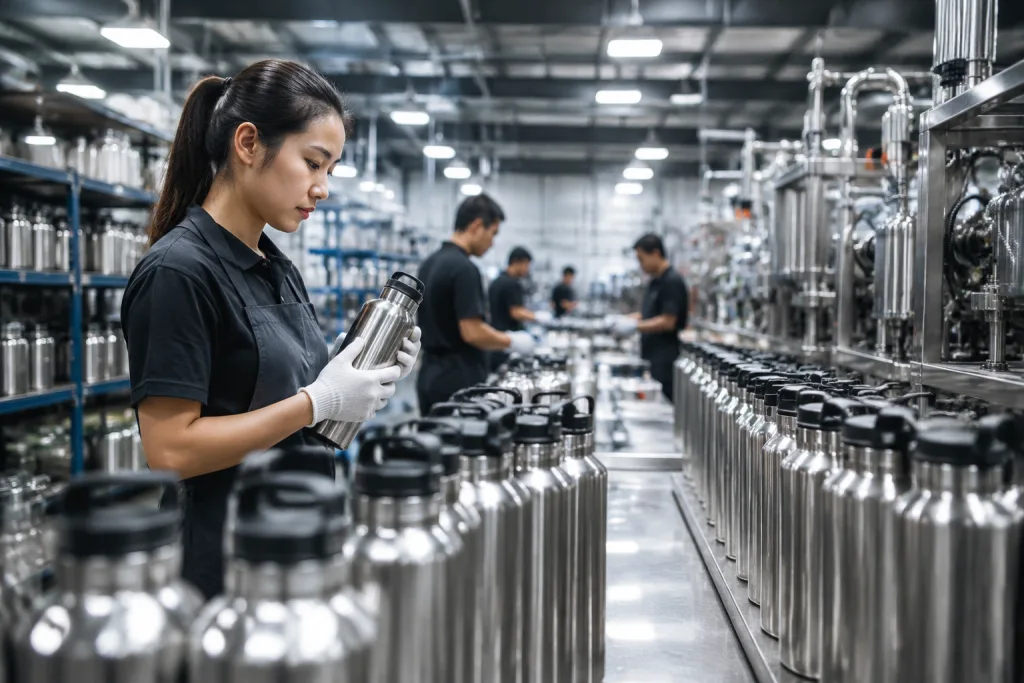
Key Takeaways
- Lock the first 4 decisions early: channel, bottle construction, decoration, and supply model; this can cut sourcing time by 30-45 days
- For most B2B programs, practical MOQ starts at 1,000-3,000 pcs per SKU, with repeat orders often shipping in 25-35 days from Zhejiang, China
- 304 stainless inner and outer walls cover most hydration needs, while 316 inner walls usually add about USD 0.25-0.60 per bottle
- Use AQL 2.5 for major defects, request leak testing at 100%, and confirm REACH, LFGB, FDA, or ASTM requirements before mass production
You are not buying a bottle. You are buying gross margin, ship dates, and a product that does not come back on an RMA. This gets messy fast. A catalog looks clean, the FOB price looks fine, then the line leaks at 15 kPa on the vacuum test, the logo fails after 300 dishwasher cycles, cartons miss the PO print, or the retail pack does not meet Europe or North America shelf requirements. We have seen one typo on a master carton PO hold 1,200 pcs for two days.
The better move is to lock four decisions early: sales channel fit, construction spec, decoration method, and supply model. Get those right first. Then you can compare a canteen supplier in China, a canteen manufacturer in Zhejiang, or a mixed distributor drinkware program without burning 3 weeks on samples that were wrong from day one. This is the wrong question to ask if you start with unit price only; QC pulled the sample, but the math still did not work.
Start with the commercial model
The first mistake 7 out of 10 buyers make is starting with color, cap style, or powder coat before they lock the commercial model. That is backwards. If you are screening a hydration bottle distributor, ask the cleaner question first: do you need a stock-and-ship partner, a direct canteen factory in China, or a hybrid supplier that runs both? On our side, the buyer who starts with Pantone before volume and delivery usually ends up revising the PO twice.
A stock distributor fits orders that need speed, low admin, and smaller runs. You usually get dispatch in 3-7 days instead of 25-35 days, but shape options stay tight and carton, insert, and neck tooling choices are limited. A direct canteen manufacturer gives you the other side of the deal: better pricing control at 5,000 pcs and up, more freedom on custom canteen development, and cleaner room to build a private-label line. The tradeoff is simple. You have to manage approvals, samples, and lead time with discipline. We have seen this go sideways over a 2 mm logo shift that the buyer flagged only after mass production photos.
For a lot of distributors and brand owners in Europe and North America, the hybrid model is the one that works in real life. You source core bodies from a canteen factory in Zhejiang, China, then keep local flexibility through warehouse stock, staggered shipments, or split decoration timing. We run this model often: bare stock ships first, then laser marking or pad print follows by batch, which helps when one SKU moves faster than the rest. This is the wrong question to ask if you only focus on ex-factory price; the math does not work if 18 days of delay costs you the season.
Use this decision filter
- Need launch speed under 20 days? Use stocked shapes and standard cartons. Ask for actual dispatch time, not a sales promise.
- Need lower landed cost on 5,000+ pcs? Work closer to a canteen manufacturer or canteen supplier in China. At that level, small changes in carton count per master carton start to matter.
- Need exclusive shape or premium margin? Consider tooling and direct factory development. QC pulled the sample on one project because the lid thread feel was off after the first mold trial.
- Need Amazon FBA or retail compliance? Confirm labeling, carton marks, FNSKU, and barcode process before quoting. We have had a buyer send the wrong barcode suffix on a PO, and that is a costly mistake if nobody checks before packing.
At BottleForge Industrial in Zhejiang, typical MOQ is 1,000 pcs for standard stainless models and 3,000 pcs for more customized drinkware configurations. Normal repeat lead time is 25-35 days after deposit and artwork approval. Those are the baseline numbers you should get from any canteen vendors or canteen distributors you shortlist. Ask for decoration limits too—screen print size, laser area, and carton spec, not vague claims. If they cannot state MOQ, lead time, and decoration limits in numbers, you do not yet have a workable supplier quote.
Choose the bottle around usage
Good buyers do not start from the bottle. They start from the usage case. Gym retail, corporate gifting, campus programs, and outdoor wholesale can all use a similar shape online, but the spec should change. We see this on the line all the time: a buyer sends one 650 ml sketch for four channels, then flags the weight after the first pre-production sample hits 420 g.
For everyday hydration, the safest base is 18/8 stainless steel, also called SUS304, with double-wall vacuum insulation in 500 ml to 750 ml. That combo works because the cost holds, the thermal result is stable, and decoration options stay open for powder coat, silk print, or laser marking. Typical wall thickness is 0.4 mm outer and 0.4 mm inner. If you move to 0.5 mm, dent resistance improves, but the bottle gets heavier and the unit price climbs. On a 700 ml body, QC usually checks the rim and bottom seam first because that extra steel shows up there fast.
If your market sells more electrolyte drinks, or you need a higher-end story, ask for a 316 inner wall. Most canteen manufacturers quote that as an upgrade, not a standard spec. For a 650 ml bottle, that often adds USD 0.25-0.60 depending on volume and steel pricing. We have also seen buyers ask for full 316 inside and outside, then pull back after the first quotation. Fair point. The math does not work for every channel.
You do not need the highest spec. You need the spec that survives your channel without killing your sell-through price.
Cap design matters as much as steel grade. A screw lid with silicone seal is still the lowest-risk option for leakage, and this is the right place to stay conservative. Straw lids, flip lids, and carry-handle caps sell well, but each one adds parts, assembly steps, and after-sales headaches. We run leak tests with a vacuum gauge and upside-down hold test, and accessory lids fail more often than buyers expect. If you are buying canteen promotional stock for events, keep it simple. If you are building a premium custom drinkware range, accessory caps can widen margin — but we have seen this go sideways when the replacement-cap MOQ starts at 3,000 pcs per color.
- Promotional volume: 500-600 ml, single color print, standard screw lid
- Retail hydration: 650-750 ml, powder coat, carry loop, branded carton
- Outdoor or camping: larger 900-1,200 ml body, stronger handle, optional custom growler family extension
- Kids or school: lighter body, easy-clean lid, ASTM-related testing if required by market
This is where terms like canteen custom, canteen customizable, and canteen customized need a clear spec behind them. If a canteen vendor cannot tie body construction, cap style, and test standard to the usage case, you are just buying from a catalog. Last month one PO even said “kid sport botle” and missed the straw cleaning brush requirement; QC pulled the sample before shipment, which saved the order.
Know where margin really moves
Most buyers fixate on the ex-works unit price. That is the wrong question to ask. On hydration bottles, margin usually moves faster in decoration, packaging, and defect control than in squeezing USD 0.08 off the steel body. We see this on the line all the time: QC pulled the sample, the body was fine, but print registration drifted 1.5 mm and the rework bill ate the “saved” cost.
Take a standard 650 ml vacuum bottle. A plain stainless item might quote around USD 2.80-3.60 FOB China at 3,000 pcs depending on steel market conditions, cap type, and carton setup. A powder-coated bottle with one-color silkscreen may land around USD 3.20-4.10 FOB. Add a gift box, laser engraving, and a second lid, and you may move above USD 4.50 quickly. That does not mean the product is overpriced. It means the cost stack changed. We run into buyer pushback here, especially on “same bottle, why higher price?” The answer is simple: extra lid set, box insert, and another packing step at the bench all add labor and loss risk.
Ask every hydration bottle distributor or canteen supplier to break the quote into parts:
- Body cost
- Lid cost
- Decoration cost by method and color count
- Packaging cost per unit
- Testing or compliance fees
- Tooling or mold amortization if any
This is how you compare offers cleanly. A direct canteen manufacturer in Zhejiang and a canteen distributor with stock and local support are not selling the same package, even if the photo looks identical. Split the quote and the gaps show up fast. We have seen bulk pack instead of individual color boxes save USD 0.18-0.45 per unit, and that is before you count faster carton packout on the line. Using laser instead of 2-color print can cut artwork registration risk; the unit cost does not always drop, so check the math.
If you also sell adjacent products such as custom growler, customizable growler, or customized growler items, ask for one decoration and packaging matrix across the range. It saves time. It also stops spec drift between SKUs. Last season one buyer sent three POs with the same matte black callout spelled two ways, and the carton marks had to be corrected before shipment.
The same principle applies to freight. A bottle that is 8 mm taller can wreck carton efficiency enough to wipe out the unit savings, and we have seen this go sideways on 40HQ planning. Ask canteen suppliers for carton dimensions, units per carton, gross weight, and estimated 40HQ loading quantity with the quote, not two weeks later. That is buying logic now.
Decoration choices have trade-offs
Every buyer wants the same thing: a bottle that looks premium, survives handling, and lands inside target cost. Most projects get two fast. Getting all three takes tighter artwork control and the right process on the line. We have seen a 1-color logo pass cost review, then fail after a 500-cycle rub test because the artwork was too fine for the powder coat texture.
For customized drinkware, the common methods are silkscreen printing, heat transfer, laser engraving, and full-wrap digital processes. Each suits a different job. This is the wrong question to ask: “Which decoration is best?” The better question is which one fits the bottle finish, MOQ, and abuse level after shipment.
- Silkscreen: Best for bold logos and simple spot colors, with lower setup cost. It is common for canteen promotional orders from 1,000 pcs up. We run this most on straight-wall bodies because wrap angle and registration stay easier to hold.
- Laser engraving: Durable and clean, especially on powder coat. Good for corporate and premium retail programs. On a 304 stainless bottle with powder coat, the mark usually stays sharp if the beam setting is dialed in before mass run.
- Heat transfer: Works for multi-color artwork, but test adhesion on curved bodies. QC pulled the sample more than once where a shoulder radius was too tight and the film lifted at the edge.
- UV or digital full wrap: Strong shelf impact, but usually higher cost and stricter handling requirements. The buyer flagged carton scuffing on one 3,000 pcs run because separators were too thin for the printed surface.
Do not approve decoration from a flat PDF alone. Ask for a pre-production sample on the exact bottle finish. Matte powder coat, glossy paint, bare stainless, and electroplated surfaces all behave differently. A 0.3 mm line that looks clean on screen can fill in on textured powder or break on a curved glossy body. We check this with the actual sample in hand, not just the artwork file.
For a canteen customizable program, define decoration limits in writing:
- Minimum line thickness, for example 0.3 mm
- Maximum logo height and width by bottle size
- Pantone matching tolerance
- Location tolerance, often plus or minus 2 mm
- Adhesion and rub test standard
If your buyer team sources from multiple canteen vendors or canteen manufacturers, standardize these rules across suppliers. That cuts the usual problem where one factory approves artwork another factory cannot reproduce. We have even seen a PO typo switch logo width from 32 mm to 23 mm, and nobody caught it until the sample stage.
China factories that run both in-house coating and printing usually control defect rates better because there are fewer handoffs. In Zhejiang, this matters because 12-day schedules get pushed to 18 days fast on seasonal programs. If the coating is outsourced and the print is done elsewhere, schedule risk goes up unless the canteen factory has strong process control and documented incoming inspection. The math does not work if each vendor blames the next one for color shift or surface dust.
Compliance is not optional paperwork
If you sell into Europe or North America, compliance sits inside the product cost and production plan. It is not a file to chase the night before shipment. A solid hydration bottle distributor should tell you, in plain terms, which standards apply by material, buyer age group, and sales channel. If they cannot do that in the first 15 minutes, we have seen that go sideways once sampling moves to the line.
For stainless steel hydration bottles, buyers usually ask for FDA or LFGB food-contact alignment, REACH screening for applicable chemical restrictions, and packaging compliance based on the destination market. For kids' items, ASTM-related requirements may apply depending on the bottle style, straw part, or accessory set. Recycled-content claims need tight backup. This is the wrong question to ask: “Can you print a recycled logo?” Ask what can be substantiated by batch documents, supplier declarations, or claim scope, and what is only sales language. QC pulled a sample last month where a PO said “RPET lid” but the approved BOM was virgin PP; that kind of typo becomes a claim problem fast.
Factory management standards matter too. BSCI, Sedex, or ISO-style quality systems do not promise a perfect bottle, and no experienced buyer should expect that. They do tell you whether the factory can run document control, close corrective actions on time, and survive a retailer audit without scrambling for 3 days to rebuild records. On our floor, that shows up in simple stuff: version-controlled SOPs at the leak-test station, calibration tags on the torque meter, and CAPA logs that match the actual defect photos.
What to confirm before deposit
- Material grade for body, lid parts, and seals
- Whether test reports are current and product-specific
- AQL standard, commonly AQL 2.5 major and 4.0 minor
- 100% leak test method and hold time
- Whether insulation performance is checked by batch
- Drop test or carton test requirements for your channel
On quality control, ask for the factory flow, not a yes-or-no answer. A workable process in China usually means incoming raw material inspection, in-process checks after forming and painting, pre-assembly leak testing, final random inspection, and shipment release against AQL. If your order is 10,000 pcs, random inspection alone does not cover lid risk. We run 100% leak testing for lids because that is where buyers push back first. Ask the factory what pressure they use, how long they hold it, and who signs off the batch card; 30 seconds on an air-pressure rig tells you more than a polished PDF.
This is where an experienced canteen supplier or canteen factory in Zhejiang earns its place. Paperwork matters. Shop-floor discipline matters more. If the line cannot match the report, the math does not work.
Build a sourcing plan that scales
Once the first SKU is right, scale is the next test. We’ve seen buyers approve one clean sample, then hit trouble on the second PO: Pantone drift on the powder coat, lid threads that bind on one body, or a 3 mm logo shift the buyer flagged at incoming inspection. A sourcing plan fixes that before the line gets busy.
Start narrow. One or two core hydration bodies, two lid options, and three proven finishes are enough for many launches, and the math doesn’t work if you open 14 combinations on day one. We usually suggest running one 500 ml and one 750 ml body first, then adding custom canteen sets, larger customizable canteen formats, or adjacent distributor growler and custom growler lines after the first repeat order ships clean.
Ask your hydration bottle distributor or direct canteen manufacturer these scaling questions, not general sales talk. QC pulled the sample once where the PO said “matt black” and the approved swatch was “matte black,” and that small typo turned into a full recheck.
- Can the same cap fit 500 ml, 650 ml, and 750 ml bodies?
- Are spare lids available for at least 12 months?
- Can repeat powder coat colors match within a defined tolerance?
- Can mixed SKUs ship in one container under one inspection plan?
- What is the monthly capacity for this body family?
At factory level, ask for numbers. A solid answer might be 300,000 units per month across stainless vacuum lines, with 7-10 days for pre-production sample approval and 30 days for mass production on standard colors. We run this check against actual line loading, not brochure claims, and 2 lines with 45,000 pcs each tell you more than someone calling themselves a large canteen manufacturer.
Payment terms shape scale too. Many China suppliers start at 30% deposit and 70% balance before shipment, usually on FOB terms from Ningbo or Shanghai, and that is normal for a first order. Buyers push for OA too early; this is the wrong question to ask before repeat quality is stable and the defect record stays inside AQL 2.5 for 2 or 3 shipments.
If you work with multiple canteen distributors, canteen suppliers, or canteen vendors, keep one internal specification sheet per SKU with approved BOM, finish code, logo position, packaging photo, carton marks, and test requirements. Put the carton size in mm, the unit weight in kg, and the backup lid code on the same sheet. That is how you turn a one-off customized canteen order into a repeatable B2B product line, not a sourcing mess that resets every season.
Get a workable hydration bottle quote fast
Send your target size, MOQ, decoration, and channel. We will recommend the right bottle spec, compliance path, and Zhejiang production plan within one business day.
Frequently asked questions
What MOQ should I expect from a hydration bottle distributor or factory in China?
For standard stainless vacuum bottles, a practical MOQ is usually 1,000 pcs per SKU for existing molds and standard colors. If you need a custom color, special lid, gift box, or more complex customized drinkware packaging, MOQ often moves to 2,000-3,000 pcs. Completely new tooling for a custom canteen body can require 5,000 pcs or more plus mold cost. In Zhejiang, China, many factories will allow mixed colors within one order if the total quantity meets the main MOQ, but decoration setup still needs minimum runs. Always ask whether MOQ applies by model, color, print design, or packaging type, because suppliers define it differently and that changes your real buying cost.
Is it better to buy from a canteen manufacturer or a canteen distributor?
It depends on your priorities. A canteen distributor is better when you need lower complexity, quicker dispatch, and smaller-volume replenishment. A direct canteen manufacturer is usually better when you need lower FOB cost, private-label control, and room for canteen customized or customizable canteen development. For many B2B buyers, the best setup is mixed: source core products from a canteen factory in China and keep flexible stock or local service through a distributor. If your annual volume is above 20,000-30,000 units across a few SKUs, buying closer to the factory often improves your margin. If you are testing a market with under 5,000 units, a distributor model may reduce risk.
What lead time is normal for custom drinkware orders?
For existing bottle shapes with standard lids, sampling usually takes 5-10 days, depending on finish and logo method. Mass production after sample approval is commonly 25-35 days for repeatable stainless programs in Zhejiang, China. Peak season, complex packaging, or multiple decoration steps can push that to 40-50 days. If you need a new mold for a custom canteen or customizable growler body, add roughly 20-35 days for tooling and confirmation samples. Freight time is separate, so buyers should plan from approved sample to delivered stock, not just factory completion date. Ask your supplier to split the schedule into sampling, production, inspection, booking, and transit so you can see where delay risk sits.
How do I compare quotes from different canteen suppliers fairly?
Use a fixed quote sheet and force every canteen supplier to price the same structure. Include bottle size, steel grade, wall thickness, lid material, seal material, finish, print method, packaging, carton size, FOB port, MOQ, sampling cost, and testing scope. Without that, one quote may look cheaper simply because it uses a lighter wall, thinner coating, or simpler carton. Also compare loading quantity per carton and per container, because freight efficiency changes landed cost. For a real apples-to-apples comparison, ask for the net unit price plus all adders. A supplier quoting USD 3.10 FOB may actually be more expensive than one quoting USD 3.25 if the first excludes color box, leak testing, or barcode labeling.
What quality checks matter most for hydration bottles?
Start with the defects that create returns: leakage, poor insulation, dents, and logo failure. Ask for 100% leak testing on assembled bottles, not random checks only. Confirm AQL level, with 2.5 for major defects being common for B2B drinkware programs. For insulation, request batch testing with clear temperature retention criteria, such as hot or cold performance after a stated number of hours. For decoration, specify adhesion and rub resistance. If the bottles are for retail, add drop testing for the packed unit and carton compression checks for transit. Good canteen manufacturers in China can document this process with inspection photos and reports, which is much more useful than a generic statement that quality is controlled.