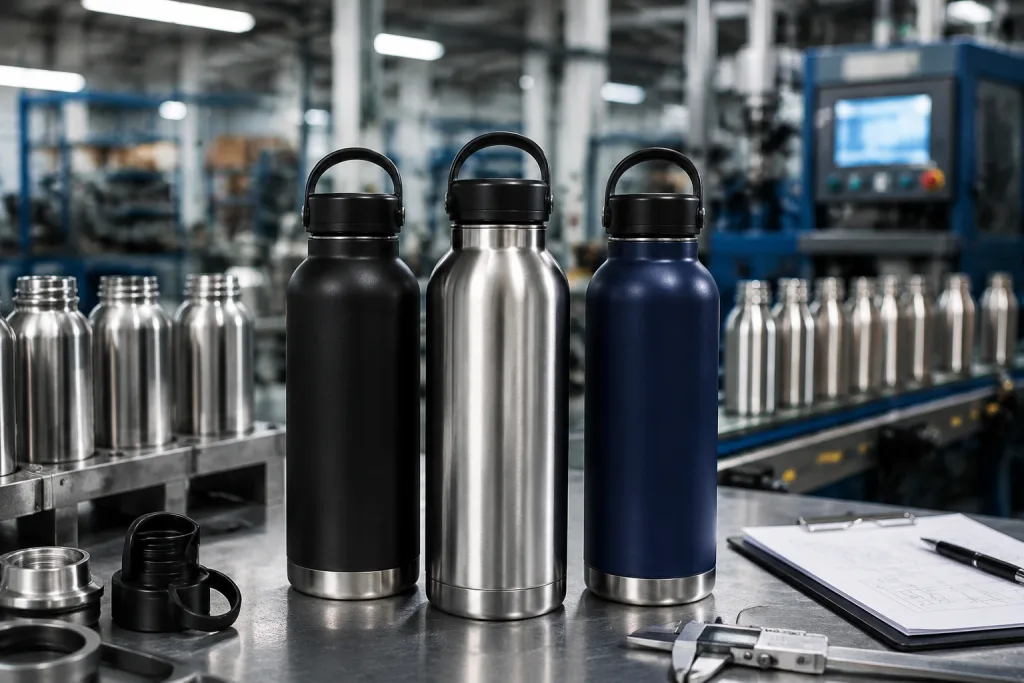
Key Takeaways
- For most stainless hydration bottle customizable orders, practical MOQ starts at 1,000 pcs per model and 300 pcs per color, with 35-45 day lead time after sample approval.
- Single-wall Tritan bottles usually land 25-40% lower in unit cost than double-wall stainless, but complaint risk rises if the market expects temperature retention.
- Silkscreen is cost-effective under USD 0.18-0.35 per color per unit, while powder coat plus laser engraving gives better durability for retail and corporate programs.
- Ask for REACH, LFGB or FDA contact material documentation, plus AQL 2.5 inspection and leak test standards before paying the 70% balance.
You are not buying a bottle. You are buying landed cost, complaint rate, print durability, and an ex-factory date your sales team can defend. On our line, QC pulled a sample after a 72-hour tape test and the logo came off at the edge. That is how first orders for hydration bottle customizable programs go sideways: the print scratches, the lid leaks by week three, the MOQ jumps once 4 colors are split, or the quote leaves out testing and export cartons.
If you source from Zhejiang or elsewhere in China, you will see 200 suppliers fast. The wrong question is who has the cheapest bottle. A practical buyer lines up body material, lid structure, decoration process, carton loading, and compliance in one sheet, then checks the math. We run this comparison every week, down to details like a 5 mm foam pad in the shipper or whether a PO typo swapped 304 stainless for painted steel. That is the sensible way to choose a custom canteen for promotions, a premium customizable growler, or a retail-ready customizable drinkware line for Europe and North America.
Start with the spec table
For a hydration bottle customizable project, do not start from the shape sketch. Start from the commercial spec table. This is the first screen we check on the line. A solid canteen manufacturer in China should answer it in one email, with MOQ, FOB, lead time, carton pack, and no fuzzy wording.
| Option | Typical MOQ | FOB China Price | Lead Time | Best Fit |
|---|---|---|---|---|
| Single-wall 18/8 stainless 600ml | 1,000 pcs | USD 2.20-3.40 | 30-40 days | Canteen promotional, gym chains, events |
| Double-wall vacuum stainless 750ml | 1,000 pcs | USD 4.10-6.80 | 35-45 days | Retail, corporate gifting, outdoor |
| Tritan 700ml with straw lid | 2,000 pcs | USD 1.60-2.90 | 25-35 days | High-volume custom drinkware programs |
| Wide-mouth growler 1.2L | 500-1,000 pcs | USD 6.80-10.50 | 40-50 days | Customized growler, brewery merch |
This table matters because each body type fixes a different business problem. For school supply, promo, or event orders, single-wall and Tritan usually carry the freight math better; a 600ml single-wall body often cuts outer carton weight by 2-3 kg versus vacuum bottles on the same master pack. For private-label retail, double-wall vacuum is usually the safer bet. It gives you better shelf value, better margin, and fewer complaints about temperature hold. We have seen this go sideways when a buyer chose the cheapest body first, then got stuck with weak repeat orders.
At BottleForge Industrial in Hangzhou, Zhejiang, we tell new buyers to lock one bottle family first, then tune the color, lid, and print. Simple works. On sample review, QC pulled a set where the PO said “navy matt” but the spray card was closer to Pantone 7545 C, and that kind of mismatch gets worse once you split across 6 SKUs. Factories that push six SKUs on day one are usually protecting their machine schedule, not your launch. A canteen factory with 500,000 units per month capacity still runs into delays if your order is broken into too many bodies, lids, straws, and decoration setups.
- Body material: 18/8 stainless, 18/10 stainless, Tritan, or glass; we usually ask for wall thickness in mm at this stage because that changes weight and dent risk fast
- Capacity: 500ml, 600ml, 750ml, 1L, and 1.2L are the most carton-efficient; the 600ml and 750ml sizes are the ones we ship most often
- Lid system: screw cap, straw lid, spout lid, bamboo cap, or flip top; buyers often flag straw leakage first, so ask what passed the inverted test
- Decoration: silkscreen, heat transfer, digital print, laser, or powder coat + engraving; check if the artwork needs a 1.5mm line minimum before you approve the proof
If a supplier cannot lay out this comparison cleanly, keep looking. This is the wrong question to dodge. A reliable canteen supplier should make the buy simpler, with clear numbers, clear trade-offs, and fewer surprises after deposit.
Material choices head to head
Buyers ask which material is best. Wrong question. The better one is which complaint you can live with at 10 cases per 10,000 units, because every material fails in its own way.
Stainless steel vs Tritan vs glass
18/8 stainless steel is the standard for premium customizable canteen and customized drinkware programs because it survives repeat use, supports vacuum insulation, and holds finishes that do not scuff up after one container drop test. Typical inner wall thickness is 0.30-0.35mm and outer wall 0.45-0.50mm for a stable retail bottle. We run thinner walls only when a buyer pushes hard on target cost, and the savings are usually a few cents while dent claims go up in transit.
Tritan fits projects that need lower FOB cost and clear-body visibility. We ship a lot of it for canteen promotional orders, sports clubs, and impulse programs, often starting from a 3,000 pcs MOQ with silk screen or heat-transfer decoration. The pushback is predictable: buyers in Europe and North America still read clear plastic as lower value, even if the drop test passes. If your target retail price is above USD 19.99, Tritan gets harder to move unless the shape, lid, and color story are sharp.
Glass looks clean and premium for office or wellness channels, but the math does not work on every program. A 550ml glass bottle with sleeve can add enough carton weight to change freight brackets, and QC pulled the sample more than once for rim chips after vibration testing. It is rarely the first choice for a distributor drinkware project unless the brand story needs glass.
A good canteen vendor does not say one material is always better. It asks where the bottle will be sold, what shelf price you target, and how many complaint cases per 10,000 units your business can tolerate.
For a custom growler or customizable growler, stainless almost always wins because sealing, insulation, and abuse resistance matter more than unit cost alone. We have seen this go sideways when a buyer tried to save USD 0.40 on body material and then flagged heat loss after 6 hours. For a customized canteen used in schools or daily commuting, double-wall stainless gives the broadest market fit. For bulk giveaways, Tritan or single-wall stainless is usually enough.
In Zhejiang and other manufacturing clusters in China, raw material sourcing is mature, but factory control still decides your result. Ask whether the canteen factory checks wall thickness with an ultrasonic gauge, cuts weld samples from the line, and runs an odor check 24 hours after painting. We caught one batch where the PO had a lid color typo and incoming resin tags did not match. These are basic buying checks, not luxury questions.
Decoration durability versus unit economics
The logo method you choose affects reorder satisfaction more than buyers expect. We have seen a USD 0.22 print choice turn into the most expensive line on the PO once rub-off claims started and QC pulled the returned sample.
Silkscreen printing is still the standard for canteen customized projects with simple 1-2 color artwork. It is economical, fast, and easy to run on the line. Typical added cost is USD 0.18-0.35 per color depending on bottle shape and print area. On a straight body we run 1 pass cleanly; on a tapered body the jig setup and print angle matter. For promotional campaigns with a short life cycle, that is usually enough.
Heat transfer and digital wrap fit complex graphics, gradients, or lifestyle branding better. They look good on customizable drinkware, but adhesion lives or dies on surface prep and curing control. Ask for cross-hatch adhesion testing and dishwasher guidance in writing. We use a 1 mm cross-hatch cutter for this, and this is where buyers get burned: the sample looks fine, then batch consistency slips if the curing window is loose.
Laser engraving on powder-coated stainless is the safest option for premium programs. It costs more up front, but it cuts abrasion complaints. That is why many canteen distributors and distributor canteen buyers go with powder coat plus laser for corporate gifting and retail launch quantities. The beam setting matters too; if the power is off, the mark looks gray instead of crisp silver, and the buyer flagged that on one 3,000 pc reorder last year.
- Silkscreen: best for cost control on simple logos
- Laser on powder coat: best for durability with stronger perceived value
- Embossed mold logo: best for large runs above 5,000-10,000 pcs, where mold cost can spread out
- UV print: workable for short runs, but test scratch resistance carefully with a tape pull and fingernail check
If you need a canteen promotional bottle at under USD 3.00 FOB China, avoid over-specifying decoration. A two-color silkscreen on a standard body usually works better than a complex art file on a low-cost substrate. The math does not work if you save USD 0.12 on the bottle body and then fight claim risk on the finish. If you need a canteen customizable retail item that can survive shelf handling and e-commerce returns, spend the extra USD 0.25-0.60 on a stronger finish.
Most experienced canteen suppliers in China will tell you to match the logo method to the sales channel. Event giveaways and supermarket promotions do not get judged the same way as DTC e-commerce. In e-commerce, close-up product photos expose every print defect, from a 0.5 mm pinhole to a dust nib under the wrap, and we have seen this go sideways fast.
Lids, leaks, and real complaint drivers
Most bottle complaints start at the top, not the body. They come from lids, seals, and the gap between what the user expects and what the closure was built to do. A solid canteen supplier should get into closure details early, because this is where returns, negative reviews, and Amazon claims pile up. On our line, QC pulled more leak samples from lid stations than body forming in one recent 10,000 pcs run.
Screw caps are still the safest choice when low leak risk matters. They fit custom canteen and customized canteen projects going into retail cartons or Amazon-style fulfillment, where one loose lid can soak a master carton. Straw lids sell fast, but the math doesn't work the same: more moving parts, more mold cavities, more hinge stress, more leak points. Flip-top spouts do well in sports programs, but we’ve seen this go sideways when buyers skip cycle testing and then flag cracked hinges after 3 months. On one PO, the buyer even typed the lid code wrong by 1 digit, and the sample approval had to be redone.
Ask your canteen vendor these questions:
- What is the leak-test standard: inverted 30 minutes, vacuum test, or pressure test?
- What silicone grade is used for the gasket?
- How many open-close cycles are tested on the lid hinge or handle?
- Can replacement lids be ordered separately, and at what MOQ?
For B2B buying, replacement part policy matters more than buyers expect. A canteen distributor or distributor growler customer usually needs spare lids before extra bodies, because the body survives while the hinge, handle, or gasket takes the abuse. If the factory cannot support spare parts at 500-1,000 pcs MOQ, you may end up placing a full reorder just to fix one lid issue. We ship spare lid cartons by model and color code for this reason.
We usually suggest simple threaded lids for first orders, especially for buyers new to China sourcing. Fancy lids are not bad, but they shrink your quality margin and your tolerance stack gets tighter fast; a 0.3 mm sealing mismatch is enough to start trouble. This is the wrong question to ask: “Which lid looks newest?” Better ask which lid survives repeated use, carton drop, and customer misuse. For corporate gifting, commuter retail, or school programs, a basic leak-resistant design often beats trend hardware.
For growler programs, treat the closure as its own product. A customized growler or customizable growler with poor sealing fails the job, even if the body finish looks perfect. Ask for carbonated beverage suitability only when the factory can back it with actual test data, not sales talk. We run pressure checks on these lids separately, and if the buyer flagged a foam leak at the thread start, we would inspect the gasket seat first.
Use-case fit by buying channel
The right bottle for a brand owner is often the wrong bottle for a canteen distributor, a canteen distributors network, or a canteen vendor covering two channels on one PO. Buy for the end use. Not for what looks good in a showroom. We have seen buyers approve a matte bottle, then reject the first bulk lot because the logo looked weak under store lighting at 1.5 meters.
Promotional and event orders
For high-volume canteen promotional orders, the main drivers are unit cost, lead time, and easy printing on the line. Single-wall stainless or Tritan usually wins. Keep the spec tight: one bottle body, one lid color, one print position, standard export carton. No gift box. No custom insert. QC pulled one event sample last season where the buyer added a second logo position after approval, and packing time jumped from 12 days to 18 days. This is the right place to stay boring. The math does not work if you decorate a giveaway bottle like a retail SKU.
Retail private label
For shelf retail or online brand launches, double-wall stainless is the safer base. You need steadier finish control, cleaner packaging, barcode handling, and less dent risk in transit. A serious canteen manufacturer or canteen manufacturers group should be ready with color box options, drop-test logic, and carton optimization based on actual pack-out, not sales talk. We run drop checks from 76 cm for packed samples because buyers flag corner crush fast. One common issue is simple: the EAN label on the color box sits 3 mm off the dieline, and the retailer rejects the first inspection photo.
Outdoor and brewery merchandise
For custom growler, customized growler, or distributor growler programs, wide-mouth stainless with a carry handle and a secure lid is still the usual path. Function wins here. Brands ask first about temperature retention, odor resistance, and a finish that survives a truck bed or taproom back room. Decoration comes later. We ship more of these with powder coat than spray finish because the line holds up better after abrasion checks, and buyers notice cap leaks before they notice fancy graphics. If the lid fails a 1-hour inversion test, the rest of the spec does not matter.
There is a real gap between what a brand owner wants and what a distributor drinkware buyer needs. Brand owners often accept higher MOQs for custom molds or exclusive lids, sometimes 3,000 to 5,000 pcs per color if they want tooling control. Distributors usually need repeatable standard models with stable pricing across seasons and spare lids that still fit six months later. This is the wrong question to ask: “What is your newest bottle?” The better question is whether the same SKU still runs cleanly on the next reorder.
If you are buying from Zhejiang or elsewhere in China for Europe and North America, align the spec with channel economics. We see this go sideways when one item tries to cover four channels and ends up fitting none.
- Promotional: target FOB under USD 3.50 where possible
- Retail: protect margin with better finish and packaging
- Distributor: prioritize repeatability and spare-part support
- E-commerce: reduce transit damage with stronger inserts and master cartons
That is why a hydration bottle customizable decision should not come from a catalog page alone. Ask for the exact spec sheet, packing data, and one pre-production sample with net weight in grams. Use-case fit is the real filter.
The supplier screen that matters
Buyers often ask for the best canteen factory, canteen manufacturer, or canteen supplier. That is the wrong question to ask. You need the supplier that fits your order type, MOQ, finish standard, and delivery window.
A capable canteen manufacturers shortlist should be screened on five things: compliance, process control, communication speed, sample accuracy, and production planning. Price only means something after those points are pinned down. We have seen buyers chase the lowest quote, then lose 12 days on sample correction because the logo sat 3 mm off-center on the first PPS.
- Compliance: ask for REACH, LFGB, FDA, Prop 65 where relevant, plus BSCI or similar social audit if your customer requires it.
- Quality system: confirm incoming inspection, in-line checks, final inspection, and AQL standard. AQL 2.5 is common for major defects; some buyers tighten to AQL 1.5 for retail programs.
- Production reality: ask monthly capacity, normal lead time, and peak-season lead time. A realistic answer beats a flattering one.
- Sampling discipline: pre-production sample should match color, finish, packaging, and logo position, not just body shape.
- Commercial terms: clarify FOB Ningbo or Shanghai, sample charges, mold charges, and payment terms such as 30/70.
In our part of China, a lot of canteen suppliers buy from the same upstream lid, straw, and steel tube sources. The gap is usually in execution on the line, not in access to 304 stainless or plastic parts. If a canteen vendor replies in 20 minutes but dodges test reports, that is a risk. A factory that takes half a day and sends LFGB reports, tolerance notes, and carton drawings is usually the safer bet. QC pulled a sample last month with a 0.8 mm lid gap; the material was fine, the control was not.
For buyers working with multiple canteen vendors or canteen distributors, consistency matters more than a one-time low price. The math does not work if you save USD 0.12 per unit and then lose 14 days because the lid color chips missed the Pantone reference and the buyer flagged the set after assembly.
Ask for the unglamorous details: carton dimensions, gross weight, pallet loading, replacement ratio, and whether the factory can label FNSKU or retailer-specific carton marks. Serious export suppliers in Zhejiang should answer that fast, often from the packing spec sheet. We ship this data every week, and sometimes the only delay is a PO typo in the carton mark line.
Costed sample order to mass production
A clean buying process cuts mistakes faster than any quality slogan. On hydration bottle customizable projects, we run a staged approval flow with cost checkpoints the buyer can see on one sheet.
Start with an existing mold unless your annual volume pays back the tooling. This is the right question to ask. On 2,000-5,000 pcs programs, custom Pantone color and logo print usually give enough shelf difference without opening new tooling. New lid molds can add USD 3,000-8,000 and 20-35 days before production even starts. We have seen buyers push for a fresh cap shape, then pull back after the 3D drawing because the math doesn't work.
A practical timeline looks like this:
- Quotation and spec confirmation: 2-4 days
- Artwork check and sample payment: 2-3 days
- Pre-production sample: 7-12 days for standard models
- Mass production: 30-45 days after approval and deposit
- Final inspection and booking: 3-7 days
For first orders, ask your canteen manufacturer to freeze the following on one approval sheet: material grade, capacity tolerance, finish code, logo size, packaging layout, carton mark, and inspection standard. We usually print this against the signed PO and sample photo, because one typo in the carton mark or a 3 mm logo move will come back at shipment stage. That sheet stops most arguments before they start.
Be realistic about split colors and split logos. A quote based on 1,000 pcs total often assumes one body color and one print design on the line. If you split into four colors at 250 pcs each, the MOQ may stop working, or decoration cost may rise by 8-15%. QC pulled a sample on one mixed-color order last season where the buyer flagged shade drift between two 250-pc lots. Small runs sound flexible. They go sideways fast.
Procurement teams in Europe and North America often press hard on unit FOB price and miss freight cube. That costs money. A 1L bottle in a gift box may cost only USD 0.40 more to produce than a 750ml bottle, yet freight per sellable unit can jump sharply because fewer pieces fit per carton and per container. We normally cost this with carton size and loading count side by side, such as 24 pcs versus 18 pcs per master carton, so the buyer sees the full landed picture.
That is the practical path: compare the spec table, choose the channel fit, control the lid risk, and approve one exact standard before bulk production. On our floor, that means one locked sample, one signed artwork file, and one packing layout before we ship bulk. Whether you buy a customizable canteen, a canteen customized promotional item, or a distributor canteen line, discipline wins at the sourcing stage.
Get a costed bottle spec comparison now
Send your target market, capacity, decoration, and annual volume. We will recommend the right custom drinkware spec, MOQ, and FOB China price range.
Frequently asked questions
What MOQ should I expect for a hydration bottle customizable order?
For standard models from a China canteen factory, MOQ is usually 1,000 pcs per size for stainless bottles and 2,000 pcs for Tritan or simpler plastic programs. Some custom growler or wide-mouth items can start at 500 pcs if the body is already in production. The real issue is color split and lid split. A quote at 1,000 pcs total often assumes one body color and one logo setup. If you need 4 colors at 250 pcs each, decoration and setup efficiency drops, and some factories will either raise price by 8-15% or reject the split. Always ask for MOQ by model, by color, and by decoration method, not just one headline number.
Which is better for B2B buying: stainless steel or Tritan?
If your sales channel is retail, corporate gifting, or outdoor, stainless steel is usually the safer buy. It supports vacuum insulation, better durability, and stronger perceived value. Typical FOB China pricing for a double-wall 750ml stainless bottle is around USD 4.10-6.80, while Tritan 700ml may be USD 1.60-2.90. Tritan works well for canteen promotional volume and lower shelf-price programs, but it does not solve temperature retention. Complaint rates also depend on user expectation. If your customer expects an all-day cold bottle, Tritan is the wrong material no matter how good the quote looks. Choose based on end use, not only on unit cost.
How do I judge whether a canteen supplier in China is reliable?
Ask for documents and process details, not promises. A reliable canteen manufacturer should provide material compliance files such as REACH, LFGB, or FDA where relevant, plus quality controls like AQL 2.5 final inspection. You should also ask for monthly capacity, normal lead time, and peak-season lead time. For example, 500,000 units per month sounds strong, but if production is already loaded, your 1,200 pcs order may still wait 2 weeks. Request a pre-production sample that includes actual color, logo, and packaging, not only a blank bottle. Also confirm payment terms, usually 30% deposit and 70% before shipment, and whether FOB is based on Ningbo or Shanghai.
What decoration method is best for custom drinkware durability?
For durability, powder coat plus laser engraving is usually the safest choice. It costs more than basic silkscreen, but it handles abrasion better and reduces complaint risk in retail and corporate gifting. Silkscreen is still the most economical option for canteen promotional orders, typically adding USD 0.18-0.35 per color per unit depending on shape and quantity. UV or digital print can look good for short runs and detailed graphics, but scratch resistance must be tested before approval. Ask the factory for adhesion test results, sample handling guidance, and a realistic statement on dishwasher suitability. If the order will be resold online, spend a bit more on finish because close-up customer reviews punish weak decoration fast.
What should be included before I approve mass production?
Before bulk production, approve one complete pre-production standard covering body material, capacity, finish, lid type, gasket, logo placement, packaging, carton marks, and inspection rules. Also confirm tolerance points such as wall thickness, color reference, and leak-test method. A sensible schedule is 7-12 days for the sample, then 30-45 days for mass production after deposit and approval. If you need retailer labels, FNSKU, or special inserts, freeze those before the purchase order is released. Many mistakes happen because buyers approve the bottle but not the packaging. In B2B drinkware, the package is part of the product cost and part of the claim risk.