Key Takeaways
- Most 6 oz stainless hip flask wholesale orders land at USD 1.65-3.80 per unit FOB China depending on steel grade, logo, and box
- Common MOQ is 500-1,000 pcs per style, but custom color plus gift box usually pushes efficient MOQ to 2,000 pcs
- Normal production lead time is 25-40 days after sample approval and deposit, with new mold or new cap tooling adding 10-18 days
- AQL 2.5/4.0 inspection, REACH packaging checks, and leak testing can prevent returns that easily cost 3-8% of order value
Most hip flask wholesale projects start with two questions: what is the real unit cost, and when do you ship? Fair questions. The wrong part is trusting a headline quote. A flask that looks like a USD 2.10 item can turn into USD 3.40 once you add a heavier cap, laser logo, retail box, and test requirements. We see this on the line all the time. Last month a buyer flagged a quote because the box insert thickness was missing, and that small 1.2 mm paperboard spec changed the packing cost fast.
If you source from Zhejiang, China or elsewhere in China, split the number first: base vessel, decoration, packaging, compliance, and freight terms. Do not compare one quote to another quote on the first page. Compare landed cost per unit at a real MOQ, such as 1,000 pcs instead of a paper price at 5,000 pcs, and match it to a production calendar you can live with—12 days for sample approval is not 3 days just because the sales sheet says so. We ship this way because the math has to hold after QC pulled the sample, not just before the PO is signed.
What actually sets flask pricing
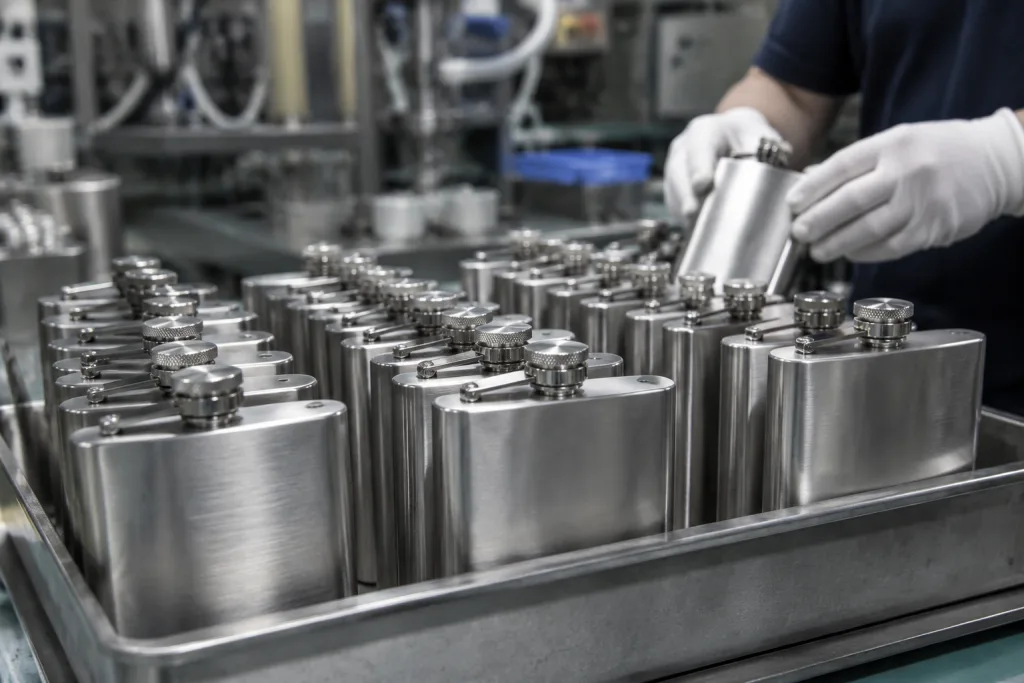
The easiest way to read a flask quote wrong is to assume every flask is the same item. It is not. In hip flask wholesale, shape on the screen matters less than the BOM under it. A standard 6 oz model in 18/8 stainless steel with a brushed finish and plain white box can be USD 1.90-2.40 FOB Ningbo or Shanghai at 1,000 pcs. If the factory swaps to thinner 201 grade, the price may drop by USD 0.15-0.30, but we have seen this go sideways after salt-spray checks and buyer complaints about rust spots near the shoulder seam. Add a powder-coated body, welded captive cap arm, laser logo, and rigid gift box, and the same flask can move to USD 2.80-3.60. On our line, a small spec shift like 0.4 mm to 0.5 mm changes steel consumption fast, so this is the first thing we check when a quote looks "too low."
The main cost drivers are usually:
- Material grade: 18/8 stainless costs more than 201, but it cuts rust claims and is safer for long-term brand use in Europe and North America. QC pulled the sample more than once where 201 looked fine on day 1 and failed after warehouse humidity exposure.
- Body thickness: 0.4 mm to 0.5 mm wall thickness is common for entry level pieces. Better hand feel and dent resistance usually start at 0.5 mm. The buyer often pushes for the lower number, then flags the soft panel after a 1-meter drop test.
- Cap construction: screw cap only is the low-cost option. An attached cap hinge or captive arm adds assembly time because the line has to check torque fit and hinge alignment piece by piece.
- Finish: mirror polish takes labor. Brushed finish runs steadier. Powder coating adds line time and reject risk, especially when coating builds up around the neck thread and cap fit goes tight.
- Decoration: laser engraving might add USD 0.08-0.18, silkscreen USD 0.05-0.12, embossing or badge application more. We run a logo position jig for this, and 2 mm drift is enough for the buyer to reject a pre-shipment photo.
- Packaging: a plain polybag and export carton is the low-cost pack; EVA insert gift sets can add USD 0.45-1.20. The math does not work if you want gift-box presentation on a promo budget.
If you also buy bulk drinkware such as a bulk canteen, bulk growler, or a beer tumbler bulk project in the same sourcing round, ask the factory to split out shared carton and decoration setup costs on the quote. This is the right question to ask. In Zhejiang, China, mixed sourcing is common, but only when the supplier has actual line capacity, not just trading access. A factory producing 300,000 units per month can usually run flask plus wholesale drinkware programs without delaying your core SKU, though we still tell buyers to confirm which item gets priority if one PO has a typo, artwork revision, or late carton approval.
MOQ tiers that change your unit cost
MOQ is not a gatekeeping number. It changes the cost math. For hip flask wholesale, the common starting MOQ is 500 pcs per design for an existing mold, but 500 pcs is often the wrong quantity to optimize around. On the line, we still spread setup time, polishing loss, logo screen cost, and carton artwork over that small run, so the unit price stays heavy. One polishing wheel change and a 3% scratch loss on mirror finish already show up in the quote.
A practical cost ladder looks like this for a standard 6 oz flask with single-color logo and white box:
- 500 pcs: around USD 2.35-2.90 FOB
- 1,000 pcs: around USD 1.95-2.45 FOB
- 3,000 pcs: around USD 1.72-2.15 FOB
- 5,000 pcs: around USD 1.65-2.00 FOB
Once you add custom paint, gift set accessories, funnel, shot cups, or window box packaging, the efficient MOQ often moves to 2,000 pcs. The reason is simple: color matching, die-cut inserts, and hand assembly stop bouncing around once the batch is bigger. We have seen buyers push for four colors x 500 pcs each, then flag the quote as too high. The math does not work. Most China factories will add USD 80-150 per color, or they just lift the unit cost by 8-15%. A sample cutter for the EVA insert might run fine at 20 sets, but the assembly table only settles down once we run volume.
This is also where buyers mix product categories and get a bad comparison. A canteen bulk order or wholesale canteen program may take a lower MOQ if the body shape is standard and the print is simple. A growler bulk or wholesale growler order, especially insulated stainless, usually needs 1,000 pcs or more because vacuum production carries a different setup load. We run separate vacuum checks, and QC pulled the sample twice last month for a heat-retention drop after 8 hours. The same issue shows up when you source drinkware wholesale assortments under one PO. The paper MOQ may look low, but the commercial MOQ still changes by item.
If your target is a launch test, ask for a split plan: 500 pcs first article order, then locked pricing for 3,000 pcs within 60 days. That question gets better answers from the factory. Good suppliers in Zhejiang will often accept it if artwork, packaging, and carton specs are frozen upfront. We have shipped this way after buyers fixed the outer carton mark and even a small PO typo on the logo position, and it saved a second round of setup.
Lead times from sample to vessel booking
Lead-time trouble usually starts before the line even runs. Buyers watch the production calendar, but artwork approval, packaging confirmation, and compliance paperwork often eat the first 7-12 days. We see this on hip flask wholesale orders all the time: the PO is in, then QC is waiting on a barcode position or a Pantone callout in the AI file. For hip flask wholesale using an existing shape, the normal timeline in China looks like this:
- Day 1-3: final quote, deposit, artwork files, purchase order confirmation
- Day 4-8: pre-production sample or digital packaging proof
- Day 9-12: sample approval and packaging sign-off
- Day 13-32: mass production
- Day 33-36: inspection, rework if needed, carton sealing
- Day 37-40: booking and cargo handover
So the realistic standard lead time is 25-40 days after sample approval, not after first inquiry. That is the wrong question to ask. If you need a new cap, custom emboss mold, or shaped gift box with foam insert, add 10-18 days. If you place orders before Chinese New Year or in Q3 peak season, add another 7-15 days of buffer. We have seen buyers push for 20-day mass production on a fully custom pack, and it usually ends one of two ways: late shipment or unstable quality. Last season one buyer flagged a lid logo depth issue at 0.3 mm, and the rework alone cost 4 days.
For comparison, a plain alcohol flask bulk order moves faster than a vacuum beer growler wholesale or beer tumbler wholesale project. A single-wall flask gives us fewer leak-risk points than a vacuum bottle or a lid assembly with a gasket and handle. The math does not work if a supplier gives one blanket date for all SKUs. If you combine alcohol flask in bulk with drinkware bulk products under one supplier, ask for separate production and shipment milestones by SKU. We usually split them by line and packing date, then ship what is ready first.
When a supplier says 30 days, ask: 30 days from deposit, from artwork approval, or from approved sample? Those are three different calendars.
At BottleForge Industrial in Hangzhou, Zhejiang, a normal customized stainless order runs on a 30-35 day production window at MOQ, but only when print files, barcode layout, and packaging dielines are approved without revision. If the buyer sends a PO with a carton mark typo or changes the insert after the white sample, the clock moves. On our floor, carton drop-test samples and barcode scans are checked before final sealing, not after cargo is on the truck.
Packaging, compliance, and hidden add-ons
The flask itself is only one line on the cost sheet. The packing bill decides whether the quote works for Europe or North America. If you sell into retail, gifting, or alcohol channels, packaging often adds 15-35% to ex-factory cost. A plain tuck box may cost USD 0.12-0.22. A color gift box with EVA insert can cost USD 0.55-1.10. Add a funnel, hang tag, barcode sticker, and instruction card, and the accessory pack can add another USD 0.18-0.45. We see buyers miss this on the first RFQ, then push back after the sample room tapes up the full set and the carton size jumps by 18 mm.
Compliance for hip flasks is not the hardest part, but this is where weak quotes get exposed. For stainless products shipped from China to Europe, buyers commonly request REACH-related checks for packaging components, plus LFGB or food-contact declarations depending on market and use case. For the US, California Proposition 65 attention on coatings and inks may matter more than the flask body itself. If the item is sold as a gift set, outer packaging components become part of the risk review. We have seen QC pull a sample because the flask passed, but the printed insert used the wrong ink batch; the math does not work if you only review the metal body.
Items buyers often forget to price
- Leak test labor: usually included on better programs, sometimes charged if 100% testing is requested; on our line, 100% leak check means an air-pressure fixture and extra labor per shift
- Barcode application: USD 0.02-0.05 per unit for FNSKU or retailer labels; the buyer often flags label position tolerance after the first 200 pcs
- Master carton drop spec upgrades: added board cost if you need stricter transit protection; a move from standard carton to heavier board can change carton weight by 0.4 kg
- Third-party testing: USD 150-400 per submission, depending on scope; this usually gets missed when the PO splits one flask into two gift-box versions
- Inspection: around USD 250-350 per man-day for third-party QC; AQL 2.5 is common, and the line moves slower once inspectors start opening sealed sets
This shows up in adjacent categories too. A wholesale growler or beer growler bulk program may need more transit protection because of larger size and cap stress. A canteen wholesale or best wholesale drink bottle search often turns into a packaging issue after e-commerce damage data comes back. We ship both, and we have seen this go sideways when the buyer asks only about bottle thickness and skips carton drop height, divider fit, or cap torque.
Quality controls that protect your margin
You do not need luxury-grade inspection for every hip flask wholesale order. You need the right control points on the line. The failures that hurt margin are usually small: a 0.5 mm logo shift, a scratch under the lacquer, rough weld polish at the shoulder, cap cross-threading, coating odor after sealing, or slow seepage after a 2-hour vibration test. We have seen buyers reject 500 pcs over issues that looked minor at first glance. If you sell under your own brand, this is the wrong place to save a few cents.
A workable QC structure for flasks includes:
- Incoming material check: confirm steel grade and sheet thickness before forming; we normally verify with a micrometer before the first coil goes to press
- In-process visual standard: sample board for polish, color, and logo placement; QC pulled the sample at first-off and keeps it at the line
- Leak testing: 100% water or air-pressure leak check for finished units; for hip flasks, we run this on every piece, not by sampling
- Torque consistency: cap fit and thread smoothness checked by batch; one bad threading tool can spoil 300 pcs fast
- Final inspection: AQL 2.5 for major defects, 4.0 for minor is common for promotional drinkware
If your order includes alcohol flask wholesale bulk packaging for gifting, watch the set assembly, not just the flask. A clean flask with a loose EVA insert or a crooked paper sleeve still gets kicked back by retailers. We ship the same way on beer tumbler in bulk, beer tumbler wholesale bulk, and beer growler in bulk programs. The vessel passes, then the lid fit, straw cut length, insert glue mark, or gift box corner crush fails. The buyer flagged this more than once.
Ask the supplier for defect photos from previous runs. Not polished marketing samples. Real rejects from mass production. A mature factory in Zhejiang, China should tell you exactly what it calls critical, major, and minor, and show an inspection finding like dented base, misaligned print, or weld pit. If the answer is vague, expect arguments later. Ask if the site runs ISO-style process control, BSCI social audit, and documented rework handling. These do not guarantee quality. They do show the factory is used to buyer discipline and paperwork control; we have seen this go sideways when rework was done without a record.
For repeat orders, keep a signed golden sample and packed carton sample in the file. Add the approved PO copy too, especially if a carton mark or item code was typed wrong once. That habit saves weeks of back-and-forth on reorders. In one case, it cut approval from 18 days to 12 days because both sides were checking the same carton sample.
How to quote apples to apples
If you want a clean supplier comparison, send one RFQ sheet with fixed fields. Do not leave room for guesswork. We see this every week: one factory prices 201 steel, another prices 304 stainless, one puts in a white box, another ships bulk only, and the cheapest number wins for the wrong reason. For hip flask wholesale, lock these points before the line quotes anything:
- Capacity: 6 oz, 7 oz, or 8 oz
- Material: 18/8 or 201 stainless, body thickness target such as 0.5 mm
- Finish: brushed, mirror, painted, wrapped, or leatherette
- Cap: attached or unattached, gasket requirement, leak standard
- Logo: laser, silkscreen, emboss, position, size, and print colors
- Packaging: polybag, white box, color box, gift set, barcode labeling
- Trade term: EXW, FOB Ningbo, FOB Shanghai, or DDP reference only
- Compliance: REACH, LFGB declaration, ASTM packaging concerns, retailer rules
Then ask for three quantity breaks, usually 1,000 / 3,000 / 5,000 pcs, plus sample cost and sample lead time. Ask for carton spec too—say 48 x 32 x 28 cm and gross weight per carton in kg—because freight math changes fast. Also ask what changes if you bundle other SKUs such as wholesale drinkware, wholesale canteen, wholesale growler, or beer tumbler wholesale. Some factories share printing plates, export cartons, and booking windows across programs. Others do not, and the buyer usually finds out late.
A practical buyer question is whether to consolidate flasks with other categories. If the supplier actually runs more than one line in-house, combining drinkware wholesale items can cut freight and admin cost on the same booking. If the supplier subcontracts half the order, risk goes up fast. We have seen this go sideways after QC pulled the sample and found the flask polish matched, but the gift box shade was off by one Pantone step. Ask one direct operating question: which items are made in-house, and which are subcontracted?
The best quote is not the lowest FOB number. This is the wrong question to ask. The quote that matters is the one that still holds after inspection, carton measurement, and vessel booking. If carton size grows 2 cm or AQL 2.5 inspection finds leaks at the gasket, the cheap offer is not cheap anymore. That is the quote you can plan margin around.
Get a real hip flask quote with timelines
Send your target quantity, packaging spec, and market. We will break out FOB cost, MOQ, sample timing, and production lead time clearly.
Frequently asked questions
What is the usual MOQ for hip flask wholesale?
For an existing flask shape, the normal MOQ is 500-1,000 pcs per design. If you only need a stock finish with a one-color logo, 500 pcs is often possible. If you want custom color, retail gift box, funnel set, or multiple logo positions, the efficient MOQ usually becomes 2,000 pcs. At 500 pcs, you can expect a unit cost roughly 12-25% higher than a 1,000 pc order because setup and packaging costs are spread over fewer units. If you are testing a brand launch, ask the supplier for trial MOQ pricing plus a price hold for 60 days on a 3,000 pc repeat order.
How much should I budget per unit for alcohol flask wholesale?
A realistic FOB China budget for a standard 6 oz stainless flask is USD 1.65-2.40 at 1,000-3,000 pcs if you use a standard shape, brushed or mirror finish, and simple packaging. For a more retail-ready alcohol flask wholesale bulk order with powder coating, laser logo, captive cap, color box, and accessory insert, budget USD 2.80-3.80. If the quote is under USD 1.50 FOB, check steel grade, wall thickness, leak testing, and packaging because something is usually being stripped out. Testing, inspection, and special labels are usually extra and can add USD 0.10-0.40 per unit depending on your setup.
How long does a custom flask order from China usually take?
For a standard customized flask using an existing mold, sample preparation is usually 5-8 days and mass production is 25-40 days after sample approval and deposit. If you need a new emboss mold, new cap tooling, or a rigid gift box with custom insert, add 10-18 days. Peak season in China, especially before Chinese New Year and in late Q3, can push total lead time out by another 7-15 days. If you need vessel booking and final inspection coordinated, build a full 45-55 day window from PO confirmation to cargo handover. Shorter promises are possible, but they often come with higher risk of quality drift or delayed cartons.
Can I combine hip flasks with canteen wholesale or growler wholesale in one order?
Yes, but only if the supplier truly manages those categories well. A factory may handle hip flasks in-house while outsourcing canteen wholesale, beer growler wholesale, or beer tumbler wholesale items. That changes lead time control and defect risk. Combining SKUs can reduce freight and simplify vendor management, especially if you are buying drinkware bulk for one seasonal launch. But ask for separate MOQ, production days, and compliance status by item. A simple single-wall flask may run in 30 days, while a vacuum growler bulk order can need 35-50 days. Keep one PO if it helps you administratively, but track each SKU on its own production schedule.
What quality checks matter most for alcohol flask in bulk orders?
Focus on the checks that affect returns: 100% leak testing, cap thread fit, logo placement, finish consistency, and carton protection. For promotional-grade orders, many buyers use AQL 2.5 for major defects and 4.0 for minor defects at final inspection. Ask the factory to confirm steel grade, target wall thickness such as 0.5 mm, and whether coatings or inks have supporting compliance paperwork for your market. If units are packed in gift sets, inspect the full packed set, not just the flask. A flask can pass functional testing and still fail retail acceptance because the insert fit, barcode placement, or outer box compression strength is poor.