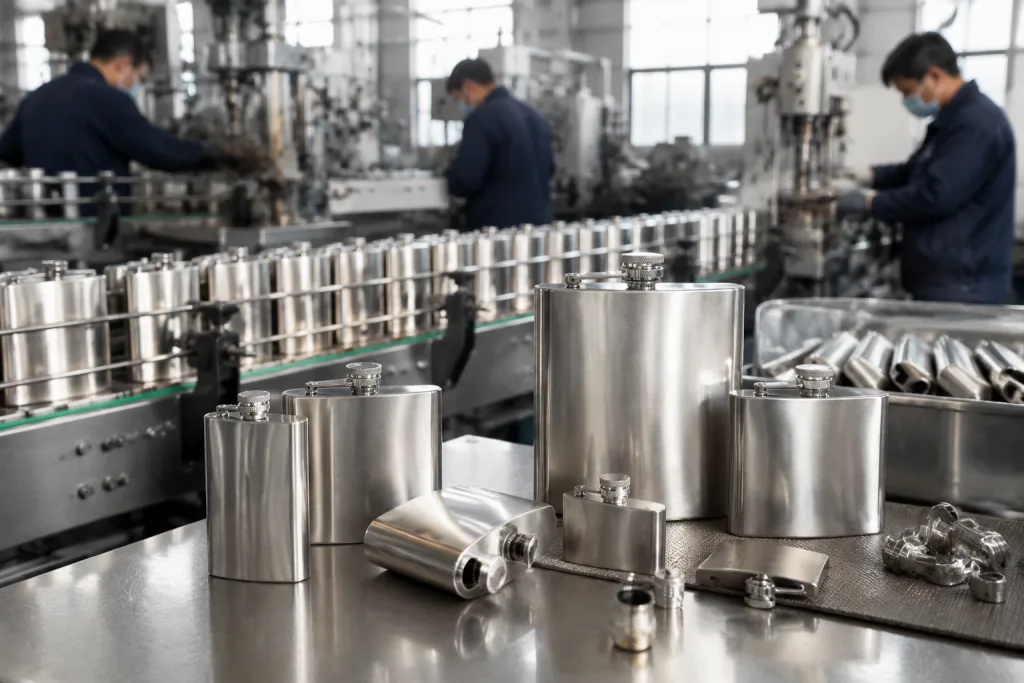
Key Takeaways
- Standard hip flask MOQ is usually 500 to 1,000 pcs per SKU, while custom-mold shapes often start at 3,000 pcs
- A basic 6 oz stainless hip flask typically quotes around USD 1.80 to 3.20 FOB China depending on steel grade, print, and packaging
- Production lead time is commonly 25 to 40 days after sample approval, with pre-production samples taking 5 to 10 days
- Decoration, gift box packaging, and leakage testing can add 8% to 25% to total order cost faster than raw material changes
If you are comparing hip flask suppliers, finding a factory is the easy part. China has thousands. The real issue is why one quote lands at USD 1.85 and another at USD 3.40 for what looks like the same 6 oz flask. On the line, those gaps usually come from steel thickness, weld finish, lid fit, plating, and packing spec. We’ve seen QC pull a sample and find a 0.3 mm wall difference that never showed on the first quote. Most buyers look at unit price first. This is the wrong question to ask. You need to see the cost stack behind it, or the cheap offer comes back later as rework, shipment delay, or a failed compliance test.
That applies whether you buy classic stainless flasks, a custom canteen line, or broader custom drinkware for a seasonal promotion. In Zhejiang, small changes in steel grade, decoration method, gift box style, and sample approval can move your landed cost by 15% to 40%. We run into this every season: a buyer flags the price, then adds a deeper laser mark, thicker EVA insert, and an extra drop-test carton. The math doesn’t work if the original quote ignored those details. A reliable China supplier should give you a real schedule—12 days vs 18 days, not a fantasy 7-day promise that turns into 28 days after deposit.
What really changes the quote
Hip flask suppliers can quote the same 8 oz shape and still land miles apart on price. We see five cost drivers on the line: steel grade, body weight, logo method, pack-out, and MOQ. New buyers often ask capacity first. That is the wrong question to ask. A flask in 18/8 stainless steel, with cleaner seam welding and hand-polished edges checked after buffing, will not sit in the same price band as a thinner low-grade body.
For a standard flask body, wall thickness often falls between 0.4 mm and 0.6 mm. Moving from 0.4 mm to 0.5 mm can add roughly USD 0.12 to 0.25 per unit depending on steel prices in Zhejiang and the complexity of the shape. That 0.1 mm sounds small on paper. On press, it changes material consumption, forming stability, and dent resistance. Surface finish shifts the quote too. Mirror polish is usually cheaper than a painted matte coating with Pantone matching and curing, because the painted option adds spray work, oven time, and more QC points for color drift.
- Basic flask: body, captive cap, polybag, export carton
- Mid-tier flask: laser logo or one-color silkscreen, white box
- Giftable retail pack: EVA insert, rigid box, barcode label, instruction card
If you also source a custom canteen, custom growler, or other customized drinkware from the same canteen factory, ask for a shared packaging and decoration matrix. We ship programs like this for 3 product types at once, and the buyer flagged carton drop performance before they flagged flask shape. A lot of canteen manufacturers and hip flask suppliers run with the same finishing workshops in China, so you can compare logo methods, carton specs, and insert costs across categories. That gives a canteen distributor or distributor drinkware buyer one clean cost sheet across flasks, bottles, and growlers. If you price each item in isolation, we've seen this go sideways.
Cheap quotes are often built on thinner steel, looser polish standards, and lighter carton protection. QC usually pulls that sample too late—after shipment, not on the quotation sheet.
MOQ tiers and where they move
MOQ is where sourcing plans live or die. For standard hip flask suppliers in Zhejiang, 500 pcs per SKU works on existing molds. We run that level on stock bodies all the time. At 1,000 pcs, the FOB price usually settles down and carton loading gets cleaner, because the line is not stopping every 20 minutes for small-batch packing changes. If you ask for a custom embossed body, a special cap, or a gift set with funnels and cups, MOQ usually shifts to 2,000 to 3,000 sets. We have seen buyers push for 800 sets on gift boxes, and the math doesn't work once hand assembly starts.
The practical rule is simple: every added hand operation pushes MOQ up. This is the right question to ask early. That applies to a customizable canteen, customizable growler, or customized canteen too. A canteen manufacturer might take 300 pcs for laser engraving on stock colors, then ask for 1,000 pcs for a full canteen customized powder coat plus a printed retail box. On the floor, that jump is easy to explain: laser marking is one station, while powder coat, curing, box folding, and insert packing pull in 4 separate touches. QC pulled the sample once because the printed sleeve was off by 2 mm, and that small miss still slowed the pack-out.
Typical MOQ bands
- 300 to 500 pcs: stock flask, laser logo, plain box, usually 2 to 4 stock colors only
- 500 to 1,000 pcs: mainstream OEM range for one SKU, where we ship the cleanest cost structure
- 1,000 to 3,000 pcs: color coating, gift set packing, tighter packaging control, more handwork on the line
- 3,000+ pcs: custom tooling, unique silhouette, full retail presentation, often with a new mold trial
If you work as a canteen supplier, canteen vendor, or canteen distributor, mixing SKUs in one container can cut risk. Some China factories allow color assortment under one master MOQ if decoration and packing stay the same. Others refuse it because changeover time kills output; on one line, a color swap and carton mark update can cost 35 minutes. Ask this early, not after the PO lands with a typo in the color code. BottleForge Industrial in Zhejiang usually sets MOQ from production logic first, not from a sales target, because that is how you keep your price intact when the repeat order comes back.
A factory with 300,000 units per month capacity can still reject a low-MOQ project if your pack-out is labor heavy. We have seen this go sideways with 400 sets that needed flask, funnel, 2 cups, EVA tray, and hand-applied barcode labels. Capacity and MOQ connect, but they are not the same thing.
Unit cost by specification level
You need a usable price ladder before you compare offers. For a standard 6 oz stainless steel flask in a white box, FOB China pricing usually falls into these bands. On our line, the gap often comes from steel thickness, polish time, and pack spec, not from magic savings.
- USD 1.80 to 2.20: entry level, stock shape, lighter gauge body, basic polish, no retail add-ons
- USD 2.20 to 2.75: more stable steel quality, cleaner surface finish, one-color logo print or laser marking
- USD 2.75 to 3.20: spray-coated finish, tighter QC checkpoint, gift box or set components
- USD 3.20 to 4.50+: premium gift sets, custom molds, PU wrap, more complex packaging with multiple parts
These numbers move with nickel and stainless costs in China, but they are still good for screening quotes. If a price lands far below range, ask what got cut. We have seen this go sideways with 0.4 mm bodies, loose cap fit, or no leak test at all. If a price looks high, ask whether the factory included items buyers miss on the first round, such as barcode labels, drop-test cartons, or 100% leakage testing.
The same costing logic applies across custom drinkware. A canteen supplier quoting a custom canteen, customized growler, or customizable drinkware SKU should break cost into body, lid, decoration, and packing. This is not optional. Buyers need an apples-to-apples comparison, and the math does not work if a vendor hides everything inside one total. We ship quotes this way because the buyer usually flags the lid cost first.
Useful extras to request separately include:
- Tooling charge for logo fixtures or embossing dies
- Sample cost and refund terms after bulk order
- AQL standard, often AQL 2.5 for major defects and 4.0 for minor
- FOB versus EXW difference
- Carton dimensions and gross weight for freight planning
For Europe and North America, do not ignore compliance cost. REACH, LFGB where applicable, and California Proposition 65 screening can add a few hundred dollars per project, but skipping them usually costs more later. QC pulled a sample last month because the outer coating smell was too strong after sealing. A serious canteen factory or hip flask supplier in Zhejiang should raise this early, without waiting for the buyer to ask.
The timeline buyers should expect
Lead time should be split by stage, not sold as one soft number. For stock-shape hip flasks from China, we usually quote it this way after the line checks artwork size and logo position against the dieline:
- 1 to 3 days: quote revision and artwork check
- 5 to 10 days: pre-production sample with logo
- 25 to 40 days: mass production after sample approval and deposit
- 2 to 7 days: final inspection, carton marking, loading
If a factory promises everything in 10 days, ask what those 10 days actually cover. This is the wrong question to skip. In most cases they are counting assembly only, or they want to squeeze your order into an open slot. In Zhejiang and other China drinkware hubs, queue control matters as much as machine speed. Before Q4 gifting season, we have seen decorated orders move from 30 days to 45 days in one week because the buyer flagged gift-box art late and the screen printing line was already full.
Custom tooling changes the schedule fast. A new mold for a flask cap or body can add 15 to 25 days before samples, and that is normal. On the floor, even a 0.3 mm change at the neck can mean another fit check before we run samples. If you combine hip flasks with a custom growler or customizable canteen program under one PO, packaging approval usually becomes the critical path. Printed gift boxes, FNSKU stickers for Amazon FBA, and retail inserts delay more shipments than the stainless body does. We have seen this go sideways over one PO typo on carton dimensions.
For distributor canteen and distributor growler programs, ask the supplier for a backward schedule from your ship date. It should show artwork freeze, sample signoff, raw material purchase, welding, polishing, decoration, assembly, inspection, and booking cutoff. QC pulled the sample is not a schedule. Good canteen distributors and canteen suppliers buying from China run this sheet early, often with dates by process, to manage launches instead of chasing ETD 7 days before cargo cutoff.
Our practical advice from Zhejiang: if your in-store date matters, add 10 to 14 buffer days on top of the quoted factory lead time. We ship enough orders to know the math does not bend for anyone. Ocean freight, customs holds, and carton rework do not care about your marketing calendar. One failed carton drop test at 76 cm can burn 3 extra days.
Decoration and packaging add up fast
Most buyers miss how fast decoration and packaging change cost and lead time. On metal drinkware, the logo itself is usually not the costly part. Process control is. A 1-color silkscreen print on a smooth panel often adds around USD 0.05 to 0.12 per unit, but only if the line holds position and ink coverage; on our side, QC pulled a sample last month for a 1.5 mm logo shift on a curved flask face. Laser engraving usually lands at USD 0.08 to 0.20, depending on position and machine cycle time. Wrapped PU leather, debossing, or decoration in two positions will push the cost up fast. This is the wrong question to ask: “What is the logo charge?” Ask what setup, rejection risk, and extra handling sit behind it.
Packaging is often the bigger swing. We see it every week. Replacing a white tuck box with a rigid gift box and EVA insert can add USD 0.45 to 1.20 per set, and it also adds packing time, carton volume, and drop-test risk. A 2-piece gift box with a 20 mm EVA insert looks clean on the table, but the math doesn't work if your target margin was built around a basic mailer. For canteen promotional projects, customized drinkware gift sets, or customizable growler kits, this is where margin disappears if you did not model it early.
Common add-on costs
- Silkscreen logo: USD 0.05 to 0.12
- Laser logo: USD 0.08 to 0.20
- Powder coating: USD 0.18 to 0.45
- Barcode/FNSKU label: USD 0.01 to 0.03
- Gift box upgrade: USD 0.45 to 1.20
If you are dealing with a canteen vendor or canteen manufacturers offering a broad catalog, ask which processes they run in-house and which ones they send out. Outsourced coating or box production is normal in China. We ship that way too. What matters is control: lead-time booking, incoming checks, and clear ownership if a box supplier misses by 3 days. We have seen this go sideways when flasks were finished, inner trays were late, and the buyer flagged “production complete” on the report as misleading. It was accurate on the line and useless for shipment.
For branded programs, ask for packed sample approval, not just product sample approval. One finished set on the table tells you more than 20 loose flasks. You can check the box fit, insert pressure, barcode position, and whether the lid scratches the body in transit; we once caught a PO typo that swapped black EVA for white before mass packing started. A finished set tells you whether your customized canteen, custom growler, or hip flask actually fits the price point you plan to sell.
How to judge supplier risk early
Hip flask suppliers are not equal, and the lowest quote tells you little about execution on the line. For B2B buyers, the early screen should cover factory audit status, QC method, test familiarity, and how the sales team answers basic process questions. If a supplier cannot explain their AQL plan, leak-test standard, or carton drop test process, move on. We ask for this in the first 2 emails, and a solid factory usually replies with a checklist or sample report within 24 hours.
Good checkpoints are BSCI or Sedex for social compliance, ISO-style production control habits, and working knowledge of REACH, ASTM, or FDA-related material expectations based on market and product use. The product looks simple. The defects are repetitive. QC pulled samples last month with leaking side seams, caps sitting 1.5 mm off-center, burrs on the mouth edge, coating that failed tape pull, and retail boxes crushed after a 76 cm drop. This is the wrong question to ask: “Do you make flasks?” Ask what defects they caught on the last order.
- Ask for defect photos from past inspections, not only beauty shots
- Request a QC checklist covering welds, finish, logo position, and leakage
- Confirm inspection timing at inline, pre-shipment, or both
- Clarify claim handling within 7 to 15 days after arrival
If you buy from a canteen manufacturer, canteen factory, or canteen suppliers that also make custom drinkware lines, check whether the same quality system actually runs across categories. We have seen this go sideways. One supplier showed clean bottle reports, then outsourced flask polishing to a 12-person workshop with no go/no-go gauge for cap fit. A factory that runs sports bottles, flasks, and growlers under one QC team usually has better process discipline than a trading-only seller juggling 3 or 4 unknown workshops.
China sourcing works well when you lock details early. In Zhejiang, 20 or 30 capable factories can run a stable OEM program, but only if specifications are frozen, inspection rules are written, and packaging is signed off before bulk starts. We ship plenty of USD 2.40 flasks, and the math does not work when unclear specs turn them into a USD 4.00 problem after returns, relabeling, and freight loss. One typo on a PO, one missed pantone check, one weak master carton at 5-ply instead of 7-ply, and the buyer flags it after arrival instead of before production.
Get a real flask quote, not a guess
Send your target size, logo method, packaging idea, and order quantity. We will reply with practical MOQ, FOB pricing, and lead-time ranges from Zhejiang, China.
Frequently asked questions
What is a normal MOQ when buying from hip flask suppliers?
For stock molds, a normal MOQ is 500 to 1,000 pcs per SKU. Some China suppliers will offer 300 pcs for a plain flask with laser marking, but the unit price usually rises by 8% to 15%. If you need a custom shape, embossed pattern, PU wrap, or a gift set with accessories, MOQ often moves to 2,000 or 3,000 sets. The same pattern applies across a custom canteen or custom growler line. If you are mixing colors, ask whether the MOQ is per color or per total SKU. In Zhejiang, many factories accept split colors under one design if decoration and packaging stay the same. Always confirm carton pack quantity too, because inner pack requirements can quietly limit assortment flexibility.
How much should I budget per unit for a custom hip flask?
A realistic FOB China budget for a standard 6 oz stainless hip flask is USD 1.80 to 3.20 per piece. At the low end, expect a stock shape, simple polish, and plain white box. At the higher end, you are usually paying for better steel consistency, tighter welding, logo decoration, and upgraded packaging. Gift boxes, PU wraps, or accessory sets can push the price to USD 4.50 or more. Sampling, lab testing, and tooling are normally separate. If you also buy customized drinkware like a customized canteen or customized growler, ask the supplier for a price split by body, lid, print, and packaging. That makes quotation review much easier and helps you negotiate only the parts that matter.
What lead time is realistic for bulk orders from China?
For a standard flask on an existing mold, plan 5 to 10 days for a pre-production sample and 25 to 40 days for bulk production after approval and deposit. Shipping prep and loading usually add another 2 to 7 days. If you need custom tooling, add 15 to 25 days for mold work and first sample correction. During peak seasons, especially before Q4 promotions, lead times in China can stretch by 7 to 15 more days. Zhejiang factories with stable scheduling will tell you this early. Buyers should also keep a 10 to 14 day buffer for packaging issues, booking delays, or final inspection rework. If a quote promises a very short timeline, ask for a milestone schedule rather than accepting one total number.
Which compliance checks matter for hip flasks and related drinkware?
For Europe and North America, start with material safety and restricted substance checks. REACH screening is common for EU-bound goods, and many buyers also ask for LFGB-style migration testing on drink-contact items where relevant. For the US, buyers may request California Proposition 65 screening depending on materials and market exposure. Packaging can also need checks for label claims and barcode requirements. A reliable China supplier should understand AQL inspection standards, leak testing, coating adhesion checks, and carton drop tests as routine QC. If you source a customizable canteen, customizable growler, or other customizable drinkware in the same program, use one compliance matrix for all SKUs. That saves time and keeps your documentation consistent across distributors and retail channels.
Is it better to source from a factory or a trading company?
It depends on your order mix. If you are buying one focused product line and want tight control on cost, sampling, and lead time, a direct canteen factory or hip flask manufacturer is usually the better fit. If you need a mixed program such as flasks, custom canteen items, customizable growler sets, and other custom drinkware across several categories, a strong trading company can simplify communication. The risk is transparency. Ask who owns production, who manages QC, and where decoration and packaging are done. A factory should give you clear capacity, such as 300,000 units per month, plus MOQ and lead-time ranges. A trader should still disclose inspection method and claim handling. If they cannot explain the supply chain, you are taking blind risk.