Key Takeaways
- Specify 18/8 stainless grade, 0.5 mm body thickness, and AQL 2.5 before paying a 30% deposit
- A practical MOQ for custom hip flasks is often 1,000 to 3,000 units, with 25 to 35 day lead time after sample approval
- Ask for REACH and LFGB or FDA material declarations, plus coating and print adhesion tests on every PO
- Combine hip flask, custom canteen, and customized drinkware programs only if the factory can show stable monthly output above 300,000 units
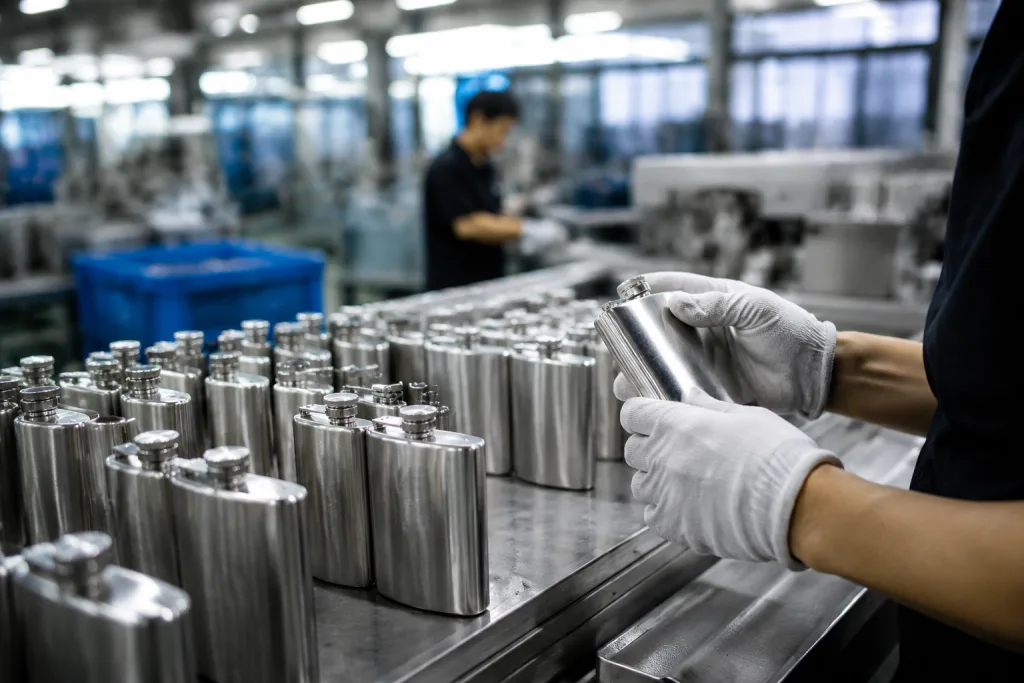
You are not buying a hip flask. You are buying repeatability on the line: clean weld seams, plating that stays even within a 0.03 mm visual tolerance, food-contact compliance, logo print that holds after abrasion testing, and cartons that still land in one piece after 35 to 45 days on the water. The hard part is this: 20 supplier listings can look almost identical on paper. A Zhejiang or broader China supplier may offer the same 6 oz and 8 oz bodies, the same brushed finish, and the same logo options, while running a different welding jig, a different QC standard, and different packing strength.
This matters more if your range is bigger than flasks. A lot of B2B buyers also source custom canteen, custom growler, and other customizable drinkware from one canteen manufacturer or canteen supplier to cut freight splits and keep packaging consistent. At BottleForge Industrial in Zhejiang, China, we see the same problem again and again: the buyer flagged quality, but the PO only said “silver finish” with no Pantone, no logo position, no drop-test standard. That is where projects go sideways. If you understand the common production failure points first, you can screen suppliers faster, write cleaner POs, and avoid rework that wrecks the math on a 3,000-piece order.
Directory listings hide uneven process control
A supplier directory is a lead list, not a factory qualification. The first mistake is assuming two factories with the same flask photos run the same process. They don’t. We’ve seen one canteen factory subcontract body forming, laser welding, polishing, and printing to 3 separate workshops within 20 km. Another canteen manufacturer runs all 4 steps on one line under one roof. That gap shows up later in 0.3 mm seam mismatch, brushed-finish shade variation, and shipments pushed from 12 days to 18 days.
If you shortlist a hip flask source, ask questions that expose the real factory setup. Skip soft words. Ask for monthly capacity, in-house processes, normal MOQ, and the share of orders that are export custom projects. A serious Zhejiang factory should answer with numbers. For example, 400,000 units per month across flasks, tumblers, and custom drinkware tells you something real. A normal custom MOQ of 1,200 pieces for a 6 oz flask is believable. A promise of 100 pieces with full tooling and retail packaging usually means a trader is quoting off a factory price sheet; the math doesn’t work. On our side, buyers often push for “factory direct” and 500-piece mixed-color runs, then flag the lead time once they see tooling and carton setup are separate jobs.
- Ask for process map: blank forming, welding, polishing, leak test, coating, logo, packing. If they run this in-house, they should name the leak-test method and the polishing wheel grit, not just send a flow chart.
- Ask for audit status: BSCI, ISO 9001, and social compliance if your retailer requires it. Ask for the latest report year too; we’ve seen buyers receive a 2019 PDF after asking for a current audit.
- Ask for export ratio: a factory shipping 70% to Europe and North America usually understands labeling, carton marks, and claims handling better. This matters when QC pulled the sample and found the PO typo repeated on 24 master cartons.
- Ask for defect data: internal reject rate under 2% is a useful sign; “low” means nothing. Ask what the top defect is—pinholes, weld marks, or coating dust—and what their last month’s number was.
A directory gives you company names. It does not tell you which supplier can hold the same brushed finish on 20,000 units across two production lots, or which one will have the buyer flagging color drift after lot one.
The same rule applies if you are buying canteen custom projects, a customizable growler line, or broader customized drinkware from a canteen vendor. Directory filters rarely show which canteen suppliers actually control stainless forming and which only source finished goods from clusters in Zhejiang and other parts of China. This is the wrong question to ask at listing stage: “Are you a manufacturer?” Ask instead which steps they run themselves, how many polishing lines they have, and whether flask neck forming uses the same tooling team as their bottle line.
Material specs fail before the first sample
The second failure starts with loose material wording. We see POs that say only “stainless steel hip flask,” sometimes with a typo in the item line, and the line still runs unless someone stops it. That is not enough. You need grade, thickness, surface finish, and food-contact requirement written down. For flasks, 18/8 stainless steel, also called SUS304, is the normal starting spec for the body and cap contact parts. If a supplier swaps to 201 stainless to save USD 0.12 to 0.25 per unit, the math does not work for most export programs. Corrosion claims show up later, especially after humid storage or when alcohol residue sits inside.
Thickness is the next miss. A 0.4 mm body can pass in a photo and still come back dented after carton drop and port handling. We run 0.5 mm to 0.6 mm for most promotional and retail orders because it holds shape better on the line and in transit. Caps, hinges, and threaded necks need their own callout. QC pulled the sample on one 6 oz flask last quarter and the leak was at the cap fit, not the shell. This is the wrong question to ask if you only focus on body metal.
What to lock in on the RFQ
- Material: SUS304 for body and inner contact surfaces
- Wall thickness: 0.5 mm minimum, 0.6 mm for premium gift sets
- Finish: brushed, mirror, powder coat, or plating with Pantone reference if coated
- Cap seal: food-grade silicone or PP component specification
- Compliance: REACH for EU, FDA or LFGB declarations as required by your market
Buyers sourcing custom canteen, customizable canteen, or customized canteen programs make the same mistake. They assume a canteen manufacturer runs one steel grade across all SKUs. In real production, some canteen manufacturers split grades by product tier, and we have seen mixed POs at MOQ 3,000 units where the buyer never caught it. If you are also buying a customizable growler or customized growler from the same canteen supplier, write the material spec separately for each SKU family. That avoids the common mess where the approved sample is SUS304, then the bulk run shifts to a cheaper substrate before final packing.
Leaks start with tolerance, not luck
The failure buyers notice first is leakage. It is preventable. A hip flask usually leaks for boring shop-floor reasons: neck forming drift of 0.2 mm, rough cap threads from a worn tap, a hinge that pulls the cap off center, or a sealing insert cut undersize by 1 mm. We’ve seen factories promise “100% inspection” at final packing, and this is the wrong question to ask. If the line does not control neck forming and thread match earlier, QC only finds bad pieces after the cost is already burned.
Ask for a written leak test standard with numbers. For a non-insulated hip flask, one common method is water fill, inverted position, and 30 minutes of observation. Better is lot sampling with pressure or vacuum-assisted leak checks if the factory has the fixture on the line. If the flask uses a captive cap, check the hinge rivet setting force and watch whether the rivet head distorts the neck circle. QC pulled one sample here last season where the neck went out by 0.3 mm after riveting, and the buyer flagged seepage after 18 days at sea. Small misalignment at assembly turns into carton returns once the goods take vibration in ocean shipping from China.
Set the inspection rule before production, not after the claim. A lot of B2B buyers run AQL 2.5 for major defects and 4.0 for minor defects with a third-party inspection before balance payment. Leakage is a major defect. Sharp edges at the mouth are major too; we check that point by glove swipe because the math doesn't work if one cut lip causes a full carton complaint. Slight polishing haze on hidden bottom areas may be minor. Put the defect standard on the PO and the PI before the first 500 pcs run.
- Pre-production sample: confirm thread fit, cap seating, funnel fit if included; we usually check cap torque by hand feel first, then verify thread engagement on 3 to 5 samples.
- During production check: inspect weld consistency and neck forming after first 300 to 500 pieces; if the line drifts early, stop it there instead of sorting 2,000 pcs later.
- Pre-shipment inspection: apply AQL and run leak tests on sampled cartons; QC should pull the sample from sealed export cartons, not loose bench pieces.
If you buy from a canteen distributor or distributor canteen source instead of direct from a canteen factory, ask who owns the leak standard and who signs the claim. We ship for traders too, and this part goes sideways when responsibility stays vague. The same issue shows up in a distributor growler or distributor drinkware program. If claims come later, you need one party named for corrective action, replacement ratio, and debit note handling, down to the SKU on the PO if there was already a typo in the item description.
Surface finishes fail in the field
A flask can pass a leak test and still come back as a claim. The next failure is the finish: plating peels, powder coat chips at the shoulder radius, laser marks look too light, or a silk-screen logo rubs off after 7 days in a pocket or bag. We see this after buyers pick a finish from a sales sheet and skip the field-use question. This is the wrong question to skip.
Brushed stainless is the safest option because there is no coating to fail, and unit cost is usually lower by USD 0.20 to 0.50 versus painted or plated finishes. We run this finish on the line with a 240-grit belt, so the result is predictable lot to lot. Mirror polish looks premium but shows scratches fast; QC pulled one sample last month with hairlines after a single carton drop test. Powder coat gives wider color choice, but edge coverage on curved hip flask corners needs a hard check, especially around a 6 mm shoulder radius. Electroplating sells well in gift channels, but the result depends on pretreatment and bath control. Poor pretreatment is why bulk orders sometimes arrive with blistering around weld zones, and we have seen this go sideways after only one humid season.
For logos, laser engraving lasts, but it can look faint on some brushed surfaces, especially if the artwork has thin strokes under 0.2 mm. Silk-screen is a good cost play for canteen promotional programs, but abrasion resistance comes down to the ink system and curing temperature. We ship samples with both options because buyers often flag visibility first, then durability after. If you are ordering canteen customizable products, customized drinkware, or a custom growler range under one artwork family, ask for the same adhesion test logic across categories. If one PO says “mat silver” and another says “matt silver,” stop and clean that up before sampling.
Useful finish tests
- Cross-hatch adhesion test for coatings
- Alcohol rub or dry rub cycle test for printed logos
- Salt spray reference for plated surfaces where relevant
- Visual standard sample approved against Pantone or master chip
A good canteen vendor or canteen distributors partner will not promise every finish on every shape. That is a good sign. An honest Zhejiang supplier should tell you that a deep metallic powder on a rounded flask shoulder has higher touch-up risk than matte black; the math does not work the same on every curve. We tell buyers this at MOQ 1,000 pcs, not after mass production. A customizable growler with textured coat is more forgiving than a mirror flask gift item, and most factories know it even if they do not say it first.
Packaging damage is usually self-inflicted
One costly mistake is trusting the factory’s standard carton. That is where damage starts. Hip flasks look small, so buyers often miss what happens in transit after pallet stacking, container vibration, and corner drops from 76 cm. Polished shells pick up hairline scratches fast, gift sets shift inside the box, and weak carton burst strength crushes corners. We have seen final inspection pass at AQL 2.5, then the buyer flagged 3% to 8% sell-through loss after arrival because the pack spec was never locked.
Set the packaging spec with the product spec, not after sampling. For a plain bulk run, we usually pack each flask in a PE bag with partition board or an egg-crate layout, and we keep master carton weight at 12 to 14 kg so the line can handle it without rough drops. For gift-box sets, call out drop performance and fit tolerance in mm. If the set has a funnel or shot cups, they cannot touch the flask body directly; QC pulled one sample last month with a 22 mm rub mark from loose accessories. One thin paper sleeve does not work. This is the wrong question to ask: not “Can you pack it?” but “What protects the finish after 18 days at sea?”
Before you approve pricing, ask for carton size, gross weight, and loading qty for 20 ft and 40 HQ. Get the pallet pattern too. We ship programs where a flask is USD 0.08 cheaper, then freight goes up 10% to 15% because the nesting is poor and the math doesn't work. This hits harder when you buy custom canteen, customized canteen, or canteen promotional assortments with flasks on the same PO; we once had a buyer mix two pack styles and lose 128 sets of container space on a 40 HQ. Packaging alignment across mixed SKUs saves real money.
- Carton standard: 5-ply export carton at minimum; 7-ply for heavier gift assortments
- Inner protection: foam, divider, or non-woven sleeve for polished finishes
- Marking: item code, PO, quantity, country of origin, and FNSKU if for marketplace prep
- Validation: drop test on packed sample from 76 cm is a practical baseline
Factories in China that ship to Amazon or major retail DCs every week usually control carton consistency better. We run into the same issue again and again: the buyer assumes a canteen distributor or canteen vendors network will sort it out later, but if the carton spec is missing from the PO or the approved packaging file—even a small PO typo on the item code—this goes sideways fast.
Lead times slip when approvals stay vague
Late delivery gets pinned on the factory, but in our orders the bigger problem is vague approvals. A hip flask project moves fast when the checkpoints are written down: artwork approval, pre-production sample, packaging sign-off, inspection date, and ex-factory window. If those points stay loose, the line stops for small calls. We see it every month. Is the logo 35 mm or 38 mm wide on the screen print jig? Does the brushed grain run vertical or radial? Should the cap top sit on the seam centerline or 2 mm off? One open point can turn 12 days into 18 days.
For a standard custom flask with one logo and one carton style, 25 to 35 days after sample approval is normal from a competent Zhejiang producer. New gift-box tooling may add 7 to 12 days. During peak season, especially before Q4 holiday shipping, add another 10 to 15 days buffer. If you are combining hip flasks with custom canteen, custom growler, or broader customizable drinkware from one canteen supplier, ask whether all SKUs share the same line or fight for the same coating oven and packing tables. This is the right question to ask. We have seen buyers assume one factory runs everything, then QC pulled the sample and half the order was waiting at the gift-box subcontractor.
A sensible approval schedule looks like this:
- Day 0 to 3: quote confirmation and deposit
- Day 4 to 8: artwork layout and pre-production sample
- Day 9 to 12: sample approval and packaging confirmation
- Day 13 to 28: mass production
- Day 29 to 32: inspection and balance payment
- Day 33 onward: FOB shipment from China port
If you buy through canteen distributors, canteen vendors, or a distributor drinkware partner, insist on one written critical path with owner names and dates. Otherwise delays disappear between trader, canteen factory, and packaging subcontractor. We ship smoother when one PO says “logo width 38 mm” instead of “same as last time” — yes, we have received that exact note. Factories that plan honestly will also tell you what they cannot do. Good. The math does not work on “no problem” if the real answer is MOQ 2,000 and 30 days, then the vessel cutoff gets missed.
Claims get messy without a written standard
The last failure mode is commercial, not technical. We see buyers spend 3 weeks grinding unit price down by $0.06 and spend 20 minutes on claim rules. Then the first problem hits: 1.8% leaks, 2.5% print rub-off, or mixed cap colors across two pallets. QC pulled the sample, the buyer flagged it, and now both sides argue over what “acceptable” means. Without a written standard, the line stops and every call gets slow.
Attach a short quality agreement to the PO. That document should state the approved sample hierarchy, test standard, AQL level, defect classification, claim window after arrival, and remedy method. Put it in plain language. We usually add photo references and carton mark details because one wrong PO suffix or lot code can waste 2 days. For example, major defects above the agreed acceptance level may trigger replacement on the next order, credit note, or partial refund. Minor defects should go to a fixed allowance rule. “We’ll discuss if anything comes up” is the wrong standard.
This matters more once your sourcing mix includes a canteen manufacturer, canteen suppliers, a canteen distributor, or distributor growler channels. Each extra handoff gives people room to dodge responsibility. We’ve seen this go sideways on split shipments where pallet A went to one warehouse and pallet B to another, then nobody could match the 6-digit lot code. A good canteen supplier or canteen factory in Zhejiang should accept documented standards because they protect both sides. If a factory pushes back on basic claim terms, ask why.
- Claim window: usually 15 to 30 days after goods arrival
- Evidence: carton photos, lot code, defect count, and sample pieces
- Remedy: replacement units, credit, or debit note method agreed in advance
- Retention sample: sealed golden sample kept by both parties
If you are building a long-term custom drinkware program, do not judge a supplier only by the first order. Judge the first claim. Any factory can ship one clean batch. The better China factories are not perfect. They keep retention samples, trace lot numbers back to one shift, and change the setup before the next canteen customized or customized growler production run. That is what keeps the same defect from showing up again 18 days later.
Send your flask spec and get a straight answer
Share your target price, MOQ, finish, and packaging. We will review the risk points, suggest workable specs, and quote realistic lead times from Zhejiang, China.
Frequently asked questions
How do I use a hip flask supplier directory without wasting time on weak suppliers?
Start by filtering for factories that can answer five points in one email: MOQ, monthly capacity, steel grade, lead time, and compliance documents. For hip flasks, a realistic MOQ is usually 1,000 to 3,000 units per design, with 25 to 35 days production after sample approval. Ask whether welding, polishing, and logo application are in-house. Request REACH plus FDA or LFGB declarations for food-contact parts, and confirm whether the supplier works FOB Ningbo or Shanghai. If you also need custom canteen or customized drinkware, ask for the same data by SKU family. A supplier directory helps you build a shortlist; it should not replace sample review, factory capability checks, and an AQL-based pre-shipment inspection.
What material and construction specs should I put on a hip flask purchase order?
At minimum, specify SUS304 or 18/8 stainless steel for body and contact parts, 0.5 mm minimum wall thickness, finish type, logo method, and closure seal material. Also define flask size, such as 6 oz or 8 oz, neck thread fit, and whether the cap is captive or detached. For premium programs, move to 0.6 mm if dent resistance matters. Add packaging details, carton weight limit, country-of-origin marking, and inspection standard such as AQL 2.5 for major defects. If the same supplier is quoting custom canteen, customizable growler, or broader custom drinkware, do not assume one material spec covers all items. List separate standards per SKU to avoid unauthorized substitutions during bulk production in China.
What defects are most common on custom hip flasks in bulk orders?
The usual problems are leaks, denting, sharp mouth edges, cap misfit, coating chips, plating blistering, and logo rub-off. In our experience, leakage and thread mismatch are the highest-risk major defects because they trigger immediate returns. Cosmetic issues become more common on mirror polish and plated surfaces than on brushed stainless. Transit dents also rise when body thickness drops below 0.5 mm or when gift-set packaging lacks internal support. For inspection, treat leaks, sharp edges, wrong material, and incorrect logo as major defects. Minor polishing haze can be minor if hidden and within the approved visual standard. Before shipment from Zhejiang or other China ports, require sampled leak tests and carton checks, not just a quick visual review.
Can one supplier handle hip flasks, custom canteen projects, and custom growler lines together?
Yes, but only if you confirm capacity by process, not just by total unit count. A supplier may claim 500,000 units per month across all drinkware, but coating or packaging bottlenecks can still delay a mixed program. Ask how many lines they run for flask forming, powder coating, laser marking, and final packing. If you are combining customized canteen, customizable drinkware, and customized growler SKUs, check whether the same QC team controls all categories and whether one approval system covers artwork, Pantone matching, and packaging. A strong canteen manufacturer or canteen factory in Zhejiang can simplify freight and carton planning, but only if lead times for each category are mapped clearly before deposit.
What is a fair claim process if a bulk shipment arrives with defects?
Set the process before production starts. A practical quality agreement gives you 15 to 30 days after arrival to file a claim with carton photos, lot codes, defect quantities, and retained samples. Tie acceptance to a pre-agreed AQL standard and an approved golden sample. For example, if major defects exceed the approved threshold, the remedy can be replacement units on the next PO, partial credit, or a refund tied to the verified defect rate. Keep leakage, sharp edges, wrong material, and compliance failures as non-negotiable major defects. If you buy through a canteen distributor, canteen vendors network, or distributor growler channel, make sure one party is contractually responsible. Otherwise claims can stall between the trader and the China factory.