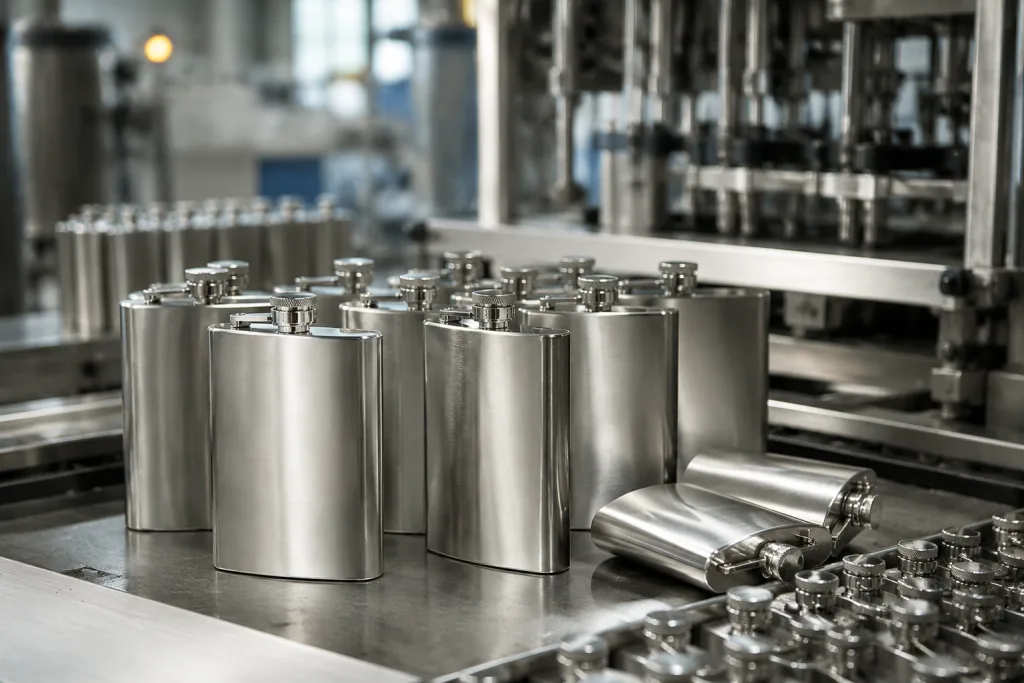
Key Takeaways
- For hip flask promotional projects, 500-1,000 pcs per SKU is the workable MOQ, with FOB pricing often at USD 1.85-3.90 depending on 6 oz or 8 oz size, finish, and box
- A realistic production calendar is 7-10 days for pre-production samples and 25-35 days for mass production after deposit and artwork approval
- Set AQL before production starts; a common final inspection plan is AQL 2.5 major and 4.0 minor with leak, logo adhesion, and carton drop checks
- If you bundle flasks with custom canteen or custom growler programs, align coating color, logo method, and packaging specs early to reduce rework by 10-15%
You usually find the trouble in a hip flask promo order after the damage is done: the cap thread grinds on the first twist, logo placement is off by 3 mm, the gift box gets corner rub after a 1.2 m drop test, or customs asks for 304 stainless and food-contact paperwork that nobody lined up. On paper, a flask looks simple. On the line, it is still a stainless steel food-contact item with decoration, packaging, and compliance exposure.
If you are buying for retail, events, spirits brands, or a distributor drinkware program, “send logo, approve sample, wait” is the wrong process. We have seen this go sideways over one typo on a PO, one missing pantone callout, or an MOQ mismatch at 1,000 pcs. In Zhejiang, a clean order is usually decided in the first spec sheet, not in the last complaint email. The right way is to run one PO from concept to final inspection, let QC pull the sample, and lock the numbers at each step.
The order starts with one use case
Assume you are buying 3,000 pieces for a spirits promotion in Europe: 6 oz stainless steel flasks, matte black powder coat, one-color white logo, each packed in a black paper gift box. You plan to ask for matching items later too—maybe a custom canteen for the same campaign and a customized growler for retail upsell. On paper, this is simple. The first mistake we see is the buyer writing “best price” and nothing else. That is the wrong question to ask. A canteen manufacturer or flask supplier in China can quote almost any number if the drawing is loose, and we have seen POs where even the logo position was typed as “front center?” with a question mark.
Your RFQ should lock five basics: capacity, steel grade, body construction, decoration method, and packaging. For hip flask promotional orders, the usual body material is 18/8 stainless steel, often called SUS304. Wall thickness for standard promo flasks is commonly 0.4-0.5 mm. We check that on the line with a micrometer, not by eye. If you push price too hard, some factories will try 201 stainless on non-contact parts or thinner body stock. It may pass a photo review, but dent resistance changes, and corrosion performance changes with it.
At BottleForge Industrial in Zhejiang, China, we usually tell buyers to state the target retail or giveaway environment first. A bartender gift set needs cleaner welds, tighter powder coat coverage around the shoulder, and a better box than a trade-show handout. QC pulled a sample last month with a glue mark inside the lid card; that is fine for a low-cost giveaway, not for bar gifting. The same logic applies if you also source canteen promotional lines, a customizable canteen, or a custom growler from the same canteen factory. End use decides what matters most: unit cost, brand appearance, or complaint rate. We have seen this go sideways when a buyer asked for retail packaging quality on a handout budget.
- Typical MOQ: 500 pcs per design for standard flask molds, 1,000 pcs if you need a custom rigid box insert
- Normal capacity options: 6 oz, 7 oz, 8 oz
- Factory rhythm: 600,000 units/month across drinkware lines, with mixed-material decoration handled in-house and by audited partners in Zhejiang
If the use case is clear, the rest of the order becomes engineering instead of guesswork. Then we can quote the right steel, the right box pack, and a realistic lead time on the first pass.
Spec sheet details that prevent expensive surprises
Get specific here. A usable flask spec sheet should show overall size, net weight tolerance, steel grade, finish code, cap structure, logo size, logo position, box construction, barcode rule, and testing requests. You do not need a 30-page file. You do need enough detail that your canteen supplier, canteen vendors, or flask factory does not fill in blanks on the line. We have seen a PO marked “black flask” turn into 3 different blacks because no one listed gloss level or powder code.
For example, “black flask with logo” is not a spec. It is a problem waiting to ship. “6 oz flask, SUS304 body, 0.5 mm body thickness, matte black powder coat 70-90 gloss units, laser logo 32 mm wide centered on front, tethered screw cap, individual paper box E-flute outer support, no tissue wrap, 20 pcs per export carton, carton gross weight under 12 kg” is a spec. That level of detail saves arguments whether you buy a hip flask promotional run of 3,000 pcs or a broader customized drinkware assortment from canteen manufacturers in China. QC pulled the sample once on a similar job because the logo sat 6 mm off-center, and the buyer flagged it right away.
What buyers often forget
- Cap torque range. If the cap closes too loose, you get leakage. Too tight, users complain. A practical target is consistent hand-close performance with no leakage after upside-down testing for 30 minutes. On our side, we usually record the cap feel against the golden sample before mass production because this is where claims start.
- Logo adhesion or abrasion standard. For silkscreen on coated surfaces, ask for a tape test and 50-cycle rub test. Laser marking avoids ink adhesion issues but looks different. This is the wrong question to skip just because laser is cheaper on one quote.
- Packaging drop expectation. Gift boxes should survive at least basic internal transit checks before export carton packing. We normally run a simple corner drop on the inner pack first; if the insert shifts, the math does not work at shipment.
- Smell control. New coatings and glues can leave odor inside boxes; ask for ventilation time before packing. We have held packed boxes open for 24 hours after gluing to clear odor before sealing master cartons.
If you source across categories, consistency matters too. A canteen customizable order, customizable drinkware set, and customizable growler launch should use a shared Pantone reference and shared carton labeling format. One warehouse label typo can split inventory fast. We have seen buyers ask for mixed programs across 2 warehouses and 4 SKUs, then miss the outer carton mark format on the PO. Good factories in Zhejiang can manage these details, but only if you write them down before sampling.
Sampling is where you spend the cheap money
Buyers rush sampling on hip flasks because the unit price looks small. That is the wrong question to ask. On a USD 2.40 FOB item, one bad call repeated across 5,000 units burns real money fast. For any project that matters, we ask buyers to sign off 3 sample stages: stock sample, pre-production sample, and packaging sample.
The stock sample is for shape, hand feel, and how the cap closes after 20 to 30 turns on the bench. The pre-production sample is for your actual coating, logo method, and final assembly from the line, not a nice-looking mockup. The packaging sample is where we check whether the box size, insert cut, and barcode position work in real packing, down to a 3 mm flap gap if the dieline is off. In China, this usually takes 7-10 days if artwork is approved fast. If the supplier also runs canteen custom, customized canteen, and customized growler items in the same campaign, allow 12-14 days because coating slots, carton mockups, and line timing need to match. We have seen this go sideways when a buyer approved artwork late, then still asked for same-week samples.
Do not approve a photo if the cap, logo method, or box material is still changing. Approve one physical sample with the final combination, then freeze it as the golden sample.
Sample fees vary, but the bigger cost is bad approval, not the courier bill. A standard flask sample can be USD 30-60 plus courier. A logo sample with custom box is often USD 80-150. Most serious canteen suppliers or canteen vendors will credit part of that back against a production PO. QC pulled the sample is not enough—you need notes, marked photos, and one clear approval record. We once had a PO typo on a barcode number, and catching it at sample stage saved a full carton reprint.
- Check fill line reality: a nominal 6 oz flask may not comfortably accept exactly 177 ml without user spillage; we usually test with a graduated cylinder, not a quick pour
- Check finish uniformity: powder coat should not pool around curved shoulders; the buyer flagged this on a matte black run where film build was visibly heavier near the weld
- Check thread alignment: cross-threading risk shows up early on poor cap tooling; on the floor we run open-close checks before mass production starts
- Check logo centering: write a tolerance such as ±1.5 mm, not “looks centered”; if you do not write the number, the math does not work in inspection
This same discipline applies if your supplier is also acting as a canteen manufacturer, canteen distributor support partner, or custom drinkware export platform. Sampling is where you spend the cheap money. Production is where mistakes get multiplied by 5,000, packed into cartons, and shipped.
Cost breaks move with decoration and packing
Here are the numbers buyers ask for first. On a standard hip flask promo order out of Zhejiang, FOB China usually sits in these bands, based on quotes we run every week and 0.5 mm body spec on the line:
- 6 oz stainless flask, plain brushed finish, polybag only: around USD 1.85-2.20 at 1,000 pcs
- 6 oz flask, matte powder coat plus one-color print, paper box: around USD 2.20-2.85 at 3,000 pcs
- 8 oz flask, premium coating, laser logo, gift set box with funnel: around USD 3.10-3.90 at 2,000 pcs
These are planning numbers, not an offer. Steel cost, coating color, gift box structure, and inspection requirements move the quote fast. Newer buyers often focus on the flask body first. That is the wrong question to ask. In 7 out of 10 quote revisions we see, the bigger jump comes from packing. A rigid box with EVA insert can add USD 0.60-1.10. A basic folding box may add only USD 0.18-0.35. QC pulled a sample last month where the EVA cavity was 3 mm off, and the flask rattled inside the box.
If you are a canteen distributor, canteen distributors group, or distributor growler buyer loading mixed SKUs in one container, ask the supplier to break out the cost stack line by line: body, finish, logo, inner pack, master carton, testing, local transport. We ship these cost sheets all the time because mixed programs get muddy fast. One buyer flagged a quote last season because the PO had the logo packed into "inner pacak" by typo, and nobody caught it until approval. With separated costing, you can see if a customized drinkware line should stay simple while a customizable canteen or customizable growler carries the premium box cost.
Lead time follows complexity more than volume. A 1,000-piece flask with a custom rigid box can run slower than a 5,000-piece flask in a standard folding carton because the box vendor, insert fit, and carton drop test all need sign-off. As a working benchmark in China:
- Standard flask with print: 25-30 days after deposit and sample approval
- Flask plus custom gift set packing: 30-35 days
- Mixed PO with flask, custom canteen, and custom growler: 35-45 days depending on coating line load
If your target market is North America and you sell through FBA, lock barcode confirmation and carton dimension approval before packing starts. We have seen this go sideways. Once the factory seals the carton with 48 mm tape, re-labeling burns labor and usually adds USD 0.05-0.12 per unit.
Compliance is simple only when documented
A hip flask is still a food-contact item. Buyers under-document it all the time because the use case sounds casual: alcohol, gifting, hospitality. We have seen this go sideways. Ask for the same paperwork discipline you would ask from a canteen supplier, canteen manufacturers network, or customized drinkware source. On our line, QC pulls the cap seal spec first, because one 1.5 mm silicone gasket can change the whole document set.
For Europe, start with REACH relevance and food-contact declarations based on the full material structure, not just the body. A 304 stainless shell with a plastic-lined cap is not a one-paper item. For North America, ask what testing basis the factory already has on similar flasks, especially if the flask will be sold at retail and not only handed out as a giveaway. This is the right question to ask early, because retesting after artwork approval can cost 12 days vs 18 days if packaging also needs revision. If the campaign touches youth channels, check packaging compliance too; the buyer flagged this on us once over a printed age cue on the gift box, not the flask itself. A factory with BSCI or similar social compliance helps when your brand audit team asks for it, but social audit does not replace product compliance.
Documents worth asking for upfront
- Material declaration for stainless steel grade and any plastics in the cap seal
- Test reports relevant to food-contact migration or heavy metal limits where applicable
- Factory quality procedure, including incoming material checks and leak testing method
- Carton spec sheet and barcode placement confirmation
- If needed, BSCI, ISO 9001, or factory audit summaries
Be practical. You do not need every test on day one, but you do need the right document set for the sales channel and country. In Zhejiang and across China, 20 factories can make a flask; maybe 3 will send clean paperwork on schedule. The math does not work if your team saves $0.08 per unit and then loses a week chasing missing declarations. If your supplier is also quoting a canteen promotional range, a customized canteen collection, or distributor canteen replenishment program, ask them to standardize one document pack across all SKUs. We ship these packs with the PI and final invoice for a reason. It saves real admin time when your compliance team reviews the PO, especially when the PO already has one typo in the barcode line or carton mark.
QC should happen before the carton closes
This is where clean orders stay clean. Final inspection matters, but checking only at the end is the wrong question to ask. On hip flask promotional orders, the defects that cost money usually show up at the weld, on leak resistance, on surface finish, and inside the gift box after drop handling. We run into this on the line all the time: QC pulled the sample, found a 0.3 mm sharp edge at the neck seam, and the carton was still open.
A practical QC plan in China needs three gates: raw material check, inline inspection, and pre-shipment inspection. Raw material check confirms steel and accessory conformity; on our side that means checking 304 stainless certs, cap gasket hardness, and lid thread match before stamping starts. Inline inspection watches body forming, coating, logo, and cap fit while the line is running, not 6 hours later after 2,000 pcs are packed. Pre-shipment inspection checks the finished packed goods against your golden sample and AQL plan. Most B2B buyers we ship to use AQL 2.5 for major defects and 4.0 for minor defects on drinkware, including flasks, custom canteen lines, and custom growler items.
- Critical defects: leakage, sharp edge, wrong material declaration, missing cap seal
- Major defects: obvious dent, crooked logo beyond tolerance, thread failure, wrong box
- Minor defects: light scuff, slight print dust point, small carton marking inconsistency
For leak testing, do not accept vague language. Ask for 100% air-pressure or water-based leak checking where the factory process supports it, plus inspector sampling at final QA. On one 5,000 pc flask order, the buyer flagged “no leak issue” on the PO, which means nothing on a factory floor. Ask for the actual method: 0.2 MPa air test for 10 seconds, or a defined water-hold standard. For decoration, lock the limits before production starts: print position tolerance in mm, laser shade expectation from approved samples, and coating color delta. For cartons, check count, gross weight, shipping marks, and barcode readability with a live scanner, not by eye.
If you source as a canteen distributor, distributor growler buyer, or across multiple canteen vendors, keep one defect standard across all categories. We have seen this go sideways. One factory marks a cap scratch as minor, another says acceptable, and your warehouse team gets stuck with the argument after 1,200 sets land. The best buyers in Zhejiang supply chains are usually the quiet ones. They write pass/fail rules before mass production, down to carton weight tolerance and logo offset, and the math works better for everyone.
Shipping problems usually begin in packaging
After inspection, margin still slips in packing and shipment. This is where orders go sideways. A hip flask is small but dense, so a loose gift box or weak master carton drives up freight and dents claim rates. We see it on flask programs, and we see it faster when one container mixes flasks with custom canteen, customized canteen, or customizable growler items. On our line, QC pulled one sample carton with 6 mm sidewall crush after a simple clamp test. That carton should never ship.
Ask for packed carton size at quoting stage, not after deposit. A common setup is 20 boxed flasks per export carton, which keeps gross weight around 10-12 kg and is easier for warehouse teams to handle. If a supplier pushes 40 gift-boxed units to cut carton count, check the real gross weight, carton drop risk, and corner crush. This is the wrong question to ask if you only look at CBM. Sea freight buyers do that all the time, then the buyer flagged scuffed gift boxes after unloading because the carton was too heavy for repeated hand moves.
For terms, most experienced buyers run FOB Ningbo or FOB Shanghai with Zhejiang factories. If you need delivered pricing, ask line by line what is included: export carton marks, palletization, FNSKU labels, or Amazon appointment support. We ship to North America every month, and a solid canteen factory or canteen manufacturers group should already know FNSKU placement, outer carton label match, and split-shipment rules. Last month we caught a PO typo where carton 12 of 48 had the old SKU suffix on the outer label. Small miss, expensive result.
The clean handoff is boring on purpose: approved golden sample, signed carton spec, final inspection report, packing list, commercial invoice, and booking schedule matched before loading. Keep one control file and reuse it if your next order adds canteen customizable SKUs, canteen customized gift sets, or a broader customizable drinkware launch. We run repeat orders off that file for a reason. Most sourcing problems are not technical; they start when carton spec V3 ships against PO V2, and nobody catches it until the forwarder has the cargo.
Send your flask spec and get a usable quote
Share capacity, finish, logo, packaging, and target market. We will review MOQ, FOB pricing, lead time, and QC points before sampling starts.
Frequently asked questions
What is the normal MOQ for a hip flask promotional order?
For standard flask molds, 500 pcs per design is usually the practical entry point in China, especially in Zhejiang where many factories share common tooling sizes like 6 oz and 8 oz. If you add a custom printed folding box, 500 pcs may still work. If you need a rigid gift box, molded insert, or multi-piece gift set with a funnel, expect 1,000 pcs or more per SKU. For mixed orders that also include custom canteen or customized drinkware items, some suppliers accept a combined MOQ value if finishes and packaging are similar. Always ask whether MOQ is per color, per logo, or per packaging style, because that changes the real buying threshold.
Which logo method works best on a promotional hip flask?
It depends on the finish and the use case. For lower-cost promotional quantities, one-color silkscreen on powder-coated flasks is common and cost-effective, often adding about USD 0.08-0.18 per unit depending on size and color count. Laser engraving costs a bit more, often around USD 0.12-0.25, but it avoids ink adhesion concerns and gives a more permanent mark. UV print can produce full color, but it needs better surface control and tighter packaging to avoid scuffing. If your brand also buys customizable canteen or customizable growler products, keep the decoration method aligned where possible so the campaign looks consistent across categories.
How long should I allow from RFQ to shipment?
A realistic cycle is 5-7 days for quoting and artwork alignment, 7-10 days for pre-production samples, and 25-35 days for mass production after deposit and sample approval. If the order includes custom gift boxes, third-party lab testing, or peak-season booking pressure, add another 7-10 days. Buyers sourcing from Zhejiang, China before holiday peaks should build extra buffer because coating lines and packaging suppliers get crowded. If you combine hip flask promotional units with a custom growler or custom canteen assortment, total lead time can move to 35-45 days simply because different production cells must finish together before final packing.
What QC points matter most for hip flasks?
Focus on leakage, cap fit, finish consistency, logo placement, and packaging integrity. A good final inspection plan often uses AQL 2.5 for major defects and 4.0 for minor defects. Require leak testing on production, not just on a few samples. Set a logo position tolerance such as ±1.5 mm and confirm acceptable coating appearance on curved edges. Check that box corners are clean and barcodes scan correctly. If the supplier is also acting as a canteen vendor or canteen distributor support partner for other drinkware, ask them to use the same defect classification logic across categories so your warehouse team is not dealing with different standards on each PO.
Can I source flasks and other drinkware from one supplier to save cost?
Often yes, and it can save more in coordination than in unit price. If one supplier can handle hip flasks, custom canteen items, customized growler products, and other customized drinkware, you can standardize artwork approval, carton markings, inspection rules, and shipping documents. That reduces admin friction and usually lowers the chance of mismatched colors or packaging errors. The real test is not the catalog size; it is whether the supplier can manage the production plan. Ask for their monthly capacity, typical lead time, and whether decoration and packaging are controlled in-house or through audited partners in China. A larger source base is only useful if execution stays consistent.