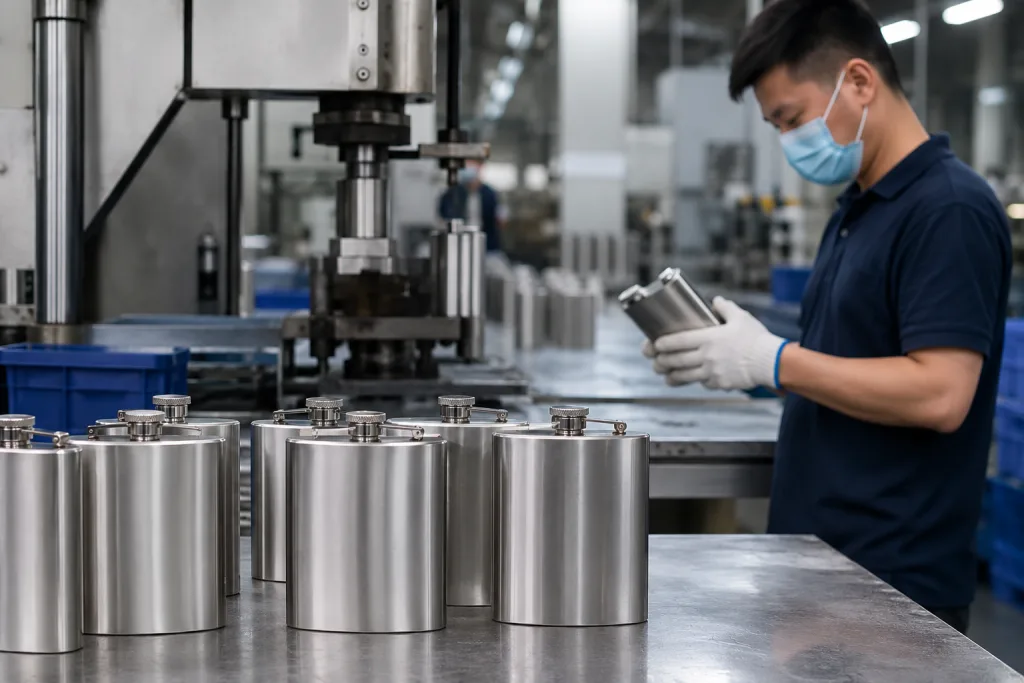
Key Takeaways
- A workable hip flask OEM project usually starts at 1,000 to 3,000 units per SKU, with repeat orders often dropping to 500 units for stock molds
- For 6 oz to 8 oz stainless flasks, specify 18/8 steel and 0.5 mm to 0.6 mm body thickness if you want a better dent-resistance result
- Mass production lead time is commonly 25 to 35 days after sample approval, with logo samples in 5 to 7 days and pre-production samples in 7 to 12 days
- Use AQL 2.5 for major defects and AQL 4.0 for minor defects, plus 100% leak testing before packing
Flask orders rarely fail because of the flask body itself. They fail because the spec sheet was loose. We’ve seen the satin finish scratch after a 1.2 m transit drop, a cap seep after 3 test drops, a logo land 2 mm off-center, and an inner box get rejected at Amazon inbound for the wrong label position. If you are buying from a hip flask OEM manufacturer in China, this is a control job first. The buyer flagged it too late, and then the line had already run 3,000 pcs.
The safer move is to walk one order from drawing to shipment before you place it. Lock the steel grade, wall thickness, decoration method, leak standard, carton drop requirement, AQL level, and shipping term before tooling starts. On our side, that usually means checking the first sample with a digital caliper, confirming wall thickness in mm, and signing off the PO before the mold shop cuts anything. In Zhejiang, where a lot of custom drinkware and canteen manufacturer programs are pushed on lead time, speed alone is the wrong question to ask. The factories that ship cleanly are the ones that turn your idea into checkpoints the QC team can actually measure.
Start with the buyer scenario
Start with a real PO, not a vague idea. You are a North American drinkware distributor lining up a holiday gift set for retail and corporate accounts. The order is 3,000 units of an 8 oz hip flask, split into two matte powder colors, packed in black rigid gift boxes with a funnel and a one-piece paper sleeve. We see this setup on the line all the time, and the split color detail matters because 1,500 pcs per color can change coating setup time and carton marks. Your sales team also wants the same supplier to quote a matching custom canteen and customizable growler for next season, so you are not just buying one flask—you are checking whether the factory can run a full shape family without quality drifting between SKUs.
This is the wrong first question to ask: “What is your best price?” The better question is simple: “What exact product are we pricing?” A solid hip flask OEM manufacturer in Zhejiang or elsewhere in China cannot give a reliable FOB quote until the spec is locked. If the buyer flagged “8 oz flask” and nothing else, we still could not cost it. We need the actual build sheet, down to 0.4 mm or 0.5 mm body thickness, because 0.1 mm changes steel weight, forming stability, and scrap rate.
- Capacity: 6 oz, 7 oz, 8 oz, or 10 oz
- Material: SUS304 inside and outside, or decorative outer wrap over stainless body
- Wall thickness: usually 0.4 mm, 0.5 mm, or 0.6 mm
- Finish: mirror polish, satin, spray paint, powder coat, leather wrap
- Logo method: laser, silkscreen, emboss, deboss, UV print
- Packaging: polybag, white box, gift box, PDQ, Amazon set pack
- Compliance: REACH, LFGB, California Proposition 65 testing needs
In this 3,000-unit case, a standard flask body on an existing mold might land around USD 2.10 to 3.40 FOB China, depending on finish and box choice. Add the rigid gift box and funnel, and the full set may move to USD 3.20 to 4.80 FOB. That spread is normal. QC pulled the sample before on a similar program because the funnel neck scratched the flask inside the box, so packaging is not a side note—it affects cost and claims. If you ask the same factory for a canteen custom program, a custom growler, or a customized canteen line, the math stays the same: lock the spec first, then cut cost where it makes sense. If you start with price alone, we have seen this go sideways fast.
What to lock before sampling
Before sampling, lock the spec sheet first. This is where a real hip flask OEM manufacturer shows up. A trading company forwards your notes; we run the drawing against the line, check the neck size with a caliper, and push back where the brief is soft. The factory should not just say yes. If the hinge pin fit or cap thread looks risky, say it early. We’ve seen this go sideways.
For the flask in our scenario, your spec sheet should state the following in writing:
- Body material: 18/8 stainless steel, food-contact grade, no recycled-contact claim unless documented
- Body thickness: 0.5 mm minimum on the main shell; cap shell 0.5 mm; hinge and neck dimensions per approved drawing
- Capacity tolerance: 8 oz nominal, plus or minus 5%
- Logo placement tolerance: plus or minus 1.5 mm from artwork centerline
- Color standard: Pantone reference with acceptable delta defined on coated surface
- Leak requirement: no leakage after inverted hold for 30 minutes and after 10 open-close cycles
- Pack-out: 24 sets per export carton, gross weight under 12 kg
If you are also buying custom drinkware across categories, use the same discipline on a canteen customizable project or a customized growler program. A canteen supplier might quote a sharp price on a 64 oz bottle, and the buyer flagged that first, but this is the wrong question to ask. If lid resin, gasket hardness, powder cure temperature, or weld polish standard are missing, the math doesn’t work because you are not quoting the same product. We once saw a PO typed “silcone” instead of “silicone,” and that small miss turned into a week of back-and-forth.
Sample stages that actually matter
There are 3 sample stages we care about on the factory side:
- Reference sample: a stock item to confirm shape, hand feel, and baseline quality before you spend money on artwork or tooling
- Logo sample: checks artwork size, color, and finish behavior; QC pulled the sample here more than once because a screen print sat 2 mm off center
- Pre-production sample: built to final pack-out standard, including insert, polybag, and carton mark, before mass production starts
In Zhejiang, factories like ours usually ship a stock flask sample in 2 to 4 days, a logo sample in 5 to 7 days, and a pre-production sample in 7 to 12 days. If new tooling is needed, add 12 to 20 days. That timing assumes artwork is signed off and the line is not waiting on a cap mold correction. For stock molds, MOQ is often 1,000 units. For a fully new flask shape, expect 3,000 to 5,000 units to justify tooling and process setup.
A buyer usually saves more money by preventing one bad carton spec than by forcing the unit price down by USD 0.08.
How factories really price the order
Comparing quotes from a canteen manufacturer, canteen supplier, or hip flask OEM manufacturer gets messy fast if the quote basis is not identical. New buyers often fixate on steel weight. That is the wrong question to ask. On hip flasks, we see unit cost swing just as much on decoration, gift packing, and reject risk. On our line, a small logo shift over 1.5 mm can turn saleable stock into rework.
For our 3,000-unit flask gift set, the rough cost stack looks like this:
- Body and cap forming: stainless sheet, stamping, welding, polishing
- Surface finish: spray or powder line, color change loss, curing
- Decoration: screen setup, laser time, fixture cost, reject rate
- Accessories: funnel, insert card, foam, gift box
- Testing and QC: leak test labor, in-line inspection, final random inspection
- Export packing: carton board grade, dividers, palletization if needed
A standard mirror-polish 8 oz flask in a white box usually sits near the low end. The same flask with matte powder, a wrapped gift box, and a tight cosmetic standard can cost 25% to 45% more. We ship that kind of order every month. If a supplier comes in far below market, ask exactly where the saving sits. In our factory, it is usually one of four places: thinner steel at 0.4 mm instead of 0.5 mm, weaker gift box board, poor surface prep before coating, or looser cosmetic sorting. QC pulled one batch last year for pinholes after curing at 180°C, and the rework ate the margin.
This matters if your sourcing plan includes a custom growler, customizable canteen, or canteen promotional line later. A canteen distributor or distributor growler buyer usually wants the shelf look to match across SKUs, not just the spec sheet. We have seen this go sideways when one supplier matches Pantone on the flask but misses it on the canteen lid by one shade card. The cheapest flask supplier is not always the right long-term custom drinkware partner if they cannot hold color across different lines.
Ask every supplier to quote on the same basis: FOB Ningbo or FOB Shanghai, exact MOQ, exact sample charge, carton size, gross weight, and whether test reports are included or charged separately. Put it in the RFQ and in the PO. We once got a PO with the carton mark typo carried into production, and that kind of loose paperwork usually shows up somewhere else too. A professional canteen vendor or canteen manufacturer in China should answer those points fast and clearly.
Production control inside the factory
Once you sign off the pre-production sample, the order moves to the line. A disciplined factory does not go from sample room straight to sealed cartons, especially for decorated stainless flasks where a 0.5 mm logo drift or dust under coating gets the buyer angry fast.
At BottleForge-style production scale, a plant making 300,000 units per month across tumblers, canteens, and flasks will usually split the order into material prep, forming, polishing, coating, decoration, assembly, and pack-out. That sounds standard. The wrong question to ask is whether they have stages; ask where QC stops the order, where the first-piece board sits, and who signs off each checkpoint.
What you should ask the factory to check
- Incoming material: verify steel grade, sheet thickness, packaging material quality; we usually check coil tags and measure sheet with a micrometer before release
- Forming and welding: check neck symmetry, hinge alignment, weld smoothness, fill volume; QC pulled the sample and caught a hinge pin sitting 0.8 mm high on one PO last month
- Surface prep: confirm no oil residue before coating or print; if the wipe cloth still shows residue, do not run coating
- Decoration: first-off approval against artwork and Pantone target; the buyer flagged a logo once because the PO typo said matte black cap but artwork file was for gunmetal
- Leak test: 100% air or water leak test before boxing; for hip flasks we prefer 100% air test on the line because missed pinholes get expensive after gift-box packing
- Packing audit: barcode scan, assortment count, drop resistance of gift box; MOQ is one thing, but if the barcode does not scan on 10 out of 10 cartons, the math doesn't work
For a flask, the common defects are small and expensive: cap thread mismatch, pinhole leakage at weld area, dust under coating, over-burned laser marks, and logo drift. On custom canteen or customized drinkware orders, QC usually finds vacuum loss, base wobble, or lid fit issues instead. Different product, same factory rule: catch it before final pack, not after 2,000 units are in cartons.
Use measurable acceptance standards. Say cosmetic finish is checked at 40 cm under normal light. Say no exposed raw metal on front face, no scratch longer than 3 mm on visible area, no odor after 24-hour clean storage, and no carton burst during 1A drop simulation if the product is a mailer pack. We have seen this go sideways when a buyer writes "good surface" on the PO and nothing else. If your buyer program serves ecommerce, ask canteen vendors and distributor canteen suppliers whether they understand FNSKU labeling, suffocation warning placement, and master carton labeling for Amazon or 3PL intake.
China factories that ship export orders every week should also understand social and quality audits such as BSCI and ISO 9001. Those audits do not guarantee a perfect order. They do show the plant has a documented process, traceable records, and someone on the floor who knows what to do when inspection finds 6 cartons with mixed labels.
Inspection plan before balance payment
The most practical inspection plan is simple. Do not make it fancy. Do not skip it either. For this order, we run one in-line check during decoration and one final random inspection after at least 80% of the goods are packed, sealed, and stacked on pallets. On our line, QC usually pulls the sample right after logo curing because that is where scratches, weak adhesion, and 1-2 mm logo shift start showing up.
A standard final inspection for a 3,000-unit lot can follow ANSI/ASQ Z1.4 sampling with General Inspection Level II. Most serious B2B buyers ask for AQL 2.5 for major defects and AQL 4.0 for minor defects. Critical defects stay at zero tolerance. That part is not negotiable. In this flask program, define defects this way:
- Critical: leakage, sharp edge, wrong material claim, missing accessory if sold as set
- Major: wrong logo, cap does not close properly, obvious dent, coating peel, wrong color family
- Minor: light scratch in non-primary area, slight carton print smudge, small logo position deviation within secondary tolerance
If the same PO also includes a custom growler or custom canteen, inspect each SKU by its own function. This is where buyers sometimes ask the wrong question. One checklist does not fit all. A customized growler needs pressure-retention and lid-fit checks; we normally leave it standing after filling and recheck for seepage at the thread. A canteen customized item needs strap pull, spout function, and base stability on a flat table; last season a buyer flagged wobble over 1.5 mm on the base ring. One reason experienced canteen distributors consolidate vendors in Zhejiang is simple: one plant running multiple categories can issue reports in the same format and keep the data easier to compare.
Do not release the balance because photos look clean. Ask for the inspection report, carton photos, barcode photos, and a short video showing random leak and function checks from packed goods. In China, a third-party inspection usually costs USD 280 to 450. The math does not work if you skip that and then lose one retail shipment over a cap issue or barcode mismatch. We have seen this go sideways over one PO typo on the outer carton mark. Also request retained samples from mass production, not only the polished approval sample. Keep at least 2 units from the actual run. Those are the pieces you go back to if a claim shows up 60 days later.
Scaling from flask to full range
If the first flask PO lands clean, most buyers move fast into a wider line. We usually see 3 to 5 follow-up SKUs within 90 days: custom canteen, customized canteen, customizable drinkware, custom growler, plus matching pieces for retail, hotel gift sets, or promo programs. This is the point where you find out if your supplier is only a hip flask OEM manufacturer or a canteen factory that can actually carry the range. We’ve seen this go sideways when the flask sample looked good, then the 64 oz body color missed by one Pantone step on the line.
Ask blunt questions. Can they run one powder code across a flask, a 32 oz canteen custom body, and a customizable growler, then check gloss with the same panel before mass production? Can they hold logo size rules across different diameters, like 48 mm on a flask and 78 mm on a growler, without the artwork looking stretched? Can they build retail packaging that stays consistent from a 6 oz gift flask to a 64 oz growler? Can they handle distributor drinkware details like mixed-SKU master cartons, retailer routing marks, or bilingual compliance labels for Europe and North America? This is the right question to ask, not whether the catalog looks polished.
Strong canteen suppliers and canteen vendors in China should be able to show you:
- Stock molds across flasks, sports bottles, growlers, and canteens, with actual neck-size and cap-fit data
- MOQ logic by process, not just one flat number like 500 pcs for everything, because the math doesn't work
- In-house or coordinated laser, silkscreen, powder coat, and assembly capability, with the line balance to keep decoration from becoming the bottleneck
- Material declarations and test-report support for REACH, LFGB, ASTM, or Proposition 65 where relevant, and QC pulled the sample files fast when the buyer flagged paperwork
- Lead time planning around peak season, especially August to November, when carton booking and coating slots get tight
Typical repeat-order lead times for stock drinkware in Zhejiang run 20 to 30 days if decoration is simple and packaging is standard. For gift-set programs or mixed custom packs, 30 to 40 days is the safer number. We ship faster on some repeats—12 days vs 18 days on plain box refills—but only when artwork, insert card, and carton marks are already locked. If your annual volume can reach 20,000 to 50,000 units across flask and canteen manufacturer categories, you can usually push for better packaging amortization, lower sample charges, and earlier line booking.
The practical test is not whether the salesperson sounds smooth. It is whether the factory can turn your brief into a controlled order with numbers attached: coating code, carton count, logo position in mm, and an inspection standard such as AQL 2.5 if that is on the PO. One buyer once sent us a PO with the color name typed wrong by one letter, and that small miss would have cost 18 days if nobody caught it. If the factory can lock down one flask order cleanly, they can usually run a distributor growler line, a canteen promotional campaign, or a broader customized drinkware program without rebuilding the process each time.
Send your flask spec for a factory-level review
Share your target size, finish, logo, MOQ, and packaging. We will review feasibility, quote realistic FOB China pricing, and flag QC risks before sampling.
Frequently asked questions
What MOQ should I expect from a hip flask OEM manufacturer?
For a stock flask mold, MOQ is usually 1,000 units per size or color, though some China factories in Zhejiang will accept 500 units for a repeat order. If you want a new mold, custom cap structure, or exclusive shape, expect 3,000 to 5,000 units to make tooling worthwhile. Gift sets raise complexity, so a flask plus funnel plus rigid box may need 1,000 sets even if the flask body alone could run lower. If you also plan a custom canteen or customizable growler program, combining categories under one seasonal PO can sometimes help you negotiate better total volume terms.
How long does a custom hip flask order usually take?
A normal timeline is 2 to 4 days for a stock sample, 5 to 7 days for a logo sample, and 7 to 12 days for a pre-production sample. Mass production usually needs 25 to 35 days after final sample approval and deposit. If you add new tooling, leather wrapping, or complicated gift packaging, add 10 to 20 days. Peak season in China, especially from August through November, can push lead times closer to 40 days. If your supplier is also making a customized canteen or custom growler under the same shipment, ask for a line-by-line production schedule so one SKU does not delay the full container.
Which material and thickness are safest for B2B flask orders?
For most export orders, ask for 18/8 stainless steel, also called SUS304, for all food-contact areas. On hip flasks, 0.5 mm body thickness is a practical baseline because it balances cost, dent resistance, and forming stability. A 0.4 mm shell is cheaper but more likely to show dents or surface distortion after polishing. If the flask is sold as a premium gift item, 0.6 mm can improve feel, but price goes up with steel weight and forming time. The same logic applies when you move into custom drinkware like a custom canteen or customized growler: thicker is not always better, but too thin usually creates claims.
What quality checks should I require before shipment?
At minimum, require 100% leak testing, in-line decoration approval, and a final random inspection at 80% packed quantity or above. For the final inspection, many buyers use ANSI/ASQ Z1.4 General Level II with AQL 2.5 for major defects and AQL 4.0 for minor defects. Critical defects should be zero tolerance. Ask for checks on logo position, cap function, coating adhesion, carton count, barcode accuracy, and accessory completeness. If the order goes to ecommerce, confirm FNSKU labels, carton marks, and drop resistance. A third-party inspection in China often costs only USD 280 to 450, which is small compared with a rejected shipment.
Can one supplier handle hip flasks, canteens, and growlers together?
Yes, but only if the factory truly has cross-category process control. A real canteen factory or canteen supplier should show you matching capabilities across powder coating, laser marking, assembly, and packaging. Ask whether they already make flask bodies, custom canteen lines, and customizable growler items on a regular basis, and whether they can keep color consistency across those products. Also check monthly capacity and packing resources. A factory producing 300,000 units per month across drinkware categories is often better positioned to support a distributor canteen or distributor growler program than a workshop focused on one small item type.