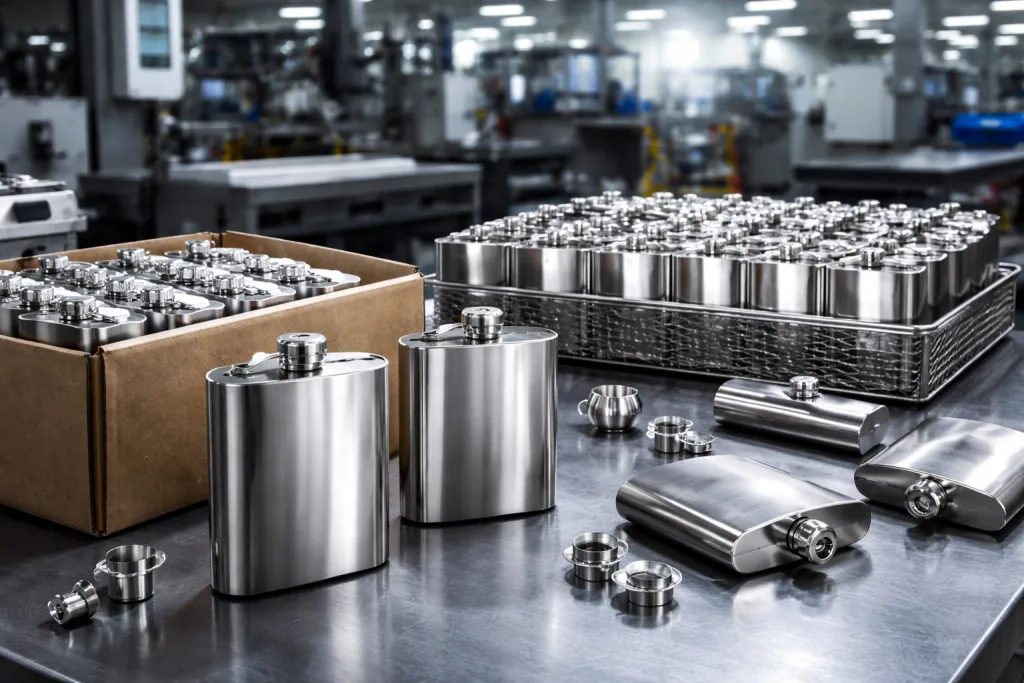
Key Takeaways
- A practical starting MOQ for hip flask in bulk is usually 1,000-3,000 pcs per SKU, with repeat orders often dropping to 500-1,000 pcs.
- FOB China pricing for 6 oz and 8 oz stainless flasks is commonly USD 1.45-3.20 depending on steel grade, coating, lid type, and packaging.
- A realistic production schedule is 7-12 days for samples and 25-40 days for mass production after deposit and artwork approval.
- Use AQL 2.5/4.0 inspection, 24-hour leak testing, logo adhesion checks, and carton drop tests before balance payment.
You are not buying a hip flask for a gift shop shelf. You are placing a production run that has to ship on time, pass inspection, survive retail handling, and still leave margin after freight, duty, and rejects. We have seen first orders go sideways on small points: a lid gap over 0.8 mm, a weak shoulder weld, a logo shifted 2 mm off center. The flask looks simple. The risk is not.
Here is a common case from our side of the table: a North American brand needs a stainless steel hip flask in bulk for autumn retail and promotional sales, with future line extensions into bulk canteen, bulk growler, and other bulk drinkware. The buyer sources from Zhejiang, China, and the line can move fast if the spec sheet is tight. We run orders like this with a clear BOM, approved pre-production sample, and carton drop test before mass packout. If you want predictable cost, lead time, and quality, this is the wrong product to buy casually.
A real order starts with specifics
Here’s what a real order looks like on the line. A Canada brand owner is buying hip flask in bulk for Q4 retail, 3,000 pieces total, split into two finishes: matte black powder coat and brushed stainless. Spec is 8 oz, body in SUS304, tethered stainless cap with a food-contact PP inner seal, plus a kraft gift box with a barcode label. Last month we ran a similar PO and the buyer even flagged a barcode typo on the outer carton proof before deposit. That saved a reprint.
Vague RFQs cost money. If the request says only “stainless flask with logo,” one factory will quote 0.4 mm body thickness, another 0.5 mm, and a third will slip in 201 stainless on non-contact parts and leave that detail buried in the sheet. Then you get three prices that look comparable on paper, but they are not the same product. We’ve seen this go sideways after sampling, when QC pulled the sample and the cap fit felt loose between lots.
For a clean RFQ, define at least these points:
- Capacity: 6 oz, 8 oz, or 10 oz
- Steel grade: SUS304 for liquid-contact parts
- Body thickness: usually 0.4-0.5 mm
- Finish: brushed, mirror polish, powder coat, or PU wrap
- Logo method: laser engraving, silk screen, UV print, or embossed badge
- Leak requirement: zero leakage after inverted 24-hour test
- Packaging: polybag, white box, kraft box, or gift set
- Compliance market: EU or US/Canada
This level of detail is not just for flasks. We ship the same way for canteen bulk, wholesale canteen, growler bulk, and wholesale drinkware. Buyers who lock their RFQ format usually get 4 or 5 quotes that can be compared line by line, instead of spending 12 days correcting specs that should have been fixed on day 1. In Zhejiang, China, the fastest quote is often the roughest one. Accuracy first. That is the right question to ask.
Quoting the flask without fooling yourself
The supplier quotes the project. On a 3,000-piece order for 8 oz stainless flasks, a normal FOB Ningbo range might be USD 1.65-2.10 for brushed finish and USD 1.95-2.55 for powder-coated finish with standard box packing. Add USD 0.08-0.22 for a custom kraft gift box, USD 0.03-0.10 for barcode labeling, and USD 80-150 for a one-time screen or laser setup depending on artwork. On our line, the setup gap usually comes from the logo size and whether the jig needs a new 0.3 mm shim.
That quote means nothing unless the scope is clear. Ask if the price includes:
- Food-contact material declaration
- Leak testing during production
- Individual polybag or tissue wrap
- Export carton with drop-safe divider
- Spare caps at 0.5%-1.0%
- Logo placement jig or fixture cost
Buyers skip this, then the back charges start. We have seen POs with a typo on the packing line, no tissue wrap listed, and then the buyer flagged scuff marks after arrival. Ask the factory how they run leak testing, not just whether they do it; QC pulled the sample from a 0.02 MPa air-pressure check tells you more than a yes/no answer.
Freight terms matter too. If your order ships FOB from Zhejiang or Shanghai, your forwarder controls the main freight. If the supplier offers DDP, confirm what duty code, destination fees, and last-mile delivery assumptions are built in. The cheap unit price story falls apart fast if inland trucking adds USD 180, cartons miss pallet height by 25 mm, or the load plan wastes 12% of container space.
This is where new buyers compare the wrong things. They start with alcohol flask bulk and then ask if the same factory can also handle drinkware bulk, bulk growler, beer tumbler bulk, or even the best wholesale drink bottle for a wider catalog. Fair question. Bad timing. Flask tooling, growler neck finishing, and tumbler vacuum construction run on different equipment, and we have seen this go sideways when one RFQ tries to cover all 5 product types.
A serious factory should explain those boundaries in plain terms. For example, a plant with output of 300,000 units/month may be strong on flasks and simple single-wall bottles, while insulated beer tumbler wholesale or beer growler wholesale programs may run in a separate workshop. Ask for product-family-specific experience, not just total factory capacity. This is the wrong question to ask if all you want is one big monthly number; ask how many flask SKUs they run, what MOQ they hold on caps, and whether the welding fixture stays in the same workshop.
Sampling is where most defects appear
Before mass production, expect three sample stages on a new flask project. First is the stock sample to confirm shape, hand feel, and whether the 8 oz body sits right in the palm. Second is the pre-production sample with your actual finish and logo. Third, if packaging is custom, is the full packed sample with insert, label, barcode, and shipping mark. We run all three for a reason. Most defects show up here, not after the cartons are loaded.
A reasonable timeline is 2-4 days for stock samples and 7-12 days for customized pre-production samples. If a supplier in China promises a fully customized flask sample in 48 hours, ask what they reused. We have seen factories pull an old lid from stock, swap in a standard white box, or send a brushed body instead of the specified powder coat. The buyer flagged this once on a PO with a typo in the coating code, and the sample came out wrong for exactly that reason.
During sample review, buyers often spend 20 minutes on color shade and 2 minutes on function. This is the wrong question to ask. A flask that photographs well and leaks on day 3 is still a bad sample. Check these points with numbers, and have QC pull the sample from the line table instead of the sales shelf.
- Cap torque: closes smoothly without cross-threading; no wobble after repeated opening. We usually check after 20 open-close cycles by hand.
- Leak test: fill to 90%, invert for 24 hours, then side-rest for 4 hours. Put tissue under the shoulder seam so seepage shows fast.
- Logo alignment: within 1.5 mm of approved position. A simple digital caliper check is enough.
- Coating adhesion: cross-hatch tape test, especially on curved shoulders. This area fails first if pretreatment was rushed.
- Weld appearance: no pinholes, sharp edges, or polish burn marks. We have seen pinholes show up only after the first water fill.
- Net weight: hold within +/-5% of approved sample. If weight drifts, wall thickness usually moved with it.
If you plan a collection that expands into alcohol flask wholesale, wholesale growler, and canteen wholesale, sample review is the stage to lock a finish standard across the full line. Matte black on a flask should visually match matte black on a future beer growler bulk or beer tumbler in bulk launch. We compare under the same 5000K light box because showroom light hides color shift. If not, your catalog looks like mixed sourcing, and buyers notice.
You are not approving a sample because it “looks fine.” You are approving it because it becomes the production reference for inspection, claims, and reorders.
Keep one sealed golden sample on your side and require the supplier to keep one at the Zhejiang factory floor for line reference. Put the approval date on the carton and the sample weight on the tag. This sounds basic. Still, we have seen this go sideways when the factory kept an unapproved backup sample by mistake.
Production control before the first carton closes
After sample approval, lock mass production with a written spec sheet. Put the drawing revision, Pantone code, barcode list, carton pack-out, and defect standard in one file. We still see POs with a barcode digit missing or a lid color note buried in email, and that is where claims start. On hip flasks, the line usually fails in four spots: body forming, neck and lid fit, surface finish, and pack assortment.
A standard payment structure is 30% deposit, 70% against inspection approval before shipment. Lead time for 3,000-5,000 pcs is commonly 25-35 days. For peak season or when gift-box suppliers are overloaded, plan 35-40 days. If your ship date is fixed, this is the right question to ask: where are the production gates by day? We usually break it out like this, and the buyer can track each step against the line plan:
- Raw material arrival: day 5-7
- Body forming and welding: day 8-14
- Polishing or coating: day 15-22
- Logo application: day 20-24
- Packing and internal QC: day 24-30
This is how you catch delay before it turns into an airfreight problem. If coating moves from day 15 to day 19, you still have room to push. If the gift box shows up wrong on day 29, the math doesn’t work. We have seen QC pull the sample carton and find a 6 mm height mismatch between insert and flask cap, which stopped closing on the outer box.
For broader wholesale drinkware sourcing, the same production visibility matters more, not less. A flask is small and simple. A beer growler wholesale bulk order brings cap seal risk and heavier carton drop stress; we usually run a filled drop check at around 12 kg gross carton weight. A wholesale canteen or drinkware wholesale insulated bottle adds vacuum retention variables, and that is where weak process control shows up fast. If a supplier keeps milestones tight on a flask order, that is a solid signal for the next SKU.
Ask whether the factory runs in-line checks at operator level, by the line supervisor, and by QA, then ask to see the actual records. Better factories in Zhejiang keep inspection logs by shift and lot number, not just one finished-goods report. We ship repeat orders more smoothly when those records are clean, because the buyer flagged issue on lot 2 can be traced before lot 5 starts packing.
QC, compliance, and the documents you actually need
For a first order of alcohol flask in bulk, book the pre-shipment inspection when at least 80% of the goods are packed and the outer cartons are sealed. We usually ask QC to pull the sample from 3 pallet positions, not just the front row. Use a practical plan such as AQL 2.5 for major defects and AQL 4.0 for minor defects. Critical defects stay at zero tolerance. No debate there. In flasks, the critical calls are usually leakage, a sharp metal edge around the mouth, wrong material declaration, or missing warning labeling where your market requires it.
Major defects are the issues buyers flag on arrival: crooked logos by 2 mm, dented bodies from line handling, flaking coating after tape pull, wrong assortment ratio, or a box barcode mismatch. Minor defects are lighter polish marks, small print shade variation, or carton scuffing that does not hurt retail presentation. This is where teams get sloppy. We have seen a PO with one digit wrong on the barcode suffix, and the whole outer case had to be relabeled.
Your inspection checklist should cover:
- Quantity count by SKU and finish
- Dimensions and capacity verification
- 24-hour leakage test on sampled units
- Salt or moisture exposure check if finish durability is critical
- Carton drop test from 76 cm on corners and faces
- Barcode scan readability and FNSKU accuracy if using marketplace fulfillment
On compliance, do not make the first request too broad, and do not skip the basics. For Europe, confirm material conformity and test support related to REACH and food-contact requirements. For the US, ask for the applicable food-contact testing and check any CPSIA concerns if the flask is sold into youth segments. If the factory also makes products like beer tumbler wholesale bulk or growler wholesale, they often already run migration testing on similar stainless parts such as 304 contact surfaces and silicone seals. Ask for the last report number. That is the faster check.
Factory audit credentials such as BSCI or ISO 9001 help as background screening, but they do not prove your flask order is under control. This is the wrong question to ask. A clean audit does not catch a loose cap thread or a missing inner tray on the line. The documents you actually need before shipment are the approved PI, packaging artwork sign-off, inspection report, and any agreed test reports. If one file is missing, do not release the balance payment yet.
After shipment, build the reorder logic
The order is not finished when the container sails. We treat the first run like a live test on the line, not a victory lap. Review landed unit cost, defect rate, customer returns, and sales by finish, then match that back to the PO and packing spec. If matte black sells 2.3 times faster than brushed stainless, change the next mix instead of repeating the same 50/50 split. If gift boxes add USD 0.18 and shelf damage drops only 0.2%, the math doesn't work. We have seen buyers miss this because the outer carton drop test passed at 76 cm, but store handling still caused corner crush.
Say your first 3,000-piece order lands with a 1.1% defect rate at incoming inspection and 0.4% retail return rate after 60 days. That is workable. Now you have enough data to talk about a repeat order of 5,000-10,000 pcs and ask for a real price break, often USD 0.06-0.12 lower per piece. We usually get there through carton optimization, one finish instead of two, or raw material buys booked together. QC pulled the sample on one repeat order last month and found we could fit 24 pcs per master carton instead of 20 without failing burst strength, which changed the freight math fast.
This is also the point to widen the range, but do it with some discipline. Buyers often start with hip flask in bulk and then add canteen bulk or growler wholesale, sometimes beer growler in bulk and beer tumbler wholesale bulk after that. That works if you carry over the same packaging standard, finish codes, and compliance file set. The wrong question to ask is whether one supplier can make everything. We ship plenty of alcohol flask wholesale bulk, but that does not mean the same factory is strong on vacuum-insulated drinkware bulk; the welding setup, leak test, and heat-retention control are different.
The best long-term supplier relationships in China are boring for good reason. MOQ is clear. Lead time holds. Claims are closed with photos, counts, and AQL records, not stories. Reorders take fewer emails because the spec pack, carton marks, and barcode position—say 35 mm from the bottom seam—are already locked. If your first order from Zhejiang runs with that discipline, you are not just buying a flask. You are building a sourcing system that scales across bulk drinkware categories without starting from zero each time.
Source your hip flask order with fewer surprises
Send your target size, finish, quantity, and market. We will review MOQ, FOB pricing, compliance, and lead time for a practical China quotation.
Frequently asked questions
What is a realistic MOQ for hip flask in bulk?
For standard stainless steel flasks, a realistic MOQ is usually 1,000 pcs per size or finish, with some factories in China accepting 500 pcs for plain stock colors. If you want custom powder coating, gift boxes, or multiple logo positions, expect 2,000-3,000 pcs per SKU for better efficiency. For mixed orders that also include canteen bulk or growler bulk items, some Zhejiang suppliers will combine production value rather than strict piece count, but you still need carton-level minimums. Ask whether MOQ is based on total order, per color, or per packaging style. Those are three different things, and buyers often confuse them.
How much should I budget for an alcohol flask in bulk order?
A practical FOB budget for an 8 oz SUS304 flask is USD 1.65-2.55 depending on finish, cap construction, and packaging. Add USD 0.08-0.22 for a custom box and USD 0.03-0.10 for barcode or warning labels. If you need third-party inspection, budget roughly USD 250-400 per man-day depending on location in China. Tooling is usually low for standard flask bodies, but custom embossing plates or fixture charges can add USD 80-300. Sea freight, duty, and destination charges can easily add 15%-35% to landed cost, so do not evaluate supplier pricing on unit price alone.
What quality problems are most common with wholesale drinkware flasks?
The big four are leakage, bad cap fit, inconsistent coating, and logo defects. Leakage often comes from poor neck forming or an unstable PP or silicone inner seal. Cap fit problems show up after repeated opening if threads are rough or misaligned. Cosmetic defects include orange peel powder coat, pinholes, polishing burn, and crooked logos over 1-2 mm off target. In mass production, assortment mistakes and wrong barcode labels are also common. For first orders, use AQL 2.5/4.0, require a 24-hour inversion leak test, and sample packed cartons for drop resistance. These checks matter just as much on a flask as they do on beer tumbler bulk or wholesale growler projects.
Can one supplier handle flasks, canteens, growlers, and tumblers together?
Sometimes, but you should verify product-family capability instead of assuming it. A supplier strong in alcohol flask wholesale may also do simple single-wall canteen wholesale items in the same workshop, but vacuum-insulated tumblers and beer growler wholesale bulk products often need different forming, vacuuming, and heat-retention controls. Ask for factory photos, monthly output by product line, and recent inspection records for each category. A serious Zhejiang factory should explain whether the items are made in-house or subcontracted. Subcontracting is not automatically bad, but you need transparency because lead times, QC control, and compliance responsibility can change when multiple workshops are involved.
What documents should I collect before paying the balance?
At minimum, collect the signed PI, approved pre-production sample record, final packaging artwork approval, carton marks, pre-shipment inspection report, and any agreed compliance test reports. If you sell into Amazon or similar channels, confirm barcode files and FNSKU placement before mass packing. Ask for the packing list with carton count, net and gross weight, and CBM so your freight booking matches reality. If the supplier claims BSCI or ISO 9001, get the current certificate copy, but treat it as background information only. The documents that protect your shipment are the ones tied directly to your exact PO, quantity, and approved specification.